
 100% FREE ACCESS
6th Standard CBSE Syllabus & Materials
6th Standard CBSE
CBSE 6th Social Science The Value of Work - New Sample Question Papers Study Material - QB365 Set A
NEW6th Standard CBSE
CBSE 6th Social Science Family and Community - New Sample Question Papers Study Material - QB365 Set A
NEW6th Standard CBSE
CBSE 6th Social Science India's Cultural Roots - New Sample Question Papers Study Material - QB365 Set A
NEW6th Standard CBSE
CBSE 6th Social Science India,That is Bharat - New Sample Question Papers Study Material - QB365 Set A
NEW6th Standard CBSE
CBSE 6th Social Science Timeline and sources of history - New Sample Question Papers Study Material - QB365 Set A
NEW6th Standard CBSE
CBSE 6th Social Science Oceans and Continents - New Sample Question Papers Study Material - QB365 Set A

Published on: 19/01/2019
Body Movements Important Questions and Answers
Download CBSE Class 6th Standard CBSE Science question papers, sample papers, important questions, and previous year solved papers in PDF format. Get free study materials, NCERT solutions, and exam preparation resources for Class 6th Standard CBSE Science
Questions + Answers key
Take MCQ Science Test
1.
Why is It that we are able to move a few parts of our body easily in various directions and some only in one direction?
2.
We are able to move a few parts of our body easily in various directions and some only in one direction. Why it is so?
3.
State the consequence if the backbone had only one long bone instead of many vertebrae.
4.
Which type of movement would have been possible if
(a) our elbow had a fixed joint.
(b) we were to have a ball and socket joints between our neck and head.
5.
Skeleton is made of bones but it has some cartilage too. Do you agree?
6.
There are 12 pairs of curved bones called X in our chest region. One end of bones X is joined to backbone and their other end is joined to bone Y in the front to form a box-like structure Z. This strong, box-like structure protects the delicate organs P, Q and R our body.
(a) What are (i) X, (ii) Y and (iii) Z?
(b) Name the organs.
(i) P (ii) Q (iii) R
7.
The body of the fish is similar to the boat. Explain, how does fish move in water.
8.
Earthworms are known as farmer's friends. Why?
9.
Bones are hard structures and cannot be bent. But we can still bend our elbow, knee, etc. How is this possible?
10.
Bhoojho fell off a tree and hurt his ankle. On examination, the doctor confirmed that the ankle was fractured. How was it detected?
11.
Describe the skeleton of a cockroach.
12.
Rishi was playing football with his friends. While playing football he fell down and started crying. On seeing him crying, his friends rushed to him and found that he was unable to move his right leg. His friends took him to his house. His father immediately rushed him to a doctor. Doctor diagnosed that his leg was fractured.
(a) Can you suggest, how did doctor diagnose in Rishi's leg?
(b) What do X-rays show us?
(c) What are the values shown by Rishi's friends?
13.
How is the skeleton of a bird well-suited for flying?
14.
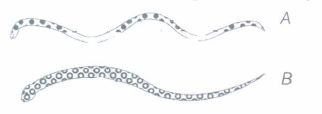
In the figure given below, there are two snakes of the same size slithering on sand. Can you identify which of them would move faster and why?
15.
A cord of dense tissue that connects a muscle to a bone is a:
Ligament
Tendon
Cartilage
Fibre
16.
The joint at the elbow is the _______joint.
Pivot
Hinge
Balland socket
Gliding
17.
The bones at joints are held together by:
Cartilage
Ligaments
Muscles
Tendons
18.
The organs for locomotion in an earthworm are :
Segments
Slime
Muscles
Setae
19.
The delicate internal organ which is not protected by the ribcage is
heart
brain
liver
lungs
20.
Which of the following organisms does not have both muscles and skeleton for movement?
Dog
Snail
Earthworm
Human being
21.
Underwater divers wear fin-like flippers on their feet to
swim easily in water
look like a fish
walk on water surface
walk over the bottom of the sea (sea bed)
22.
Snail moves with the help of its
shell
bone
muscular foot
whole body
23.
How many muscles work together to move a bone?
One
Two
Three
Four
24.
Which of the following parts of our body help us in movement?
(i) Bones
(ii) Skin
(iii) Muscles
(iv) Organs
Choose the correct answer from the option below.
(i) and (iii)
(ii) and (iv)
(i) and (iv)
(ii) and (iii)
25.
Why does an earthworm find it difficult to move on a glass?
26.
Why is the upper part of the human ear not soft as the lower part or the earlobe?
27.
The movements of some parts/organs of the body are not under control. Can you name two such parts/organs.
28.
An earthworm does not have bones or legs, then how does it move?
29.
The hard and strong skull protects a delicate organ of our body. Name that organ
30.
Name three animals having streamlined body.
31.
Name the organs that are protected by the rib cage.
32.
What would have happened if our backbone was made up of one single bone?
33.
If there is no joints, then will it be possible to move? Explain.
34.
Name the type of joints of your hand which helps you to grasp a badminton racquet.
35.
There are ________ types of joints in human skeleton.
36.
The place where two bones meet, is called _________.
37.
Hollow space in bone is called ________.
38.
________ bone is the longest and the strongest bone in human body.
39.
Elbow joint is a ________ joint.
40.
How does a streamlined body help in movement of animals that fly or swim in water?
41.
What do you understand by the term "Gait of animals?
42.
Name the joint where our neck joins the head.
43.
What modifications do birds have for flying?
44.
Why is our backbone not fixed?
1.
The movement depends on the type of joints which join two bones together. The body parts having ball and socket joint move in all directions while the body parts having hinge joint move only in one direction.
2.
We can bend or move our body parts only at those places where two bones join together. Such places are called joints.
The amount of movement depends on the type of joint, e.g. ball and socket joint allows movement in all directions whereas hinge joint allows only one directional movement.
3.
Our vertebral column is comprised of 31 small bones. These are joined together with soft tissue in the form of cartilage discs. This arrangement makes this bony structures to have some limited movements of the body.
If there is only one long bone instead of many in the vertebral column, the organism will not be able to avail the limited movements which are necessary for the organisms for its survival.
4.
(a) If our elbow had a fixed joint, we would not be able to bend/fold our arms. A fixed joint does not allow any movement.
(b) If we were to have a ball and socket joints between our neck and head, we would be able to rotate our head 360°. A ball and socket joint allows movement in all directions.
5.
Yes, cartilages are the additional parts of the skeleton that are not as hard as the bones and which can bent. So, we can say that though most of the skeleton is made of bones but it has some cartilages too.
6.
(a) (i) Ribs X (ii) Breast bone Y (iii) Ribcage Z
(b) (i) Heart P (ii) Lungs Q (iii) Liver R
7.
The streamlined shape of fish helps it to move in water. Skeleton and muscles present in front side of fish move it on one side while tail muscles move the body the other side. This makes a jerk and pushes the body forward. In this way, it moves in water.
8.
An earthworm is called as farmer's friend as it eats its way through the soil thereby loosening the soil. Also, earthworm's body excretes the undigested materials that increase the fertility of soil.
9.
Elbow and knee are not made up of a single bone rather they are made up of two or more bones which are joined to each other by a joint, i.e. hinge joint. This joint along with the muscles helps us to bend the elbow and knee.
10.
The doctor must have observed a swelling around his ankle and taken an X-ray of his ankle. X-ray images confirm any type of injuries/fractures in the bones.
11.
Cockroaches walk and climb as well as fly in the air. They have three pairs of legs which help them in walking. The body is covered with a hard outer skeleton. This outer skeleton is made of different units joined together which permit movement. There are two pairs of wings attached to the thorax. The cockroaches have distinct muscles-those near the legs move the legs for walking. The thoracic muscles move the wings when the cockroach flies.
12.
(a) The doctor has diagnosed the fracture by taking photographs of bones, i.e. X-ray images.
(b) X-rays show us the images and shapes of different bones in our body.
(c) Friendly behaviour, sense of responsibility and kind nature are the values shown by Rishi's friends.
13.
The skeleton of a bird is well-suited for flying because
(i) bones are hollow and light in weight
(ii) bones of hindlimbs are used for walking and perching.
(iii) bones of forelimbs are modified as wings.
(iv) shoulder bones are strong, thus helpful in flying.
(v) breast bones hold flight muscles and are used to move the wings up and down for flying.
14.
A snake form loops in its body while slithering. Each loop of the snake gives it a forward push by pressing against the ground. The snake with a larger number of loops will move much faster than the snake with lesser number of loops. Thus, the snake A will move faster than snake B as we can see that loops in snake A are more than in snake B.
15.
16.
17.
18.
19.
(b)
brain
20.
(c)
Earthworm
21.
(a)
swim easily in water
22.
(c)
muscular foot
23.
(b)
Two
24.
(a)
(i) and (iii)
25.
Earthworm fixes its front end and releases the rear end for movement. On a glass, it loses its grip.
26.
The upper part of the human ear is made up of cartilage while the earlobe consists of only muscles.
27.
(i) Movements in heart (ii) Movement in lungs.
28.
An earthworm does not have bones or legs. It has muscles which help them to lengthen and shorten the body to move.
29.
The hard and strong skull protects a delicate organ of our body called brain..
30.
Fish, birds and snake have streamlined body.
31.
Heart and lungs are protected by the rib cage.
32.
If our backbone was made up of one single bone, then we would not have been able to bend our body (from waist).
33.
No, movement in the body of an animal is possible in the presence of joints only.
34.
Hinge joint of our hand helps us to grasp a badminton racquet.
35.
()
five.
36.
()
joint
37.
()
cavity
38.
()
Femur
39.
()
hinge
40.
()
A streamlined body is thicker in middle and tapers at both ends. This shape allows water to move easily around the body and offers least resistance to its flow.
41.
()
"Gait of animals" refers to the way of movement in animals. Different animals have different body parts that help them to move. Aristotle, an ancient Greek philosopher, wrote the book "Gait of Animals.
42.
()
The joint where our neck joins the head is a pivotal joint.
43.
()
Forelimbs of birds are modified to wings which help them in flying.
44.
()
Backbone is not fixed so that we can bend it.

6th Standard CBSE Syllabus & Materials
6th Standard CBSE
CBSE 6th Social Science Locating Places on the Earth - New Sample Question Papers Study Material - QB365 Set A
NEW6th Standard CBSE
CBSE 6th Science A Journey Through States of Water - New Sample Question Papers Study Material - QB365 Set A
NEW6th Standard CBSE
CBSE 6th Science Temperature and its Measurement - New Sample Question Papers Study Material - QB365 Set A
NEW6th Standard CBSE
CBSE 6th Science Materials Around Us - New Sample Question Papers Study Material - QB365 Set A



CBSE 6th Standard CBSE Subjects
CBSE Standards




