
 100% FREE ACCESS
6th Standard CBSE Syllabus & Materials
6th Standard CBSE
CBSE 6th Social Science The Value of Work - New Sample Question Papers Study Material - QB365 Set A
NEW6th Standard CBSE
CBSE 6th Social Science Family and Community - New Sample Question Papers Study Material - QB365 Set A
NEW6th Standard CBSE
CBSE 6th Social Science India's Cultural Roots - New Sample Question Papers Study Material - QB365 Set A
NEW6th Standard CBSE
CBSE 6th Social Science India,That is Bharat - New Sample Question Papers Study Material - QB365 Set A
NEW6th Standard CBSE
CBSE 6th Social Science Timeline and sources of history - New Sample Question Papers Study Material - QB365 Set A
NEW6th Standard CBSE
CBSE 6th Social Science Oceans and Continents - New Sample Question Papers Study Material - QB365 Set A

Published on: 28/09/2019
Body Movements
Download CBSE Class 6th Standard CBSE Science question papers, sample papers, important questions, and previous year solved papers in PDF format. Get free study materials, NCERT solutions, and exam preparation resources for Class 6th Standard CBSE Science
Questions + Answers key
Take MCQ Science Test
1.
Why is It that we are able to move a few parts of our body easily in various directions and some only in one direction?
2.
Explain, how do we bend our elbow.
3.
Briefly explain an exoskeleton. Also give examples.
4.
Write the differences between bone and cartilage.
5.
Bhoojho fell off a tree and hurt his ankle. On examination, the doctor confirmed that the ankle was fractured. How was it detected?
6.
Describe the skeleton of a cockroach.
7.
Describe the skeletal system. Write any two functions of it.
8.
Rishi was playing football with his friends. While playing football he fell down and started crying. On seeing him crying, his friends rushed to him and found that he was unable to move his right leg. His friends took him to his house. His father immediately rushed him to a doctor. Doctor diagnosed that his leg was fractured.
(a) Can you suggest, how did doctor diagnose in Rishi's leg?
(b) What do X-rays show us?
(c) What are the values shown by Rishi's friends?
9.
How is the skeleton of a bird well-suited for flying?
10.
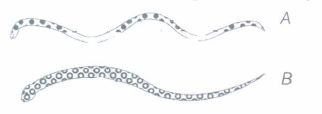
In the figure given below, there are two snakes of the same size slithering on sand. Can you identify which of them would move faster and why?
1.
The movement depends on the type of joints which join two bones together. The body parts having ball and socket joint move in all directions while the body parts having hinge joint move only in one direction.
2.
Elbow is not one long bone from the upper arm to our wrist. It is different bones joined together at the elbow. The joint present at the elbow is hinge joint that helps in its bending.
3.
The bodies of insects, crabs, spiders have hard covering made up of chitin. These animals do not have endoskeleton.
Instead, this hard covering gives them a shape, so it is called exoskeleton. Scales of fishes and cockroaches, outer shells of snail and oyster are also examples of exoskeleton
4.
The difference between bone and cartilage
| Bone | Cartilage |
| They are hard. | They are soft. |
| They cannot bend. | They can bend upto some extent. |
| They form the frame work of the whole body, e.g. thigh bone, backbone, ribcage. | They form some parts of the body, e.g. pinna of ear, some part of nose, etc. |
5.
The doctor must have observed a swelling around his ankle and taken an X-ray of his ankle. X-ray images confirm any type of injuries/fractures in the bones.
6.
Cockroaches walk and climb as well as fly in the air. They have three pairs of legs which help them in walking. The body is covered with a hard outer skeleton. This outer skeleton is made of different units joined together which permit movement. There are two pairs of wings attached to the thorax. The cockroaches have distinct muscles-those near the legs move the legs for walking. The thoracic muscles move the wings when the cockroach flies.
7.
The framework of bones and cartilage which supports the body of an animal is called its skeletal system.
Human skeletal system is made up of 206 bones and cartilage. The human skeletal system consists of the skull, backbone, ribs, breastbone, bones in arms and legs, shoulder and hip bones.
Functions of the skeletal system:
(i) It forms framework of the body.
(ii) It helps to protect the delicate organs of the body in their proper positions.
8.
(a) The doctor has diagnosed the fracture by taking photographs of bones, i.e. X-ray images.
(b) X-rays show us the images and shapes of different bones in our body.
(c) Friendly behaviour, sense of responsibility and kind nature are the values shown by Rishi's friends.
9.
The skeleton of a bird is well-suited for flying because
(i) bones are hollow and light in weight
(ii) bones of hindlimbs are used for walking and perching.
(iii) bones of forelimbs are modified as wings.
(iv) shoulder bones are strong, thus helpful in flying.
(v) breast bones hold flight muscles and are used to move the wings up and down for flying.
10.
A snake form loops in its body while slithering. Each loop of the snake gives it a forward push by pressing against the ground. The snake with a larger number of loops will move much faster than the snake with lesser number of loops. Thus, the snake A will move faster than snake B as we can see that loops in snake A are more than in snake B.

6th Standard CBSE Syllabus & Materials
6th Standard CBSE
CBSE 6th Social Science Locating Places on the Earth - New Sample Question Papers Study Material - QB365 Set A
NEW6th Standard CBSE
CBSE 6th Science A Journey Through States of Water - New Sample Question Papers Study Material - QB365 Set A
NEW6th Standard CBSE
CBSE 6th Science Temperature and its Measurement - New Sample Question Papers Study Material - QB365 Set A
NEW6th Standard CBSE
CBSE 6th Science Materials Around Us - New Sample Question Papers Study Material - QB365 Set A



CBSE 6th Standard CBSE Subjects
CBSE Standards




