
 100% FREE ACCESS
6th Standard CBSE Syllabus & Materials
6th Standard CBSE
CBSE 6th Social Science The Value of Work - New Sample Question Papers Study Material - QB365 Set A
NEW6th Standard CBSE
CBSE 6th Social Science Family and Community - New Sample Question Papers Study Material - QB365 Set A
NEW6th Standard CBSE
CBSE 6th Social Science India's Cultural Roots - New Sample Question Papers Study Material - QB365 Set A
NEW6th Standard CBSE
CBSE 6th Social Science India,That is Bharat - New Sample Question Papers Study Material - QB365 Set A
NEW6th Standard CBSE
CBSE 6th Social Science Timeline and sources of history - New Sample Question Papers Study Material - QB365 Set A
NEW6th Standard CBSE
CBSE 6th Social Science Oceans and Continents - New Sample Question Papers Study Material - QB365 Set A

Published on: 19/01/2019
Food: Where does it Come from? Important Questions
Download CBSE Class 6th Standard CBSE Science question papers, sample papers, important questions, and previous year solved papers in PDF format. Get free study materials, NCERT solutions, and exam preparation resources for Class 6th Standard CBSE Science
Questions + Answers key
Take MCQ Science Test
1.
Cow and Yak are _________ producing animals.
2.
__________ protects the body against diseases.
3.
Things that are used to make food item are known as ________________ .
4.
The practice of bee-keeping is called _____________ .
5.
Deer eats only plant products and so, is called _________ .
6.
Is eating excess of food correct? Give reason to support your answer.
7.
Why is food present in the roots of some plants, although it is made in the leaves?
8.
Why are potatoes considered stems and not roots?
9.
Does everyone around you get enough food to eat? If not, why?
10.
There is a liquid syrup like food material obtained from some animal. It is made by some insects using nectar and pollens. Name the product and the animal who makes it.
11.
List all the major ingredients required for kheer preparation. Which of the ingredients comes from animal?
12.
Assign a term to different components of food.
13.
Two set ups are prepared from pulses, one set up shows dry seeds while other is sprouted. Which seeds will have more nutritious value sprouted or normal seeds?
14.
Name three edible parts of the plant.
15.
Name one non-green plant, we eat.
16.
Name two ingredients in our food that are not obtained from plants or animals. Mention one source for each ingredient.
17.
Write two plants whose roots are used as vegetables.
18.
From where do humans obtain their food?
19.
Ravi does not eat enough food per day. His mother advised him to eat enough food.
(a) What are the functions of food?
(b) What values were shown by his mother?
20.
What are sprouted seeds? How are they eaten?
21.
Which parts of a plant are the sources of our food? State some of the items of our food whose ingredients are obtained from plants. Also, list their plant parts.
22.
A and B are two plants. Plant A produces flowers which are eaten as vegetable and its fruit is nutritious, so eaten raw as a fruit. Plant B produces seed which is a source of oil and its leaves are used as vegetable. Name the plants A and B and their edible parts.
23.
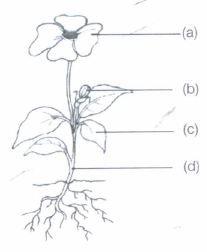
Label the different parts of the plant given below in figure.
24.
Why do organisms need food? Write two reasons.
25.
Why should we avoid wastage of food?
26.
Which of the following organisms is not an omnivore?
Goat
Cat
Cockroach
Human
27.
Both seeds and leaves of this plant are edible. Which plant is this?
Potato
Cabbage
Radish
Mustard
28.
Which part/parts of the banana plant is/are edible?
Fruit
Fruit and stem
Fruit and leaves
Fruit, stem and leaves
29.
Which of the following living organisms uses sunlight to make its food?
Cat
Frog
Snake
Coconut tree
30.
Which of the following is not an ingredient of idli?
Water
Rice
Urad dal
Oil
31.
Given below is a list of edible plants
(i) Banana
(ii) Pumpkin
(iii) Lady's finger
(iv) Brinjal
Which pair of plants has two or more edible parts?
(i) and (ii)
(ii) and (iii)
(iii) and (iv)
(i) and (iv)
32.
Carrot and radish food obtained from plants are examples of
stem
roots
leaves
flowers
33.
Read each set of terms and identify the odd set.
Cow, milk, butter
Hen, meat, egg
Goat, milk, meat
Plant, vegetable, butter, milk
34.
The part of a banana plant not used as food is
flower
fruit
stem
root
35.
Honeybee makes honey from
pollen
petals
nectar
bud
36.
Potato is the root of a plant that we eat.
37.
Sprouts are more nutritious than their seeds.
38.
All nutrients can be obtained from one kind of food only.
39.
Ingredient of kheer is milk only.
40.
Food for all living beings is same.
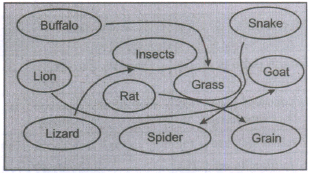
41.
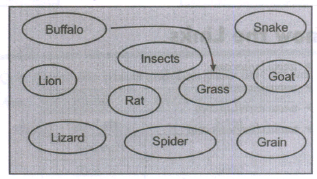
Connect the animal with the food it eats by an arrow using different colours in Fig. One is done for you.
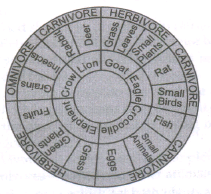
42.
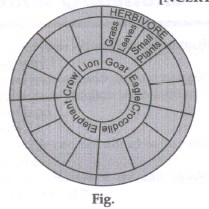
Read the names of animals written in the inner ring of Fig. Within the second ring write the types of food they eat and the category to which they belong (based on the eating habit) in the outer most ring. One example has been worked out for you. Use red, green and blue colours for writing.
1.
()
milk
2.
()
Food
3.
()
ingredients
4.
()
apiculture
5.
()
herbivore
6.
No, because eating excess food can harm our body as it is not digested easily.
7.
Food is present in the roots of some plants, although it is made in the leaves because root system also provides support for plants in the form of an anchor in the soil. e.g., carrots store food in their roots and live on it all winter and in summers, a new plant grows from these roots.
8.
Potato is a stem vegetable. The potatoes grow on underground stems, called stolons. Potato tubers are thickened stems because they have buds that sprout stems and leaves. Roots don't do that.
9.
No, everyone around us does not get enough food to eat because of following reasons:
(i) Lack of food
(ii) Poverty
Poor people can not afford to buy enough food for themselves.
10.
The described properties of food resemble honey.
It is made by insect called honeybees. It is a nutritious food rich in sugar, minerals and enzymes.
11.
The ingredients of kheer are rice, sugar and milk. Milk is a product obtained from animal (cow/buffalo).
12.
Ingredients are the components needed to prepare a particular dish.
13.
Sprouted seeds will have more nutritious value.
14.
Roots, fruits and leaves are edible parts in different plants.
15.
Mushroom is non-green plant used as vegetable.
16.
The two ingredients in our food that are not obtained from plants or animals are
(i) Salt It is obtained from oceans and rocks.
(ii) Water It is obtained from river/tap/pond/lake/rain.
17.
Carrot and radish are used as vegetables.
18.
The plants, animals and their products are the main sources of food for humans.
19.
(a) The functions of food are as follows:
(i) It helps in the growth and development of a living organism.
(ii) It provides energy to do physical work.
(iii) It helps to perform body functions.
(b) Love, caring.
20.
Sprouted seeds are the seeds with seedlings. Seeds are first soaked in water for one day. The water is drained and the seeds are kept wrapped in a wet cloth and left for one more day. After sprouting, they can be eaten raw. They can also be boiled. They can also be made into a tasty snack by adding spices to them.
21.
Leaves and fruits are the main sources of our food as parts of a plant. However, roots, stems and flowers are also considered as sources of our food in some plants.
| Items/ingredients | Part of plant which gives us the ingredient |
|---|---|
| Brinjal | Fruits |
| Chilli as spice | Fruits |
| Oil from groundnut, mustard, soybean any other plants |
seed |
| Rice | Seed |
| Wheat | Seed |
| Spinach | Leaves |
22.
The plant A is banana whose fruit is eaten raw and flowers are cooked as vegetable. The plant is B mustard. Its seeds are used to make mustard oil whereas its leaves are cooked to make green vegetable called 'sarson ka saag'.
23.
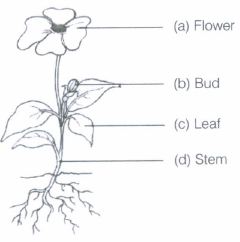
The different parts of the plant are as labelled:
24.
Food is needed by organisms for the following reasons
(i) Food provides us energy to perform various functions of body to sustain life.
(ii) Food helps us to protect the body against various diseases and infections.
25.
We should avoid wastage of food because
(i) there are many people amongst us, who do not get sufficient food.
(ii) some people do not have enough money to buy it.
26.
(a)
Goat
27.
(d)
Mustard
28.
(d)
Fruit, stem and leaves
29.
(d)
Coconut tree
30.
(d)
Oil
31.
(a)
(i) and (ii)
32.
(b)
roots
33.
(d)
Plant, vegetable, butter, milk
34.
(d)
root
35.
(c)
nectar
36.
(b)
37.
(a)
38.
(b)
39.
(b)
40.
(b)
41.
42.

6th Standard CBSE Syllabus & Materials
6th Standard CBSE
CBSE 6th Social Science Locating Places on the Earth - New Sample Question Papers Study Material - QB365 Set A
NEW6th Standard CBSE
CBSE 6th Science A Journey Through States of Water - New Sample Question Papers Study Material - QB365 Set A
NEW6th Standard CBSE
CBSE 6th Science Temperature and its Measurement - New Sample Question Papers Study Material - QB365 Set A
NEW6th Standard CBSE
CBSE 6th Science Materials Around Us - New Sample Question Papers Study Material - QB365 Set A



CBSE 6th Standard CBSE Subjects
CBSE Standards




