
 100% FREE ACCESS
6th Standard CBSE Syllabus & Materials
6th Standard CBSE
CBSE 6th Social Science The Value of Work - New Sample Question Papers Study Material - QB365 Set A
NEW6th Standard CBSE
CBSE 6th Social Science Family and Community - New Sample Question Papers Study Material - QB365 Set A
NEW6th Standard CBSE
CBSE 6th Social Science India's Cultural Roots - New Sample Question Papers Study Material - QB365 Set A
NEW6th Standard CBSE
CBSE 6th Social Science India,That is Bharat - New Sample Question Papers Study Material - QB365 Set A
NEW6th Standard CBSE
CBSE 6th Social Science Timeline and sources of history - New Sample Question Papers Study Material - QB365 Set A
NEW6th Standard CBSE
CBSE 6th Social Science Oceans and Continents - New Sample Question Papers Study Material - QB365 Set A

Published on: 15/09/2018
Model Question 1
Download CBSE Class 6th Standard CBSE Science question papers, sample papers, important questions, and previous year solved papers in PDF format. Get free study materials, NCERT solutions, and exam preparation resources for Class 6th Standard CBSE Science
Questions + Answers key
Take MCQ Science Test
1.
Name some of the devices in which electric cells are used.
2.
Complete the following table. WIll bulb glow or not?
| Object used in place of the switch | Material is made of | Bulb glows? (Yes/No) |
|---|---|---|
| 1.Keys 2.Eraser 3. Scale 4. Matchstick 5. Glass bangle 6. lron nail 7. Notebook |
Metal Rubber Plastic Wood Glass Metal Paper |
3.
Name the place where an organism lives and gets its food.
4.
Name the type of motion possessed by planet around the sun.
5.
Are there any ingredients in food which do not provide any nutrients?
6.
Flowers of which plants are used as vegetables?
7.
(a) What are carbohydrates? Give an example.
(b) In which forms are carbohydrates found in our food?
8.
List some differentiating features between composting and vermicomposting.
9.
Two animals X and Y are present in the same habitat called grassland. The animal X is a herbivore. It has eyes on the sides of its head and big ears. It is very agile animals. The animal Yis a carnivore. It has eyes in the front of the head. This animal has long, strong sharp claws in its front legs which can tear flesh easily and withdraw inside the toes. It also runs very fast.
(a) Can you recognise animal X and Y?
(b) List the benefit of animal X or having eyes on the sides of the head?
(c) Mention the advantage of animal Yfor having eyes in front of its head?
10.
Four children measure the length of a table which was about 2 m. Each of them used different ways to measure it.
(a) Shyam measured it with a half metre long thread.
(b) Gurmeet measured it with a 15 cm scale from her geometry box.
(c) Reena measured it using her handspan.
(d) Salim measured it using a 5 m long measuring tape.
Which one of them would get the most accurate length? Give reasons for your answer.
11.
Why should we avoid wastage of food?
12.
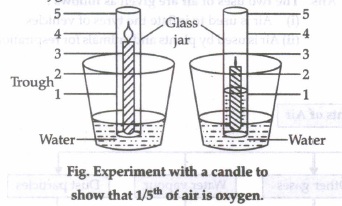
Give an experiment to show that one-fifth of air is oxygen.
13.
Observe the items given in fig. carefully and answer the questions that follow.
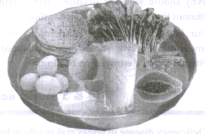
(a) Food item rich in carbohydrates is _______
(b) Egg is a rich source of protein, the mineral, ________ and vitamin _________
(c) _______ is a rich source of fat.
(d) Milk provides ________, vitamin D and ________ (mineral)
(e) _______ (fruit) is a rich source of vitamin A.
(f) Spinach is a good source of the mineral _________
(g) Both eggs and ________ are rich in ________.
14.
What is a shadow? Explain a simple process for shadow formation.
15.
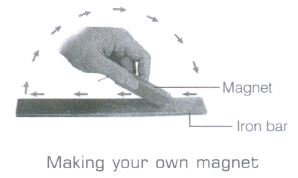
Describe the steps involved in the magnetising of an iron strip with the help of a magnet.
16.
Answer the following questions in one or two words or sentences.
(a) Why should we prefer to use paper bags rather than polythene bags?
(b) Who out of the following, should properly dispose of the garbage-father, mother, elder brother, younger sister?
Which one out of beetles, roundworm and earthworm are used for vermicomposting and why?
17.
Gimmy went for holidays with her parents for few weeks. She kept a plant in her room and before going away she placed it near her window and water it sufficiently. After her return, she saw that plant in her room has bend towards window from where light was coming. She observed this behaviour and asked her teacher questions about it in the class .
(a) What happened to the plant?
(b) (i) Do ail living things show this characteristic?
(ii) Give another example showing this characteristic.
(c) From this incident, what values do you think Gimmy has?
18.
Rishi was playing football with his friends. While playing football he fell down and started crying. On seeing him crying, his friends rushed to him and found that he was unable to move his right leg. His friends took him to his house. His father immediately rushed him to a doctor. Doctor diagnosed that his leg was fractured.
(a) Can you suggest, how did doctor diagnose in Rishi's leg?
(b) What do X-rays show us?
(c) What are the values shown by Rishi's friends?
19.
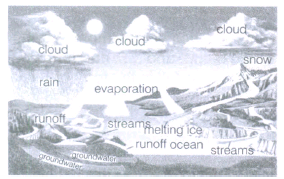
Draw a diagram to show how sea water reaches a lake or pond?
20.
It is not accurate to measure a length with elastic tapes. Explain why.
21.
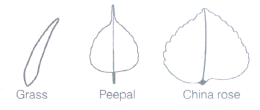
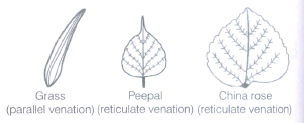
Draw the veins of leaves given in figure below and write the type of venation.
22.
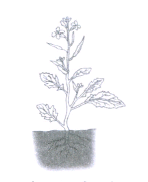
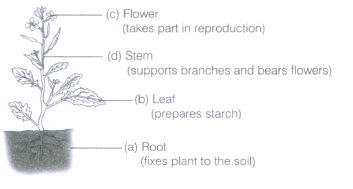
Read the functions of parts of a plant given below:
(a) fixes plant to the soil
(b) prepares starch
(c) takes part in reproduction
(d) supports branches and bears flowers in the diagram given in figure, write the names of the parts whose function you have just read at the appropriate space.
23.
Given figure shows some insects and a place where it collects its food.
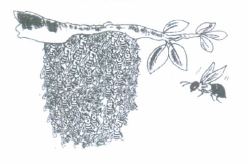
(a) Name the insect and the place where it lives as shown in the figure.
(b) What is the food of this insect?
(c) How does it help farmers while collecting its food?
(d) Name the product we collect from this insect.
(e) Name the nutritive constituents of the insect.
24.
Copper metal is a
Good conductor of heat
Highly magnetic material
Translucent material
Ornamental metal
25.
The energy-providing nutrients are:
Carbohydrates
Fats
Carbohydrates and fats both
Proteins
26.
When we move up in air, the temperature becomes:
Very high
Little high
Low
Very low
27.
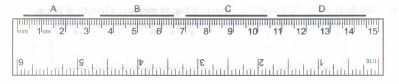
Four pieces of wooden sticks A, B, C and D are placed along the length of 30 cm long scale as shown in Fig. Which one of them is 3.4 cm in length.
A
B
C
D
28.
One decametre is equal to
10cm
10mm
10m
10km
29.
Which parts of an onion plant do we eat?
Root and leaves
Stem and flower
Stem and leaves
Root, stem and fruit
30.
What is not true about air?
It makes the windmill rotate
It helps in the movement of aeroplanes
Birds can fly due to presence of air
It has no role in water cycle
31.
How many muscles work together to move a bone?
One
Two
Three
Four
32.
Which is a way to make a change happen?
Heating of substance
Mixing of substance with another substance
Cooling of substance
All of the above
33.
Which amongst the following methods would be most appropriate to separate grains from bundles of stalks?
Handpicking
Winnowing
Sieving
Threshing
34.
Eating too much of fat-rich foods may lead to a condition called ________.
35.
Animals that eat other animals are called _________.
36.
Which type of foods are known as body-building foods?
1.
Some devices which make use of the electric cells are:
(i) Transistor radio, (ii) Camera, (iii) Wrist watch, (iv)Alarm clock.
2.
| Object used in place of the switch | Material is made of | Bulb glows? (Yes/No) |
|---|---|---|
| 1.Keys 2.Eraser 3. Scale 4. Matchstick 5. Glass bangle 6. Iron nail 7. Notebook |
Metal Rubber Plastic Wood Glass Metal Paper |
Yes No No No No Yes No |
3.
Habitat is a place where animal lives and gets its food.
4.
The motion possessed by the planets around the sun is circular motion.
5.
Water and roughage are two components of food which do not provide any nutrients.
6.
Pumpkin flowers are used as vegetables.
7.
(a) Carbohydrates are the compounds made up of carbon, hydrogen and oxygen. These are formed in plants during photosynthesis, e.g., glucose.
(b) Carbohydrates found in our food are in the form of starch and sugar.
8.
Composting It is a natural process by which biodegradable waste like leaves can be turned into manures by the use of microbes only.
Vermicomposting In this process, manure is formed from the waste by use of redworms along with the microbes.
9.
(a) Yes, X is dear and Y is lion
(b) The eyes on the sides of the head enables the deer to see in all directions at the same time.
(c) The eyes in front of its head enables the lion to have correct idea of the location of its prey like deer.
10.
(d) Shyam will measure it most accurately because of the following reasons
(i) Length 2 m which he want to measure can be measured using this scale only in a single attempt.
(ii) This scale is standard scale and will measure the correct measurements. Other scales given are either non-standard or having the length less than the length we want to measure.
11.
We should avoid wastage of food because
(i) there are many people amongst us, who do not get sufficient food.
(ii) some people do not have enough money to buy it.
12.
Take a candle and fix it at the centre of a glass vessel. Add some quantity of water in the vessel. Now place an empty dry glass jar over it. Mark five lines at an equal distance above the water surface. Now, carefully light the candle and cover the glass jar. Wait for a few seconds and how the flame will be extinguished due to absence of oxygen to bum.
Now, we can observe that the water level raised in the glass jar is 1/5 of the volume of air present in the glass jar
This experiment shows that one-fifth of air is oxygen
13.
(a) chapati
(b) calcium, D
(c) Butter
(d) protein, calcium
(e) Papaya
(f) iron
(g) peas, proteins.
14.
Opaque objects do not allow light to pass through them. When an opaque object is placed in the path of light, then the light is obstructed by the object leading to the formation of a dark patch known as the shadow of that object, which can be taken on a screen placed behind it.
Shadow formation: To form a shadow, there must be (i) a light source (ii) a screen (iii) an opaque object placed between the light source and the screen. For shadow formation, we can follow the given steps
Step 1: Take an opaque object.
Step 2: Throw light on it from a light source.
Step 3: Put a screen behind the object. In this way, a shadow of an object can be obtained on the screen.
In this way, a shadow of an object can be obtained on the screen.
15.
Steps involved in the magnetising of an iron strip are
(i) Take an iron strip which is to be magnetised.
(ii) Keep it in a wooden table.
(iii) Hold one end of bar magnet in your hand and keep the other end of bar magnet at one end of iron bar.
(iv) Without lifting, move the lower end of bar magnet to the end of iron bar.
(v) After reaching end of iron bar, lift the bar magnet and bring it to the same position and repeat the process again and again.
16.
(a) We should prefer using paper bags rather than polythene bags as paper can be decomposed whereas polythene bags do not degrade.
(b) Every member of the society or family is responsible to dispose off garbage properly.
(c) Earthworms are the best organisms to be used vermicomposting as they convert the waste from plants, animals or their products into compost.
17.
(a) The plant responded to the stimuli of light. Since, light was coming through window so, plant grew towards that direction.
(b) (i) Yes, all living things responds to changes around them. These changes are called stimulus and our reaction towards them is response.
(ii) Folding/Closing of 'touch-me-not' plant leaves when someone touches its leaves closing of eyes due to sudden bright light
(c) She is careful, responsible and observant. She is also curious about unique behaviours and has an inquistive/enquiring nature.
18.
(a) The doctor has diagnosed the fracture by taking photographs of bones, i.e. X-ray images.
(b) X-rays show us the images and shapes of different bones in our body.
(c) Friendly behaviour, sense of responsibility and kind nature are the values shown by Rishi's friends.
19.
Sea water reaches a lake or pond is represented by a diagram:
20.
Elastic tapes are stretchable due to which their length can be increased during the measurement if it is not handle with care. Therefore, the measurement done by elastic tapes may be greater than the actual length of the object. So, we can say that elastic tapes are not accurate to measure a length.
21.
The veins of leaves and their type of venation are
22.
Functions of parts of a plant are
23.
(a) The insect is 'honeybee'. Its place is 'beehive'.
(b) This insect feeds on pollens and nectar of flowers.
(c) Honeybee visits the flowers and it brings about pollination while collecting its food, thus helps the farmers, setting is facilitated.
(d) We collect honey from beehive.
(e) Honey is rich in sugars, enzymes and minerals. We use it as a food.
24.
25.
(c)
Carbohydrates and fats both
26.
(d)
Very low
27.
(c)
C
28.
(c)
10m
29.
(c)
Stem and leaves
30.
(d)
It has no role in water cycle
31.
(b)
Two
32.
(d)
All of the above
33.
(d)
Threshing
34.
()
obesity
35.
()
carnivores
36.
()
Protein-rich foods are known as body-building foods.

6th Standard CBSE Syllabus & Materials
6th Standard CBSE
CBSE 6th Social Science Locating Places on the Earth - New Sample Question Papers Study Material - QB365 Set A
NEW6th Standard CBSE
CBSE 6th Science A Journey Through States of Water - New Sample Question Papers Study Material - QB365 Set A
NEW6th Standard CBSE
CBSE 6th Science Temperature and its Measurement - New Sample Question Papers Study Material - QB365 Set A
NEW6th Standard CBSE
CBSE 6th Science Materials Around Us - New Sample Question Papers Study Material - QB365 Set A



CBSE 6th Standard CBSE Subjects
CBSE Standards




