
 100% FREE ACCESS
6th Standard CBSE Syllabus & Materials
6th Standard CBSE
CBSE 6th Social Science The Value of Work - New Sample Question Papers Study Material - QB365 Set A
NEW6th Standard CBSE
CBSE 6th Social Science Family and Community - New Sample Question Papers Study Material - QB365 Set A
NEW6th Standard CBSE
CBSE 6th Social Science India's Cultural Roots - New Sample Question Papers Study Material - QB365 Set A
NEW6th Standard CBSE
CBSE 6th Social Science India,That is Bharat - New Sample Question Papers Study Material - QB365 Set A
NEW6th Standard CBSE
CBSE 6th Social Science Timeline and sources of history - New Sample Question Papers Study Material - QB365 Set A
NEW6th Standard CBSE
CBSE 6th Social Science Oceans and Continents - New Sample Question Papers Study Material - QB365 Set A

Published on: 10/10/2019
Light, Shadows and Reflections
Download CBSE Class 6th Standard CBSE Science question papers, sample papers, important questions, and previous year solved papers in PDF format. Get free study materials, NCERT solutions, and exam preparation resources for Class 6th Standard CBSE Science
Questions + Answers key
Take MCQ Science Test
1.
Show an experiment which proves that light always travels in a straight line.
2.
Differentiate between a luminous and non-luminous objects.
3.
Differentiate between a shadow and an image.
4.
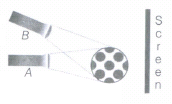
A torch is placed at two different positions A and B one by one as shown in figure.The shape of the shadow obtained in two positions is shown in the given figure.
Match the position of the torch and shape of the shadow of the ball.
5.
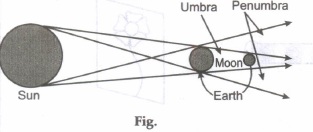
Explain about solar eclipse and lunar eclipse. Also, give the ray diagrams.
6.
What is a shadow? Explain a simple process for shadow formation.
7.
A football match is being played at night in a stadium with flood lights ON. You can see the shadow of a football kept at the ground but cannot see its shadow when it is kicked high in the air. Explain.
8.
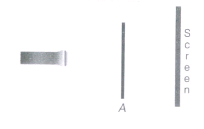
A sheet of plywood, a piece of muslin cloth and that of a transparent glass, all of the same size and shape were placed at A one by one in the arrangement shown in figure. Will the shadow be formed in each case? If yes, then how will the shadow on the screen be different in each case? Give reasons for your answer.
9.
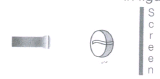
A student had a ball, a screen and a torch in working condition. He tried to form a shadow of the ball on the screen by placing them at different positions. Sometimes,1he shadow was not obtained. Explain.
10.
Explain with the help of a diagram that how can we see an image behind wall using a periscope.
1.
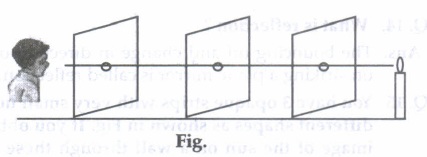
The light always travels in a straight line. This can be shown by performing a simple activity. For this, first of all let us take three cardboards of equal size. Now, a hole is made'at the centre of each cardboard at the same level. The three cardboard are placed on a flat table and aligned linearly as shown in the figure.
A candle is lighted at one end of the table with its flame at the level of the holes and is seen at the other end. It is observed that the light of the candle is seen effortlessly. Now, the middle one of the three cardboards is displaced from its position. Now, we are unable to see the light. The reason behind this is that the light travelling in the straight line is obstructed due the misalignment of the cardboards. This proves that light always travels in a straight line
2.
Luminous objects are those objects which emit the light of their own e.g. the stars, the sun, burning candle, etc. While non-luminous objects are those objects which do not emit light of their own, e.g. Blackboard, moon, earth, etc.
3.
The dark patch of light is known as a shadow which is formed when there is an opaque object in the path of light.
When an image is the reflection of light. By seeing image, we can identify the object but shadow can mislead you from actual object.
4.
Position A of the torch will form the image (a) and position B of the torch will form the image (b) of the football.
5.
Solar Eclipse: When the sun, the earth and the moon come in a straight line with the moon in between the earth and the sun, then the shadow of the moon falls on the earth. This results in solar eclipse. Solar eclipse occurs on a new moon day.
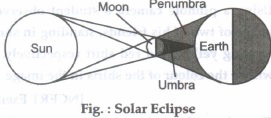
Lunar Eclipse: When the sun, the earth and the moon come in a straight line with the earth in between the moon and the sun, then the shadow of the earth falls on the moon. This results in Lunar eclipse. Lunar eclipse takes place on a full moon day. The shadow consists of two parts. One part is completely dark part of the shadow, where light does not reach from the source of light and this part is known as umbra. Other part is not completely dark, where some light reaches from the source of light and this part is known as penumbra. Penumbra surrounds the umbra.
6.
Opaque objects do not allow light to pass through them. When an opaque object is placed in the path of light, then the light is obstructed by the object leading to the formation of a dark patch known as the shadow of that object, which can be taken on a screen placed behind it.
Shadow formation: To form a shadow, there must be (i) a light source (ii) a screen (iii) an opaque object placed between the light source and the screen. For shadow formation, we can follow the given steps
Step 1: Take an opaque object.
Step 2: Throw light on it from a light source.
Step 3: Put a screen behind the object. In this way, a shadow of an object can be obtained on the screen.
In this way, a shadow of an object can be obtained on the screen.
7.
The shadow of the object cannot be caught if the screen and the object are very far from each other. This is the same case, the shadow of the football cannot be seen on the ground when it is kicked high in the air. This happens because if we take the object away and away from the screen, the image becomes smaller and smaller and a time comes when it disappears from the screen.
8.
Yes, the shadow will be formed in all the cases but in all the cases, the darkness of the shadow will be different.
(i) Most of the light in case of transparent sheet will pass through the glass. So, the darkness of shadow will be very low.
(ii) Also most the light in case of muslin cloth will be reflected. So, the shadow will be darker than the transparent sheet.
(iii) While in case of plywood, all the light would be stopped completely by the plywood. So, the darkness strength will be highest in this case.
9.
Sometimes, the shadow of the object (ball) may not be formed because of improper arrangement. It may be that the direction of the torchlight is not towards the screen. The shadow will be formed only if screen, torch and ball are in the same straight line (as shown in figure).
10.
The image can be observed behind wall using a periscope with the help of plane mirror by reflection of light.
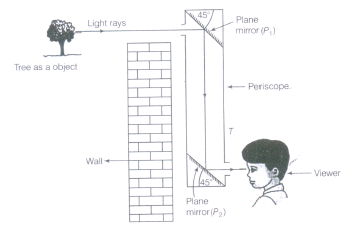
So, when rays of light coming from tree behind the wall fall on plane mirror (P1), then after reflection, it goes to the plane mirror (P2), which again reflects the light rays towards viewer. Therefore, we can see the tree which is behind wall.

6th Standard CBSE Syllabus & Materials
6th Standard CBSE
CBSE 6th Social Science Locating Places on the Earth - New Sample Question Papers Study Material - QB365 Set A
NEW6th Standard CBSE
CBSE 6th Science A Journey Through States of Water - New Sample Question Papers Study Material - QB365 Set A
NEW6th Standard CBSE
CBSE 6th Science Temperature and its Measurement - New Sample Question Papers Study Material - QB365 Set A
NEW6th Standard CBSE
CBSE 6th Science Materials Around Us - New Sample Question Papers Study Material - QB365 Set A



CBSE 6th Standard CBSE Subjects
CBSE Standards




