
 100% FREE ACCESS
6th Standard CBSE Syllabus & Materials
6th Standard CBSE
CBSE 6th Social Science The Value of Work - New Sample Question Papers Study Material - QB365 Set A
NEW6th Standard CBSE
CBSE 6th Social Science Family and Community - New Sample Question Papers Study Material - QB365 Set A
NEW6th Standard CBSE
CBSE 6th Social Science India's Cultural Roots - New Sample Question Papers Study Material - QB365 Set A
NEW6th Standard CBSE
CBSE 6th Social Science India,That is Bharat - New Sample Question Papers Study Material - QB365 Set A
NEW6th Standard CBSE
CBSE 6th Social Science Timeline and sources of history - New Sample Question Papers Study Material - QB365 Set A
NEW6th Standard CBSE
CBSE 6th Social Science Oceans and Continents - New Sample Question Papers Study Material - QB365 Set A

Published on: 26/09/2019
Light, Shadows and Reflections
Download CBSE Class 6th Standard CBSE Science question papers, sample papers, important questions, and previous year solved papers in PDF format. Get free study materials, NCERT solutions, and exam preparation resources for Class 6th Standard CBSE Science
Questions + Answers key
Take MCQ Science Test
1.
Show an experiment which proves that light always travels in a straight line.
2.
Differentiate between a luminous and non-luminous objects.
3.
Explain the reason of using a silver glass as a mirror.
4.
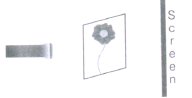
In given figure, a flower made of thick coloured paper has been pasted on the transparent glass sheet. What will be the shape and colour of shadow seen on the screen?
5.
Suggest any two means for the conversion of a transparent glass sheet into a translucent sheet.
6.
Using a pinhole camera, a student observes the image of two of his friends standing in sunlight wearing yellow and red shirt respectively. What will be the colours of the shirts in the image?
7.
Differentiate between a shadow and an image.
8.
A student covered a torch with red cellophane sheet to obtain red light. Using the red light, she obtains a shadow of an opaque object. She repeats this activity with green and blue light. Will the colour of the light affect the shadow? Explain.
9.
You are given a transparent glass sheet. Suggest any two ways to make it translucent without breaking it.
10.
Suggest a situation where we obtain more than one shadow of an object at a time.
11.
State some of the properties of light.
12.
Three identical towels of red, blue and green colour are hanging on a cloth line in the sun. What would be the colour of shadows of these towels?
13.
On a sunny day, does a bird or an aeroplane flying high in the sky cast its shadow on the ground? Under what circumstances, can we see their shadow on the ground?
14.
In a completely dark room, if you hold up a mirror in front of you. Will you see a reflection of yourself in the mirror?
15.
Rearrange the boxes given below to make a sentence that helps us to understand opaque objects.

1.
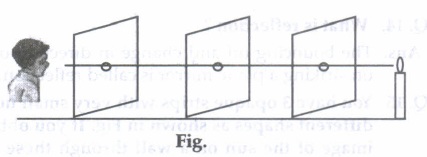
The light always travels in a straight line. This can be shown by performing a simple activity. For this, first of all let us take three cardboards of equal size. Now, a hole is made'at the centre of each cardboard at the same level. The three cardboard are placed on a flat table and aligned linearly as shown in the figure.
A candle is lighted at one end of the table with its flame at the level of the holes and is seen at the other end. It is observed that the light of the candle is seen effortlessly. Now, the middle one of the three cardboards is displaced from its position. Now, we are unable to see the light. The reason behind this is that the light travelling in the straight line is obstructed due the misalignment of the cardboards. This proves that light always travels in a straight line
2.
Luminous objects are those objects which emit the light of their own e.g. the stars, the sun, burning candle, etc. While non-luminous objects are those objects which do not emit light of their own, e.g. Blackboard, moon, earth, etc.
3.
As we know that the silvered glass surface is very smooth and shiny as well. So, this type of surface helps informing the clear image. So, silvering makes it shiny and this shiny surface in turn helps in reducing the absorption.
4.
The shape of the flower on the screen will be same as that of the flower but the shadow of flower is of black colour.
5.
The two ways through which a transparent glass sheet can be converted into a translucent sheet are
(i) If one side of butter paper gets covered, then a transparent glass sheet turns into a translucent one.
(ii) By smearing a thin layer of oil.
6.
Colours of the shirts will remain same. We see them on the screen because pinhole camera forms the images of the object having same colour but upside down. So, yellow shirt will form yellow image and red shirt will form red image.
7.
The dark patch of light is known as a shadow which is formed when there is an opaque object in the path of light.
When an image is the reflection of light. By seeing image, we can identify the object but shadow can mislead you from actual object.
8.
Shadow is just an absence of light at that place. Shadow is not affected by the colours of the object because the amount of light is preventing to pass, will remain same. The shadow is affected by the shape of the object only. If the object is large, the shadow will be large and vice-versa.
9.
Transparent sheet can be made translucent by two ways
(i) By rubbing it on the ground and make it rough.
(ii) By polishing it, not completely but partially.
10.
Place the object in front of a mirror and put the light source behind the object as shown in figure.
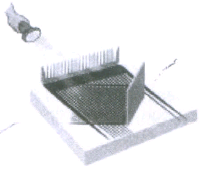
The image/shadow will be formed by the object as well as the image of the object by mirror.
11.
Some of the properties of light which can be stated as follows
(i) Light is a form of energy.
(ii) It travels in a straight line.
(iii) For an opaque object, light casts a shadow.
12.
Shadow does not change on changing the colour. Shadow will always show the absence of light at that place. So, the shadow colour will remain same in all the cases. Thus, the shadow of all the towels are black in colour.
13.
No, they do not cast any shadow on the ground because they are so high.
They can cast shadow only if they are at some lower height, i.e. if they are near to the ground, we can see their shadows.
14.
No, because reflection is the phenomenon in which light ray is sending back towards while travelling through mirror. If there is no source of light, no image will be formed and hence, we cannot see the image of ourself or any other object unless light source is there.
15.
Rearrangement of given boxes is shown as below:

The above rearrangement implies a sentence, i.e. opaque objects make shadows.

6th Standard CBSE Syllabus & Materials
6th Standard CBSE
CBSE 6th Social Science Locating Places on the Earth - New Sample Question Papers Study Material - QB365 Set A
NEW6th Standard CBSE
CBSE 6th Science A Journey Through States of Water - New Sample Question Papers Study Material - QB365 Set A
NEW6th Standard CBSE
CBSE 6th Science Temperature and its Measurement - New Sample Question Papers Study Material - QB365 Set A
NEW6th Standard CBSE
CBSE 6th Science Materials Around Us - New Sample Question Papers Study Material - QB365 Set A



CBSE 6th Standard CBSE Subjects
CBSE Standards




