
 100% FREE ACCESS
6th Standard CBSE Syllabus & Materials
6th Standard CBSE
CBSE 6th Social Science The Value of Work - New Sample Question Papers Study Material - QB365 Set A
NEW6th Standard CBSE
CBSE 6th Social Science Family and Community - New Sample Question Papers Study Material - QB365 Set A
NEW6th Standard CBSE
CBSE 6th Social Science India's Cultural Roots - New Sample Question Papers Study Material - QB365 Set A
NEW6th Standard CBSE
CBSE 6th Social Science India,That is Bharat - New Sample Question Papers Study Material - QB365 Set A
NEW6th Standard CBSE
CBSE 6th Social Science Timeline and sources of history - New Sample Question Papers Study Material - QB365 Set A
NEW6th Standard CBSE
CBSE 6th Social Science Oceans and Continents - New Sample Question Papers Study Material - QB365 Set A

Published on: 06/03/2020
6th Standard CBSE Science Public Exam Important Question 2019-2020
Download CBSE Class 6th Standard CBSE Science question papers, sample papers, important questions, and previous year solved papers in PDF format. Get free study materials, NCERT solutions, and exam preparation resources for Class 6th Standard CBSE Science
Questions + Answers key
Take MCQ Science Test
1.
What happens if it rains heavily?
2.
Define attractive and directive properties of a magnet.
3.
Give an example each of a combustible solid, liquid and gas.
4.
What are periodic and non-periodic changes? Give examples
5.
Is the light from a far away object able to travel to our eyes through opaque objects?
6.
Explain the adaptations of birds for flying in the air.
7.
Name the part of the redworms which help them in grinding the food which they feed on.
8.
Camels live in desert habitat. How do they adapt to such harsh climate?
9.
Mention how many types of terminals of an electric cell are there.
10.
In a number of musical instruments, air plays an important role. Can you name some such instruments?
11.
During rolling of a ball, which type of motion is performed?
12.
Which two crops were cultivated near the river Nile and were used for making fabrics?
13.
Identify the kind of stem in the following plants.
(a) Money plant (b) Bean stalk (c) Gourd plants (d) Grapevines
14.
Write four materials that can be used for the process of filtration.
15.
Blood clotting is function of which nutrients?
16.
Name three edible parts of the plant.
17.
How does earthworm fix parts of its body to the ground?
18.
What do various nutrients do for our body?
19.
How is Cactus adapted to survive in a desert ?
20.
How will you separate a mixture of saw dust and sugar?
21.
Column I shows different positions in which one pole of a magnet is placed near that of the other. Column II indicates the resulting action between them for each situation. Fill in the blanks.
| Column I | Column II |
| N-N | |
| N- | Attraction |
| S-N | |
| -S | Repulsion |
22.
(a) Collect pieces of different kinds of paper. Find out, which of these can be recycled?
(b) With the help of a lens, look at the pieces of paper you collected for the above. Do you see any difference in the material of recycled paper and a new sheet of paper?
23.
Paheli connected two bulbs to a cell as shown in figure.
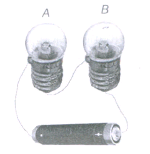
She found that filament of bulb 8 is broken. Will the bulb A glow in this circuit? Give reason.
24.
How will you show that air is dissolved in water?
25.
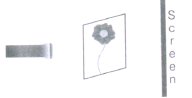
In given figure, a flower made of thick coloured paper has been pasted on the transparent glass sheet. What will be the shape and colour of shadow seen on the screen?
26.
Take out a cooled bottle of water from refrigerator and keep it on a table. After sometime you notice a puddle of water around it, why?
27.
Give two examples of periodic motion.
28.
Give five examples each of objects that float and sink in water.
29.
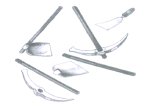
How the iron blade in these tools is fixed to the wooden handle?
30.
Classify the following fibres as natural or synthetic:
31.
If a plant has fibrous root, what type of venation do its leaves likely to have?
32.
Food habits of people living in South India are different from others. What are they?
33.
Three identical iron bars are kept on a table. Two out of three bars are magnets. In one of the magnets the North-South poles are marked. How will you find out which of the other two bars is a magnet? Identify the poles of this magnet
34.
Chalk, iron nail, wood, aluminium, candle, cotton usually look different from each other. Give some properties by which we can prove that these materials are different.
35.
How can the quality of cotton fabrics be improved?
36.
Describe the skeleton of a cockroach.
37.
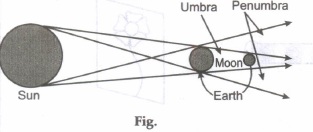
Explain about solar eclipse and lunar eclipse. Also, give the ray diagrams.
38.
Beautiful handcrafted articles like boxes and toys are made up of paper pulp in our country. Can you explain how paper pulp which is made from paper can be used to make hard boxes and other articles?
39.
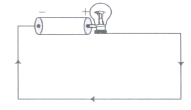
Boojho has a cell and a single piece of connecting wire. Without cutting the wire in two, will he be able to make the bulb glow? Explain with the help of a circuit diagram.
40.
Write a few sentences for an imaginary situation if any of the following gases disappear from the atmosphere.
(a) Oxygen (b) Nitrogen (c) Carbon dioxide
41.
Ravi and Ritu went on a vacation to different places. They went to Rishikesh, Himalayas, Kerala, Rajasthan. They saw many kinds of trees, plants and animals, e.g. pine trees on Himalayas and cactus in Rajasthan. All the places were so, different from each other. They clicked pictures, collected samples and showed it to their teacher asking to explain the reason behind these variations.
(a) Why is there a difference in type of plants growing in different places?
(b) What do you mean by survival place of an organism?
(c) How many types of such places that give living organism shelter, food, etc., are you aware about?
(d) Give an example of variation plants from different regions.
(e) What values do we observe in Ravi and Ritu?
42.
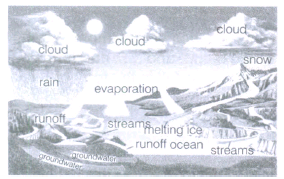
Draw a diagram to show how sea water reaches a lake or pond?
43.
Boojho was riding in his bicycle along a straight road. He classified the motion of various parts of the bicycle as (a) rectilinear motion (b) circular motion and (c) both rectilinear as well as circular motion. Can you list one part of the bicycle for each type of motion? Support your answer with reason.
44.
When a candle burns, both physical and chemical changes occur. Explain.
45.
Observe figure and attempt the questions that follow it.
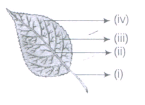
(a) Label the parts (i), (ii), (iii) and (iv) in the figure.
(b) What type of venation does the leaf has?
(c) What type of venation is seen in grass leaves?
46.
Read the story titled 'Wise Farmer' and tick the correct option to complete the story.
A farmer was sad/happy to see his healthy wheat crops ready for harvest. He harvested the crops and left it under the sun/rain to dry the stalks. To separate the seeds from the bundles of the stalk, he handpicked/threshed them.
After gathering the seed grains, he wanted to separate the stones and husk from it. His wife winnowed/ threshed them to separate the husk and later sieved/ handpicked to remove stones from it. She ground the wheat grains and sieved/filtered the flour. The wise farmer and his wife got a good price for the flour. Can you tell why?
47.
List all the sources and importance of the following minerals in food.
(a) Calcium
(b) Magnesium
(c) Potassium
(d) Zinc
(e) Iron
48.
Rajni went to Chennai to visit her friend. She noticed that the climate was very hot and the food available was so different than at home. Coconut is used extensively and rice is included in all meals. Her friend's mother explained these differences to Rajni.
(a) What changes were observed by Rajni in regard with food habits?
(b) Food habits of all places are different. What do you understand by food habits?
(c) List one dish commonly made in South India. Identify its ingredients, and separate plant and animal derived ingredients.
(d) Do you observe any values in Rajni? Name them.
49.
A solution which cannot dissolve more of a given substance at a given temperature is
Solution
Filtrate
Saturated solution
Unsaturated solution
50.
____________ are organisms which cannot prepare their food.
Autotrophs
Phototrophs
Heterotrophs
None of the above
51.
Banana has ________ roots.
Tap
Lateral
Fibrous
None
52.
Which of the following is not a non-magnetic substance?
Glass
Wood
China ware
Nickel
53.
The mineral which controls the functioning of thyroid is
phosphorous
calcium
magnesium
iodine
54.
Which of the following items is not soluble in water?
Salt
Sugar
Oil
All of these
55.
Air is a mixture of
Oxygen and nitrogen
Carbon dioxide and oxygen
Various gases, dust particles and water vapour
Oxygen and dust particles
56.
Image of sun through a pinhole camera can be seen as:
Long
Cylindrical
Circular
Any of these
57.
Find the odd one out:
Rotation of earth about its axis
Tabla surface
Blades of rotating fan
Moving vehicle on straight road
58.
Which of the following has different eating habits compared with the others?
Elephant
Cow
Dog
Giraffe
59.
Among the following items from waste, which item can be recycled?
Waste paper
Leather shoes
Animal waste
Kitchen waste
60.
A device that breaks the circuit is called
filament
bulb
switch
None of these
61.
Fishes swim by
forming loops alternately on two sides of the body
forming loops on single side
somersalting
alternate dipping and coming up
62.
Circulation of water between ocean and land is known as
water cycle
rain cycle
water management
water harvesting
63.
Which statement out of the following is incorrect?
Use of charkha was popularised by Mahatma Gandhi as a part of the Independence movement
In India, jute is mainly grown in Kerala and Punjab
To make fabric, the fibres are first converted into yarns
To make fabric, the fibres are first converted into yarns
64.
Which one of the steps while burning a candle is not reversible?
Melting of solid wax
Wax vapour burn into flame
Liquid wax changes into vapours
All of the above
1.
It may lead to flood.
2.
(i) Attractive property: A magnet has the property to attract some substance like iron, cobalt and nickel when brought near it. This property of magnet is called the attractive property.
(ii) Directive property: If we suspend a magnet freely with a thread, then it always aligns itself in the geographic north-south direction when it comes to rest. This is called the directive property of a magnet.
3.
Coal is a combustible solid, petrol is a combustible liquid and CNG is a combustible gas
4.
Periodic change : A change that repeats after a definite time interval is known as periodic change, e.g., phases of moon, heart-beat, etc.
Non-periodic change : A change that does not repeat again and again after a regular interval of time is known as non-periodic change, e.g., earthquake, flood and so on.
5.
No, light cannot pass through opaque objects
6.
The following adaptations are seen in the body of birds.
(i) Bones are hollow.
(ii) Forelimbs are modified into wings.
(iii) Body is streamlined.
7.
Redworms have gizzard (a kind of teeth) in their alimentary canal which can grind the hard particles of garbage.
8.
Camels have long legs, a hump and padded feet. All of these are adaptive features which help camel to survive in desert habitat.
9.
There are two terminals of an electric cell, i.e. positive and negative terminals.
10.
Air plays an important role in number of musical instruments such as flute, trumpet harmonium.
11.
Rotational and rectilinear motion are performed during the rolling of a ball.
12.
In ancient Egypt, cotton as well as flax were cultivated near the river Nile and were used for making fabrics.
13.
Bean stalk, gourd plants money and grapevines plants all have weak stem but readily climbs up a neighbouring support or a tree. These plants are called climbers.
14.
The materials that can be used are a wire-mesh, a piece of cotton, a piece of fine cloth and strainer.
15.
Vitamin-K and calcium both help in clotting of blood.
16.
Roots, fruits and leaves are edible parts in different plants.
17.
Earthworm has a large number of tiny bristle projections. These bristles are connected with muscles, which help the earthworm in fixing parts of its body to the ground.
18.
Our body needs different kinds of food for some special purposes.
For example,
| Carbohydrates and fats | for energy |
| Proteins | for body-building |
| Vitamins and minerals | for protection against diseases. |
19.
(i) The stem of Cactus helps to retain water.
(ii) Its leaves are modified into spines to reduce transpiration.
These adaptations help Cactus to survive in a desert.
20.
Following steps are used to separate a mixture of
saw dust and sugar :
(i) Add water to the mixture
(ii) Sugar present in the mixture dissolves in water but saw dust does not.
(iii) The solution is then filtered through filter paper.
(iv) We will get sugar solution as filtrate and saw dust will remain on the filter paper.
(v) Then the solution is heated and when water evaporates completely, sugar is left behind
21.
As, we know that like poles of a magnet repel each other and unlike poles attract each other.
Thus, the complete table is shown as below:
| Column I | Column II |
| N-N | Repulsion |
| N-S | Attraction |
| S-N | Attraction |
| S-S | Repulsion |
22.
(a) Pieces of papers can be obtained from newspapers, notebooks, magazines, etc. All of these can be recycled whereas shiny plastic coated papers cannot be recycled. Because plastic is non-biodegradable. The paper which cannot be recycled can be reused to make paper bags, envelopes, etc.
(b) Yes, there is a difference as surface of recycled paper is rough, while that of new sheet of paper is smooth. Recycled sheets are prepared from used papers. This type of paper can be used for making carry bags and other packaging materials.
23.
No, the bulb will not glow in the circuit because the filament of the bulb B is broken and current will not flow in the whole circuit, i.e. the circuit is broken or incomplete.
24.
Take some water in a glass vessel or beaker. Heat it slowly on a tripod stand well before the water begins to boil. Look carefully at the inner surface of the vessel, you will see tiny bubbles inside. These bubbles come from the air dissolved in water.
25.
The shape of the flower on the screen will be same as that of the flower but the shadow of flower is of black colour.
26.
As the temperature outside the refrigerator is higher than the refrigerator. So, when the cooled bottle of water is kept on a table, water vapours gets condensed and as a result, puddle of water appears around the bottle.
27.
Two examples of periodic motions are
(i) Motion of the earth around the sun
(ii) To and fro movement of bob of a pendulum
28.
Objects that float in water are plastic, sawdust, dry leaves, ice, kerosene objects the objects that sink in water are copper, silver, gold, stone, chalk.
29.
To fix the handle, the ring is heated and it becomes slightly large in size. Then, the handle easily fits into the ring. When the ring cools down contracts and fits tightly onto the handle.
30.
Nylon, wool, cotton, silk, polyester, jute
Natural fibres Wool, cotton, silk, jute.
Synthetic fibres Nylon, polyester.
31.
If a plant has fibrous root, its leaves have parallel venation.
32.
South India being close to sea, provides plenty of sea animal products like fish, etc. Chiefly grown cereal there is rice.
So, the people there mainly eat rice, fish, meat, etc. Vegetarians make idli, sambhar, uttapam, banana chips, coconut chutney. They use coconut oil as a cooking medium.
33.
It can be found in following ways:
(i) Take the bar magnet with known poles in you hand.
(ii) Take one of the other two iron bars in other hand.
(iii) Bring one side of iron bar towards the south pole of the bar magnet and note down whether it is attracted or repelled.
(iv) Bring other side of iron bar towards the south pole of the bar magnet and again note down the same thing.
(v) If there is an attraction in both cases i.e.,(iii) and (iv), then it is definitely a simple iron bar.
(vi) If there is an attraction in one case and repulsion in other case, then it is a bar magnet.
(vii) Do the same for the third iron bar. Now, poles can be found in following ways-If in case (iii), the bar is attracted, then it is North pole of the identified bar magnet. If the bar is repelled, then it is a south pole of the identified bar magnet.
34.
There are following properties by which we can prove that these materials are different:
| Material | Lustre | Hardness/softness | Roughness/smoothness |
|---|---|---|---|
| Chalk | - | Soft | Rough |
| Iron nail | Lustrous | Hard | Rough |
| Wood | - | Hard | Rough |
| Aluminium | Lustrous | Hard | Smooth |
| Candle | Candle | Soft | Smooth |
| Cotton | - | Soft | Smooth |
35.
The quality of cotton fabrics can be improved by :
(i) improving the quality of soil.
(ii) protecting the crops from pests.
(iii) discarding infected fibres.
(iv) twisting the fibres to make yarn properly.
(v) ensuring minimum or no gaps during weaving.
36.
Cockroaches walk and climb as well as fly in the air. They have three pairs of legs which help them in walking. The body is covered with a hard outer skeleton. This outer skeleton is made of different units joined together which permit movement. There are two pairs of wings attached to the thorax. The cockroaches have distinct muscles-those near the legs move the legs for walking. The thoracic muscles move the wings when the cockroach flies.
37.
Solar Eclipse: When the sun, the earth and the moon come in a straight line with the moon in between the earth and the sun, then the shadow of the moon falls on the earth. This results in solar eclipse. Solar eclipse occurs on a new moon day.
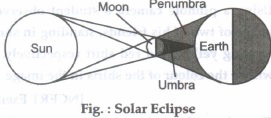
Lunar Eclipse: When the sun, the earth and the moon come in a straight line with the earth in between the moon and the sun, then the shadow of the earth falls on the moon. This results in Lunar eclipse. Lunar eclipse takes place on a full moon day. The shadow consists of two parts. One part is completely dark part of the shadow, where light does not reach from the source of light and this part is known as umbra. Other part is not completely dark, where some light reaches from the source of light and this part is known as penumbra. Penumbra surrounds the umbra.
38.
By following these simple steps, we can make hard gifting boxes or other articles from the recycled paper pulp:
Step I Create a stencil by unfolding a small, one piece cardboard box and trace it on a piece of cardboard that is the same size as your mold. Then, cut out that shape with scissors.
Step II Place the box stencil between your mold and deckle.
Step III Raise the mold, deckle and stencil to the surface in one continuous motion and then remove them from the pulp.
Step IV Remove the box from the stencil and let the paper dry.
Step V Assemble the box by folding and gluing or taping the edges. Decorate it as your need.
39.
This can be done by arranging the circuit as the given diagram.
One terminal should be connected to the terminal of the cell directly and other terminal can be connected using the given wire.
40.
(a) There will be no life on the earth. Oxygen is vital for life. It helps in burning, respiration, photosynthesis, etc. Oxygen is basic need of all living beings.
(b) Nitrogen does not support burning. If nitrogen gas disappear from the atmosphere, things will burn very fast.
(c) Carbon dioxide is needed for photosynthesis which occurs in green plants. In its absence, plants will not be able to prepare their food and hence, there will be no life on the earth.
41.
(a) Plants growing in different places appear different due to the presence of unique adaptive features which can be morphological or functional
(b) It is called a habitat. It provides food, water and shelter, etc., to all living organisms
(c) Two types of habitats have been observed
(i) terrestrial (ii) aquatic
(d) Leaves of cactus present in desert are thorn like (spines) on reduced to green fleshy stem, to reduce rate of transpiration while leaves of trees like deodars have cone or pine-shaped leaves to let show falling on them slide off easily.
(e) Ravi and Ritu both are adventurous, curious and observant. They are learners and have scientific temperament.
42.
Sea water reaches a lake or pond is represented by a diagram:
43.
(a) Rectilinear motion The handle of bicycle will always move in rectilinear path because it cannot do circular or rotatory motion.
(b) Circular motion The Paddles of bicycle will always move circularly around its chain fixing system because it cannot move in forward direction without the whole chain system.
(c) Both rectilinear and circular The wheels of bicycle will move in rectilinear as well as in circular motion because the wheel as a whole will move forward and its point or particles around the rim will execute circular motion.
44.
Physical changes A candle is made up of wax. We take a small candle and measure its length with scale. Now fix this candle on a tile kept on table and light it with burning matchstick. Allow the candle to burn for some time. Now we absorb melting wax comes to side of candle or table. This wax is reversible and we can used this wax.
Chemical changes The wax near the flame burns and gives new substance like carbon dioxide, carbon soot, water vapours, heat and light.
45.
(a) In the given figure:
(i) Petiole (ii) Midrib (iii) Lamina (iv) Vein
(b) The leaf has reticulate venation, the veins in leaf occur in an irregular way forming a net-like structure.
(c) Grass leaves have parallel type of venation. The vein run parallel to each other on both sides of midrib.
46.
(i) happy
(ii) sun
(iii) threshed
(iv) winnowed
(v) handpicked
(vi) sieved
They got a good price as they used appropriate methods of separation to get good quality of flour (atta).
47.
(a) The main sources of calcium minerals are milk, cheese, eggs and green vegetables. It also found in flour and bread.
It helps in formation of bone, teeth and blood clotting.
(b) Magnesium is found in cheese, green vegetable, bread and fish.
It helps in energy transfer and muscles activity. It works with calcium and vitamin-C.
(c) Potassium is found in meat, fruit, eggs, milk, etc.
The main function of potassium is balance in tissue fluid and blood. It also helps in nerve impulse conduction.
(d) Zinc is mainly found in onions, liver and green vegetables.
It works as a enzyme activator in our body.
(e) Iron is found in green vegetables, fresh fruits, etc.
Iron is needed to make haemoglobin present in red blood cells which carry oxygen from the lungs to the body parts.
48.
(a) Food habits of people in Chennai were different as they used coconut oil for cooking and coconut is extensively used in preparing other dishes. Rice was part of every meal, they consume less or no chapatis.
(b) Food habits refer to particular interest towards certain types of food. It is commonly influenced by location, climate and availability.
(c) Sambhar dal is very common. Its main ingredients are dal, condiments, vegetables and oil. All of these ingredients are plant products.
(d) Rajni is friendly, observant and knowledge seeking girl. She is aware of her surroundings which is very important.
49.
(c)
Saturated solution
50.
(c)
Heterotrophs
51.
(d)
None
52.
(d)
Nickel
53.
(d)
iodine
54.
(c)
Oil
55.
(c)
Various gases, dust particles and water vapour
56.
(c)
Circular
57.
(d)
Moving vehicle on straight road
58.
(c)
Dog
59.
(a)
Waste paper
60.
(c)
switch
61.
(a)
forming loops alternately on two sides of the body
62.
(a)
water cycle
63.
(c)
To make fabric, the fibres are first converted into yarns
64.
(b)
Wax vapour burn into flame

6th Standard CBSE Syllabus & Materials
6th Standard CBSE
CBSE 6th Social Science Locating Places on the Earth - New Sample Question Papers Study Material - QB365 Set A
NEW6th Standard CBSE
CBSE 6th Science A Journey Through States of Water - New Sample Question Papers Study Material - QB365 Set A
NEW6th Standard CBSE
CBSE 6th Science Temperature and its Measurement - New Sample Question Papers Study Material - QB365 Set A
NEW6th Standard CBSE
CBSE 6th Science Materials Around Us - New Sample Question Papers Study Material - QB365 Set A



CBSE 6th Standard CBSE Subjects
CBSE Standards




