
 100% FREE ACCESS
6th Standard CBSE Syllabus & Materials
6th Standard CBSE
CBSE 6th Social Science The Value of Work - New Sample Question Papers Study Material - QB365 Set A
NEW6th Standard CBSE
CBSE 6th Social Science Family and Community - New Sample Question Papers Study Material - QB365 Set A
NEW6th Standard CBSE
CBSE 6th Social Science India's Cultural Roots - New Sample Question Papers Study Material - QB365 Set A
NEW6th Standard CBSE
CBSE 6th Social Science India,That is Bharat - New Sample Question Papers Study Material - QB365 Set A
NEW6th Standard CBSE
CBSE 6th Social Science Timeline and sources of history - New Sample Question Papers Study Material - QB365 Set A
NEW6th Standard CBSE
CBSE 6th Social Science Oceans and Continents - New Sample Question Papers Study Material - QB365 Set A

Published on: 06/03/2020
6th Standard CBSE Science Public Exam Sample Question 2020
Download CBSE Class 6th Standard CBSE Science question papers, sample papers, important questions, and previous year solved papers in PDF format. Get free study materials, NCERT solutions, and exam preparation resources for Class 6th Standard CBSE Science
Questions + Answers key
Take MCQ Science Test
1.
Name any two water soluble and water insoluble materials
2.
What is a fixed joint? Give an example.
3.
Have you seen any fabrics that are made of the fibres on the outer covering of coconut? What are these fibres normally used for?
4.
What is venation? What are the types of venation?
5.
State whether the phenomenon is due to evaporation or condensation:
(i) Water drops appear on the outer surface of a glass containing cold water.
(ii) Blackboard dries up after getting wiped it.
(iii) Fog appearing on a cold winter morning.
(iv) Steam arising from wet clothes while they are ironed.
6.
What are the inexact methods of measurement?
7.
Do the materials other than magnet also come to rest in the same direction in the statue of emperor's chariot?
8.
Plastic bags are said to be harmful for stray animals. Why?
9.
Some animals cannot cope in low temperature habitat. What happens to them?
10.
Give the examples of some gadgets which use electricity.
11.
Air is necessary for burning. Yes/No? Give reason for your answer.
12.
In a complete dark room, we are not able to see our face. Why?
13.
Write the changes which cannot be reversed.
14.
Define the term condensation.
15.
Do you think all nutrients can be made available to us from only one source of food?
16.
Write two plants whose roots are used as vegetables.
17.
How does an electric cell produce electricity?
18.
Check whether the substance disappears in water or not
| Substance | Disappears in water/does not disappear |
|---|---|
| Salt | Disappears completely in water |
| Sugar | |
| Sand | |
| Chalk powder | |
| Sawdust |
19.
Fill in the table to explain how animals move from place to place.
| Animals | Body parts used for moving from place to place | How does the animal move? |
| Cow Humans Snake Bird Insect Fish |
Legs -------------- Whole body -------------- -------------- -------------- |
Walk ------------ Slither ------------ ------------ ------------ |
20.
In places, such as the mountains, where temperatures get very low during winters, the plastic pipes meant for water transportation break. Why do you think it happens?
21.
(a) What are carbohydrates? Give an example.
(b) In which forms are carbohydrates found in our food?
22.
Priya went a place for her summer vacation with her sister Monami Mukherji. As the day was dark, so she didn't confirm that in which direction is east. Her sister had a magnetic compass and she told Priya to find the direction with the compass.
(a) State the values that Monami Mukherji reflect here.
(b) Mention what happen to a freely suspended magnet.
23.
List some differentiating features between composting and vermicomposting.
24.
(a) Name one process which removes carbon dioxide from air.
(b) Suggest two processes which put back carbon dioxide into air.
25.
Which of the non-living things listed below, were once part of a living thing?
Butter, leather, soil, wool, electric bulb, cooking oil, apple, rubber
26.
Pooja was moving with her friend Ankit. She found that in ambulance, the spelling of ambulance was written in such a way that it was difficult to read. Her friend explains why it is so.
(a) Mention values that Ankit reflect here?
(b) Explain the term 'lateral inversion'.
27.
Lakes and ponds are small waterbodies, how are these waterbodies formed?
28.
Can an object be in motion and rest simultaneously for different observers? Give an example and consequence.
29.
Describe the main features of fabric which is made up of coconut fibre.
30.
Can the stem of a plant be compared with a street with two ways traffic? Give reason.
31.
Is it possible to separate sugar mixed with wheat flour? If yes, how will you do it?
32.
Can you identify the major ingredients of pizza. Which of the ingredients of pizza
(a) come from plants
(b) do not come from plants
33.
Give an experiment to show that one-fifth of air is oxygen.
34.
Suggest an activity to prepare a magnetic compass by using an iron needle and a bar magnet
35.
Chalk, iron nail, wood, aluminium, candle, cotton usually look different from each other. Give some properties by which we can prove that these materials are different.
36.
How can the quality of cotton fabrics be improved?
37.
One day Arun and Raj were playing cricket in a field along with their classmates. Suddenly Raj fell down very badly while he was trying to take a catch. Seeing this Arun ran towards him and found that he was not able to lift his left hand. So Arun immediately cushioned his hand by his sweater and took him to a nearby doctor. After examining Raj, the doctor, told them that Raj had dislocated one of the bones at the joint and had a minor fracture in his left hand. But he consoled them that after proper treatment Raj would get well soon.
(i) Name the types of joints found in the human body.
(ii) What values are possessed by Arun?
(iii) What values are possessed by the doctor?
38.
What are the characteristics of plants?
39.
In the given table, check whether the given changes can be reversed or not.
| Change | Can be reversed |
|---|---|
| Raw egg to boiled egg | Yes/No |
| Batter to Idli | |
| Wet clothes to dry clothes | |
| Woollen yarn to knitted sweater | |
| Grain to its flour | |
| Cold milk to hot milk | |
| Straight string to a coiled string | |
| Bud to flower | |
| Milk to paneer | |
| Cowdung to biogaes | |
| Stretched rubber band to its | |
| normal size | |
| Ice cream to molten ice cream |
40.
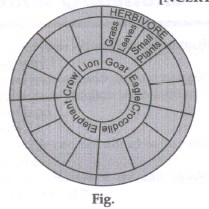
Read the names of animals written in the inner ring of Fig. Within the second ring write the types of food they eat and the category to which they belong (based on the eating habit) in the outer most ring. One example has been worked out for you. Use red, green and blue colours for writing.
41.
Burning of leaves is harmful. Why? Is burning of leaves considered illegal in India. If no, do you suggest it should be made illegal?
42.
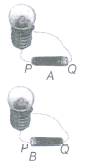
In figures A and B, show a bulb connected to a cell in two different ways.
(a) Mention the direction of the current through the bulb in both the cases (Q to P or P to Q)?
(b) Will the bulb glow in both the cases?
(c) Does the brightness of the glowing bulb depend on the direction of current through it?
43.
Ravi and Ritu went on a vacation to different places. They went to Rishikesh, Himalayas, Kerala, Rajasthan. They saw many kinds of trees, plants and animals, e.g. pine trees on Himalayas and cactus in Rajasthan. All the places were so, different from each other. They clicked pictures, collected samples and showed it to their teacher asking to explain the reason behind these variations.
(a) Why is there a difference in type of plants growing in different places?
(b) What do you mean by survival place of an organism?
(c) How many types of such places that give living organism shelter, food, etc., are you aware about?
(d) Give an example of variation plants from different regions.
(e) What values do we observe in Ravi and Ritu?
44.
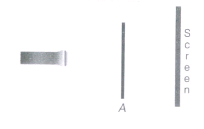
A sheet of plywood, a piece of muslin cloth and that of a transparent glass, all of the same size and shape were placed at A one by one in the arrangement shown in figure. Will the shadow be formed in each case? If yes, then how will the shadow on the screen be different in each case? Give reasons for your answer.
45.
Most of the water that falls on the land as rain and snow, sooner or later goes back to a sea or an ocean. Explain how it happens.
46.
It is not accurate to measure a length with elastic tapes. Explain why.
47.
Read the story titled 'Wise Farmer' and tick the correct option to complete the story.
A farmer was sad/happy to see his healthy wheat crops ready for harvest. He harvested the crops and left it under the sun/rain to dry the stalks. To separate the seeds from the bundles of the stalk, he handpicked/threshed them.
After gathering the seed grains, he wanted to separate the stones and husk from it. His wife winnowed/ threshed them to separate the husk and later sieved/ handpicked to remove stones from it. She ground the wheat grains and sieved/filtered the flour. The wise farmer and his wife got a good price for the flour. Can you tell why?
48.
Radha came back from school hungry and went to her mother in kitchen. Radha's mother was peeling vegetables. She noted that the peels were very thick and her mother then started washing vegetables. Radha asked her to stop washing the vegetables. Her mother was surprised and asked why? Radha told her all she knew about how nutrients are washed away if we peel and then wash them?
(a) If thick peels are removed from vegetables, what happens?
(b) Washing of vegetables after peeling is not a good practice. Can you tell why?
(c) What are those components that get washed away?
(d) Give two examples of vitamins and minerals containing food.
(e) Do you think Radha has any values? Name them.
49.
The process due to which steam changes into liquid state on cooling
Decantation
Sedimentation
Filtration
Evaporation
50.
We move our hand immediately, if we touch the hot object. In this which is stimulus.
hand
brain
hot object
spinal cord
51.
The part of plant which grows above the ground is___________?
Shoot system
Root system
both a & b
None
52.
the nerves in our body transmits messages as __________
Electrical impulses
Radio waves
Electromagnetic waves
None
53.
In _____________ electrical energy is transformed in to mechanical energy.
Transistor
Mixer grinder
Electromagnet
Electric bell
54.
The layer of air which surrounds the earth is:
atmosphere
air envelope
matter
none of these
55.
Rusting of iron is an example of
Slow change
Fast change
Physical change
Reversible change
56.
One decametre is equal to
10cm
10mm
10m
10km
57.
Which of the following organisms is not an omnivore?
Goat
Cat
Cockroach
Human
58.
Out of the following materials which one cannot be recycled?
Book
Wooden stool
Mirror
Tin can
59.
Light travels in a
random direction
straight line
curved line
zig-zag line
60.
The joint in cranium is a
gliding joint
ball and socket joint
fixed joint
hinge joint
61.
Which of these is a result of condensation of water vapours?
Rain
Snowfall
Hail
Tiny water droplets
62.
Which of the following statements is not true?
Materials are grouped for convenience
Materials are grouped to study their properties
Materials are grouped for fun
Materials are grouped according to their uses
63.
The correct sequence to get cloth is
fibre\(\rightarrow \) fabric \(\rightarrow \)yarn
fibre\(\rightarrow \) yarn \(\rightarrow \) fabric
fabric\(\rightarrow \) yarn\(\rightarrow \) fibre
yarn\(\rightarrow \) fibre\(\rightarrow \) fabric
64.
Minerals and vitamins present in food are
protective
energy giving
body building
roughage
1.
Soluble materials - Salt and sugar.
Insoluble materials - Sand and chalk
2.
Fixed joint is the one where there is no relative movement of the bones. The joint between the head and the upper jaw is an example of fixed joint.
3.
These fibres are normally used for a variety of clothing items by using process of spinning, weaving and knitting.
4.
Arrangement of veins on the lamina of leaf is called venation. They are of two types:
(a)Reticulate venation
(b) Parallel venation
5.
(i) Condensation
(ii) Evaporation
(iii) Condensation
(iv) Evaporation
6.
Foot, handspan and arm length are used to measure the length. These are inexact methods of measurement.
7.
No, the materials like iron bar, plastic or wooden scale inside the statue will not come in the same direction.
8.
The stray animals feed on the content of these bags and end up eating plastic.
9.
Animals unable to cope in harshen conditions go to sleep to prevent extreme cold and food shortage, this is known as hibernation.
10.
The gadgets which use electricity are fan, heater, television, air conditioner, etc.
11.
Yes because oxygen present in air supports burning.
12.
To see a thing, there must be light which comes after reflection from the object to our eyes. In dark room there is no light, so we are not able to see our face.
13.
The two changes which cannot be reverse are
(i) Change of milk into curd.
(ii) Rusting of iron
14.
The process of conversion of water vapour into its liquid form is called condensation.
15.
No, different nutrients are available from variety of foods derived from different sources.
16.
Carrot and radish are used as vegetables.
17.
The chemical energy stored in the chemicals stored inside a cell converts into electrical energy. When the chemicals of the cell are used up, it stops producing electricity.
18.
| Substance | Disappears in water/does not disappear |
|---|---|
| Salt | Disappears completely in water |
| Sugar | Disappears completely in water |
| Sand | Does not disappear |
| Chalk powder | Does not disappear |
| Sawdust | Does not disappear |
19.
The table to explain the movement of animals from place to place is given below:
| Animals | body parts used for moving from place to place | How does the animal move? |
| Cow Human Snake Bird Insect Fish |
Legs Legs Whole body Wings Wings/setae Fins |
Walk Walk and run Slither Fly Fly, walk, creep and craw Swim |
20.
Water pipes break because the water inside them expands as it gets close to freezing. This causes an increase in pressure inside the pipe. When the pressure gets too high for the pipe to contain, it breaks.
21.
(a) Carbohydrates are the compounds made up of carbon, hydrogen and oxygen. These are formed in plants during photosynthesis, e.g., glucose.
(b) Carbohydrates found in our food are in the form of starch and sugar.
22.
(b) A freely suspended magnet orients itself in North-South direction of the earth.
(a) Monami is intelligent and caring girl.
23.
Composting It is a natural process by which biodegradable waste like leaves can be turned into manures by the use of microbes only.
Vermicomposting In this process, manure is formed from the waste by use of redworms along with the microbes.
24.
(a) Photosynthesis by plants.
(b) Respiration by plants and animals and burning of fuels.
25.
Following are the non-living things from the list which were once part of living things:
Butter - Obtained from milk from dairy animals
Leather - From animal skin
Wool - From hair of sheep or goat
Cooking oil - Seeds of plants
Apple - Fruit from apple tree
Rubber - Latex of rubber tree
26.
(a) Ankit is intelligent and has good knowledge of light.
(b) During the image formation in plane mirror. Left seems to be right and right seems to be left, this is called lateral inversion.
27.
The rainwater runs on the surface of the earth and gets collected at the low lying areas. This results in the formation of lakes and ponds.
28.
Yes, a person driving a car is in rest with respect to other person in car but in motion with respect to a person standing roadside. State of motion and rest depends upon observer or reference point.
29.
The main features of fabric which is made up of coconut fibre
(i) The fibre in the coconut shell is also known as coir. It is the latest eco-friendly fabric.
(ii) Fabrics made from coconut fibre provide accelerated moisture management and protection from harmful UV (ultraviolet) rays.
(iii) Coconut fabrics are lightweighted, machine washable and naturally fit for comfort, quality and performance, e.g. doormats, brushes, mattresses, etc.
30.
Yes, the stem of a plant can be compared with a street with two ways traffic because
(i) It carries water and minerals from the roots to the leaves and other parts of plant in upward direction.
(ii) It takes the prepared food by the leaves to other parts of the plant.
31.
Yes, it is possible to separate sugar mixed with wheat flour by sieving.
Size of sugar particles is more than that of the wheat flour. So, sugar will stay on sieve and wheat flour will pass through the holes of the sieve.
32.
Ingredients of pizza are maida, butter, cheese and vegetables.
(a) Maida and vegetables come from plants.
(b) Butter and cheese do not come from plants. They come from animals.
33.
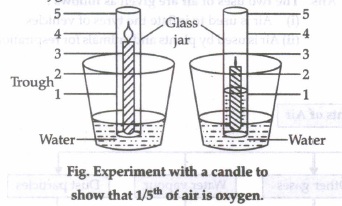
Take a candle and fix it at the centre of a glass vessel. Add some quantity of water in the vessel. Now place an empty dry glass jar over it. Mark five lines at an equal distance above the water surface. Now, carefully light the candle and cover the glass jar. Wait for a few seconds and how the flame will be extinguished due to absence of oxygen to bum.
Now, we can observe that the water level raised in the glass jar is 1/5 of the volume of air present in the glass jar
This experiment shows that one-fifth of air is oxygen
34.
Following steps are used to prepare a magnetic compass by using an iron needle and a bar magnet:
(i) Take a small piece of cork, and the magnetised needle (which can be magnetised by using a bar magnet).
(ii) Take a cup filled with water and let the cork float on it; the needle should not touch the water.
(iii) Now, compass is ready to work. Note the direction in which the needle points when the cork is floating.
(iv) Rotate the cork in different directions. Note the direction in which the needle points when the cork begins to float again without rotating. We see that the needle always points in the same direction, when the cork floats without rotation
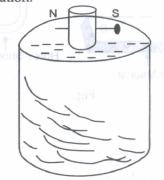
Activity showing magnetic compass by using iron needle and a bar magnet
35.
There are following properties by which we can prove that these materials are different:
| Material | Lustre | Hardness/softness | Roughness/smoothness |
|---|---|---|---|
| Chalk | - | Soft | Rough |
| Iron nail | Lustrous | Hard | Rough |
| Wood | - | Hard | Rough |
| Aluminium | Lustrous | Hard | Smooth |
| Candle | Candle | Soft | Smooth |
| Cotton | - | Soft | Smooth |
36.
The quality of cotton fabrics can be improved by :
(i) improving the quality of soil.
(ii) protecting the crops from pests.
(iii) discarding infected fibres.
(iv) twisting the fibres to make yarn properly.
(v) ensuring minimum or no gaps during weaving.
37.
| Structural | Functional |
| Fibrous Joints (fixed): Bones held together by fibrous connective tissue incl. many collagen fibres.No synovial cavity/fluid. |
Immovable Joint: Synarthrosis (singular), Synarthroses (plural). |
| Cartilaginous Joints (slightly movable): Bones held together by cartilage.No synovial cavity/fluid. | Slightly movable joint: Amphiarthrosis (singular), Amphiarthroses (plural). |
| Synovial Joints (incl. freely movable): Joint include a synovial cavity containing fluid secreted by synovial membrane.Bones forming the joint surrounded by an articular capsule. | Movable Joint, or Freelymovable joint: Diarthrosis (singular), Diarthroses (plural). |
(ii) Value: Caring, loyal towards his friend.
(ill) The doctor has extensive knowledge of bones
dislocations and other disorders.
38.
Characteristics of plants are :
(i) They cannot move from one place to another.
(ii) They can prepare their own food.
(iii) These are the living organisms on the earth which are responsible for the formation of food for all the living forms directly or indirectly.
(iv) All other organisms on the earth depend on the plants and their products for their survival.
(v) Plants grow in the soil from where they take nutrients for their growth and propagation.
39.
| Change | Can be reversed |
|---|---|
| Raw egg to boiled egg | No |
| Batter to Idli | No |
| Wet clothes to dry clothes | Yes |
| Woollen yarn to knitted sweater | Yes |
| Grain to its flour | No |
| Cold milk to hot milk | Yes |
| Straight string to a coiled string | Yes |
| Bud to flower | No |
| Milk to paneer | No |
| Cowdung to biogas | No |
| Stretched rubber band to its | Yes |
| Ice cream to molten ice cream | Yes |
40.
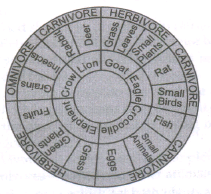
41.
Burning of leaves leads to air pollution and release of toxic gases which can cause diseases in living organisms.
No, burning of leaves is not illegal but it should be because leaves can be disposed in a very useful manner like compost.
It also releases harmful components in air on burning which leads to respiratory diseases and cancer in all.
42.
(a) The direction of current will be from Q to P in A and direction of current will be from P to Q in B. Because direction of current is always from positive terminal to negative terminal of the cell or battery.
(b) Yes, the bulb will glow in both the cases because to glow the bulb, we just need to complete the circuit.
(c) No, the brightness of the bulb never depend upon the direction of current passing through it.
43.
(a) Plants growing in different places appear different due to the presence of unique adaptive features which can be morphological or functional
(b) It is called a habitat. It provides food, water and shelter, etc., to all living organisms
(c) Two types of habitats have been observed
(i) terrestrial (ii) aquatic
(d) Leaves of cactus present in desert are thorn like (spines) on reduced to green fleshy stem, to reduce rate of transpiration while leaves of trees like deodars have cone or pine-shaped leaves to let show falling on them slide off easily.
(e) Ravi and Ritu both are adventurous, curious and observant. They are learners and have scientific temperament.
44.
Yes, the shadow will be formed in all the cases but in all the cases, the darkness of the shadow will be different.
(i) Most of the light in case of transparent sheet will pass through the glass. So, the darkness of shadow will be very low.
(ii) Also most the light in case of muslin cloth will be reflected. So, the shadow will be darker than the transparent sheet.
(iii) While in case of plywood, all the light would be stopped completely by the plywood. So, the darkness strength will be highest in this case.
45.
The process by which land water returns back to a sea or an ocean is as follows:
(i) Snow/Rain falling on the mountains melts into water that flows down in the form of streams and rivers.
(ii) A part of the rainwater gets absorbed into the ground and rest also flow in the form of stream or rivers.
(iii) The river water after passing through various regions ultimately reaches into a sea or an ocean
46.
Elastic tapes are stretchable due to which their length can be increased during the measurement if it is not handle with care. Therefore, the measurement done by elastic tapes may be greater than the actual length of the object. So, we can say that elastic tapes are not accurate to measure a length.
47.
(i) happy
(ii) sun
(iii) threshed
(iv) winnowed
(v) handpicked
(vi) sieved
They got a good price as they used appropriate methods of separation to get good quality of flour (atta).
48.
(a) Many vegetables contain most of the nutrients just below their skin surface. Thick peeling may lead to their removal.
(b) Washing of vegetables after peeling or cutting removes the water soluble vitamins and minerals from them and lowers their nutritive value.
(c) These components are called nutrients like minerals (iron, calcium, phosporous) and vitamins (B, A, C, D, E).
(d) Vegetables like tomatoes, potatoes, green leafy vegetables, etc.
(e) Yes, Radha is sincere, observant, helpful and knowledgeable. She used her knowledge in right place and stopped her mother for doing incorrect work.
49.
(d)
Evaporation
50.
(a)
hand
51.
(d)
None
52.
(a)
Electrical impulses
53.
(b)
Mixer grinder
54.
(a)
atmosphere
55.
56.
(c)
10m
57.
(a)
Goat
58.
(d)
Tin can
59.
(b)
straight line
60.
(c)
fixed joint
61.
(c)
Hail
62.
(c)
Materials are grouped for fun
63.
(b)
fibre\(\rightarrow \) yarn \(\rightarrow \) fabric
64.
(a)
protective

6th Standard CBSE Syllabus & Materials
6th Standard CBSE
CBSE 6th Social Science Locating Places on the Earth - New Sample Question Papers Study Material - QB365 Set A
NEW6th Standard CBSE
CBSE 6th Science A Journey Through States of Water - New Sample Question Papers Study Material - QB365 Set A
NEW6th Standard CBSE
CBSE 6th Science Temperature and its Measurement - New Sample Question Papers Study Material - QB365 Set A
NEW6th Standard CBSE
CBSE 6th Science Materials Around Us - New Sample Question Papers Study Material - QB365 Set A



CBSE 6th Standard CBSE Subjects
CBSE Standards




