
 100% FREE ACCESS
6th Standard CBSE Syllabus & Materials
6th Standard CBSE
CBSE 6th Social Science The Value of Work - New Sample Question Papers Study Material - QB365 Set A
NEW6th Standard CBSE
CBSE 6th Social Science Family and Community - New Sample Question Papers Study Material - QB365 Set A
NEW6th Standard CBSE
CBSE 6th Social Science India's Cultural Roots - New Sample Question Papers Study Material - QB365 Set A
NEW6th Standard CBSE
CBSE 6th Social Science India,That is Bharat - New Sample Question Papers Study Material - QB365 Set A
NEW6th Standard CBSE
CBSE 6th Social Science Timeline and sources of history - New Sample Question Papers Study Material - QB365 Set A
NEW6th Standard CBSE
CBSE 6th Social Science Oceans and Continents - New Sample Question Papers Study Material - QB365 Set A

Published on: 22/09/2018
Slip Test
Download CBSE Class 6th Standard CBSE Science question papers, sample papers, important questions, and previous year solved papers in PDF format. Get free study materials, NCERT solutions, and exam preparation resources for Class 6th Standard CBSE Science
Questions + Answers key
Take MCQ Science Test
1.
Does animal food also consist of different components and do they also need a balanced diet?
2.
Why jute is not used for making the fabrics (dresses)?
3.
Yarn, fabric and fibres are related to each other. Show the relationship by filling the blanks in the following sentence.
Fabric of cotton saree is made by weaving cotton _______ which in turn is made by spinning thin cotton________ .
4.
Out of the following food items, which one does not provide any nutrients?
Milk, Water, Orange juice, Tomato soup
5.
Write two plants whose roots are used as vegetables.
6.
Which is the best season for the cultivation of jute? In which part of India is jute grown?
7.
What do various nutrients do for our body?
8.
Identify the animals in the grid given below as Fig. and categorise them into herbivore, carnivore and omnivore.
| T | A | C | O | W | O | L | F |
| T | A | R | W | X | G | O | R |
| N | N | O | L | I | O | N | O |
| E | T | W | Q | L | A | N | G |
| H | U | M | A | N | T | W | O |
9.
What do we eat? List some common food items, their ingredients and sources.
10.
Write two steps for making fabrics from fibres?
11.
Read the items of food listed below. Classify them into carbohydrate rich, protein rich and fat rich foods and fill them in the given table.
Moong dal, fish, mustard oil, sweet potato, milk, rice, egg, beans, butter, butter milk (chhachh), cottage cheese (paneer), peas, maize, white bread.
| Carbohydrate rich food item | Protein rich food item | Fat rich food item |
| ............... | ............... | ............... |
| ............... | ............... | ............... |
| ............... | ............... | ............... |
| ............... | ............... | ............... |
| ............... | ............... | ............... |
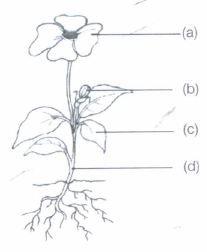
12.
Label the different parts of the plant given below in figure.
13.
Food habits of people living in South India are different from others. What are they?
14.
If you are given moong dal grains. How will you make the sprouts from them?
15.
Why should we avoid wastage of food?
16.
This is made up of a number of fibres twisted together:
Cloth
Yarn
Fibre
Fabric
17.
Coir fabric is obtained from:
Coconut plant
Cotton
Sheep hairs
Cocoon of silkworm
18.
Beera is a farmer. His field has black soil and the climate is warm. Which fibre yielding plant should he grow in his field?
Jute
Cotton
Coconut
Wool
19.
Read the food items given below.
(i) Wheat
(ii) Ghee
(iii) lodised salt
(iv) Spinach (palak)
Which of the above food items are energy giving foods?
(i) and (iv)
(ii) and (iv)
(i) and (ii)
(iii) and (iv)
20.
We get eggs from
goose
buffalo
bee
goat
21.
Plant fibres are obtained from __________and _________ .
22.
Silk is obtained from ___________ of silkworm.
23.
Balanced diet is one containing all __________ .
24.
Things that are used to make food item are known as ________________ .
25.
Bees make _____________ from nectar of flowers.
1.
Yes, animal food also consists of different components in the form of nutrients. They also need a balanced diet for their maintenance and growth.
2.
Jute is a rough fibre so, it is not used for making the fabrics (dresses).
3.
yarn, fibres
4.
Among the given food items, water does not provide any nutrient whereas milk provides proteins, fats and vitamin-D while orange juice and tomato soup provide vitamin-C.
5.
Carrot and radish are used as vegetables.
6.
Rainy season is the best season for cultivation of jute. It is grown in Bihar, Assam and West Bengal.
7.
Our body needs different kinds of food for some special purposes.
For example,
| Carbohydrates and fats | for energy |
| Proteins | for body-building |
| Vitamins and minerals | for protection against diseases. |
8.
The animals in the grid are given below:
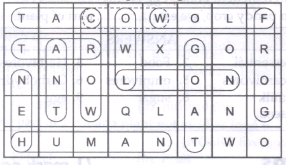
These animals are categorised as:
| Herbivores | Carnivores | Omnivores |
|---|---|---|
| Cow | Lion | Human |
| Goat | Frog | Rat |
| Hen | Wolf | Cat |
| Owl | ||
| Crow | ||
| Ant |
9.
Some common food items, their ingredients and sources are listed below:
| S.No | Food items | Major Ingredients | Sources |
|---|---|---|---|
| (a) | Rice | Raw rice | Plant |
| Water | Tap/River | ||
| (b) | Chapati | Wheat flour | Plant |
| Water | Tap/River | ||
| (c) | Omelette | Egg | Animal |
| Onion. | Plant | ||
| Chillies | Plant | ||
| Oil | Plant | ||
| Salt | Sea water | ||
| (d) | Idli | Rice | Plant |
| Urad dal | Plant | ||
| Salt | Sea water | ||
| Water | Tap/River | ||
| (e) | Vegetable soap | Vegetables | Plant |
| wafer | Tap/River | ||
| Salt | Sea water | ||
| Oil | Plant | ||
| Spices | Plant | ||
| (f) | Dal | Raw dal | Plants |
| Oil | Plants | ||
| Ghee | Animals | ||
| Spices | Plants | ||
| Salt | Sea water | ||
| Water | Tap/River |
10.
The fabrics are made from fibres in the following two steps:
(i) Fibres are first converted into yarn by the process of spinning.
(ii) Fabric is made from yarn by the process of weaving or knitting.
11.
The complete filled table is
| Carbohydrate rich food items | Protein rich food items | Fat rich food items |
| Sweet potato | Moong dal | Mustard oil |
| Rice | Fish | Milk |
| Maize | Milk | Egg |
| White Bread | Egg | Butter |
| Beans | ||
| Butter Milk | ||
| Cottage cheese | ||
| Peas |
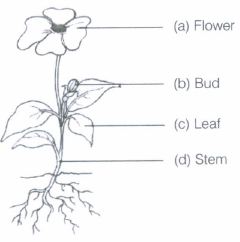
12.
The different parts of the plant are as labelled:
13.
South India being close to sea, provides plenty of sea animal products like fish, etc. Chiefly grown cereal there is rice.
So, the people there mainly eat rice, fish, meat, etc. Vegetarians make idli, sambhar, uttapam, banana chips, coconut chutney. They use coconut oil as a cooking medium.
14.
We will soak a handful of moong dal in water overnight. In the morning, we will drain out water and wrap seeds in wet cotton cloth for one more day. Third day, the seeds will show sprouts which are edible and good source of proteins and minerals.
15.
We should avoid wastage of food because
(i) there are many people amongst us, who do not get sufficient food.
(ii) some people do not have enough money to buy it.
16.
(b)
Yarn
17.
(a)
Coconut plant
18.
(b)
Cotton
19.
(c)
(i) and (ii)
20.
(a)
goose
21.
()
cotton plants, jute plants
22.
()
cocoon
23.
()
nutrients
24.
()
ingredients
25.
()
honey

6th Standard CBSE Syllabus & Materials
6th Standard CBSE
CBSE 6th Social Science Locating Places on the Earth - New Sample Question Papers Study Material - QB365 Set A
NEW6th Standard CBSE
CBSE 6th Science A Journey Through States of Water - New Sample Question Papers Study Material - QB365 Set A
NEW6th Standard CBSE
CBSE 6th Science Temperature and its Measurement - New Sample Question Papers Study Material - QB365 Set A
NEW6th Standard CBSE
CBSE 6th Science Materials Around Us - New Sample Question Papers Study Material - QB365 Set A



CBSE 6th Standard CBSE Subjects
CBSE Standards




