
 100% FREE ACCESS
6th Standard CBSE Syllabus & Materials
6th Standard CBSE
CBSE 6th Social Science The Value of Work - New Sample Question Papers Study Material - QB365 Set A
NEW6th Standard CBSE
CBSE 6th Social Science Family and Community - New Sample Question Papers Study Material - QB365 Set A
NEW6th Standard CBSE
CBSE 6th Social Science India's Cultural Roots - New Sample Question Papers Study Material - QB365 Set A
NEW6th Standard CBSE
CBSE 6th Social Science India,That is Bharat - New Sample Question Papers Study Material - QB365 Set A
NEW6th Standard CBSE
CBSE 6th Social Science Timeline and sources of history - New Sample Question Papers Study Material - QB365 Set A
NEW6th Standard CBSE
CBSE 6th Social Science Oceans and Continents - New Sample Question Papers Study Material - QB365 Set A

Published on: 26/07/2019
On the Trail of the Earliest People
Download CBSE Class 6th Standard CBSE Social Science question papers, sample papers, important questions, and previous year solved papers in PDF format. Get free study materials, NCERT solutions, and exam preparation resources for Class 6th Standard CBSE Social Science
Questions + Answers key
Take MCQ Social Science Test
1.
Mention the archaeological sources which tell us about man's life in the early period.
2.
Why did the hunter-gatherers travel from place to place? In what ways are these similar to/different from the reasons for which we travel today?
3.
Grasslands developed in various areas around:
700 years ago
12,000 years
6 million years
170 years ago
4.
Grasslands led to an increase in :
Human population
Birds
Animals which feed on grass
Aquatic animals
5.
Which type of tools have survived best?
Stone tools
Wood tools
Bone tools
None of the above
6.
Edible plants are
poisonous
non-poisonous
tool making plants
used in making huts
7.
The hunter-gatherers lived in the subcontinent as early as
1 million years ago
2 million years ago
3 million years ago
4 million years ago
8.
How did the early man learn herding and rearing animals?
9.
Where were Ostrich egg shells found in India?
10.
Where were traces of ash found?
11.
Why did the people choose to live in natural caves?
12.
Where is Bhimbetka located?
13.
Fire was used as a source of light.
14.
Humans led a well-settled life by Palaeolithic Age.
15.
Bhimbetka is located in present day Madhya Pradesh.
16.
Traces of ash suggest that people were familier with the use of fire.
17.
Grains such as wheat and rice grew naturally.
18.
Ostriches were found in India during
19.
A Palaeolithic site in Central India
20.
Many old paintings show
21.
Mesolithic
22.
Site
23.
What are the major developments of Neolithic age ?
24.
Answer the questions based on the picture given below:
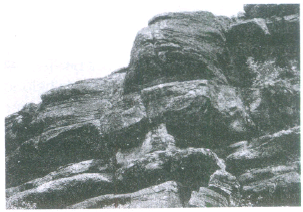
(i) Where are the above sites located?
(ii) Bhimbetka is located in which state?
(iii) Which valley is closer to these rock shelters?
25.
Hunter-gatherers generally hunted ______________ caught fish and birds, etc.
26.
_____________ name came from the way in which they got their foods.
27.
In Hunsgi, tools were made of ______________
28.
Early people painted on the ______________ of caves
29.
Grasslands developed around_________ years ago.
1.
Archeological sources such as tools, caves and rock paintings tell us about the eating habits of early man, materials used by him during that time and the activities performed:
(i) Tools: The earliest tools were made of stone, bone and wood. They were used to cut meat and bones, scrape barks from trees, for hunting, for stitching clothes, etc.
(ii) Caves: People lived in caves and rock shelters as they provided them with shelter from the rain, heat and wind.
(iii) Rock paintings: The early man made paintings in the caves and rock shelters. These paintings were drawn with great accuracy and skill.
2.
(I) The hunter-gatherers travelled from one place to another in search of food.
(ii) Sometimes they followed the animals who were also moving from place to place in search of their foods. For example, smaller prey, grass and leaves etc.
(iii) The hunter-gatherers often moved from season to season in search of different seasonal plants.
(iv) Sometimes they moved in search of enough sources of water for their survival. The movement of hunter-gatherers were totally based on their basic needs, mainly food and water. This is quite different from the reasons for which we travel today. Now we generally travel for official responsibility, exploring the new lands or personal reasons. We are not travelling in search of food. But poor sections of our society are often migrating in search of their livelihood, which can be described as in search of food also.
3.
(b)
12,000 years
4.
(c)
Animals which feed on grass
5.
(a)
Stone tools
6.
(b)
non-poisonous
7.
(b)
2 million years ago
8.
()
When the hunters followed animals for hunting, they might have learnt about their food habits and their breeding seasons. It is likely that this helped people to start thinking about herding and rearing these animals themselves.
9.
()
Large quantities of Ostrich egg shells were found at Pune in Maharashtra.
10.
()
Traces of ash were found in the Kurnool caves
11.
()
People chose to live in natural caves because it provided shelter from the rain, heat and wind.
12.
()
Bhimbetka is located in the state of Madhya Pradesh, also known as habitation sites.
13.
(a)
14.
(b)
15.
(a)
16.
(a)
17.
(a)
18.
()
Palaeolithic Age
19.
()
Bhimbetka
20.
()
Wild animals
21.
()
period from about 12,000 years ago till about 10,000 years ago.
22.
()
a place wherethe remains of things (tools ,pots , buildingsetc ) werefound which were left behind by people
23.
The major developments of the Neolithic age are :
(i) Growing crops and domesticating animals.
(ii) Use of polished stone tools and weapons.
(iii) The art of making pottery and making painted potteries.
(iv) Practice of the burying the dead along with pottery, weapon, food and drink.
(v) Invention of the wheel.
24.
(i) These sites are located in Bhimbetka.
(ii) Bhimbetka is located in Madhya Pradesh.
(iii) The Narmada Valley is close to these rock shelters.
25.
()
Wild animals
26.
()
Hunter-gatherers
27.
()
limestone
28.
()
walls
29.
()
12,000

6th Standard CBSE Syllabus & Materials
6th Standard CBSE
CBSE 6th Social Science Locating Places on the Earth - New Sample Question Papers Study Material - QB365 Set A
NEW6th Standard CBSE
CBSE 6th Science A Journey Through States of Water - New Sample Question Papers Study Material - QB365 Set A
NEW6th Standard CBSE
CBSE 6th Science Temperature and its Measurement - New Sample Question Papers Study Material - QB365 Set A
NEW6th Standard CBSE
CBSE 6th Science Materials Around Us - New Sample Question Papers Study Material - QB365 Set A



CBSE 6th Standard CBSE Subjects
CBSE Standards




