
 100% FREE ACCESS
6th Standard CBSE Syllabus & Materials
6th Standard CBSE
CBSE 6th Social Science The Value of Work - New Sample Question Papers Study Material - QB365 Set A
NEW6th Standard CBSE
CBSE 6th Social Science Family and Community - New Sample Question Papers Study Material - QB365 Set A
NEW6th Standard CBSE
CBSE 6th Social Science India's Cultural Roots - New Sample Question Papers Study Material - QB365 Set A
NEW6th Standard CBSE
CBSE 6th Social Science India,That is Bharat - New Sample Question Papers Study Material - QB365 Set A
NEW6th Standard CBSE
CBSE 6th Social Science Timeline and sources of history - New Sample Question Papers Study Material - QB365 Set A
NEW6th Standard CBSE
CBSE 6th Social Science Oceans and Continents - New Sample Question Papers Study Material - QB365 Set A

Published on: 01/10/2019
From Gathering to Growing Food
Download CBSE Class 6th Standard CBSE Social Science question papers, sample papers, important questions, and previous year solved papers in PDF format. Get free study materials, NCERT solutions, and exam preparation resources for Class 6th Standard CBSE Social Science
Questions + Answers key
Take MCQ Social Science Test
1.
This is a picture of a sack full of grains. Answer the following questions related to the picture:
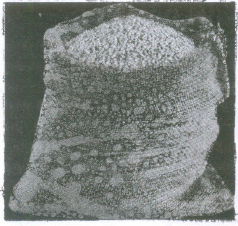
(i) In what ways were grains used?
(ii) How did the early man store grains?
(iii) How did farming affect the life of the early man?
2.
Look at this picture of a house in Mehrgarh and answer the following questions:
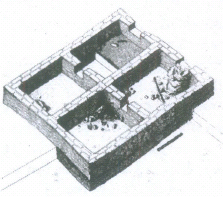
(i) Where is Mehrgarh located?
(ii) What type of houses were found in Mehrgarh?
(iii)Why is it considered as an important site?
3.
What is a burial? Describe the burials of the early man with examples.
4.
Do you grow the cereals you have listed.If yes, draw a chart to show the stages in growing them. If not, draw a chart to show how these cereals reach you from the farmers who grow them?
5.
Make a list of all the animals mentioned in the table. For each one describe what they may have been used for.
6.
You are in charge of a small plot of land and have to decide what crops to grow. What are the plants you would choose? Where would you get the seeds from? How would you plant them? How would you look after your plants? And when would they be ready for harvesting?
7.
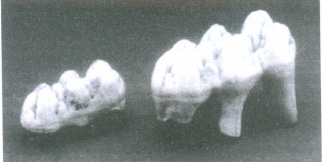
Look at these two sets of teeth. Which do you think belongs to a wild pig and which to a domesticated one?
8.
Write a short note on the Neolithic site Daojali Hading.
9.
Describe the traces of bones from the sites of Mehrgarh.
10.
Describe the works of artisans of early period.
1.
(i) Grains were used as seeds, food and as gifts.
(ii) The early man stored grains in large pots, woven baskets or in pits, which were dug in the ground.
(iii) When the early man started farming, he had to stay at one place for a long time looking after plants, watering, weeding and protecting them from animals and birds till the grain ripened. So, instead of wandering from place to place in search of food, he began to live a settled life.
2.
(i) Mehrgarh is located on a fertile plain, near the Bolan Pass, one of the most important routes into Iran.
(ii) The remains of square and rectangular houses were found at Mehrgarh. Each house was composed of four or more compartments, some of which may have been used for storage.
(iii) The evidences discovered at Mehrgarh prove that it was probably one of the places where women and men learnt to grow barley and wheat and rear sheep and goats for the first time in human history.
3.
A burial is an arrangement made by people for their relatives and friends.
When people die, generally respect is paid to them. Dead people are looked after perhaps because of the belief that there is some form of life after death. Several burial sites have been found at Mehrgarh, For instance, the dead persons were buried with goats, which were probably meant to serve as food in the next world.
4.
The farmers grow the cereals. The various steps involved are:
(i) Ploughing the fields and putting manure.
(ii) Sowing the seeds and looking after the tender plants and saving them from pests.
(iii)Watering the fields.
(iv) Harvesting the crop and storing them in the sheds. The chart given below show how the cereals reach the people from the farmers:
| Step 1 | Step 2 | Step 3 |
| The crops are purchased by the middlemen from the farmers. They bring them to the cities. |
They sell them to the wholesale traders or retailers. |
We buy it from the shops, either from the wholesale traders or from the retailers. |
5.
(i) Pig \(\rightarrow\) for meat.
(ii) Buffalo \(\rightarrow\) milk-giving animal.
(iii) Sheep\(\rightarrow\) meat and wool.
(iv) Dog \(\rightarrow\) to look after the house and fields.
(v) Cattle\(\rightarrow\) for dairy and milk products.
(vi) Ox\(\rightarrow\) for ploughing the fields and pulling the carts.
(vii) Goat \(\rightarrow\) milk and meat.
6.
(i) I would like to plant vegetables in my plot.
(ii) I will get the seeds of vegetables from the government outlet of seeds.
(iii) First of all, I will prepare the land by proper ploughing. Then I will sow the seeds and arrange for timely irrigation.
(iv) I will protect my crop from the birds and insects by putting statues of fake men and using insecticides.
Result: The crop will be ready for harvesting in around mid-April.
7.
The larger one is the teeth of a wild pig, and the smaller one is related to the domesticated one. Because the teeth and horns of wild animals are usually much larger than those of domesticated animals.
8.
Grain and bones are found in Daojali Hading. This is a site on the hills near the Brahmaputra Valley. It is close to routes leading into China and Myanmar. Here stone tools, including mortars and pestles, have been found. These indicate that people were probably growing grain and preparing food from it. Jadeite, a stone that may have been brought from China, tools made of fossil wood (ancient wood that has hardened into stone), and also pottery, are found here.
9.
Traces of bones of various animals have been found at the site of Mehrgarh.
(i) It was probably one of the places where women and men learnt to grow barley and wheat, and rear sheep and goats for the first time in this area. It is one of the earliest villages that we know about.
(ii) The evidence of many kinds of animal bones from c the earliest levels has been found by archaeologists during excavation levels, which included bones of wild animals such as deer and pig.
(iii) In later levels, they found more bones of sheep and goat and in still later levels, cattle bones are most common.
(iii) This implies that sheep, goat and cattle were reared by people in later period.
10.
Works of artisans of early period were as follow.
(i) Artisans made advanced stone tools that were polished and had a fine cutting edge.
(ii) Various kinds of decorated pots have been found which were used for storing things.
(iii) This was the beginning of using pots for cooking food, especially grains like rice, wheat and lentils.
(iv) Besides these, people also began weaving clothes, using different kinds of materials, for example cotton.

6th Standard CBSE Syllabus & Materials
6th Standard CBSE
CBSE 6th Social Science Locating Places on the Earth - New Sample Question Papers Study Material - QB365 Set A
NEW6th Standard CBSE
CBSE 6th Science A Journey Through States of Water - New Sample Question Papers Study Material - QB365 Set A
NEW6th Standard CBSE
CBSE 6th Science Temperature and its Measurement - New Sample Question Papers Study Material - QB365 Set A
NEW6th Standard CBSE
CBSE 6th Science Materials Around Us - New Sample Question Papers Study Material - QB365 Set A



CBSE 6th Standard CBSE Subjects
CBSE Standards




