
 100% FREE ACCESS
6th Standard CBSE Syllabus & Materials
6th Standard CBSE
CBSE 6th Social Science The Value of Work - New Sample Question Papers Study Material - QB365 Set A
NEW6th Standard CBSE
CBSE 6th Social Science Family and Community - New Sample Question Papers Study Material - QB365 Set A
NEW6th Standard CBSE
CBSE 6th Social Science India's Cultural Roots - New Sample Question Papers Study Material - QB365 Set A
NEW6th Standard CBSE
CBSE 6th Social Science India,That is Bharat - New Sample Question Papers Study Material - QB365 Set A
NEW6th Standard CBSE
CBSE 6th Social Science Timeline and sources of history - New Sample Question Papers Study Material - QB365 Set A
NEW6th Standard CBSE
CBSE 6th Social Science Oceans and Continents - New Sample Question Papers Study Material - QB365 Set A

Published on: 21/10/2019
GEO - Major Landforms of the Earth
Download CBSE Class 6th Standard CBSE Social Science question papers, sample papers, important questions, and previous year solved papers in PDF format. Get free study materials, NCERT solutions, and exam preparation resources for Class 6th Standard CBSE Social Science
Questions + Answers key
Take MCQ Social Science Test
1.
Write a note on Lava Plateau
2.
How are Block Mountains formed?
3.
How are Fold Mountains formed?
4.
Describe the features of a volcano
5.
Write any three benefits of plateau and any two benefits of plains.
6.
Answer the following questions based on the following picture?
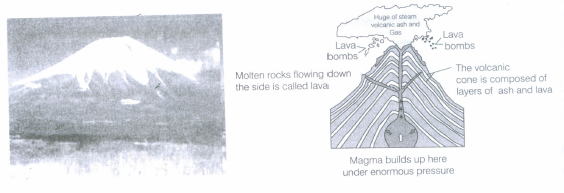
(i) Which type of mountain is shown in the picture?
(ii) Write any two examples of such mountain system.
7.
Answer the following question based on given picture?
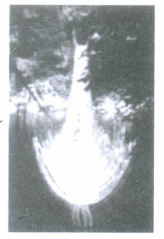
Above picture is located in which state of India and what does it depict?
8.
Write about features of following.
(a) Plateau
(b) Mountain
9.
What are the types of mountains?
10.
Differentiate between the internal and external processes.
1.
(i) Lava plateaus are formed by highly fluid (runny) basaltic lava during numerous successive eruptions through numerous vents without violent explosions (quiet eruptions).
(ii) These eruptions are quiet because of low viscosity of lava and contains small amount of trapped gases.
(iii) Multiple successive and extensive lava flows cover the original landscape to eventually form a plateau, which may contain lava fields, cinder cones, shield volcanoes and other volcanic landforms.
2.
(i) Block Mountains are formed when large areas of bedrock are widely broken up by faults creating large vertical displacements of continental crust.
(ii) Vertical motion of the resulting blocks, sometimes accompanied by tilting, can then lead to high escarpments.
(iii) These mountains are formed by the Earth's crust being stretched and extended by tensional forces.
(iv) Fault block mountains commonly accompany rifting, another indicator of tensional tectonic forces.
(v) The uplifted blocks are called block mountains or Horsts. The intervening dropped blocks are termed as graben.
(vi) These can be small and form extensive rift valley systems. This form of landscape can be seen in East Africa, the Vosges, the Basin and Range province of Western North America, in South-Central New England and the Rhine Valley.
(vii) Volcanic eruptions often occur when the regional stress is extensional and the crust is thinned.
3.
(i) Fold mountains are generally formed in the less deformed areas adjacent to areas strongly affected by thrust tectonics.
(ii) Typically, they are found in the foreland region where a major mechanically weak horizon is present.
(iii) The frontal thrust (or thrusts) propagate(s) a long distance along the horizon and subsequent movement on the thrust can give rise to a sequence of folds as the hanging wall of the thrust effectively crumples.
(iv) The anticline crests may be high enough to form mountains.
(v) Most of the fold mountains are likely to be relatively young in geological terms as they will start eroding as soon as they are formed.
4.
(i) A volcano is an opening on the surface of the Earth from which magma, associated gases and ash erupt.
(ii) Volcano has a magma chamber that is a huge bottomless pot of molten rocks.
(iii) The main channel through which magma moves towards the surface is the central vent.
(iv) A crater is at the top of a volcano and it is from here, that much of the lava, gas, rock fragments and ash are ejected.
(v) Volcanic cones are the result of eruptions which are mostly small pieces of rocks that build up cones around the vent.
5.
Benefit of plateau:
(i) Plateaus have rich mineral deposits.
(ii) Most precious metals like gold, silver, etc. are also obtained from mines found in the plateau regions.
(iii) Plateau region soil is made up of lava, which is good for crops like cotton.
Benefits of Plains:
(i) They provide us ideal sites for settlement.
(ii) Plains are the food bowl of a region.
6.
(i) Volcanic mountain
(ii) Kilimanjaro, Vesuvius mountain (Itali's Southern part)
7.
Above picture depicts Rope Bridge and it is located in Arunachal Pradesh.
8.
(a) Plateau A plateau may have one or more sides with steep slopes. It is a flat-topped table land standing above the surrounding area. Plateaus may be young or old. The height of plateaus varies from few hundred metres to several thousand metres.
(b) Mountain A mountain is a natural elevation of the earth's surface more than 600 metres. Mountains are of three types. They are- Fold mountains, Block mountains and the Volcanic mountains.
9.
Mountains can be divided into three groups. They are as follows:
Block mountains They are created when large areas are broken and displaced vertically. For example-the Vosges mountain.
Volcanic mountains They are formed by volcanic activities. They are formed by the deposition of lava. For example-Mt. Kilimanjaro.
Folded mountain Folded mountains are with rugged relief and high conical peaks. For example- Himalayan mountains and Alps. while others with rounded features and low elevation like-Ural mountains.
10.
Internal process The continuous movement inside the earth is called internal process, which lead to the upliftment and sinking of the earth's surface at several places and changes the shape of the surface.
External processes The external process is the continuous changing on the earth's surface with the help of several agents like- ice, water and wind. It results into wearing down and rebuilding of the land surface.

6th Standard CBSE Syllabus & Materials
6th Standard CBSE
CBSE 6th Social Science Locating Places on the Earth - New Sample Question Papers Study Material - QB365 Set A
NEW6th Standard CBSE
CBSE 6th Science A Journey Through States of Water - New Sample Question Papers Study Material - QB365 Set A
NEW6th Standard CBSE
CBSE 6th Science Temperature and its Measurement - New Sample Question Papers Study Material - QB365 Set A
NEW6th Standard CBSE
CBSE 6th Science Materials Around Us - New Sample Question Papers Study Material - QB365 Set A



CBSE 6th Standard CBSE Subjects
CBSE Standards




