
 100% FREE ACCESS
6th Standard CBSE Syllabus & Materials
6th Standard CBSE
CBSE 6th Social Science The Value of Work - New Sample Question Papers Study Material - QB365 Set A
NEW6th Standard CBSE
CBSE 6th Social Science Family and Community - New Sample Question Papers Study Material - QB365 Set A
NEW6th Standard CBSE
CBSE 6th Social Science India's Cultural Roots - New Sample Question Papers Study Material - QB365 Set A
NEW6th Standard CBSE
CBSE 6th Social Science India,That is Bharat - New Sample Question Papers Study Material - QB365 Set A
NEW6th Standard CBSE
CBSE 6th Social Science Timeline and sources of history - New Sample Question Papers Study Material - QB365 Set A
NEW6th Standard CBSE
CBSE 6th Social Science Oceans and Continents - New Sample Question Papers Study Material - QB365 Set A

Published on: 17/10/2019
GEO - Motions of the Earth
Download CBSE Class 6th Standard CBSE Social Science question papers, sample papers, important questions, and previous year solved papers in PDF format. Get free study materials, NCERT solutions, and exam preparation resources for Class 6th Standard CBSE Social Science
Questions + Answers key
Take MCQ Social Science Test
1.
Differentiate between Solstice and Equinox.
2.
Rotation is the movement of the Earth in a circular motion around the axis line, while the movement of the Earth around the Sun in a fixed path or orbit is called revolution.
(i) What is the impact of rotation and revolution of the Earth?
(ii) What will happen if the Earth would not rotate?
3.
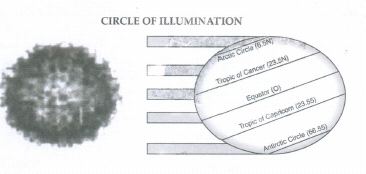
What is Circle of Illumination? Explain with the help of a diagram
4.
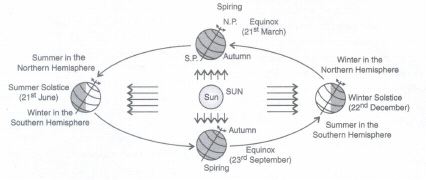
Diagrammatically show Equinox, Summer and Winter Solstices.
5.
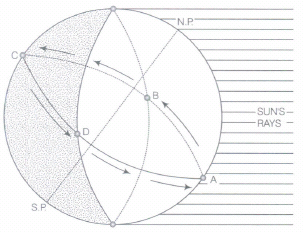
Make a drawing to show the inclination of the earth.
6.
How are seasons changed on the Earth?
7.
The rotation of the Earth is responsible for causing day and night. Explain with the proper example?
8.
Differentiate between the summer solstice and the winter solstice and the winter solstice.
9.
Why do our shadows seem to be long in the morning and evening but shorter in the noon?
10.
What is the relative importance of the Revolution of the Earth?
1.
The difference between Solstice and Equinox are given below:
| S.No | Solstice | Equinox |
| (i) (ii) (iii) |
It is dependent on the sunrays falling on the tropics. When the rays fall vertically on the tropics, days and nights are either longer or shorter. There is summer solstice or winter. |
It is dependent on the falling on the equator. Nights and days are always equal along the equator. There is Autumn Equinox Spring. |
2.
(i) The revolution of the Earth is responsible for bringing about changes in the season. Day and night are caused due to the rotation of the Earth.
(ii) The portion of the Earth facing the Sun would always experience day, thus bringing continuous warmth to ie region. The other half would remain in Darkness and would be freezing cold all the time. would not have been possible in such extreme conditions.
3.
The circle that divides the day from the night on the globe is called the Circle of Illumination. In the following image, the shadowed portion of the Earth experiences day and the white portion of the Earth experiences night. The circle that divides the two is the Circle of Illumination.
4.
5.
6.
The seasons are changed on the Earth because of the inclination of the Earth's axis in a fixed direction and due to the change in the position of the Earth around the sun.
On 21st June, the Northern hemisphere is tilted towards the sun. These areas receive more heat because the sun rays fall directly on the tropic of Cancer.
The tropic of Capricorn receives direct sun rays due to tilting of South Pole towards the sun on 22nd December.
The Northern hemisphere experiences autumn season while Southern hemisphere spring season on 23rd September. On 21st March, itIS spring in Northern hemisphere and autumn in Southern hemisphere.
7.
The Earth rotates from West to East on its axis. The Earth takes about 24 hours to complete one rotation around its axis. The period of rotation is known as the earthday. The spherical shape of the Earth allows only one half of the Earth to receive sunlight at a time.
The portion facing the sun experiences day, while the other half away from the sun experiences night. It is because of the rotation of the Earth that allows day and night following each other regularly.
8.
The difference between the summer solstice and the winter solstice is as follows:
Summer Solstice In the Northern hemisphere the longest day and the shortest night occur on 21st June. The Sunrays fall directly on the tropic of Cancer. All these conditions are opposite in Southern hemisphere and it is winter there. The nights are longer than the days in Southern hemisphere. This position of the Earth is called the summer solstice.
Winter Solstice The tropic of Capricorn receives direct rays due to tilting of South Pole towards the sun on 22nd December. The vertically falling sun rays at the tropic of Capricorn 23 1/2° provide heat to a larger portion of it. Therefore, it is summer in Southern hemisphere. This position of the Earth is called the winter solstice.
9.
The shadows are long in the morning and evening and shorter at noon. It is the effect of the slanting and direct rays of the Sun. When the rays of the Sun are overhead in afternoon, shadows are the shortest. The rays of the Sun are slanting during evening and morning hence, the shadows are longer.
10.
The change of seasons is caused due to the revolution of the Earth around the Sun.

6th Standard CBSE Syllabus & Materials
6th Standard CBSE
CBSE 6th Social Science Locating Places on the Earth - New Sample Question Papers Study Material - QB365 Set A
NEW6th Standard CBSE
CBSE 6th Science A Journey Through States of Water - New Sample Question Papers Study Material - QB365 Set A
NEW6th Standard CBSE
CBSE 6th Science Temperature and its Measurement - New Sample Question Papers Study Material - QB365 Set A
NEW6th Standard CBSE
CBSE 6th Science Materials Around Us - New Sample Question Papers Study Material - QB365 Set A



CBSE 6th Standard CBSE Subjects
CBSE Standards




