
 100% FREE ACCESS
6th Standard CBSE Syllabus & Materials
6th Standard CBSE
CBSE 6th Social Science The Value of Work - New Sample Question Papers Study Material - QB365 Set A
NEW6th Standard CBSE
CBSE 6th Social Science Family and Community - New Sample Question Papers Study Material - QB365 Set A
NEW6th Standard CBSE
CBSE 6th Social Science India's Cultural Roots - New Sample Question Papers Study Material - QB365 Set A
NEW6th Standard CBSE
CBSE 6th Social Science India,That is Bharat - New Sample Question Papers Study Material - QB365 Set A
NEW6th Standard CBSE
CBSE 6th Social Science Timeline and sources of history - New Sample Question Papers Study Material - QB365 Set A
NEW6th Standard CBSE
CBSE 6th Social Science Oceans and Continents - New Sample Question Papers Study Material - QB365 Set A

Published on: 19/01/2019
In the Earliest Cities Chapter Important Questions
Download CBSE Class 6th Standard CBSE Social Science question papers, sample papers, important questions, and previous year solved papers in PDF format. Get free study materials, NCERT solutions, and exam preparation resources for Class 6th Standard CBSE Social Science
Questions + Answers key
Take MCQ Social Science Test
1.
Answer the following questions related to the Great Bath of Mohenjodaro :
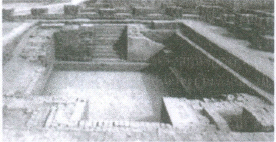
(i) What was the use of the Great Bath ?
(ii) What materials were used in the Great Bath ?
(iii) From where was water brought into the tank?
2.
Discuss the evidence of food-production in the Harappan civilisation.
3.
Who is a specialist? Discuss it in the context of Harappan civilisation.
4.
Describe the use of metals by the Harappan people.
5.
Discuss the Harappan drainage system.
6.
Why did the Harappan houses look a like?
7.
Write a note on the Great Bath in Mohenjodaro.
8.
Describe the general layour of the Harappan cities?
9.
What do you know about the discovery of the Harappan Civilisation ?
10.
What do you mean by raw material?
11.
What type of life was there in the city of Harappa?
12.
What was special about these cities?
13.
How were the seals used in Harappa?
14.
How do archaeologists know that cloth was used in the Harappan civilisation?
15.
Was stone used to make weights?
16.
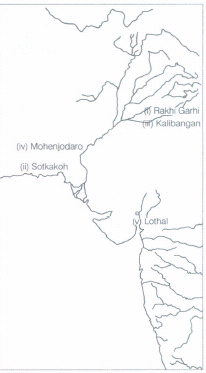
Show the following cities on the outline map of India
(i) Rakhi Garhi
(ii) Sotkakoh
(iii) Kalibangan
(iv) Mohenjodaro
(v) Lothal
17.
'Which cities had five attars?
Kalibangan
Lothal
Both (i) and (ii)
None of these
18.
Cotton was probably grown in Mehrgarh around:
2000 years ago
4000 years ago
7000 years ago
12000 years ago
19.
Which metals were used to make ornaments?
Gold
Silver
Both (a) and (b)
None of these
20.
The Great Bath has been found in :
Harappa
Mehrgarh
Mohanjodaro
Surat
21.
In earlier cities, the part to the west was smaller but higher and was called:
Citadel
Lower town
Upper town
Non of these
22.
The city of Lothal stood beside a_______of the________in Gujarat.
23.
The carefully preserved bodies are known as_________.
24.
At Mehrgarh, near Bolan Pass, remains of_______and________houses have been found.
25.
In some cities, special buildings were constructed on the_________.
26.
About eighty years ago, archaeologists found the site arid realised that this was one of the oldest cities in the_______.
27.
Spindle whorls were used to spin thread.
28.
People knew about cotton much before Harappan period.
29.
Harappan seals were made of metal.
30.
Rainfall was less in Harappan region.
31.
Houses in Harappa were poorly built.
32.
What symbolises the end of the civilisation?
33.
What do you know about the excavations at the cities of Dholavira and Lothal in Gujarat?
34.
What was special about the cities of Harappa?
1.
(i) Important people (priests, rulers) took ritual baths in this tank.
(ii) The tank was lined with kiln burnt bricks, plaster of gypsum and bitumen was used to make the tank water-resistant.
(iii) Water was probably brought in from a well and drained out after use.
2.
(i) We know from the remains of plants that the Harappans grew wheat, barley, pulses, peas rice, sesame, linseed and mustard.
(ii) A new tool, the plough, was used to dig the earth for turning the soil and planting seeds.
(iii)As this region did not receive heavy rainfall, some form of irrigation may have been used. It means that water was stored and supplied to the fields when the plants were growing.
3.
(i) A specialist is a person who is trained to do only one specialized kind of work, for example, cutting stone or polishing beads, or carving seals.
(ii) Not everybody can be a specialist. We do not know whether only men were specialists or only women were specialists in the Harappan civilization.
4.
(i) Most of the things that have been found by archaeologists are made of stone, shell and metal, including copper, bronze, gold and silver.
(ii) Copper and bronze were used to make tools weapons, ornaments and vessels.
(iii) Gold and silver were used to make ornaments and vessels.
5.
(i) Many of the Harappan cities had covered drains which were laid out in straight lines.
(ii) Each drain had a gentle slope, so that water could flow through it.
(iii)Very often, drains in houses were connected to those on the streets and smaller drains led into bigger ones.
6.
(i) Generally, houses were either one or two storey high with rooms built around a courtyard.
(ii) Most houses had a separate bathing area and some had wells to supply water.
7.
(i) In Mohenjodaro, a very special tank which archaeologists call the Great Bath, was built in the Citadel area.
(ii) It was lined with bricks, coated with plaster and made water-tight with a layer of natural tar.
(iii)There were steps leading down to it from two sides, while there were rooms on all sides.Perhaps. the important people took a dip in this tank on special occasions.
8.
(i) Many of the Harappan cities were divided into two or more parts.
(ii) Usually, the part to the west was smaller but higher. Archaeologists describe it as the Citadel.
(iii) Generally, the part to the East was larger but lower. It is called the lower town.
9.
(i) Nearly a hundred and fifty years ago, when railway lines were being laid down for the first time in Punjab, engineers stumbled upon the site of Harappa in present-day Pakistan.
(ii) To them, it seemed like a mound that was a rich source of readymade, high-quality bricks.
(iii) Then about eighty years ago, archaeologists found the site and realised that it was one of the oldest cities in the sub-continent.
10.
Substances that are either found naturally or produced by farmers. and herders and then processed to make finished goods are known as raw materials.
11.
The Harappan city was a very busy place. There were people who planned the construction of special buildings in the city, People may have kept the most valuable objects, such. as ornaments of gold and silver. People also travelled to distant lands.
12.
These cities were divided into two or more parts. The part to the west was smaller but higher. Walls of baked bricks were built around each part. The bricks were laid in an interlocking pattern.
13.
Seals may have been used to stamp bags or packets containing goods that were sent from one place to another.
After a bag was closed or tied, a layer of wet clay was applied on the knot and the seal was pressed on it. The impression of the seal is known as a sealing.
14.
Archaeologists know that people in the Harappan civilisation used cloth because they have found pieces of cloth attached to the lid of a silver vase. They have also found spindle whorls, made of terracotta and faience, which were used to spin thread. Moreover, a stone statue of a man wearing an embroidered garment was found in Mohenjodaro.
15.
Yes, a special kind of stone known as chert was used as weights.
16.
17.
(c)
Both (i) and (ii)
18.
(c)
7000 years ago
19.
(c)
Both (a) and (b)
20.
(c)
Mohanjodaro
21.
(a)
Citadel
22.
()
Tributary, Sabarmati
23.
()
Mummies
24.
()
Square, rectangular
25.
()
Citadel
26.
()
Subcontinents
27.
(a)
28.
(a)
29.
(b)
30.
(a)
31.
(b)
32.
(i) Around 3900 years ago, we find the beginning of a major change. People stopped living in many of the cities.
(ii) Writing, seals and weights were no longer used.
(iii) Raw materials brought from distant places became rare.
(iv) In Mohenjodaro, we find that garbage was piled up on the streets, the drainage system broke down, and new, less impressive houses were built, even over the streets.
33.
Dholavira:
(i) The city of Dholavira was located on Khadir Beyt in the Rann of Kutch, where there was fresh water and fertile soil.
(ii) Dholavira was divided into three parts and each part was surrounded with massive stone walls with entrances through gateways.
(iii) There was also a large open area in the settlement where public ceremonies could be held.
(iv) Other findings include large letters of the Harappan script that were carved out on white stone and perhaps laid in wood. This is a unique discovery, as generally, Harappan writing has been found on small objects such as seals.
Lothal:
(i) The city of Lothal stood besides a tributary of the Sabarmati in Gujarat, close to the Gulf of Khambat.
(ii) It was situated near areas where raw materials such as semi-precious stones were easily available.
(iii) It was an important centre for making objects out of stone, shell and metal.
(iv) There was also a store house in the city.
(v) Many seals and sealing (the impression of seals on clay) were found in a storehouse.
(vi) Abuilding that was found here was probably a workshop for making beads as pieces of stone, half-made beads, tools for bead rr-aking, and finished beads have also been found here.
34.
(i) The Harappan cities developed about 4700 years ago. Many of these cities were divided into two or more parts. Usually, the part to the West was smaller but higher. Archaeologists describe it as the citadel. Generally, the part to the East was larger but lower and it is called the lower town,
(ii) In some cities, special buildings were constructed on the citadel. For example, in Mohenjodoro, a very special tank, which archeologists call the Great Bath, was built It was lined with bricks and coated with plaster, Perhaps, important people took a dip in this tank on special occasions,
(iii) Other cities, such as Kaibangan and Lothal had fire altars where sacrifices may have been performed. And some cities like Mohenjadaro, Harappa and Lothal had elaborate storehouses. These cities were found in Punjab and Sindh in Pakistan and in Gujarat, Haryana, Rajasthan and Punjab in India.
(iv) There were people who planned the construction of special buildings in the city. They were probably the rulers.
(v) It is likely that the rulers sent people to distant lands to get metals, precious stones and other things that they wanted. They may have kept the most valuable objects, such as ornaments of gold and silver or beautiful beads for themselves.

6th Standard CBSE Syllabus & Materials
6th Standard CBSE
CBSE 6th Social Science Locating Places on the Earth - New Sample Question Papers Study Material - QB365 Set A
NEW6th Standard CBSE
CBSE 6th Science A Journey Through States of Water - New Sample Question Papers Study Material - QB365 Set A
NEW6th Standard CBSE
CBSE 6th Science Temperature and its Measurement - New Sample Question Papers Study Material - QB365 Set A
NEW6th Standard CBSE
CBSE 6th Science Materials Around Us - New Sample Question Papers Study Material - QB365 Set A



CBSE 6th Standard CBSE Subjects
CBSE Standards




