
 100% FREE ACCESS
6th Standard CBSE Syllabus & Materials
6th Standard CBSE
CBSE 6th Social Science The Value of Work - New Sample Question Papers Study Material - QB365 Set A
NEW6th Standard CBSE
CBSE 6th Social Science Family and Community - New Sample Question Papers Study Material - QB365 Set A
NEW6th Standard CBSE
CBSE 6th Social Science India's Cultural Roots - New Sample Question Papers Study Material - QB365 Set A
NEW6th Standard CBSE
CBSE 6th Social Science India,That is Bharat - New Sample Question Papers Study Material - QB365 Set A
NEW6th Standard CBSE
CBSE 6th Social Science Timeline and sources of history - New Sample Question Papers Study Material - QB365 Set A
NEW6th Standard CBSE
CBSE 6th Social Science Oceans and Continents - New Sample Question Papers Study Material - QB365 Set A

Published on: 19/01/2019
Major Domains of the Earth Important Five Marks Questions
Download CBSE Class 6th Standard CBSE Social Science question papers, sample papers, important questions, and previous year solved papers in PDF format. Get free study materials, NCERT solutions, and exam preparation resources for Class 6th Standard CBSE Social Science
Questions + Answers key
Take MCQ Social Science Test
1.
Giving an example, state how the three domains of the Earth interact with each other.
2.
How is the Atlantic Ocean different from the Arctic Ocean?
3.
Explain some of the features of the continents of Antarctica.
4.
How is the continent of North America different from that of South America?
5.
Describe some of the characteristics of the continent of Africa.
6.
Explain some of the characteristics of the continent of Asia.
7.
Count the squares given in the picture and answer the following:
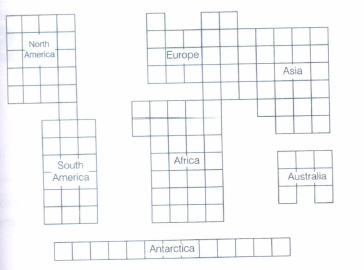
(i) Name the largest continent.
(ii) Which is larger- Europe or Australia?
8.
Write a short note on atmosphere?
9.
Write short notes on the following domains of the earth.
(i) Lithosphere
(ii) Hydrosphere
(iii) Biosphere
10.
Give the details of following main continents:
(i) Asia (ii) Africa
(iii) North America (iv) South America
11.
Write short notes on the following:
(i) Indian ocean (ii) Pacific ocean
(iii) Arctic ocean (iv) Antarctic ocean
12.
On the outline map of the world, mark the following?
Europe, Asia, Antarctica, South America, Australia, Indian Ocean, Pacific ocean, Atlantic ocean and Ural mountains.
1.
(i) All living organisms including humans are linked to each other and to the biosphere for survival.
(ii) The organisms in biosphere may be broadly divided into the plant kingdom and animal kingdom.
(iii) The three domains of the Earth interact with each other and affect each other in some way or the other.
For example, cutting of forests for fulfilling our needs of wood or clearing land for agriculture may lead to fast removal of soil from slopes. Similarly, the earth's surface may be changed due to natural calamities like earthquakes.
2.
Atlantic Ocean:
(i) The Atlantic Ocean is the second largest Ocean in the world.
(ii) It is 'S' shaped. It is flanked by North and South America on the western side, and Europe and Africa on the eastern side.
(iii) The coastline of the Atlantic Ocean is highly indented, which provides an ideal location for natural harbours and ports.
(iv) From the point of view of commerce, it is the busiest ocean.
Arctic Ocean
(i) The Arctic Ocean is located within the Arctic Circle and surrounds the North Pole.
(ii) It is connected with the Pacific Ocean by a narrow stretch of shallow water known as Bering Strait.
(iii) It is bound by northern coasts of North America and Eurasia.
3.
(i) Antarctica, completely in the Southern Hemisphere, is a huge continent, It is larger than the combined area of Europe and Australia.
(ii) The South Pole lies. almost at the centre of this continent.
(iii) It is permanently covered with thick ice sheets.
(iv) There are no permanent human settlements.
(v) Many countries have research stations in Antarctica. India also has research stations there. These are named as Maitri and Dakshin Gangotri.
4.
North America:
(i) North America is the third largest continent of the world.
(ii) It is linked to South America by a very narrow strip of land called the Isthmus of Panama.
(iii) The continent lies completely in the Northern and Western Hemisphere.
(iv) Three oceans which surround this continent are the Pacific Ocean, Atlantic Ocean and Arctic Ocean.
South America:
(i) South America lies mostly in the Southern Hemisphere.
(ii) The Andes, world's longest mountain range runs through its length from North to South.
(iii) South America has the world's largest river, the Amazon River.
5.
(i) Africa is second largest continent after Asia.
(ii) The Equator or 0° Latitude runs almost through the middle of the continent.
(iii) A large part of Africa lies in the Northern Hemisphere.
(iv) It is the only continent through which the Tropic of Cancer, Equator and Tropic of Capricorn pass.
(v) The Sahara Desert, the world's largest hot desert, is located in Africa.
(vi) The continent is bound on all sides by oceans and seas. The world's longest river, the Nile flows through Africa.
6.
(i) Asia is the largest continent. It covers about one third of the total land area of the Earth.
(ii) The continent lies in the Eastern Hemisphere.
(iii) The Tropic of Cancer passes through this continent.
(iv) Asia is separated from Europe by the Ural Mountains on the West.
(v) The combined landmass of Europe and Asia is called the Eurasia (Europe + Asia).
7.
(i) Asia with 44 squares is the largest continent.
(ii) Europe (10 squares) is larger than Australia (8 squares).
8.
The earth is surrounded by a layer of gas called the atmosphere. This thin blanket of air is an integral and important aspect of the planet. It provides us with the air we breathe and protects us from the harmful effects of sun's rays. The atmosphere extends upto a height of about 1600 km. The atmosphere is divided into five layers based on composition, temperature and other properties. These layers starting from earth's surface are called the troposphere, the stratosphere, the mesosphere, the thermosphere and the exosphere.
9.
(i) Lithosphere It is made-up of solid rock surface of the earth's crust and the thin layers of soil, which contain nutrient elements essential for life. There are two main divisions of the earth's surface. The large landmasses are known as the continents and massive water bodies are called ocean basins.
(ii) Hydrosphere The earth is called the blue planet. More than 71 per cent of the earth is covered with water and 29 per cent is with land. Hydrosphere consists of water in all its forms. As running water in oceans and rivers and in lakes, ice in glaciers, underground water and the water vapour in atmosphere, all comprise the hydrosphere.
(iii) Biosphere It is the zone with existing life. There are several organisms found here from microbes to large animals. All the organisms are linked with each other and biosphere as well. The living organisms in biosphere can be broadly divided into plant kingdom and animal kingdom.
10.
(i) Asia It is the largest continent. It covers about one- third of the total land area of the earth. The tropic of cancer passes through this continent. Asia is separated from Europe by the Ural mountains on the West.
(ii) Africa It is the second largest continent after Asia. The Equator runs almost through the middle of the continent. A large part of Africa lies in the Northern hemisphere. The tropic of cancer and tropic of Capricorn pass through it. The continent is bound on all sides by oceans and seas.
(iii) North America North America is the third largest continent of the world. It is linked to South America by a very narrow strip of land called the Isthmus of Panama. The continent lies completely in the Northern and Western hemisphere.
(iv) South America South America lies mostly in the Southern hemisphere. The Andes runs through its length from North to South. South America has the world's largest river, the Amazon.
11.
(i) Indian ocean The Indian ocean is the only ocean named after a country, India. The shape of this ocean is almost triangular. It is bound by Asia in the North, in the West by Africa and in the East by Australia. (ii) Pacific ocean The Pacific ocean is the largest ocean. It is spread over one-third of the earth. The Pacific ocean is almost circular in shape. Asia, Australia, North America and South America surround it.
(iii) Arctic ocean It is connected with the Pacific ocean by a narrow stretch of shallow water called Berring strait.
The Arctic ocean is located within the Arctic Circle and surrounds the North Pole. It is bound by Northern coasts of North America and Eurasia.
(iv) Antarctic ocean The Southern ocean encircles the continent of Antarctica and extends northward to 60 degrees South latitude. Most of the time, it is covered with thick ice.
12.
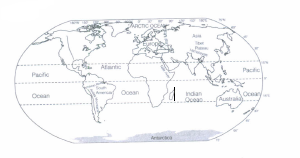
(A) Europe
(B) Asia
(C) Antarctica
(D) Sourh America
(E) Australia
(F) Indian ocean
(G) Pacific ocean
(H) Atlantic ocean
(I) Ural mountains

6th Standard CBSE Syllabus & Materials
6th Standard CBSE
CBSE 6th Social Science Locating Places on the Earth - New Sample Question Papers Study Material - QB365 Set A
NEW6th Standard CBSE
CBSE 6th Science A Journey Through States of Water - New Sample Question Papers Study Material - QB365 Set A
NEW6th Standard CBSE
CBSE 6th Science Temperature and its Measurement - New Sample Question Papers Study Material - QB365 Set A
NEW6th Standard CBSE
CBSE 6th Science Materials Around Us - New Sample Question Papers Study Material - QB365 Set A



CBSE 6th Standard CBSE Subjects
CBSE Standards




