
 100% FREE ACCESS
6th Standard CBSE Syllabus & Materials
6th Standard CBSE
CBSE 6th Social Science The Value of Work - New Sample Question Papers Study Material - QB365 Set A
NEW6th Standard CBSE
CBSE 6th Social Science Family and Community - New Sample Question Papers Study Material - QB365 Set A
NEW6th Standard CBSE
CBSE 6th Social Science India's Cultural Roots - New Sample Question Papers Study Material - QB365 Set A
NEW6th Standard CBSE
CBSE 6th Social Science India,That is Bharat - New Sample Question Papers Study Material - QB365 Set A
NEW6th Standard CBSE
CBSE 6th Social Science Timeline and sources of history - New Sample Question Papers Study Material - QB365 Set A
NEW6th Standard CBSE
CBSE 6th Social Science Oceans and Continents - New Sample Question Papers Study Material - QB365 Set A

Published on: 19/01/2019
Motions of the Earth Full Material
Download CBSE Class 6th Standard CBSE Social Science question papers, sample papers, important questions, and previous year solved papers in PDF format. Get free study materials, NCERT solutions, and exam preparation resources for Class 6th Standard CBSE Social Science
Questions + Answers key
Take MCQ Social Science Test
1.
Why does the Southern Hemisphere celebrate Christmas in summers?
2.
What do you understand by the term 'Autumn Equinox'?
3.
Why do our shadows seem to be long in the morning and evening but shorter in the noon?
4.
Why is it hotter when the sunrays fall vertically at a place?
5.
What will happen if the Earth does not rotate?
6.
What is the relative importance of the Revolution of the Earth?
7.
Why is Norway known as the 'Land of Midnight Sun'.
8.
What causes change in seasons?
9.
Why does the circle of illumination not coincide with the axis of the Earth?
10.
When does the Northern hemisphere have summer and why?
11.
Explain the importance of leap year.
12.
Why do the poles experience about six months day and six months night?
13.
What is an equinox?
14.
Differentiate between the summer and winter solstice.
15.
Define rotation and revolution.
16.
To revolve around the sun, the Earth takes:
3651/4 days
366 days
3661/4 days
364 days
17.
On 23rd September, the Southern Hemisphere experiences
Autumn
Summer
Spring
Winter
18.
On 21st June, the Northern Hemisphere is tilted towards the:
Earth
Sun
Moon
Sky
19.
A leap year occurs after every
two years
three years
six years
four years
20.
The axis of the Earth makes an angle of 661/2° with its :
rotation
revolution
orbitalplane
illumination
21.
The axis of the Earth is alan
straight line
curved line
real line
imaginary line
22.
The circle that divides the globe into day and night is called
circle of day
circle of night
circle of illumination
circle of darkness
23.
When do the equinox occur on the Earth?
23rd September
21st March
Both 'a' and 'b'
None of the above
24.
Motion of the Earth on its axis is called
rotation
revolution
circle
None of these
25.
On 23rd September, what season will be in Northern and Southern hemisphere respectively?
Spring and winter
Winter and summer
Autumn and summer
Autumn and spring
26.
We consider a year as consisting of how many days?
366 days
365 days
365 days and 6 hours
364 days
27.
Cycle of the seasons is caused due to
rotation
revolution
gravitation
28.
Christmas is celebrated in summer in
Japan
India
Australia
29.
Direct rays of the sun fall on the equator on
21st March
21st June
22nd December
30.
The movement of the Earth around the sun is known as
Rotation
Revolution
inclination
31.
Differentiate between Solstice and Equinox.
32.
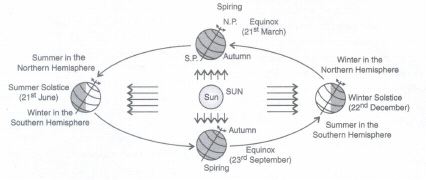
Diagrammatically show Equinox, Summer and Winter Solstices.
33.
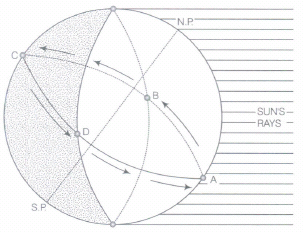
Make a drawing to show the inclination of the earth.
34.
How are seasons changed on the Earth?
35.
Differentiate between the summer solstice and the winter solstice and the winter solstice.
36.
What are the two factors responsible for the change of seasons?
37.
When do the sunrays fall directly on the Equator?
38.
When do sunrays fall directly on the Tropic of Cancer?
39.
Does the Earth follow exactly the same orbit every year?
40.
How much time does the Earth take to complete one Rotation? What is it known as?
41.
What is an Orbital Plane?
42.
How are day and night caused?
43.
What is Rotation?
44.
Name the four major seasons.
45.
When do we observe a leap year?
46.
Only half of the Earth gets light from the Sun at a time due to its____________ shape
47.
Days and nights occur due to____________ of the Earth.
48.
On _____________it is autumn season in the Northern Hemisphere and spring in the Southern Hemisphere
49.
The period of rotation is known as the________________.
50.
The sun rays fall vertically at the Tropic of____________ on 22nd December.
51.
The axis of the Earth marks an angle of 23Y2 with its orbital plane.
52.
Every five years February is of 29 days instead of 28 days.
53.
Life is not possible in extreme conditions.
54.
Season changes due to the change in the position of the Earth around the Sun.
55.
When there is summer in the Northern Hemisphere, it is spring in the Southern Hemisphere.
1.
On 22nd December, the Tropic of Capricorn receives direct sunrays due to the tilt of South Pole towards it. As the sunrays are vertical on it, hence it has summers. Therefore, Christmas which falls on 25th December is celebrated in summers in the Southern hemisphere.
2.
On September 22nd or 23rd in the Northern Hemisphere, night and day are nearly of the same length as the Sun crosses the Equator, moving southwards. And in the Southern Hemisphere on 20th or 21st March, the Sun crosses the Equator, moving northwards it is known as Autumn Equinox.
3.
The shadows are long in the morning and evening and shorter at noon. It is the effect of the slanting and direct rays of the Sun. When the rays of the Sun are overhead in afternoon, shadows are the shortest. The rays of the Sun are slanting during evening and morning hence, the shadows are longer.
4.
The sunrays at noon are the hottest in comparison to the sunrays of the morning and evening. This is because the rays of the Sun are almost vertical at noon. They fall over a small area and hence, give a greater amount of heat that means the heat received at per unit area increase. The rays of the Sun are slanting in the morning and in the evening. They spread over a wider area and hence, they cover larger area but give less amount of heat. That is why, it is hotter when the sunrays are vertical at a place.
5.
The portion of the Earth facing the Sun would always experience day, thus bringing continuous warmth to the region. The other half would remain in darkness and would be freezing cold all the time. Life would not have been possible in such extreme conditions.
6.
The change of seasons is caused due to the revolution of the Earth around the Sun.
7.
Norway is known as the Land of Midnight Sun because:
(i) The Sun does not go below the horizon or come above it on 21st June.
(ii) The Sun moves at a long elevation from horizon to horizon. Although the attitude is very low, it continues shining longer for all the 24 hours.
8.
The change in seasons is caused due to :
(i) The rotation of the Earth,
(ii) Inclination of the Earth's axis,
(iii) The revolution of the Earth, and
(iv) The parallelism of the Earth's axis
9.
The circle of illumination does not coincide with the axis of the Earth because of the inclination of the axis by 23 1/2°. The circle of illumination divides day from night and the Earth takes 24 hours to complete one rotation around its axis.
10.
On 21st June, the Northern hemisphere is tilted towards the sun. These areas receive more heat because sun rays fall directly on the tropic of Cancer. As the larger portion of Northern hemisphere gets light from the sun, it is summer in the Northern part of equator.
11.
The movement of the Earth on its axis around the sun takes 365 days (one year) and 6 hours to revolve once around the sun. We ignore six hours for the sake of convenience and consider a year consisting of 365 days. Saved six hours are added to make one day (24 hours) over span of four years.
This surplus day is added to the month of February and in every fourth year, February is of 29 days in spite of 28 days.
12.
The North Pole remains inclined towards the sun for six months due to which places beyond the Arctic circle experience continuous daylight for about six months while South Pole remains away from the sun for six months and experiences night for same period. The same condition reverses for the next six months when South Pole inclines towards the sun and experiences day while North Pole experiences night
13.
On 21st March and 23rd September, the whole Earth experiences equal days and equal nights because neither of the poles is tilted towards the sun and the equator receives direct sun rays, this is called an equinox.
14.
Summer Solstice The days are longer with shorter nights in Northern hemisphere in summer while the conditions are reversed in the Southern hemisphere. This position of the Earth is called the summer solstice.
Winter Solstice The Southern hemisphere experiences summer and it is winter in Northern hemisphere. The days are longer with shorter night in Southern Hemisphere. This position of the Earth is called the winter solstice.
15.
Rotation is the movement of the Earth on its axis, while the movement of the Earth around the sun in an orbit (fixed path) is called revolution (second type of motion of the Earth). It takes 365 days (one year) and 6 hours to revolve once around the sun.
16.
(a)
3651/4 days
17.
(c)
Spring
18.
(b)
Sun
19.
(d)
four years
20.
(c)
orbitalplane
21.
(d)
imaginary line
22.
(c)
circle of illumination
23.
(c)
Both 'a' and 'b'
24.
(a)
rotation
25.
(d)
Autumn and spring
26.
(b)
365 days
27.
(b)
revolution
28.
(c)
Australia
29.
(a)
21st March
30.
(b)
Revolution
31.
The difference between Solstice and Equinox are given below:
| S.No | Solstice | Equinox |
| (i) (ii) (iii) |
It is dependent on the sunrays falling on the tropics. When the rays fall vertically on the tropics, days and nights are either longer or shorter. There is summer solstice or winter. |
It is dependent on the falling on the equator. Nights and days are always equal along the equator. There is Autumn Equinox Spring. |
32.
33.
34.
The seasons are changed on the Earth because of the inclination of the Earth's axis in a fixed direction and due to the change in the position of the Earth around the sun.
On 21st June, the Northern hemisphere is tilted towards the sun. These areas receive more heat because the sun rays fall directly on the tropic of Cancer.
The tropic of Capricorn receives direct sun rays due to tilting of South Pole towards the sun on 22nd December.
The Northern hemisphere experiences autumn season while Southern hemisphere spring season on 23rd September. On 21st March, itIS spring in Northern hemisphere and autumn in Southern hemisphere.
35.
The difference between the summer solstice and the winter solstice is as follows:
Summer Solstice In the Northern hemisphere the longest day and the shortest night occur on 21st June. The Sunrays fall directly on the tropic of Cancer. All these conditions are opposite in Southern hemisphere and it is winter there. The nights are longer than the days in Southern hemisphere. This position of the Earth is called the summer solstice.
Winter Solstice The tropic of Capricorn receives direct rays due to tilting of South Pole towards the sun on 22nd December. The vertically falling sun rays at the tropic of Capricorn 23 1/2° provide heat to a larger portion of it. Therefore, it is summer in Southern hemisphere. This position of the Earth is called the winter solstice.
36.
()
The combined effect of the Earth's orbital motion and the tilt of its rotation axis results in the seasonal changes.
37.
()
Sunrays fall directly on the Equator on 21st March
38.
()
The sunrays are directly on the Tropic of Cancer on 21st June.
39.
()
No, the Earth doesn't follow exactly the same orbit every year due to changing positions of the planets.
40.
()
The Earth takes about 24 hours to complete one rotation on its axis. The period of rotation is known as the Earthday
41.
()
The plane formed by an orbit is known as Orbital Plane.
42.
()
Day and night are caused due to the rotation of the Earth on its own axis.
43.
()
Rotation is the movement of the Earth on its axis.
44.
()
The four major seasons are:
(i) Summer
(ii) Winter,
(iii) Autumn
(iv) Spring.
45.
()
We observe a leap year after every four years.
46.
()
spherical
47.
()
rotation
48.
()
23rd September
49.
()
Earthday
50.
()
Capricorn
51.
(b)
52.
(b)
53.
(a)
54.
(a)
55.
(b)

6th Standard CBSE Syllabus & Materials
6th Standard CBSE
CBSE 6th Social Science Locating Places on the Earth - New Sample Question Papers Study Material - QB365 Set A
NEW6th Standard CBSE
CBSE 6th Science A Journey Through States of Water - New Sample Question Papers Study Material - QB365 Set A
NEW6th Standard CBSE
CBSE 6th Science Temperature and its Measurement - New Sample Question Papers Study Material - QB365 Set A
NEW6th Standard CBSE
CBSE 6th Science Materials Around Us - New Sample Question Papers Study Material - QB365 Set A



CBSE 6th Standard CBSE Subjects
CBSE Standards




