
 100% FREE ACCESS
6th Standard CBSE Syllabus & Materials
6th Standard CBSE
CBSE 6th Social Science The Value of Work - New Sample Question Papers Study Material - QB365 Set A
NEW6th Standard CBSE
CBSE 6th Social Science Family and Community - New Sample Question Papers Study Material - QB365 Set A
NEW6th Standard CBSE
CBSE 6th Social Science India's Cultural Roots - New Sample Question Papers Study Material - QB365 Set A
NEW6th Standard CBSE
CBSE 6th Social Science India,That is Bharat - New Sample Question Papers Study Material - QB365 Set A
NEW6th Standard CBSE
CBSE 6th Social Science Timeline and sources of history - New Sample Question Papers Study Material - QB365 Set A
NEW6th Standard CBSE
CBSE 6th Social Science Oceans and Continents - New Sample Question Papers Study Material - QB365 Set A

Published on: 16/08/2019
New Empires and Kingdoms
Download CBSE Class 6th Standard CBSE Social Science question papers, sample papers, important questions, and previous year solved papers in PDF format. Get free study materials, NCERT solutions, and exam preparation resources for Class 6th Standard CBSE Social Science
Questions + Answers key
Take MCQ Social Science Test
1.
Do you think ordinary people would have read and understood the Prashastis? Give reasons for your answer.
2.
Discuss the role of Arvind in the play.
3.
What changes do you find in the army at this time?
4.
Name a famous man who taught in Prakrit and a king who issued inscriptions in Prakrit.
5.
What does the description about Samudragupta tell you? And also about how kings fought wars?
6.
The technique of making paper was first introduced in which of the following countries?
Korea
Japan
India
China
7.
What is the height of the iron pillar located in Delhi?
8.2 m
9.2 m
7.2 m
12 m
8.
Who were not paid regular salaries by the kings?
Brahmins
Samantas
Nagaram
Zamindars
9.
Who led the army against the ruler of Bengal?
Harshavardhana
Pulakeshm II
Chandragupta II
Samudragupta
10.
Who was the founder of Gupta dynasty?
Chandragupta
Samudragupta
Shrigupta
Skandagupta
11.
What was Sabha?
12.
How many rulers were there in Dakshinapatha?
13.
Where was the capital of Chalukyas?
14.
Who led an expedition to West India?
15.
What is the meaning of the word prashasti?
16.
.................... who ruled nearly 1400 years ago, was one such ruler.
17.
The best-known Chalukya ruler was .........
18.
.................. is known for hie plays depicting life in the king's court.
19.
The Prathama-kulika stands for the ______________
20.
The _____________and Chalukyas were the most important ruling dynasties in South India.
21.
Local assemblies functioned for several centuries in South India
22.
There were twelve rulers in Dakshinapatha
23.
Military leaders were paid huge salaries.
24.
Prashasti is word from hindi language.
25.
Sandhi-vigrahika means a minister of war and peace.
26.
Military leaders
27.
Kalidasa
28.
Kumara Devi
29.
Aryavarta
30.
Assembly
31.
Mark the following important cities and kingdoms on the outline map of India:
(i) Thanesar (ii) Ujjain (iii) Pataliputra
32.
Explain the administrative system adopted by the kings of the earlier times.
33.
Describe the life history of the dominant kings Harshavardhana.
1.
(i) The Prashasti was composed in very long sentences.
(ii) The Prashasti in praise of Samundragupta was written in Sanskrit language, the language of the learned people.
2.
Arvind played a role of a king. He had expected to march solemnly in splendid robes, to twirl his moustaches and wield the silver-paper wrapped sword with gusto. He also had to play a veena, and recite poetry.
3.
The changes made in the army at this time are:
Kings of this time had a large and well maintained army. Except this regular army, there were some military leaders who provided kings with troops whenever they required. These military leaders were not paid salaries. They collected revenue from the land granted by the king and used collected revenue for maintaining good army. Thus, during wars, the military leaders who provided army to kings were known as samantas. This system became an important part of the army at that period.
4.
Lord Buddha taught in Prakrit language and King Ashoka issued his inscriptions in Prakrit language.
5.
The description about Samudragupta tells us that Samudragupta was a brave warrior, who had fought successful wars. His body was covered with hundreds wound marks.
The kings in those days fought with arrows, spikes, spears, battle axes, swords, iron clubs, barbed arrows, javelins, long arrows and many other weapons.
6.
(d)
China
7.
(c)
7.2 m
8.
(b)
Samantas
9.
(a)
Harshavardhana
10.
(c)
Shrigupta
11.
()
Sabha was an assembly of Brahim land owners. This assembly functioned through sub-committees, which looked after irrigation, agricultural operations, making roads, local temples, etc.
12.
()
There were twelve rulers in Dakshinapatha.
13.
()
Aihole was the capital of Chalukyas.
14.
()
Chandragupta-II led an expedition to Western India.
15.
()
Prashasti is a Sanskrit word meaning 'in praise of'.
16.
()
Harshavardhana
17.
()
Pulakeshin II
18.
()
Kalidas
19.
()
Chief craftsman
20.
()
Pallavas
21.
(a)
22.
(a)
23.
(b)
24.
(b)
25.
(a)
26.
()
Samanta
27.
()
A renowned poet
28.
()
Lichchavi clan
29.
()
The ruler of Northern part of the sub-continent
30.
()
A group of persons gathered together
31.
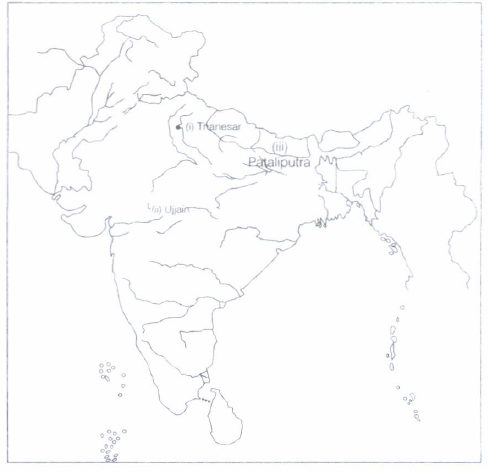
32.
(i) Kings adopted a number of steps to win the support of men who were powerful either economically or socially or because of their political and military strength.
(ii) Some important administrative posts were now hereditary.
(iii) Sometimes, one person held many offices. For instance, besides being a Maha-Danda-Nayaka, Harisena was a Kumar-Amartya, Meaning an important minister.
(iv)Besides, some important men had a say in local administration. These included chief bankers or merchants of the city, the leaders of the merchant caravans, the chief craftsmen, and the head of the tribes.
33.
(i) Establishment of Harsha-vardhan Empire: The breakup of the Gupta empire was followed by a period of disorder. Small kingdoms fought against one another. Finally, Harshavardhana conquered these kingdoms and established a powerful empire.
(ii) Military Campaigns: The capital of Harsha's empire was Kannauj. He conquered Punjab, Eastern Rajasthan and the whole of the Ganga valley up to Assam. He attacked the Chalukyan King but was defeated. Harsha did not annex all the territories that he conquered. He allowed some kings whom he defeated, to continue ruling. They accepted Harsha as their overlord and paid him an annual tribute.
(iii) Sources of Information: Banabhatta, a learned man who wrote a biography of Harsha called Harshacharita gives us information about this period.
Another source of information is Hieun Tsang, a Chinese Buddhist scholar who came from China via Central Asia to India. He stayed in India for 15 years. He gave an account of life in Harsha's period in a book called Si-Yu-Ki or records of the Western World.
(iv) Religion: Before embracing Buddhism, Harsha worshipped Shiva and Surya. Later on, he became a Buddhist like Ashoka, Manender and Kanishka. Like them, he was tolerant towards other religions. The Indian government practises this attitude of tolerance towards all religious even today.
(iv) Administration: Just like the Mauryas and Guptas, the king was assisted by a council of ministers. Unlike the Mauryas but similar to the Guptas, power was not centralised. Harsha's empire was also divided into provinces. These were headed by Governors.

6th Standard CBSE Syllabus & Materials
6th Standard CBSE
CBSE 6th Social Science Locating Places on the Earth - New Sample Question Papers Study Material - QB365 Set A
NEW6th Standard CBSE
CBSE 6th Science A Journey Through States of Water - New Sample Question Papers Study Material - QB365 Set A
NEW6th Standard CBSE
CBSE 6th Science Temperature and its Measurement - New Sample Question Papers Study Material - QB365 Set A
NEW6th Standard CBSE
CBSE 6th Science Materials Around Us - New Sample Question Papers Study Material - QB365 Set A



CBSE 6th Standard CBSE Subjects
CBSE Standards




