
 100% FREE ACCESS
6th Standard CBSE Syllabus & Materials
6th Standard CBSE
CBSE 6th Social Science The Value of Work - New Sample Question Papers Study Material - QB365 Set A
NEW6th Standard CBSE
CBSE 6th Social Science Family and Community - New Sample Question Papers Study Material - QB365 Set A
NEW6th Standard CBSE
CBSE 6th Social Science India's Cultural Roots - New Sample Question Papers Study Material - QB365 Set A
NEW6th Standard CBSE
CBSE 6th Social Science India,That is Bharat - New Sample Question Papers Study Material - QB365 Set A
NEW6th Standard CBSE
CBSE 6th Social Science Timeline and sources of history - New Sample Question Papers Study Material - QB365 Set A
NEW6th Standard CBSE
CBSE 6th Social Science Oceans and Continents - New Sample Question Papers Study Material - QB365 Set A

Published on: 19/01/2019
New Empires and Kingdoms Study Material
Download CBSE Class 6th Standard CBSE Social Science question papers, sample papers, important questions, and previous year solved papers in PDF format. Get free study materials, NCERT solutions, and exam preparation resources for Class 6th Standard CBSE Social Science
Questions + Answers key
Take MCQ Social Science Test
1.
Who was Harshavardhana?
2.
What do you know about Prashasti?
3.
Harshavardhan's army will visit your village next week. Your parents are preparing for the visit. Describe what they say and do.
4.
How were these kingdoms administered?
5.
What does Samudragupta's prashasti tell?
6.
How do you think wars affect the lives of ordinary people today?
7.
What changes do you find in the army at this time?
8.
Name a famous man who taught in Prakrit and a king who issued inscriptions in Prakrit.
9.
Arrange these titles in order of importance: raja, maharaj-adhiraja, maha-raja.
10.
What does the description about Samudragupta tell you? And also about how kings fought wars?
11.
Capital of the Pallavas was
Mysore
Thiruvanathapuram
Kanchipuram
Raichur Doab
12.
What is the literally meaning of Purana?
Text books
Poems
Old
Testimony
13.
Which was the capital of Kosala?
Ayodhya
Kashi
Hastinapur
Magadha
14.
Who was Aryabhata?
A politician
An astronomer
A teacher
A writer
15.
The Tamil epic, the Manimekalai was composed by
Surdasa
Kalidasa
Madhavi
Sattanar
16.
Where was the image of the chief deity placed?
Bhitargaon
Garbhagriha
Shikhara
None of these
17.
Iron pillar is located in which of the following cities?
New Delhi
Sarnath
Ajmer
Bulandshahar
18.
The ruler of Northern India were from
Dakshinanatha
Chalukya
Pallavas
Aryavarta
19.
Abhijnana Shakuntalam was written by whom?
Dushyanta
Ravikirti
Kalidasa
Harishena
20.
Who was the chief judicial officer in the reign of Samudragupta?
Harishena
Ravikirti
FaXian himself
Samudragupta
21.
Who led the army against the ruler of Bengal?
Harshavardhana
Pulakeshm II
Chandragupta II
Samudragupta
22.
Ravikirti was the court poet of which of the following kings?
Pulakeshin
Pulakeshin II
Chandragupta II
Samudragupta
23.
The capital of Pallavas was
Raichur
Kanchipuram
Tungabhadra
Ujjain
24.
Harishena was the court poet of
Harsha
Samudragupta
Chandragupta
Banabhatta
25.
Who was the founder of Gupta dynasty?
Chandragupta
Samudragupta
Shrigupta
Skandagupta
26.
Explain the policies adopted by Samudragupta regarding different rulers.
27.
Explain the administrative system adopted by the kings of the earlier times.
28.
Explain the features of the Prashastis written about Samudragupta.
29.
Who was Pulakeshin II? Mention his main achievements, as describes his prashasti?
30.
Describe some of the main achievements of the Pallavas and the Chalukyas.
31.
The Prathama-kulika stands for the ______________
32.
Harshacharita is the biography of______________
33.
The court poet of Pulakeshin II was ____________
34.
The kingdom of the Pallavas spread from the region around their capital, _____________to the Kaveri delta.
35.
The _____________and Chalukyas were the most important ruling dynasties in South India.
36.
Mark the following important cities and kingdoms on the outline map of India:
(i) Thanesar (ii) Ujjain (iii) Pataliputra
37.
Military leaders were paid huge salaries.
38.
Sabha was an assembly of Kshatriyas.
39.
Pulakshein II was a pallava ruler
40.
Chaulkya kingdom centered around Raichur Doab
41.
Prashasti is word from hindi language.
42.
How is Ur different from Nagaram?
43.
Name the two important dynasties that ruled Southern India.
44.
What do you mean by Ayurveda?
45.
Who were Samantas?
46.
Name the capital of the Chaulkyas.
1.
Harshavardhana was the king of Thanesar who ruled nearly 1400 years ago. We came to know about him through his court poet, Banabhattaa who wrote his biography, the Harshacharita in Sanskrit.
2.
The 'Prashasti' word comes from Sanskrit and it means 'in praise of'. Court poets often wrote accounts in which they listed the achievements of the king and praised him. they engraved such accounts on pillars so that the people could read them.
3.
As Harshavardhan's army will enter our village, they will be accompanied by musicians beating drums and other playing horns and trumpets. Our parents give them gifts, gur and flower and fodder for their animals. Later on they will meet the king and place their complaints and petitions before him. These complaints, are on the behalf of villagers.
4.
At that time, village remained basic unit of administration and land revenue remained important for these rulers. Some important administrative posts were hereditary and important men had their influence in local administration.
5.
In Samudragupta's prashasti, the poet praised the king in glowing terms-as a warrior, as a king who won victories in battle, who was learned and the best of poets. He is also described as equal to the Gods.
6.
wars affect the lives o/the ordinary people today in the following ways:
(i) It disturbs the economic position of the country.
(ii) It increases the rate of poverty.
(iii) It causes tremendous loss of life and property.
(iv) It hampers the developmental work of the country.
(v) It gives birth to number of new diseases due to use of chemical weapons.
7.
The changes made in the army at this time are:
Kings of this time had a large and well maintained army. Except this regular army, there were some military leaders who provided kings with troops whenever they required. These military leaders were not paid salaries. They collected revenue from the land granted by the king and used collected revenue for maintaining good army. Thus, during wars, the military leaders who provided army to kings were known as samantas. This system became an important part of the army at that period.
8.
Lord Buddha taught in Prakrit language and King Ashoka issued his inscriptions in Prakrit language.
9.
The titles in order of their importance are:
Raja, maha-raja, maharaj-adhiraja.
10.
The description about Samudragupta tells us that Samudragupta was a brave warrior, who had fought successful wars. His body was covered with hundreds wound marks.
The kings in those days fought with arrows, spikes, spears, battle axes, swords, iron clubs, barbed arrows, javelins, long arrows and many other weapons.
11.
(c)
Kanchipuram
12.
(c)
Old
13.
(a)
Ayodhya
14.
(b)
An astronomer
15.
(d)
Sattanar
16.
(b)
Garbhagriha
17.
(a)
New Delhi
18.
(d)
Aryavarta
19.
(c)
Kalidasa
20.
(a)
Harishena
21.
(a)
Harshavardhana
22.
(b)
Pulakeshin II
23.
(b)
Kanchipuram
24.
(b)
Samudragupta
25.
(c)
Shrigupta
26.
Harishena, Samudragupta's court poet described four different kinds of rulers, and the policies followed by him towards them.
(i) The rulers of Aryavarta: Here there were nine rulers who were uprooted and their kingdoms were made a part of Samudragupta's empire.
(ii) The rulers of Dakshinapatha: There were twelve rulers and they surrendered to Samudragupta after being defeated and he then allowed them to rule again.
(iii) The inner circle of the neighbouring states, including Assam, coastal Bengal, Nepal, and a number of gana sanghas in the North-West, brought tribute, followed his orders, and attended his court.
(iv) The rulers of the outlying areas, the descendants of the Kushanas and Shakas, and the ruler of Sri Lanka, who submitted to him and offered daughters in marriage.
27.
(i) Kings adopted a number of steps to win the support of men who were powerful either economically or socially or because of their political and military strength.
(ii) Some important administrative posts were now hereditary.
(iii) Sometimes, one person held many offices. For instance, besides being a Maha-Danda-Nayaka, Harisena was a Kumar-Amartya, Meaning an important minister.
(iv)Besides, some important men had a say in local administration. These included chief bankers or merchants of the city, the leaders of the merchant caravans, the chief craftsmen, and the head of the tribes.
28.
(i) The poet praised the king in Glowing terms-as a warrior and as a king who won victories in battle.
(ii) He is stated as a learned man and the best of poets.
(iii) He is also described as equal to God.
(iv) The Prashasti was composed in very long sentences.
29.
(i) The best known Chalukya ruler was Pulakeshin II. We known about him from a prashasti. This prashasti (inscription) was composed by Pulakeshin II's court poet Ravikirti. This tells us about his ancestors, who are traced back through four generations from father to son.
(ii) Pulakeshin II evidently got the Kingdom from his uncle. According to Ravikirti
(a) He led expeditions along both the West and the East coast.
(b) Pulakeshin II checked the advance of Harsha. Harsha means happiness.
(c) Pulakeshin II also attacked the Pallava king, who took shelter behind the walls of Kanchipuram. However the successors of Pulakeshin II were not very capable and therefore the Chalukyas victory was short-lived.
30.
The main achievements of the Pallavas and the Chalukyas were:
(i) The Pallavas and Chalukyas were that most important ruling dynasties in South India. The kingdom of the Pallavas spread from the region around their capital, Kanchipuram to the Kaveri delta, while that of the Chalukyas was centred around the Raichur Doab, between the rivers Krishna and Tungabhadra.
(ii) The Pallavas and Chalukyas frequently attacked one another's areas, particularly they attacked the capital cities, which were prosperous towns.
(iii) Aihole, the capital of the Chalukyas, was an important trading and commercial centre. Initially this town developed as a religious centre, with a number of temple.
(iv) During the days of Pulakeshin II, the Chalukyas defeated Harshavardhana. But this victory was short-lived.
(v)Ultimately, both the Pallavas and the Chalukyas gave way to new rulers belonging to Rashtrakuta and Chola dynasties.
31.
()
Chief craftsman
32.
()
Harshavardhana
33.
()
Ravikirti
34.
()
Kanchipuram
35.
()
Pallavas
36.
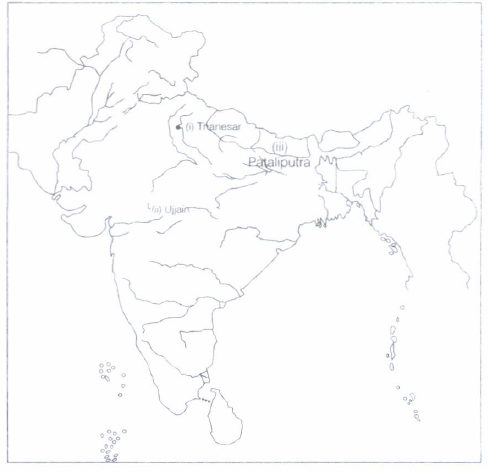
37.
(b)
38.
(b)
39.
(b)
40.
(a)
41.
(b)
42.
()
Ur was a village assembly found in areas where the landowners were not Brahmins, whereas Nagaram was an organisation of merchants.
43.
()
The Pallavas and Chalukyas were the most important ruling dynasties in South India
44.
()
Ayurveda is a system of medicine based on herbs and plants which cure many diseases. Ayurveda is a major system of medicine practised in India these days.
45.
()
Samantas were some military leaders who provided the king with troops whenever he needed them.
46.
()
Aihole was the capital of Chaulkyas.

6th Standard CBSE Syllabus & Materials
6th Standard CBSE
CBSE 6th Social Science Locating Places on the Earth - New Sample Question Papers Study Material - QB365 Set A
NEW6th Standard CBSE
CBSE 6th Science A Journey Through States of Water - New Sample Question Papers Study Material - QB365 Set A
NEW6th Standard CBSE
CBSE 6th Science Temperature and its Measurement - New Sample Question Papers Study Material - QB365 Set A
NEW6th Standard CBSE
CBSE 6th Science Materials Around Us - New Sample Question Papers Study Material - QB365 Set A



CBSE 6th Standard CBSE Subjects
CBSE Standards




