
 100% FREE ACCESS
6th Standard CBSE Syllabus & Materials
6th Standard CBSE
CBSE 6th Social Science The Value of Work - New Sample Question Papers Study Material - QB365 Set A
NEW6th Standard CBSE
CBSE 6th Social Science Family and Community - New Sample Question Papers Study Material - QB365 Set A
NEW6th Standard CBSE
CBSE 6th Social Science India's Cultural Roots - New Sample Question Papers Study Material - QB365 Set A
NEW6th Standard CBSE
CBSE 6th Social Science India,That is Bharat - New Sample Question Papers Study Material - QB365 Set A
NEW6th Standard CBSE
CBSE 6th Social Science Timeline and sources of history - New Sample Question Papers Study Material - QB365 Set A
NEW6th Standard CBSE
CBSE 6th Social Science Oceans and Continents - New Sample Question Papers Study Material - QB365 Set A

Published on: 06/03/2020
6th Standard CBSE Social Science Public Exam Sample Question 2020
Download CBSE Class 6th Standard CBSE Social Science question papers, sample papers, important questions, and previous year solved papers in PDF format. Get free study materials, NCERT solutions, and exam preparation resources for Class 6th Standard CBSE Social Science
Questions + Answers key
Take MCQ Social Science Test
1.
The Hindu Succession Amendment Act, 2005 rectify which types of inequalities ?
2.
What are the functions of Gram Sabha ?
3.
How many days did the Constituent Assemblies take to complete the Constitution? Name any four prominent members of the Constituent Assembly?
4.
Why is Mercury the hottest planet in the Solar System?
5.
Many girls are named after rivers e.g. Yamuna, Mandakini and Kaveri
(i) Do you know anyone in your locality who is named after a river? Ask your parents and others and make a list of such names,
(ii) Could you also find other names related to water e.g. Shabnam ?
6.
What are epics?
7.
State the features of Mahayana Buddhism.
8.
What impact did the war of Kalinga have on Ashoka?
9.
Who was Chandragupta?
10.
How do burials help in understanding social differences?
11.
Can you identify the skeletons of goats?
12.
What are other shops of the village Kalpattu?
13.
What did Gangabai say when the Commissioner said that there were not enough trucks in the city?
14.
"Saving for old age". Discuss.
15.
Why do less people live in mountain areas?
16.
The earth is called a blue planet due to large availability of water, but still we face shortage of water. Explain it.
17.
Discuss why you think Samir Do did not attend school? Do you think it would have been easy for him to attend school if he wanted to? In your opinion is it a fair situation that some children get to go to school and others don't?
18.
Do you think the police shooting of Hector could have been avoided? How?
19.
List two ways in which rajas of the mahajanapadas were different from those mentioned in the Rigveda.
20.
Discuss the difference between the democratic and monarchical form of government.
21.
Write a short note on mountain vegetation.
22.
How do symbols help in reading maps?
23.
What are important parallels of latitude.
24.
What is the angle of inclination of the Earth's axis with its orbital plane?
25.
Rome is one of the oldest cities in Europe, and developed around the same time as the cities in the Ganga valley. Rome was the capital of one of the largest empires, one that spread across Europe, North Africa and West Asia. Augustus, one of the most important emperors, who ruled about 2000 years ago, said that he found Rome a city of brick and made it into a city of marble. He and later rulers, built temples and palaces. They also built huge amphitheatres- open arenas surrounded by tiers of seats- where citizens could watch all kinds of shows and public baths (with separate timings for men and women), where people met and relaxed. Huge aqueducts- channels to supply water- were built to bring water to the city- for the baths, fountains and toilets.
Why do you think the amphitheatres and aqueducts have survived?
26.
Make a list of the people who lived in the city. Were any of these people listed as living in villages such as Mehrgarh?
27.
How did the archaeologists know about the factories?
28.
How did the beggar convince the sages to share their food with him?
29.
Why do people travel now-a-days?
30.
'Suffrage' refers to :
The right to eat
The right to live
The right to vote
The right to suffer
31.
The number of major religions in the world is :
Seven
Eight
Nine
Ten
32.
Which continent is also known as the 'white continent'?
South America
Australia
Asia
Antarctica
33.
Who takes decisions that affect the entire city?
A group of Councillors
A group of teachers
A group of doctors
None of these
34.
Who was given the credit of bringing Christianity to India?
St. Columbus
St. Thomas
Lord Macaulay
Lord Wellesley
35.
The highest court of appeal in India is the :
District Court
High Court
Session Court
Supreme Court
36.
Area which receives the maximum heat is called:
Frigid Zone
Temperate zone
Torrid zone
Heated zone
37.
The Great Bath has been found in :
Harappa
Mehrgarh
Mohanjodaro
Surat
38.
Jana refers to
Raja
Shudras
People
Army
39.
Early man became a herder of animals initially by :
counting them
protecting them
killing them
eating them
40.
Vishvamitra was
A Sage
A god
A king
A soldier
41.
Who was Aryabhata?
A politician
An astronomer
A teacher
A writer
42.
When did they go to the sea?
At 2 am
At noon
At 4 am
At evening
43.
What is Sudha's employment status?
She is self-employed
She works in a company
She is a labourer
She is a salesperson
44.
Who is the owner of Grassland?
Raghu
Mohan
Madhya Pradesh Government
Ratan Lal
45.
The habitation is easy in the area
Plains
Plateaus
Mountains
Valleys
46.
Who was Amirchand?
A Politician
A Zamindar
A simple villager
A Sarpanch
47.
Which one of the following is not an intermediate direction?
North-West
South-West
West
North- East
48.
Wild goats and snow leopards are found in
Himalayan region
Peninsular regionGir forests
Gir forests
49.
Who were not paid regular salaries by the kings?
Brahmins
Samantas
Nagaram
Zamindars
50.
Only one portion of the Earth gets sunlight at a time because of Earth's
spherical shape
round shape
wrinkled shape
circular shape
51.
The Palk Strait lies between the countries
Sri Lanka and Maldives
India and Sri Lanka
India and Maldives
52.
South India was famous for
gold
pepper
precious stones
All of these
53.
Which kinds of inscriptions have been found in Mathura?
Stone slabs and statues
Mud bricks
Palaces inscriptions
None of the above
54.
In ancient India, the Milky Way Galaxy was known as
Akash Ganga
Nakshatra Ganga
Antariksha
Vyom
55.
Who was the son of Chandragupta Maurya?
Bindusara
Ashoka
Bimbisara
Samudragupta
56.
After attaining enlightenment, where did Buddha go to teach for the first time?
Sarnath
Ayodhya
Sanchi
Nepal
57.
Traces of ash gave the indication of
use of metal
use of match box
use of kerosene
use of fire
58.
'About 4700 years ago'-also can be written as
4700 BC
2687 BC
2687 AD
4700 AD
59.
What are the main features of a democratic country?
60.
What is the "Minimum Needs Programmes" ?
61.
What are the steps taken by the government to protect wildlife?
62.
Write five rules that became effective from April 1993 regarding the Panchayati Raj system.
63.
Look again at the statements that you believed to be true about rural and urban life in India. Do you have a prejudice against rural or urban people ?
Find out if this is shared by others and discuss the reasons why people have these prejudices.
(i) More than 50%of all Indians live in villages.
(ii) Villagers do not care about their health. They are full of superstitions.
(iii) In peak harvesting and plantation seasons, families spend 12 to 14 hours in the fields.
(iv) Villagers are dirty and not hygienic.
64.
Distinguish between Andaman Islands and Lakshadweep Islands.
65.
List the functions of the Chief Executive Officer in a Municipal Corporation.
66.
Why do all planets have different time periods to complete a revolution?
67.
How does the climatic condition of the Ladakh region affect the cultivation of crops? Name the major crops grown in this region.
68.
Write a note on Lava Plateau
69.
In the given diagram mark the important parallels of Latitudes.
(i) Equator
(ii) Tropic of Cancer
(iii) Tropic of Capricorn
(iv) Arctic Circle
(v) Antarctic Circle
70.
What do the following colours represent on map?
71.
Explain the features of seals.
72.
Why did hunter-gatherers move from place to place? Give at least four reasons.
73.
Explain the features of the Prashastis written about Samudragupta.
74.
What is a burial? Describe the burials of the early man with examples.
75.
In the Rigveda people were described in terms of the work they did and the language they spoke.Fill the names of six people you know, three men and three women. For each of them, mention the work they do and the language they speak. Would you like to add anything else to the description.
76.
Give a brief account on rural livelihoods.
77.
Look at the pictures given below carefully and answer the following questions:
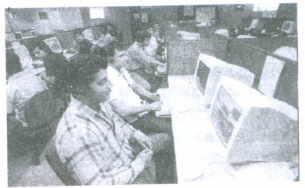
(i) Describe the work condition at all centres. Why are many call centres set up in India?
(ii) Where do we find a labour?
78.
"Besides voting there are other ways of participating in the process of government." Discuss how it gives us a sense of works of government.
79.
Count the squares given in the picture and answer the following:
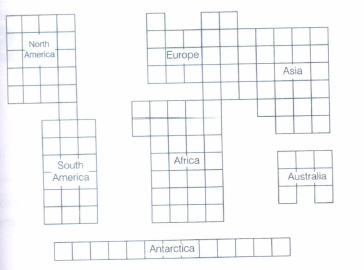
(i) Name the largest continent.
(ii) Which is larger- Europe or Australia?
80.
How were stupas and temples built?
81.
How are seasons changed on the Earth?
82.
Anwers the questions based on the given picture below.
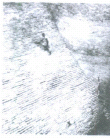
(i) Where is this fortification wall located?
(ii) How many years ago a part of this wall is built?
83.
'Dozens of caves were hollowed out of hills for monks to live in'. Discuss.
84.
How do we find out about early cities of the sub-continent?
85.
Answer the questions based on the picture given below:
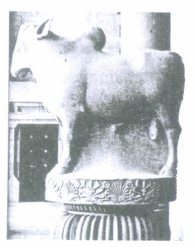
(i) Which type of bull is shown in the picture?
(ii) Above picture belongs to which dynasty?
(iii) Where it has been found?
86.
Answer the questions based on the picture given below:
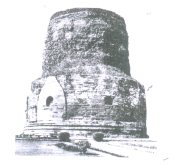
(i) Which type of monument is in the picture?
(ii) Why the monument was built?
87.
Answer the questions based on the picture given below:
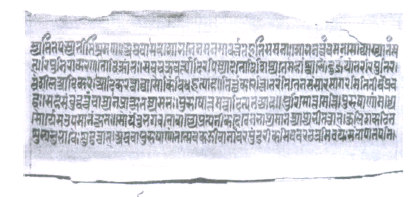
(i) How many years ago this manuscript was written?
(ii) How were books made from palm leaves?
(iii) What type of manuscripts is shown in the picture?
88.
On an outline map of the world, mark the following:
(i) Mountain ranges: Himalayas, Rockies and Andes.
(ii) Plateau Tibet
89.
Show the following cities on the outline map of India
(i) Rakhi Garhi
(ii) Sotkakoh
(iii) Kalibangan
(iv) Mohenjodaro
(v) Lothal
90.
On the outline map of the world, mark the following?
Europe, Asia, Antarctica, South America, Australia, Indian Ocean, Pacific ocean, Atlantic ocean and Ural mountains.
91.
Look at the map of India in an Atlas and locate Kerala and Ladakh. Can you list three ways in which the different geographical location of these two regions would influence the following?
(i) The food people eat
(ii) The clothes they wear
(iii) The work they do.
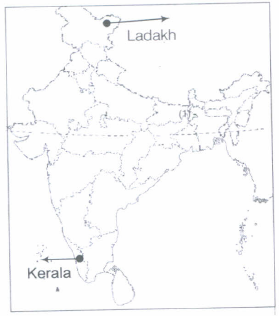
92.
Mark the following important cities and kingdoms on the outline map of India:
(i) Thanesar (ii) Ujjain (iii) Pataliputra
93.
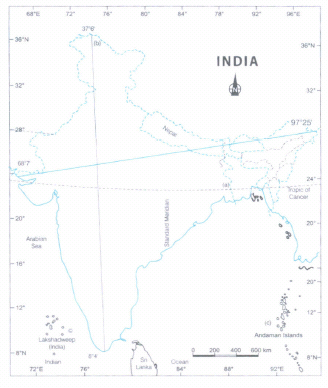
On an outline map of India, mark the following
(a) Tropic of Cancer
(b) Standard Meridian of India
(c) Andaman Islands and Lakshadweep Islands
(d) Western Ghat and Eastern Ghats.
94.
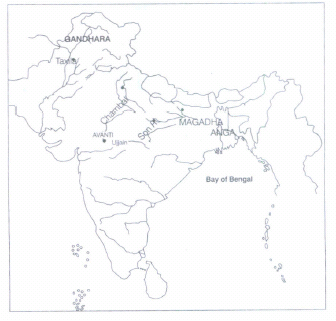
Mark the following Janapadas and Mahajanapadas on the outline map of India:
(i) Taxila (ii) Ujjain (iii) Vaishali (iv) Magadha (v) Gandhara (vi) Avanti
95.
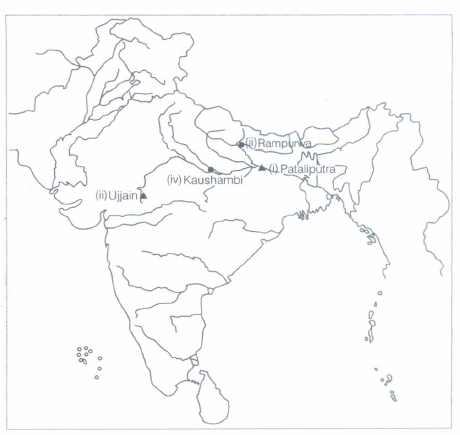
Mark the following places on the outline map of India:
(i) Pataliputra
(ii) Ujjain
(iii) Rampurwa
(iv) Kaushambi
96.
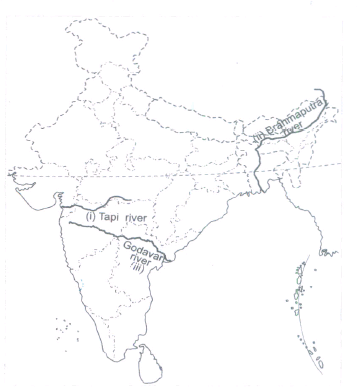
Locate the following of the outline physical map of India.
(i) Tapi river
(ii) Brahmaputra river
(iii) Godavari river
1.
(i) The 2005 Act rectifies various gender inequalities persisting on several fronts such as agricultural land Mitakshara joint family property, parental dwelling house and certain right of widow's.
(ii) According to the new law, sons, daughters and their mothers can get equal shares in the land.
(iii)This law has benefitted a large number of women in achieving their property rights.
2.
(i) The Gram Sabha is the key factor in making the Gram Panchayat a responsible local body.
(ii) It prevents the Village Panchayat from doing wrong things like misusing money.
(iii) It plays an important role in keeping an eye on the elected members.
3.
The Constituent Assembly took two years, eleven months and seven days to complete its historic task of drafting the Constitution of independent India. The Constituent Assembly consisted of 299 members. All the prominent leaders of the freedom movement were members of the Assembly. Some of the major ones were Dr Rajendra Prasad, Jawaharlal Nehru, K.M. Munshi and Sardar Patel.
4.
The temperature of a planet depends on the distance from the Sun. Mercury is very close to the Sun and hence, it is the very hottest planet in the solar system. Its temperature goes above 400oC.
5.
(i) Yes, two girls, Krishna and Ganga live in my locality who are named after a river.
(ii) The list of such names related to water are Ravi, Jhelum and Godavari.
6.
Indian mythology consists of tales of Gods, the devas and the asuras. However, there are only two famous epics - Mahabharata and Ramayana. Epics are grand, long compositions about heroic men and women and include stories about Gods.
7.
(i) Earlier, Buddha's presence was shown in sculptures by using certain signs. Now, statues of Buddha are made.
(ii) The second change was a belief in Bodhisattvas. They were supposed to be persons who attained enlightenment' and remained in the world to teach and help other people.
8.
Kalinga is the ancient name of coastal Odisha. Ashoka fought a war to conquer Kalinga. However, he was so horrified when he saw the violence and bloodshed, that he decided not to fight any more wars. He is the only king in the history of the world who gave up conquest after winning a war
9.
Chandragupta was the first ruler of the Gupta dynasty to adopt the grand title of Maharajadhiraja, a title that Samudragupta and his son, also used.
10.
Archaeologists think that objects found with a skeleton probably belonged to the dead person.
(i) Sometimes, more objects are found in one grave than in another. For example, in Brahmagiri, one skeleton was buried with 33 gold beads, 2 stone beads, 4 copper bangles and one conch shell. Other skeletons had only a few pots.
(ii) These findings suggest that there was some difference in status amongst the people who were buried. Some were rich, others poor, some chiefs, while others were followers.
11.
Yes, we can identify the skeletons of goats because person was buried with goats as it was thought that this would provide him food in the next world.
12.
The other shops of the village Kalpattu are:
(i) Blacksmith family whose home serves as their workshop. Next to their home is a cycle hire and repair shop.
(ii) There are also two washerman families. Some people go to nearby town to work as construction workers. Some work as lorry drivers.
13.
When the Commissioner said that there were not enough trucks in the city, Gangabai said, "But you seem to have enough trucks to collect the garbage from the rich localities".
14.
A part of the salary is kept in a fund with the government. These savings give interest on funds. After retirement, everyone who does work in a government or other companies / factories get this money and can then live on that.
15.
Life is difficult in mountainous areas. Plains provide much better conditions. It is tough to grow crops, build a house or a road in a mountain. That's why people live there in less amount.
16.
The major portion of water is present on the Earth in salty form. The large per cent of fresh water is present in the form of ice sheets and underground water, only 0.03 per cent is available as fresh water for our use. This is the reason behind shortage of water on the earth.
17.
Samir Do did not attend school due to the following reasons:
(i) He had to earn his own livelihood and for his mother.
(ii) He did not have enough time to join a school.
No, I think it would have been difficult for him to attend school even if he wanted to. He would not get time to study in school while selling newspapers. He could find it difficult to pay the school fees.
In my opinion it is not a fair situation that some children go to school and others do not. Every child must go to school.
18.
Yes, I think the police shooting of Hector could have been avoided by:
(i) Talking to him in a peaceful manner. (ii) Putting him in jail.
19.
Rajas of Mahajanapadas
(i) They became rajas by performing very big sacrifices where people accepted their supremacy.
(ii) They had capital cities, which were fortified. They also had large armies.
Rajas in Rigveda
(i) The rulers were chosen by the jana i.e. the people.
(ii) They did not have capital city, palaces and armies. Also, they did not collect taxes.
20.
Differences between the democratic and monarchical form of government are as follows:
| Democratic Government | Monarchical Government |
| People give power to the government. | King or Queen has the power to run the government |
| Election process takes place | No election process prevails. Hereditary transfer of power |
| Government has to explain its actions and defend its decisions. | King or Queen does not have to explain the actions or defend the decisions taken. |
21.
A wide range of species is found in the mountains according to the variation in height. With increase in height, the temperature falls. At a height between 1500 metres and 2500 metres, most of the trees are conical in shape. These trees are called coniferous trees. Chir, pine and deodar are important trees of these forests.
22.
Symbols give a lot of information in a limited space. Maps have a universal language (symbol) so that any person speaking any language can understand it. We can collect information from maps with the help of symbols.
23.
There are four important parallels of latitudes on the Earth. They are:
(i) Tropic of Cancer It is an imaginary line that crosses at 23 1 / 2° in Northern hemisphere.
(ii) Tropic of Capricorn It is an imaginary line that crosses at 23 1 / 2° in Southern hemisphere.
(iii) Arctic Circle It is a circle at 66 1 / 2° North of the equator.
(iv) Antarctic Circle It is a circle at 66 1 / 2° South of the equator.
24.
The angle of inclination of the Earth's axis with its orbital plane is 66 1/2°.
25.
The amphitheatre and aqueducts were made of bricks and cement mortar. Romans were the first to find cement
26.
The people who lived in a Harappan city were:
(i) Rulers (ii) Traders (iii) Scribes (iv) Crafts persons
In Mehrgarh, there were farmers, herders and probably leaders of the tribes.
27.
Archaeologists have found blocks of stone tools that were made and perhaps discarded because they were not perfect and chips of waste stone left behind at these sites.
So, from these evidences, the archaeologists knew about the factories.
28.
The beggar convinced the sages that all people are part of the universal world i.e., God, and he is also a part of the universal soul. If the sages refused food to the beggar, they are refusing it to God. So, the sages shared their food with him.
29.
Now-a-days, people are more travelling than even before. There are many reasons of travelling:
(i) One of the most important reason is economic.
(ii) The means of transportation are better than in the past.
(iii) People travel because they want to learn new things and get new ideas about different places.
30.
(c)
The right to vote
31.
(b)
Eight
32.
(d)
Antarctica
33.
(a)
A group of Councillors
34.
(b)
St. Thomas
35.
(d)
Supreme Court
36.
(c)
Torrid zone
37.
(c)
Mohanjodaro
38.
(c)
People
39.
(b)
protecting them
40.
(a)
A Sage
41.
(b)
An astronomer
42.
(a)
At 2 am
43.
(b)
She works in a company
44.
(c)
Madhya Pradesh Government
45.
(a)
Plains
46.
(b)
A Zamindar
47.
(c)
West
48.
(a)
Himalayan region
49.
(b)
Samantas
50.
(a)
spherical shape
51.
(b)
India and Sri Lanka
52.
(d)
All of these
53.
(a)
Stone slabs and statues
54.
(a)
Akash Ganga
55.
(a)
Bindusara
56.
(a)
Sarnath
57.
(d)
use of fire
58.
(a)
4700 BC
59.
The main features of a democratic country are:
(i) People have the power to elect their representative to form and run the government and also to take decisions on their behalf.
(ii) The competitive elections are held at regular intervals.
(iii) There is aspiration of powers between the three organs of the government, i.e., Legislature, Executive and Judiciary.
(iv) People enjoy Freedom of speech and expression.
(v) Fundamental rights are enjoyed by its citizens.
(vi) There is effective participation of the people in the decision making process.
60.
The Minimum Needs Programme was introduced in the first year of the Fifth Five Year Plan. The objective of the Programme was to set up a network of basic services and facilities of social consumption in all areas as per nationally accepted norms within a particular time-frame. The programme is intended to assist in raising living standards and in reducing the regional disparities in development. The basic needs of the people accredited for this programme are elementary education, adult education, rural health, rural roads, rural electrification, rural housing, environmental improvement of urban slums and nutrition.
61.
The government has taken many steps to preserve wildlife like:
(i) Many national parks, wild sanctuaries, zoological gardens have been set up
(ii) Hunting of animals has been banned.
(iii) The government has started many projects, such as Project Tiger, Project Elephant, etc
(iv) It is also observes Wildlife Week to create awareness among the People.
62.
In 1992, the Parliament amended the Constitution and formulated rules for the Panchayati Raj System. The States and the centre had to follow these rules from April, 1993 onwards. The rules are listed below:
(i) It should be a three-tier system at village level, the intermediate or block level and the district level.
(ii) Direct elections should be conducted for all the seats in the Panchayats.
(iii) The state should ensure representation of the Scheduled Castes and Scheduled Tribes in proportion to their population in the area. Minimum of one-third of the total number of seats is to be reserved forwomen.
(iv) A member of Panchayat should not be less than 21 years of age.
(v) The State Election Commission should hold regular Panchayat elections.
63.
(i) It is not a prejudice but the government has given figures which show more than 50% Indians live in the villages.
(ii) Villagers care about their health. They go to the health centres, if they are sick and take the medicines given to them.
(iii) It is true and not a myth. They have to harvest the crops and store them in godowns. They also have to sow their fields, requires a lot of work.
(iv) It is not a prejudice. It is true because:
(a) Most of the villagers work in the fields from morning till evening and get dirty.
(b) Enough water is not available to them to bath regularly. They are not dirty the kind of work they do, makes them dirty and full of mud.
(c) Living in the city is expensive. A large part of people's earning is spent on rent and transport.
It is true that people have to pay rent for a house on exorbitant rates. They travel long distances to reach their places of work.
64.
| S.No | Andaman Islands | Lakshadweep Islands |
| (i) | Islands are riurnerous | Islands are few in number |
| (ii) | They are volcanic in origin | They are coral in origin |
| (iii) | They are in the Bay of Bengal | They are in the Arabian Sea |
| (iv) | They are arranged in a linear pattern. | They are arranged in a floral pattern. |
65.
The Chief Executive Officer in a Municipal Corporation is also known as the Municipal Commissioner. The State Government appoints this person. The Executive Officer acts as a link between the State Government and Municipal Corporation. Various officers in charge of departments like those in charge of health, education, engineering and sanitation help him or her in this work. The Municipal Commissioner co-ordinates their work and has the power to appoint lower level employees. He/she is the head of the executive branch of the Municipal Corporation. The Municipal Commissioner has all the executive powers. The day-to-day work of the Municipal Corporations is carried out with the help of a number of committees.
66.
(i) In our Solar System, the time taken by each planet to complete a revolution around the Sun varies greatly.
(ii) Inner planets have much shorter orbits in distance and take lesser time than outer planets.
(iii) For example, Mercury, the closest planet to the Sun completes its orbital revolution around the Sun in 88 days, while the Earth takes 1 year to complete its revolution.
(iv) In addition, outer planets have slower average orbital speeds than inner planets.
67.
Ladakh is a desert in the mountains in the eastern part of Jammu and Kashmir. Very little agriculture is possible as the region does not receive any rain and as it is covered which snow for a large part of the year. There are very few trees which grow in their region. The major crops of this region are rice, wheat, barley, peas, millet and maize.
68.
(i) Lava plateaus are formed by highly fluid (runny) basaltic lava during numerous successive eruptions through numerous vents without violent explosions (quiet eruptions).
(ii) These eruptions are quiet because of low viscosity of lava and contains small amount of trapped gases.
(iii) Multiple successive and extensive lava flows cover the original landscape to eventually form a plateau, which may contain lava fields, cinder cones, shield volcanoes and other volcanic landforms.
69.
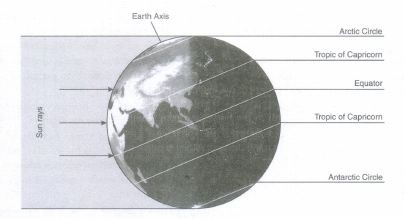
70.
Blue-lakes, rivers, streams, oceans, reservoirs, etc.
Red-major highways, roads, urban areas, airports, special interest sites, military sites, place names, buildings, borders.
Yellow-built-up or urban areas.
Green-parks, golf courses, forest, orchards, highways.
Brown-deserts, historical sites, national park", military reservations or bases, contour (elevation) lines.
Black-railways, highways, bridges, place names, buildings, borders.
71.
(i) Seals are clay tablets have been found from various Harappan sites. They have figures of animals, trees and various letters carved on them.
(ii) Seals may have been used to stamp bags or packets containing goods that were sent from one place to another.
(iii) After a bag was closed or tied, a layer of wet clay was applied on the knot and seal was pressed on it
(iv) The impression of the seal is known as sealing. If the sealing was intact, one could be sure that the goods cased arrived safely.
72.
The reasons behind the movement moving of hunters-gatherers are:
(i) If they stayed at one place for a long time, they would have eaten up all the available plant and animal resources. Therefore, they had to move elsewhere in search of food.
(ii) Animals move from place to place - either in search of smaller prey or in the case of deer and wild cattle, in search of grass and leaves. That is why, those who hunted them had to follow their movements.
(iii) Plants and trees bear fruit in different seasons. So, people may have moved from season to season in search of different kinds of plants.
(iv) People, plants and animals need water to survive. People living on river banks had to go in search of water during the dry seasons as some rivers are seasonal while others are perennial (with water throughout the year).
73.
(i) The poet praised the king in Glowing terms-as a warrior and as a king who won victories in battle.
(ii) He is stated as a learned man and the best of poets.
(iii) He is also described as equal to God.
(iv) The Prashasti was composed in very long sentences.
74.
A burial is an arrangement made by people for their relatives and friends.
When people die, generally respect is paid to them. Dead people are looked after perhaps because of the belief that there is some form of life after death. Several burial sites have been found at Mehrgarh, For instance, the dead persons were buried with goats, which were probably meant to serve as food in the next world.
75.
| Name | Work | Language | Anything else |
|---|---|---|---|
| i. Soniya (Sales girl in the shop) | Displays the goods in the shops and shows them to customers | Hindi, English | Tries to sell the goods as quickly as possible |
| ii.Dr. Mayank (Doctors,Male) | Give medical treatment and advice | Hindi, English | Give medicines and injections |
| iii. Shiv Charan (Vegetable sellers, Male) | Sells vegetables | Hindi | Used to haggling and tries to give less weight. |
| iv. Asha (Maid Servant,Female) | Does household work. | Hindi or Mother tongue | Cooks food |
| v. Rajeev (Driver, Male) | Drives our cars. | Hindi | Drops us to our school and home |
| vi. Aradhana (Teachers,Female) | Teaches us. | English, Hindi | Sometimes they act the scene with the help of the children |
76.
There are several ways to earn a living of rural areas. These are farming and non-farming activities.
The farming activities are:
(i) Preparing the land
(ii) Sowing
(iii) Harvesting
(iv) Weeding
(v) Transplanting
People of rural areas are dependent upon the seasons, sometime they face problem such as failure of crops etc.
Non-farming activities are:
(i) Making baskets
(ii) Making utensils
(iii) Making pots
(iv) Making bricks
(v) Making bullock-carts
(vi) Fishing
(vii) Crafting
Some of the people have shops such as blacksmith's shop, tea shop, grocery shop, barber shop, cycle repair shop etc.
77.
(i) Call centres are generally set-up as large rooms with work stations that include a computer, a telephone set and supervisor's stations. India has become a major centre not only for Indian companies but also foreign companies. They set-up call centres here as they can get people who can speak English and will work for lower wages.
(ii) We find labour at labour chowk where many people were sitting on railings or in groups at the crossing These labourers are daily wage labourers.
78.
Besides voting, there are other ways of participating in the process of government.
(i) People participate by taking an interest in the working of the government and by criticising it when required.
(ii) Sometimes people take out rallies and also organise signature campaign. Things that are unfair and unjust are also brought forward through rallies, dharnas, strikes etc.
(iii) Now, magazines, newspapers and TV also play a role in discussing government issues and responsibilities.
(iv) Another way for people to participate is by organising themselves into social movements that seek to challenge the government and its functioning. Members of the minority community, dalits, adivasis, women and others are often able to participate in this manner.
If we see a rally winding through the streets ot our cities and towns or villages, we should pause to find out what the rally is about, who is participating in it, and what they are protesting about.Thus, this will help to give us a sense of how our government works.
79.
(i) Asia with 44 squares is the largest continent.
(ii) Europe (10 squares) is larger than Australia (8 squares).
80.
The stupas and temples were built through the following steps:
(i) Good quality stone had to be found, quarried and transported to the place that was often carefully chosen for the new buildings.
(ii) The rough blocks of stones were shaped and carved into pillars, and panels for walls, floors and ceilings.
(iii) They were often placed in precisely the right position.
(iv) Devotees brought gifts, which were used to decorate the buildings.
(v) Merchants, farmers, garland makers, perfumers, smiths and hundreds of men and women also paid for decorations and their names were inscribed on pillars, railings and walls.
81.
The seasons are changed on the Earth because of the inclination of the Earth's axis in a fixed direction and due to the change in the position of the Earth around the sun.
On 21st June, the Northern hemisphere is tilted towards the sun. These areas receive more heat because the sun rays fall directly on the tropic of Cancer.
The tropic of Capricorn receives direct sun rays due to tilting of South Pole towards the sun on 22nd December.
The Northern hemisphere experiences autumn season while Southern hemisphere spring season on 23rd September. On 21st March, itIS spring in Northern hemisphere and autumn in Southern hemisphere.
82.
(i) This fortification wall is located at Kaushambi.
(ii) A part of this wall was probably built about 2500 years ago.
83.
Buddhism spread to Western and Southern India and caves were made out of hills for monks to live in. The caves were made on the order of kings and queens and also some of the caves are made by farmers and merchants.
Location of the caves were near passes through the Western Ghats. There were roads connecting these ports with cities in the Deccan ran through these passes. The traders used to stop in these caves while they were travelling. Buddhism also spread South Eastwards to Sri Lanka, Myanmar, Thailand and other parts of South-East Asia including Indonesia. But Theravada Buddhism, the older form of Buddhism was more popular in these areas.
84.
We find out about early cities of the sub-continent through the following sources:
(i) Stories The Jatakas were stories that were probably composed by ordinary people and then written down and preserved by Buddhist monks. The Jatakas throw sufficient light on the lives of the people who used to live there.
(ii) Accounts of travellers and sailors Another way of finding out about early cities is from the accounts of sailors and travellers who visited them.
(iii) Sculptures We can use other kinds of evidences to find out about life in some of these early cities. Sculptors carved scenes depicting peoples lives in towns and villages, as well as in the forest.
(iv) Archaeological findings In many early cities, archaeologists have found rows of pots or ceramic rings arranged one on top of the other. They have also found many silver and copper coins. From all these findings, many important facts about the early cities can be known.
85.
(i)Rampurwa bull is shown in the picture.
(ii)The picture belongs to the Mauryan dynasty.
(iii) Mauryan Pillar has been found in Rampurwa, Bihar
86.
(i)The monument in the picture is Buddhist Stupa at Sarnath.
(ii)Stupa was built to mark the place where the Buddha first taught his message.
87.
(i) This manuscript was written about a thousand years ago.
(ii) The palm leaves were cut into pages and tied together to make books.
(iii) A palm leaf manuscript.
88.
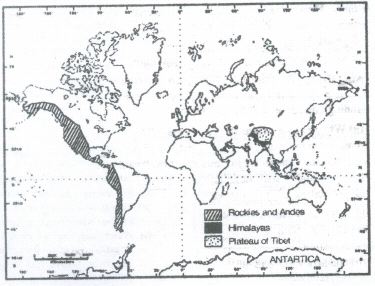
89.
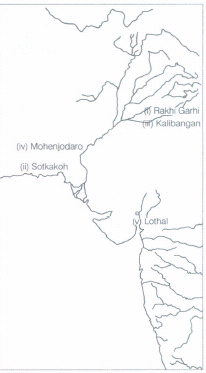
90.
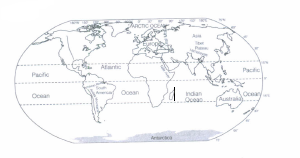
(A) Europe
(B) Asia
(C) Antarctica
(D) Sourh America
(E) Australia
(F) Indian ocean
(G) Pacific ocean
(H) Atlantic ocean
(I) Ural mountains
91.
Yes, we can list three ways in which the different geographical location of these regions (Kerala and Ladakh) would be influence:
| Kerala | ladakh | |
|---|---|---|
| Food | Rice, fish, vegetables | Meat and milk. |
| Clothes | Cotton and synthetic cloths. Loose cotton. No woollen clothes | Woolen and fur clothes. |
| Work | Fishing, agriculture | Sheep rearing, wool collection, trading |
92.
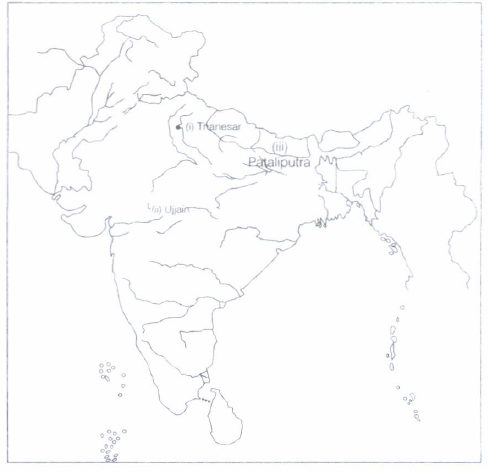
93.
94.
95.
96.

6th Standard CBSE Syllabus & Materials
6th Standard CBSE
CBSE 6th Social Science Locating Places on the Earth - New Sample Question Papers Study Material - QB365 Set A
NEW6th Standard CBSE
CBSE 6th Science A Journey Through States of Water - New Sample Question Papers Study Material - QB365 Set A
NEW6th Standard CBSE
CBSE 6th Science Temperature and its Measurement - New Sample Question Papers Study Material - QB365 Set A
NEW6th Standard CBSE
CBSE 6th Science Materials Around Us - New Sample Question Papers Study Material - QB365 Set A



CBSE 6th Standard CBSE Subjects
CBSE Standards




