
 100% FREE ACCESS
6th Standard CBSE Syllabus & Materials
6th Standard CBSE
CBSE 6th Social Science The Value of Work - New Sample Question Papers Study Material - QB365 Set A
NEW6th Standard CBSE
CBSE 6th Social Science Family and Community - New Sample Question Papers Study Material - QB365 Set A
NEW6th Standard CBSE
CBSE 6th Social Science India's Cultural Roots - New Sample Question Papers Study Material - QB365 Set A
NEW6th Standard CBSE
CBSE 6th Social Science India,That is Bharat - New Sample Question Papers Study Material - QB365 Set A
NEW6th Standard CBSE
CBSE 6th Social Science Timeline and sources of history - New Sample Question Papers Study Material - QB365 Set A
NEW6th Standard CBSE
CBSE 6th Social Science Oceans and Continents - New Sample Question Papers Study Material - QB365 Set A

Published on: 19/01/2019
Understanding Diversity Full Material
Download CBSE Class 6th Standard CBSE Social Science question papers, sample papers, important questions, and previous year solved papers in PDF format. Get free study materials, NCERT solutions, and exam preparation resources for Class 6th Standard CBSE Social Science
Questions + Answers key
Take MCQ Social Science Test
1.
What is meant by drought? Mention any two droughts affected states of India.
2.
Who composed the national song of India? Who has done the English translation of this song?
3.
What is the theme of the book the "Discovery of India"?
4.
Can you think of a situation in which you made friends with someone who was very different from you. Wr e a story that describe this.
5.
How does the caste system bar equality?
6.
Why does Ladakh have very little agricultural activities?
7.
Underline the line in the poem sung after the Jallianwala Bagh massacre, which according to you, reflects India's essential unity.
8.
What do you think living in India with its rich heritage of diversity adds to your life?
9.
Do you know the story of the Indian flag?
10.
Make a list of the languages besides your mother tongue that you can speak at least one or two words of.
11.
Discuss why you think Samir Do did not attend school? Do you think it would have been easy for him to attend school if he wanted to? In your opinion is it a fair situation that some children get to go to school and others don't?
12.
Make a list of the festivals that might have been celebrated by the two boys.
Samir EK Samir Do
Can you think of a situation in which you made friends with someone who was very different from you? Write a story that describes this.
13.
Name three ways in which Samir Ek and Samir Do were different? Did these differences prevent them from becoming friends?
14.
How did India become like this? Are all kinds of difference a part of diversity?
15.
Look around you in the classroom: do you see anyone who looks exactly like you do?
16.
Both Kerala and Ladakh were influenced by______and_______traders.
17.
Samir Ek and Samir Do come from different religious and _____________ backgrounds.
18.
Habitat is associated with the _______________ one lives in
19.
India's diversity has always been__________ as a __________ of its strength.
20.
Local versions of the Tibetan national epic the _____________ are performed by, both Muslims and Buddhists.
21.
The Apostle of Christ, _____________ is believed to have come to Kerala nearly 2000 years ago.
22.
I like reading books about _____________
23.
My favourite sport is _____________
24.
At home I speak in ___________
25.
When I go out I like wearing ___________
26.
What is Cheena-vala?
Utensil
Fishing nets
Fishing bowl
None of the above
27.
Who composed our National Anthem?
Pt. Jawaharlal Nehru
Rabindranath Tagore
Mahatma Gandhi
Dr. Rajendra Prasad
28.
Onam festival is celebrated in
Kerala
Punjab
Karnataka
Jammu nd Kashmir
29.
What is dzos?
A type of dog
A type of cat
A type of yak-cow
A type of goat
30.
'Discovery of India' was written by
Indira Gandhi
Pt. Jawaharlal Nehru
Sardar Vallabhbhai Patel
Mahatma Gandhi
31.
Where did the Jallianwala Bagh Massacre take place?
Ludhiana
Rohtak
Amritsar
Bhatinda
32.
Where are Pashmina shawls woven
Kashmir
Haryana
Punjab
Himachal Pradesh
33.
Which of the following regions is located in the South-West corner of India?
Ladakh
Tamil Nadu
Kerala
Punjab
34.
What does Samir Do do?
sells the newspapers
goes to school
plays cricket
Both (a) and (c)
35.
Which of the following religions does Samir EK belong to?
Muslim
Sikh
Hindu
Christian
36.
Which is the famous festival of Kerala?
37.
Who discovered the sea route to India?
38.
Why did Samir Do think that Samir Ek did not know Hindi?
39.
Give an example of diversity in India?
40.
Mention the different religions that are practised Ladakh?
41.
How many different religions are practised in Kerala?
42.
Why was Samir Do tense?
43.
What is Ladakh also known as?
44.
Why was the Indian flag used during the freedom struggle?
45.
What are the constant reminders of our rich traditions of respecting for diversity?
46.
Why was Ladakh considered to be a good trade route for the ancient traders from China and Europe?
47.
Do you think you would enjoy living in a place Iike this? List five different things that you would miss the most if you lived here?
48.
How does Jallianwala Bagh Massacre reflect unity in diversity?
49.
Compare the life in Kerala and Ladakh in your own words?
50.
Pt. Nehru was the first President of India.
51.
All Indians have the same national language.
52.
All Indians speak the same language.
53.
Kerala and Ladakh are in different parts of India.
54.
All Indian share the national anthem.
55.
The people of Ladakh mostly eat fish and rice.
56.
Samir Ek belongs to Islam religion.
57.
Pt. Jawaharlal Nehru was the first Prime Minister of India.
58.
Caste system is another example of inequality.
59.
The geography of Ladakh allows cultivation of wheat.
60.
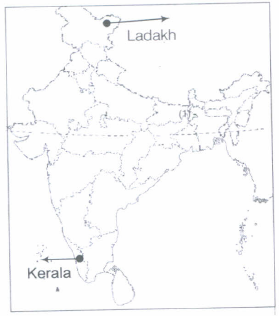
Look at the map of India in an Atlas and locate Kerala and Ladakh. Can you list three ways in which the different geographical location of these two regions would influence the following?
(i) The food people eat
(ii) The clothes they wear
(iii) The work they do.
1.
Drought is a dry weather condition that persists long enough to cause problems such as crop damage and water supply shortages. The two states that are severely affected by drought are Rajasthan and Gujarat.
2.
The national song of India was composed by Bankim Chandra Chatterjee in Bengali language. The English translation of the song was done by Shree Aurobindo.
3.
The book "Discovery of India" gives a complete view of Indian history, philosophy and culture. Pandit Jawaharlal Nehru studied the history of India starting from the Indus Valley Civilization to Aryans invasion and then to the British rule. The effect of these people on Indian culture and their incorporation in the Indian society was examined in the book.
4.
I have a friend who belongs to Gujarat and is a Muslim. He shifted here in search of job and finally he got the job in my organization. He usually comes to my home but my mother dislike him Lecause he is a Muslim and he eats meat etc. His way of speaking Hindi is somewhat different as we speak. Whenever I go to his home, his family members, specially female members do not come out from their rooms because they believe in purdah system and they talk in Gujarati with each other. Inspite of these dissimilarities, we are very close friends.
5.
The society was divided into different groups depending upon the work that people did and they were supposed to remain in those groups.
If one's parents were potters, then that person could only become a potter and one's profession denoted his/her caste. So this created a situate of inequality.
6.
Ladakh has very little agricultural activities because it is covered with snow for most part of the year and also does not receive any rainfall.
7.
According to me the following line reflects India's essential unity:
"O, friend!
The blood of Hindus and Muslims flow together today".
8.
Yes, living in India with its rich heritage of diversity adds to our life in the following ways:
(i) We know different people, their culture, customs, traditions, backgrounds. These diverse things add to our life.
(ii) Geographical diversities decide our way of life, our food, our occupations and many other things.
9.
Yes, I know the story of the Indian flag. The Flag was used as a symbol of protest against the British rule by the people of India everywhere.
The National Flag underwent several changes and finally it represents India today and is a symbol of faith, dignity, and patrotism.
10.
List of languages beside our mother tongue:
| (i) Hindi (iii) Urdu (v) Kannad (vii) Marathi (ix) Assamese |
(ii) Punjabi (iv) English (vi) Tamil (viii) Gujarati (x) Odiya. |
11.
Samir Do did not attend school due to the following reasons:
(i) He had to earn his own livelihood and for his mother.
(ii) He did not have enough time to join a school.
No, I think it would have been difficult for him to attend school even if he wanted to. He would not get time to study in school while selling newspapers. He could find it difficult to pay the school fees.
In my opinion it is not a fair situation that some children go to school and others do not. Every child must go to school.
12.
List of the festivals that might have been celebrated by the two boys:
Samir Ek - Holi, Diwali, Durgapuja, Janmastami etc.
Samir Do - ID-ul-fitr, Id-ul-Zuha, Muharram etc.
Now, the students can tell a story of this event themselves.
13.
Three ways in which Samir Ek and Samir Do were different are as follows:
(i) Samir Ek was a Hindu, Samir Do a Muslim
(ii) Samir Ek was more familiar with English, Samir Do spoke Hindi.
(iii) Samir Ek was a student while Samir Do was a newspaper hawker.
Despite all the differences, they were very good friend.
14.
India became like this because of the arrival and settlement of different people from different places. Yes, all kinds of difference are a part of diversity.
15.
No, no one around me in the classroom looks exactly like me.
16.
()
Chenise, Arab
17.
()
cultural
18.
()
geographical area
19.
()
recognised, source
20.
()
Kesar Saga
21.
()
St. Thomas
22.
()
Drama and personalities.
23.
()
football.
24.
()
Hindi and English
25.
()
shirt, pants, socks and shoes.
26.
(b)
Fishing nets
27.
(b)
Rabindranath Tagore
28.
(a)
Kerala
29.
(c)
A type of yak-cow
30.
(b)
Pt. Jawaharlal Nehru
31.
(c)
Amritsar
32.
(a)
Kashmir
33.
(c)
Kerala
34.
(a)
sells the newspapers
35.
(c)
Hindu
36.
()
Onam is the famous festival of Kerala.
37.
()
The Portuguese discovered the sea route to India from Europe, when Vasco-da-Gama landed with his ship here.
38.
()
Samir Ek looked like a foreigner, so Samir Do thought that he did not know Hindi
39.
()
There are many different languages which are spoken by us. It is an example of diversity in India
40.
()
The people of Ladakh mainly practise Islam and Buddhist religions.
41.
()
There are five different religions practised in Kerala.
42.
()
Samir Do was tense because riots had broken out in Meerut, where his family lived.
43.
()
Ladakh is known as Little Tibet.
44.
()
The Indian flag was used for protesting against the British, during freedom struggle. It was used as a symbol of protest.
45.
()
Songs and symbols that emerged during freedom struggle are constant reminders of our rich traditions of respect for diversity.
46.
Ladakh was a major trading centre on the Silk Route between China and the Mediterranean. It was considered to be a good trade route as it had many passes through which caravans travelled to Tibet. As a result, Ladakh came to be known as the 'Land of Passes'. The caravans carried textiles, spices, raw silk and carpets.
47.
If I was forced to live in a place where people wore the same two colours, red and white, ate the same food (maybe potatoes), took care of the same two animals, for example, the deer and the crow, and to entertain themselves played snakes and ladders. I would miss the following:
(i) I do not like deer and crow. I will miss keeping dog as a pet.
(ii) I would miss wearing clothes of different colours-blue, green, yellow, etc.
(iii) I like to play basketball and will miss it, if I lived there.
(iv) I would not like to eat potatoes every day. I like variety in my food, eating different vegetables, fruit, milk, curd and cheese.
Nehru in his book 'Discovery of India' wrote that India has been always united inspite of geographical, religious and cultural differences. Indian unity is not something imposed from outside, but is something deep and within its is fold. The widest tolerance of beliefs and customs has always been acknowledged and even encouraged.
48.
Jallianwala Bagh Massacre happened in Amritsar in which a British General opened fire on a large group of unarmed, peaceful people killing many and wounding even more.
Men and women, Hindus, Sikhs and Muslims, rich and poor had gathered to protest against the British.
After this incident, a song was sung which included a line that said "The blood of Hindus and Muslims flow together today". Thousands of people were killed.
This shows how Indians proved that, whatever caste, creed, religions, culture we belong to, we are one and united to do anything for our motherland.
49.
Comparison of the life in Kerala and Ladakh is as follows:
| Kerala | Ladakh |
|---|---|
| Kerala located in the South-West corner of India. | Ladakh is a desert in the mountains in the Eastern part of Jammu and Kashmir. |
| It is bounded by sea on one side and by mountain on other side. | It is covered with the snow due to Himalayan ranges. |
| Fertile land and abundant rainfall have resulted in the rice cultivation. | People here keep sheep in this region produce pashmina wool. |
| Fishing is main occupation here and probabily people eat fish and rice. | The people eat meat and milk products such as cheese and butter. |
50.
(b)
51.
(a)
52.
(b)
53.
(a)
54.
(a)
55.
(b)
56.
(b)
57.
(a)
58.
(a)
59.
(b)
60.
Yes, we can list three ways in which the different geographical location of these regions (Kerala and Ladakh) would be influence:
| Kerala | ladakh | |
|---|---|---|
| Food | Rice, fish, vegetables | Meat and milk. |
| Clothes | Cotton and synthetic cloths. Loose cotton. No woollen clothes | Woolen and fur clothes. |
| Work | Fishing, agriculture | Sheep rearing, wool collection, trading |

6th Standard CBSE Syllabus & Materials
6th Standard CBSE
CBSE 6th Social Science Locating Places on the Earth - New Sample Question Papers Study Material - QB365 Set A
NEW6th Standard CBSE
CBSE 6th Science A Journey Through States of Water - New Sample Question Papers Study Material - QB365 Set A
NEW6th Standard CBSE
CBSE 6th Science Temperature and its Measurement - New Sample Question Papers Study Material - QB365 Set A
NEW6th Standard CBSE
CBSE 6th Science Materials Around Us - New Sample Question Papers Study Material - QB365 Set A



CBSE 6th Standard CBSE Subjects
CBSE Standards




