
 100% FREE ACCESS
6th Standard CBSE Syllabus & Materials
6th Standard CBSE
CBSE 6th Social Science The Value of Work - New Sample Question Papers Study Material - QB365 Set A
NEW6th Standard CBSE
CBSE 6th Social Science Family and Community - New Sample Question Papers Study Material - QB365 Set A
NEW6th Standard CBSE
CBSE 6th Social Science India's Cultural Roots - New Sample Question Papers Study Material - QB365 Set A
NEW6th Standard CBSE
CBSE 6th Social Science India,That is Bharat - New Sample Question Papers Study Material - QB365 Set A
NEW6th Standard CBSE
CBSE 6th Social Science Timeline and sources of history - New Sample Question Papers Study Material - QB365 Set A
NEW6th Standard CBSE
CBSE 6th Social Science Oceans and Continents - New Sample Question Papers Study Material - QB365 Set A

Published on: 20/09/2019
What, Where, How and When?
Download CBSE Class 6th Standard CBSE Social Science question papers, sample papers, important questions, and previous year solved papers in PDF format. Get free study materials, NCERT solutions, and exam preparation resources for Class 6th Standard CBSE Social Science
Questions + Answers key
Take MCQ Social Science Test
1.
The following picture is a page from the palm leaf manuscript. Answer the following questions related to the manuscript:
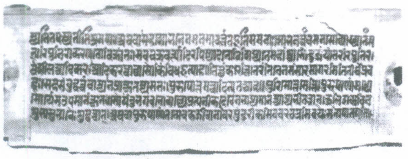
(i) What are manuscripts?
(ii) How did the manuscript get spoilt?
(iii) Where are these manuscripts preserved?
2.
Why is the plural word 'Pasts' used in the title of this book, 'Our Pasts' ?
3.
How do scholars understand what is written in the inscriptions ?
4.
What do AD and BC stand for?
5.
Why did people travel from one part of the subcontinent to another?
6.
Where did the word 'India' originate from?
7.
What did the manuscripts contain ?
8.
Return to Rasheeda's question. Can you think of some answer to it ?
9.
You have to interview an archaeologist. Prepare a list of five questions that you would like to ask her/him.
10.
In what ways is the coin different from the ones we use today.
11.
Do you think cloth is found frequently by archaeologists ?
12.
List one major difference between manuscripts and inscriptions.
13.
How was the name 'India' originated?
14.
What are the evidences of the past we can analyse today?
15.
Can you think of the advantages of writing on a hard surface? And what could have been the difficulties?
1.
(i) Manuscripts are the books written by hand.
(ii) Most of the manuscripts were written on perishable materials. So with time, some of them were eaten away by insects and some were completely destroyed due to effect of time and atmospheric conditions.
(iii)These manuscripts are often preserved in temples and monasteries.
2.
The word 'Pasts' is used in plural to draw attention to the fact that the past was different for different groups of people.
(i) For example, the lives of kings and queens were different from those of peasants and herdsmen, the lives of traders were different from those of crafts-persons and so on. This fact is true even in the modern times. The life of the people living in the Andaman islands is very different from those living in the cities.
(ii) Secondly, we know a lot about the kings and battles they fought because they recorded all their victories.We know very little about the lives of the ordinary people because they did not keep any record of what they did.
3.
The scholars understand what is written in the inscriptions through the process called decipherment. Most of these inscriptions were written several hundred years ago, and languages and the script used in the inscriptions have changed with time. One good example of decipherment is of the Rosetta stone found in Egypt which was used to decipher ancient Egyptians using Greek language.
4.
(i) AD stands for two Latin words, 'Anno Domini', meaning 'in the year of the Lord' (i.e., Christ). The year 2007, also written as AD 2007, means 2007 years after the birth of Christ.
(ii) BC stands for 'Before Christ', meaning before the birth of Christ. For example, a time period written as 200 BC means 200 years before the birth of Christ. BC runs into countdown format as 10..,9..,8..,7.., 1.. upto the time of Jesus Christ's birth and after his birth it started to run in today's date format, i.e., 1..,2..,3...., onwards.
5.
(i) They moved in search of livelihood.
(ii) Men marched in armies to conquer the other lands.
(iii) Merchants travelled with caravans or ships to sell goods.
(iv) Some people travelled to discover new places.
6.
It comes from the word 'Indus', called 'Sindhu' in Sanskrit. The Greeks and Iranians called it 'Hindos' or 'Indos' meaning the land to the east of the river called India.
The name Bharat was used by the people who lived in the North-West. Later, it was used for the country India.
7.
Manuscripts contained all kinds of subjects like religious beliefs and practices, the lives of kings, medicine and science. It also contained poems, epics and plays. These were written in Sanskrit, Prakrit and Tamil.
8.
Rasheeda's question was how could anyone know what had happened so many years ago. There are various ways by which the people can know about the past.
(i) By the study of remains left by the early men in the form of tools, weapons, pots, pans, ornaments and coins.
(ii) Various inscriptions written on hard surfaces which contain both scripts and languages and these inscriptions were deciphered.
(iii) By various manuscripts and religious books, epics and poems.
9.
We will ask these five questions as given below:
(i) How old is our civilization?
(ii) Are you able to read manuscripts written in Harappa age?
(iii) What is the meaning of inscriptions?
(iv) How can you study the remains of any building?
(v) What did people eat in the past?
10.
In the past, the coins were made of silver and sometimes of gold. Now-a-days, the coins are made of mixed alloys.
11.
Yes, cloth has been found in various ancient civilizations. Cotton, silk cloth, etc., has been found in India, Iraq and China
12.
One major diffirence between manuscripts and inscriptions is:
| Manuscripts | Inscriptions |
|---|---|
| Manuscripts were written on palm leaf or specifically on the birch. | Inscriptions were written on hard surfaces such as stone, metals etc. |
13.
The Iranians and the Greeks who came through the North-West about 2500 years ago and were familiar with the Indus, called it the Hindos or the Indos and the land to the East of the river was called India.
14.
There are several things we can find out-what people ate, the kinds of clothes they wore, the houses in which they lived. Also we can find out about the lives of hunters, herders, farmers, rulers, merchants, priests, crafts persons, artists, musicians and scientists.
15.
The advantages of writing on a hard surface are as follow:
(i) The hard surfaces are long-lasting.
(ii) They overcome all chances of destruction from all objects of nature i.e. wind, rain, sun etc.
(iii) They are preserved for future generations to know about our rich past and culture.
(iv) The insects could not eat such materials as they destroyed the manuscripts of the past.
The disadvantages of writing on hard surface are as follow:
(i) It is not easily portable.
(ii) Writing on hard surface is a very difficult task.
(iii) It needs much hard metal to write on the hard surface.
(iv) It requires a lot of time to complete the writing.

6th Standard CBSE Syllabus & Materials
6th Standard CBSE
CBSE 6th Social Science Locating Places on the Earth - New Sample Question Papers Study Material - QB365 Set A
NEW6th Standard CBSE
CBSE 6th Science A Journey Through States of Water - New Sample Question Papers Study Material - QB365 Set A
NEW6th Standard CBSE
CBSE 6th Science Temperature and its Measurement - New Sample Question Papers Study Material - QB365 Set A
NEW6th Standard CBSE
CBSE 6th Science Materials Around Us - New Sample Question Papers Study Material - QB365 Set A



CBSE 6th Standard CBSE Subjects
CBSE Standards




