
 100% FREE ACCESS
6th Standard CBSE Syllabus & Materials
6th Standard CBSE
CBSE 6th Social Science The Value of Work - New Sample Question Papers Study Material - QB365 Set A
NEW6th Standard CBSE
CBSE 6th Social Science Family and Community - New Sample Question Papers Study Material - QB365 Set A
NEW6th Standard CBSE
CBSE 6th Social Science India's Cultural Roots - New Sample Question Papers Study Material - QB365 Set A
NEW6th Standard CBSE
CBSE 6th Social Science India,That is Bharat - New Sample Question Papers Study Material - QB365 Set A
NEW6th Standard CBSE
CBSE 6th Social Science Timeline and sources of history - New Sample Question Papers Study Material - QB365 Set A
NEW6th Standard CBSE
CBSE 6th Social Science Oceans and Continents - New Sample Question Papers Study Material - QB365 Set A

Published on: 14/08/2019
Traders, Kings and Pilgrims
Download CBSE Class 6th Standard CBSE Social Science question papers, sample papers, important questions, and previous year solved papers in PDF format. Get free study materials, NCERT solutions, and exam preparation resources for Class 6th Standard CBSE Social Science
Questions + Answers key
Take MCQ Social Science Test
1.
State the features of Mahayana Buddhism.
2.
Who were Satavahanas?
3.
How is silk made?
4.
Discuss the reasons why the Chinese pilgrims came to India
5.
List the reasons why Xuan Zang wanted to study in Nalanda
6.
Can you think of how Buddhism spread to these lands?
7.
Kushanas
8.
Buddhacharita
9.
Xuan Zang
10.
Ashvaghosha
11.
Muvendar
12.
Puhar or Kaveripaltinam was the port of the Pandyas.
13.
The statues of Buddha were made in Mathura and Taxila.
14.
It was about 7000 years ago, making of silk was discovered.
15.
Central India was famous for gold and spices
16.
The idea of Bhakti is present in:
Ramayana
Mahabharata
Bhagwad Gita
None of these
17.
Ashvaghosha was a:
Piet
King
Soldier
Pilgrim
18.
Technique of making silk was first invented in
China
South India
Sri Lanka
None of these
19.
How many centres of power did the Cholas, Cheras and Pandyas have?
One
Two
Three
Four
20.
South India was famous for
gold
pepper
precious stones
All of these
21.
Who were Bodhisattvas?
22.
Who were the best known rulers who controlled the Silk Route?
23.
Who came to be known as lords of the dakshinapatha?
24.
What does the word muvendar describe?
25.
Name the Chinese visitors who came to India. What was their aim of visit?
26.
Answer the questions based on picture given below:
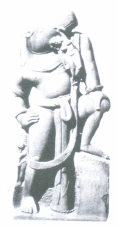
(i) What does statue depict?
(ii) When did Vishnu take the shape of a Boar?
27.
The second change was a belief in ______
28.
The most famous Kushana ruler was _____ who ruled around 1900 years ago.
29.
The most important ruler of the Satavahanas was _____
30.
The word ______ like the term 'India' is derived from the river Indus.
1.
(i) Earlier, Buddha's presence was shown in sculptures by using certain signs. Now, statues of Buddha are made.
(ii) The second change was a belief in Bodhisattvas. They were supposed to be persons who attained enlightenment' and remained in the world to teach and help other people.
2.
(i) Around 200 years later a dynasty known as the Satavahanas became powerful in Western India.
(ii) The most important ruler of the Satavahanas was Gautamiputra Shri Satakarni. (They all) He and other were known as Lords of the Dakshinapatha.
3.
Technique of making silk was first introduced in China around 7000 years ago. And the making of silk was kept secret for thousands of years. In order to make silk, raw silk has to be extracted from the cocoons of silk worms and then spun into thread and lastly woven into cloth. The process of making silk is quite complicated.
4.
Pilgrims are men and women who undertake journeys to holy place in order to offer worship. The best-known of these are the Chinese Buddhist pilgrims, Fa Xian, who came to the sub-continent about 1600 years ago, Xuan Zang, who came around 1400 years ago and I-Qing, who came about 50 years after Xuan Zang.
They came to visit places associated with the life of the Buddha as well as famous monasteries. They spent time studying in the monasteries. Xuan Zang and other pilgrims spent time studying in Nalanda (Bihar), the most famous Buddhist monastery of that period.
5.
Nalanda was a unique centre of Buddhist learning and the most famous Buddhist monastery of that period
Xuan Zang wanted to study in Nalanda as:
• The teachers are men of the highest ability and talent. They follow the teachings of the Buddha in all sincerity.
• The rules of the monastery are strict and everyone has to follow them.
6.
Buddhism spread South Eastwards, to Sri Lanka, Myanmar, Thailand and other parts of the South-East Asia including Indonesia, because Buddhist monks travelled to these parts with merchants and traders, and exchanged their views with the people.
Even some rulers, like Ashoka took initiative to spread ideas of Buddhism in these areas. Ashoka sent messengers to spread Buddhism in Sri Lanka.
7.
()
Control the silk route
8.
()
Biography of Buddha
9.
()
Chinese pilgrim
10.
()
Buddhacharita
11.
()
Cholas, Cheras and Pandyas
12.
(b)
13.
(a)
14.
(a)
15.
(b)
16.
(c)
Bhagwad Gita
17.
(a)
Piet
18.
(a)
China
19.
(b)
Two
20.
(d)
All of these
21.
()
Bodhisativas were supposed to be persons who attained enlightenment.
22.
()
Kushanas were the best known rulers who controlled the Silk Route.
23.
()
Gautamiputra Shri Satakarni and other Satavahana rulers were called as lords of the dakshinapatha.
24.
()
The word is used for the heads of three ruling families, the Cholas, Cheras and Pandyas.
25.
The Chinese Buddhist pilgrims who visited India were:
(i) Fa Xian, who Came to the sub-continent about 1600years ago,
(ii) Xuan Zang who came around 1400 years ago, and
(iii) I-Qing, who came about 50 years after Xuan Zang.
Their aim was to visit places associated with the life of Buddha as well as the famous monasteries.
26.
(i)Statue depicts Vishnu as Varaha or Boar.
(ii) According to the Puranas, Vishnu took the shape of a boar in order to rescue the earth.
27.
()
Bodhisattvas
28.
()
Kanishka
29.
()
Gautamiputra Shri Satakarni
30.
()
Hindu

6th Standard CBSE Syllabus & Materials
6th Standard CBSE
CBSE 6th Social Science Locating Places on the Earth - New Sample Question Papers Study Material - QB365 Set A
NEW6th Standard CBSE
CBSE 6th Science A Journey Through States of Water - New Sample Question Papers Study Material - QB365 Set A
NEW6th Standard CBSE
CBSE 6th Science Temperature and its Measurement - New Sample Question Papers Study Material - QB365 Set A
NEW6th Standard CBSE
CBSE 6th Science Materials Around Us - New Sample Question Papers Study Material - QB365 Set A



CBSE 6th Standard CBSE Subjects
CBSE Standards




