
 100% FREE ACCESS
6th Standard CBSE Syllabus & Materials
6th Standard CBSE
CBSE 6th Social Science The Value of Work - New Sample Question Papers Study Material - QB365 Set A
NEW6th Standard CBSE
CBSE 6th Social Science Family and Community - New Sample Question Papers Study Material - QB365 Set A
NEW6th Standard CBSE
CBSE 6th Social Science India's Cultural Roots - New Sample Question Papers Study Material - QB365 Set A
NEW6th Standard CBSE
CBSE 6th Social Science India,That is Bharat - New Sample Question Papers Study Material - QB365 Set A
NEW6th Standard CBSE
CBSE 6th Social Science Timeline and sources of history - New Sample Question Papers Study Material - QB365 Set A
NEW6th Standard CBSE
CBSE 6th Social Science Oceans and Continents - New Sample Question Papers Study Material - QB365 Set A

Published on: 19/01/2019
Urban Livelihoods Complete Study Material
Download CBSE Class 6th Standard CBSE Social Science question papers, sample papers, important questions, and previous year solved papers in PDF format. Get free study materials, NCERT solutions, and exam preparation resources for Class 6th Standard CBSE Social Science
Questions + Answers key
Take MCQ Social Science Test
1.
Why can't Bachchu Manjhi live with his family?
2.
What suggestions have been made so that street vendors have a place to work and that these is also a free flow of traffic to the people?
3.
"I wanted to have zari work done on one of my dresses which I needed for a special occasion". Comment.
4.
Discuss the activities at opposite side of the pavement.
5.
What was the plan of Harpreet and Vandana?
6.
Discuss the work of daily wage labourers.
7.
Discuss the scene at Sudha's office
8.
What are the problems faced by non-permanent workers?
9.
Discuss the working condition of Nirmala.
10.
"Saving for old age". Discuss.
11.
What are the benefits of regular and permanent workers?
12.
Fill in the following table to show the services provided by people in the markets which you visit frequently.
13.
In what way is a permanent and regular job different from a casual job? Discuss.
14.
Describe the working conditions of people like Nirmala keeping in mind the following: working hours, conditions in the workplace, earnings and the days of work available.
15.
What are the differences between those who sell on the street and those in the market?
16.
Talk to a shopowner in a market and find out how he plans his work. Have there been any changes in his business in the past 20 years?
17.
Why did Harpreet and Vandana start a showroom? What do they have to do to run the showroom?
18.
Talk to a vegetable vendor or hawker and find out how do they organise their work, their way of preparing, purchasing, selling etc
19.
Some parts of the city are different from others. What differences do you notice in this illustration?
20.
You have already read about the work that people do in rural areas. Now compare the work that people in this illustration are doing with the work that people do in rural areas.
21.
Most of the businessmen are
Self employed
Municipal Corporation
Central Government
Court
22.
What is the profession of Vandana?
A garment expert
A dress designer
An engineer
A doctor
23.
Where do labourers stand?
At labour chowk
At cinema halls
At ramlila ground
At home
24.
Where does Nirmala work?
In an export garment unit
In a ticket booking centre
In Sudha's office
In a market street
25.
What is Sudha's employment status?
She is self-employed
She works in a company
She is a labourer
She is a salesperson
26.
How much salary does Sudha get?
Rs 10,000 PM
Rs. 20,000 PM
Rs 15,000 PM
Rs 30,000 PM
27.
Vendors sell things that are often prepared at which of the following places?
At shops
At homes
At street itself
At neighbouring shops
28.
In a survey of Ahmedabad city how many workers were found to be working on the street?
13 per cent
15 per cent
45 per cent
12 per cent
29.
How much does Bachchu Manjhi earn per day?
Rs 40
Rs 180
Rs 100
Rs 50
30.
Bachchu Manjhi is a/an
engineer
auto-rickshaw-driver
rickshaw-puller
worker
31.
Compare the livelihood challenges faced by rural and urban women.
32.
Why do people prefer working in an organised sectors?
33.
Name the local bodies that look after the urban areas.
34.
Why do small workshops and factories need casual workers?
35.
Look at the pictures given below carefully and answer the following questions:
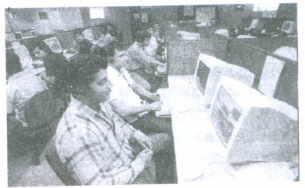
(i) Describe the work condition at all centres. Why are many call centres set up in India?
(ii) Where do we find a labour?
36.
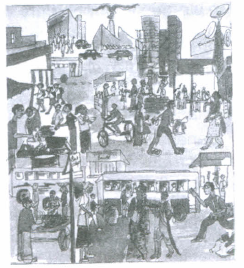
What do you see in this illustration?
37.
Describe the challenges which are faced by the rural and urban women in our country.
38.
Discuss the lives of hawkers in the city.
39.
Working in ............ is a new form of employment in the big cities.
40.
Often workers who make a living in the city are forced to set up their _____________ on the ____________ as well.
41.
Those who sell food or snacks on the street prepare most of these ______________
42.
We decided to take ___________ to the market
43.
My wife also earns from ___________ work that she gets once in a while.
44.
Some materials of Vandana's and Harpreet's showroom come from Noida and Gurgaon.
45.
A dentist's clinic is also at the starting place of the market
46.
Vendors sell things that are often prepared at home by their families.
47.
Bachchu Manjhi came from a village in Uttar Pradesh.
48.
Sudha works in a factory where garments work was done.
49.
Business persons
50.
Rickshaw puller
51.
Helpers to masons
52.
Marketing manager
53.
Tailor
1.
Bachchu Manjhi cannot live with his family because he lives in a rented room with his friends.
2.
Following suggestions have been made:
(a) Hawking zones have been suggested for towns and cities.
(b) Mobile vendors should be allowed to more around freely.
(c) Hawkers need to be part of committees that are set up to take these and other decisions relating to them.
3.
This is a story of a city where a factory was established. There were garments work being done. My cousin knew a being employee whose name was Nirmala. Nirmala's neighbours did zari work and embroidery.
So, we (I and my cousin) caught a bus and headed towards the factory area where. Nirmala promised to get zari work done on my dress.
4.
On the opposite pavement, we saw a person selling newspapers with a small crowd of people around him. Everyone wanted to read the news.
Buses whizzed past and there were auto-rickshaws filled with school children. Nearby, under a tree, a cobbler sat taking his tools and materials out of a small tin box Next to him the roadside barber had begun his work: he already had a customer who wanted an early - morning shave.
5.
Harpreet and Vandana planned to buy the building in the market in which their showroom was located. Ever since the market has become the main market for people living in the surrounding apartments, their business has grown. They have been able to buy a car and book a flat in an apartment complex nearby.
6.
The daily wage labourers work as helpers to masons. They dig at construction sites, lift loads or unload trucks in the market, dig pipelines and telephone cables and also build roads.
7.
Sudha's office was in an area surrounded by tall buildings. There were hundreds of people coming out. Some headed for the car park while others went towards the row of buses.
8.
The problems faced by non-permanent workers are as follow:
(i) If workers complain about their pay or working conditions, they are asked to leave.
(ii) There is no job security or protection if there is ill treatment.
(iii) They are also expected to work very long hours.
9.
Nirmala have to work very long hours in the months from December to April. A normal working day begins at 9 am and finishes only by 10 pm, sometimes even later.
She works for six days a week. At time when the work needs to be done urgently, she works on Sundays too.
10.
A part of the salary is kept in a fund with the government. These savings give interest on funds. After retirement, everyone who does work in a government or other companies / factories get this money and can then live on that.
11.
The regular and permanent workers attend the office or factory regularly. Their work is clearly identified. They get a regular salary. Unlike casual workers they will not be asked to leave if the factory does not have much work.
12.
| Name of the shop or office | Nature of the service provided |
|---|---|
| General store | Grocery items |
| Book store | Books of different levels, stationery, items, pens, pencils etc. |
| Chemist shop | Different t}pes of medicine |
| Mother dairy booth | Milk, curd, ice-cream and different types of vegetables. |
| Electricity office | To deposit electricity bill and to complain against the quality of electric supply, if any. |
13.
Permanent and Regular Job These jobs are secure. People with these jobs have stable future. They have fixed working hours and fixed salaries. They are also provided facilities like medical facilities, all national holidays, annual leaves and provident fund.
Casual Job These jobs are on temporary basis. The people are employed on daily wages. They are provided Rs 70 to 100 per day. Their work is very hard. Casual jobs are provided by private factories when their product's demand is on full swing. The future is not secured in these kinds of jobs.
14.
Workers like Nirmala have to work very long hours in the months from December to April. A normal working day begins at 9 am and finishes only by 10 pm, sometimes even later. She works for six days a week. At times when the work needs to be done urgently, she works on Sundays too. Nirmala is paid Rs 80 per day for eight hours and Rs 40 extra for working late. By June the work is over and the factory reduces its staff. Nirmala will also be asked to leave. For about three or four months in the year, there is no work for her.
15.
The following points show the differences between those who sell on the street and those in the market:
| On the Street | In the Market |
|---|---|
| (i) They work on their own. | (i) They employ some workers. |
| (ii) The shops are not permanent | (ii) The shops are permanent. |
| (iii) The quality of goods may not be good. | (iii) The quality of goods is good. |
| (iv) The police may ask them to dismantle their shops at any time. | (iv) these shops have a licence to do business from the Municipal Corporation. |
16.
By talking to a businessman, our opinion is:
(i) He took the showroom on rent.
(ii) Now, he wants to purchase it.
(iii) Earlier he has purchased a house in nearby apartments.
(iv) He has already purchased a car.
The showroom's running is based on the following activities:
(i) He buys different things from different places.
(ii) He advertises his products in the newspapers, radios and TV channels.
(iii) During the last 20 years, things have changed. Earlier he sold clothes.
(iv) Now, he sells readymade garments as the trend is for readymade garments.
People like to wear readymade clothes because:
(i) They are cheaper.
(ii) They fit the body of customer more than the stitched clothes.
(iii) Time is also saved.
17.
Harpreet and Vandana started the showroom after completing their college education.
They have to do the following things to run the showroom:
(ii) They have to purchase garments from different cities and states.
(iii) They have to put them is showcases.
(iv) They have to give advertisements in different newspapers, radios channels, TV channels etc.
18.
The vegetable vendors or hawkers organise their work in following manner:
(i) They purchase vegetables or groceries from the wholesale market.
(ii) They arrange them on the pulling rickshaws and cycle.
(iii) They sell their goods by calling out prospective buyers.
19.
Some parts of the city have high rise buildings. Some parts of the city are crowded and congested as they are occupied by pavement shops and vendors. The smoke of industry also pollutes the atmosphere.
20.
Basically, the people in the rural areas work in the fields or they go to catch fish etc. While in the cities there are vendors, hawkers, shopkeepers etc. The life in city is very busy. Everyone is busy in their work.
21.
(a)
Self employed
22.
(b)
A dress designer
23.
(a)
At labour chowk
24.
(a)
In an export garment unit
25.
(b)
She works in a company
26.
(d)
Rs 30,000 PM
27.
(b)
At homes
28.
(d)
12 per cent
29.
(c)
Rs 100
30.
(c)
rickshaw-puller
31.
Challenges faced by rural women:
(i) Poor resource base and resource quality (small or no agricultural land and water).
(ii) Illiteracy and lack of skill.
(iii) Lack of awareness on different government schemes and programmes.
(iv) Lack of knowledge of disasters.
Challenges faced by urban women:
(i) Lack of employment and irregular jobs.
(ii) Lack of job security and low wages.
(iii)Lack of sufficient and timely credit support system for petty trades.
(iv) Fear of eviction by police and civic bodies.
(v) Congested and hazardous working conditions
32.
Un-organised sector is characterised by low wages, long hours of work and lack of job security. people prefer to work in an organised sectors because of the following reasons:
(i) Workers enjoy security of employment.
(ii) There are fixed number of working hours. If workers work more, they have to be paid overtime by the employer.
(iii)Employees of the organised sectors are entitled to medical leaves, payment during holidays, provident fund, etc.
(iv) Workers also get medical benefits and under the laws, factory manager has to ensure the provision of facilities like drinking water and a safe working environment.
33.
The local bodies that look after the problems of the urban areas are:
(i) Municipal Corporations,
(ii) Municipalities, and
(ii)Town Area Committees.
(i) Municipal Corporations: These are the local governing bodies of big cities such as Delhi, Mumbai, Kolkata, Chennai, etc. The main functions of the Municipal Corporations are providing public health and sanitation, making arrangement for vaccination, supply of safe drinking water, clearing and disposal of garbage, cleaning roads, drains and public toilets.
(ii) Municipalities: Smaller towns and cities with population ranging between 20,000-5,00,000have Municipalities as the local government body.
(iii)Town Area Committees: Municipalities and Municipal Corporations carry their day-to-day work with the help of a number of committees such as the Education Committee, the Public Health Committee and the District Planning Committee.
34.
Small workshops and factories need casual workers for big profits and less investment. Casual workers are called for when the employer needs them. They are employed when the employer gets large orders or during certain seasons. If they complain about their payor working conditions, they are asked to leave any time. They are also expected to work for very long hours. If there is the need to finish same work urgently then these workers are called for work even on Sundays. All these factors are in favour of small workshops and factories. Therefore, they employ casual workers
35.
(i) Call centres are generally set-up as large rooms with work stations that include a computer, a telephone set and supervisor's stations. India has become a major centre not only for Indian companies but also foreign companies. They set-up call centres here as they can get people who can speak English and will work for lower wages.
(ii) We find labour at labour chowk where many people were sitting on railings or in groups at the crossing These labourers are daily wage labourers.
36.
It is a busy street in a city with hawkers and vendors. Various types of vehicles like cycles, buses, cars are plying on the roads.
Some of the people are trying to board the bus.
Many other people are buying goods from various shops. Some children are going to school. Also some people are taking their meals at dhaba.
37.
Challenges faced by rural women are:
(i) Poor resource base and resource quality (small or no agricultural land and water).
(ii) Illiteracy and lack of skill.
(iii) Lack of awareness about different government schemes and programmes.
(iv) Lack of knowledge of disasters.
Challenges faced by urban women are:
(i) Lack of employment and irregular jobs.
(ii) Lack of job security and low wages.
(iii) Lack of sufficient and timely credit support system for petty trade.
(iv) Fear of eviction by police and civic bodies.
(v) Congested and hazardous working conditions.
38.
The hawkers face many things per day.
These are following:
(i) They work on their own, they are not employed by anyone. They sell their products from one place to another.
(ii) Their shops are usually temporary structures like some boards or papers spread over discarded boxes or may be a canvas sheet hung up on a few poles.
(iii) They may also use their own carts or simply a plastic sheet spread on the pavement.
(iv) They can be asked to dismantle their shops at any time by the police.
(v) There are certain parts of the city where these hawkers are not allowed to enter.
39.
()
call centres
40.
()
homes, street
41.
()
at home
42.
()
rickshaw
43.
()
agriculture
44.
(b)
45.
(b)
46.
(a)
47.
(b)
48.
(b)
49.
()
Harpreet and Vandana.
50.
()
Manjhi
51.
()
Daily wage labourers
52.
()
Sudha
53.
()
Nirmala

6th Standard CBSE Syllabus & Materials
6th Standard CBSE
CBSE 6th Social Science Locating Places on the Earth - New Sample Question Papers Study Material - QB365 Set A
NEW6th Standard CBSE
CBSE 6th Science A Journey Through States of Water - New Sample Question Papers Study Material - QB365 Set A
NEW6th Standard CBSE
CBSE 6th Science Temperature and its Measurement - New Sample Question Papers Study Material - QB365 Set A
NEW6th Standard CBSE
CBSE 6th Science Materials Around Us - New Sample Question Papers Study Material - QB365 Set A



CBSE 6th Standard CBSE Subjects
CBSE Standards




