
 100% FREE ACCESS
6th Standard CBSE Syllabus & Materials
6th Standard CBSE
CBSE 6th Social Science The Value of Work - New Sample Question Papers Study Material - QB365 Set A
NEW6th Standard CBSE
CBSE 6th Social Science Family and Community - New Sample Question Papers Study Material - QB365 Set A
NEW6th Standard CBSE
CBSE 6th Social Science India's Cultural Roots - New Sample Question Papers Study Material - QB365 Set A
NEW6th Standard CBSE
CBSE 6th Social Science India,That is Bharat - New Sample Question Papers Study Material - QB365 Set A
NEW6th Standard CBSE
CBSE 6th Social Science Timeline and sources of history - New Sample Question Papers Study Material - QB365 Set A
NEW6th Standard CBSE
CBSE 6th Social Science Oceans and Continents - New Sample Question Papers Study Material - QB365 Set A

Published on: 05/03/2019
What Books and Burials Tell Us Important Questions
Download CBSE Class 6th Standard CBSE Social Science question papers, sample papers, important questions, and previous year solved papers in PDF format. Get free study materials, NCERT solutions, and exam preparation resources for Class 6th Standard CBSE Social Science
Questions + Answers key
Take MCQ Social Science Test
1.
You live in Inamgaon 3000 years ago and the chief has died the previous night. Today your parents are preparing for the burial. Describe the scene including how food is being prepared for the funeral. What do you think would be offered?
2.
Discuss the contribution of Charaka to Indian medicine
3.
How do historians study the literary sources?
4.
In what ways are the books we read today different from the Rigveda?
5.
Read the previous section once more and see whether you can find out what the rajas did.
6.
People who composed hymns were called
Dasyus
Aryas
Jana
Vish
7.
The word __ means big stone.
chalcolith
neolith
microlith
megalith
8.
A popular drink __ was prepared from milk and
sura
ghee
butter
soma
9.
Sanskrit is a part of a family of languages which is known as
Indo-Dravin
Indo-European
Indo-Russian
Indo-China
10.
Who were slaves?
11.
When was the Rigveda composed?
12.
The following page is from a manuscript of the Rigveda. Answer the following questions related to this manuscript
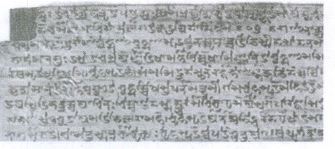
(i) Where is this manuscript preserved now?
(ii) On which material was this manuscript written?
(iii) From where have we found this manuscript?
(iv) What was this manuscript used for?
13.
Discuss the megalithic site of Inamgaon
14.
What words have been used to describe 'people' in the Rigveda?
15.
In the Rigveda people were described in terms of the work they did and the language they spoke.Fill the names of six people you know, three men and three women. For each of them, mention the work they do and the language they speak. Would you like to add anything else to the description.
16.
What were the silent sentinels behind the story of the megaliths?
17.
Oracle bones
18.
Around_____years ago, we find some of the first evidence of writing in
19.
There are four Vedas_____,______,______
20.
Sanskrit and Tamil belong to the same family of languages.
1.
The chief had died last night. The whole community had gathered near his house to pay their last homage. May be they were wearing white coloured clothes. In the fields outside, people had collected things needed for the burial. The fire was lighted and some people were cooking food. May be rice was being cooked along with vegetables in the mud pot or they may be cooking that food which was relished by the chief. The people may be chanting the holy prayers, otherwise there was silence all round.
2.
(i) About 2000 years ago, there was a famous physician named Charaka who wrote a book on medicine known as the Charaka Samhita.
(ii) There he stated that the human body has 360 bones, which is a much larger number than 200 bones that are recognised by modem anatomy.
(iii) Charaka arrived at this figure by counting the teeth, joints and cartilage.
3.
Historians read the literary sources carefully and take clues from them. On the basis of such information, they try to create an understanding of the socio-cultural political set- up and place it in the right context and time.
4.
The important differences between the Rigveda and the modern books are:
(i) The books we use today an: written and printed. Bur the Rigv~a was memorised and recited by the students and passed on to later generations. The Rigveda was printed less than 200 years ago.
(ii) The Rigveda was composed in old or Vedic Sanskrit. This is different from the Sanskrit language which is learned by students today.
5.
In Rigvedic period, Rajas fought battle for land and water and to capture cattle and people. Land was important for pasture and for growing crops. Water was needed for irrigation and daily usages. Owning a large number of cattle and dasas (whom they captured in the war) was a sign of strength of the raja in Rigvedic period.
6.
(b)
Aryas
7.
(d)
megalith
8.
(d)
soma
9.
(b)
Indo-European
10.
()
Slaves were those persons who were treated as the property of their owners.
11.
()
The oldest Veda is the Rigveda, composed about 3500 years ago.
12.
(i) This manuscript is now preserved in a library in Pune, Maharashtra
(ii) This manuscript was written on birch bark.
(iii) This manuscript has been found in Kashmir.
(iv) This manuscript was used to prepare one of the earliest printed texts of the Rigveda.
13.
Inamgaon is a site on the river God, a tributary of the river Bhima. It was occupied between 3600 and 2700 years ago.
(i) Here, adults were generally buried in the ground, laid out straight, with the head towards the north
(ii) Sometimes burials were within the houses.
(iii) Vessels that probably contained food and water were placed with the dead bodies.
(iv) One man was found buried in a large, fourlegged clay jar in the courtyard of a five-roomed house (one of the largest houses at the site) in the centre of the settlement.
(v) This house also had a granary. The body was placed in a cross-legged position.
14.
(i) There are several ways of describing people - in terms of these work they do, the language they speak, the place they belong to, their families, their communities and cultural practices.
(ii) There are two groups who are described in terms of their work - the priests, sometimes called brahmins, who performed various Rituais and the rajas. The rajas did not have capital cities, palaces or armies, nor did they collect taxes. Generally, sons did not automatically succeed fathers as rajas.
(iii) Two words were used to describe the people or the community as a whole. One was the word 'jana' and the other was 'vish'.
(iv) Several vish or jana are mentioned by names. So, we find reference to the Puru jana or vish, the Bharata jana or vish, the Yadu jana or vish, and so on.
15.
| Name | Work | Language | Anything else |
|---|---|---|---|
| i. Soniya (Sales girl in the shop) | Displays the goods in the shops and shows them to customers | Hindi, English | Tries to sell the goods as quickly as possible |
| ii.Dr. Mayank (Doctors,Male) | Give medical treatment and advice | Hindi, English | Give medicines and injections |
| iii. Shiv Charan (Vegetable sellers, Male) | Sells vegetables | Hindi | Used to haggling and tries to give less weight. |
| iv. Asha (Maid Servant,Female) | Does household work. | Hindi or Mother tongue | Cooks food |
| v. Rajeev (Driver, Male) | Drives our cars. | Hindi | Drops us to our school and home |
| vi. Aradhana (Teachers,Female) | Teaches us. | English, Hindi | Sometimes they act the scene with the help of the children |
16.
The silent sentinels behind the story of the megaliths were as follow:
(i) The big stones or the stone boulders are known as megaliths which were carefully arranged by people, and were used to mark burial sites.
(ii)The practice of erecting'megaliths began about 3000 years ago, and was prevalent throughout the Deccan, South India, in the North-East and Kashmir.
(iii) Some of the megaliths can be seen on the surface, other megalithic burials are often underground.
(iv) Archaeologists often find that a circle of stone boulders or a single large stone standing on the ground, are the only indications of burials.
(v) The burials have some common features as the dead were buried with distinctive pots, which are' called Black and Red Ware. Tools and weapons of iron and sometimes, skeletons of horses, horse equipment and ornaments of stone and gold are also found.
17.
()
On which writings has been found
18.
()
3500, China
19.
()
Rigveda, Samaveda, Yajurveda and Atharvaveda
20.
(b)

6th Standard CBSE Syllabus & Materials
6th Standard CBSE
CBSE 6th Social Science Locating Places on the Earth - New Sample Question Papers Study Material - QB365 Set A
NEW6th Standard CBSE
CBSE 6th Science A Journey Through States of Water - New Sample Question Papers Study Material - QB365 Set A
NEW6th Standard CBSE
CBSE 6th Science Temperature and its Measurement - New Sample Question Papers Study Material - QB365 Set A
NEW6th Standard CBSE
CBSE 6th Science Materials Around Us - New Sample Question Papers Study Material - QB365 Set A



CBSE 6th Standard CBSE Subjects
CBSE Standards




