
 100% FREE ACCESS
6th Standard CBSE Syllabus & Materials
6th Standard CBSE
CBSE 6th Social Science The Value of Work - New Sample Question Papers Study Material - QB365 Set A
NEW6th Standard CBSE
CBSE 6th Social Science Family and Community - New Sample Question Papers Study Material - QB365 Set A
NEW6th Standard CBSE
CBSE 6th Social Science India's Cultural Roots - New Sample Question Papers Study Material - QB365 Set A
NEW6th Standard CBSE
CBSE 6th Social Science India,That is Bharat - New Sample Question Papers Study Material - QB365 Set A
NEW6th Standard CBSE
CBSE 6th Social Science Timeline and sources of history - New Sample Question Papers Study Material - QB365 Set A
NEW6th Standard CBSE
CBSE 6th Social Science Oceans and Continents - New Sample Question Papers Study Material - QB365 Set A

Published on: 19/01/2019
What is Government? Important Five Mark Question Paper
Download CBSE Class 6th Standard CBSE Social Science question papers, sample papers, important questions, and previous year solved papers in PDF format. Get free study materials, NCERT solutions, and exam preparation resources for Class 6th Standard CBSE Social Science
Questions + Answers key
Take MCQ Social Science Test
1.
What do you understand by democracy? What did Gandhiji say about right to vote in his journal 'Young India'?
2.
State the differences between direct democracy and indirect democracy.
3.
How can citizens fight corruption?
4.
Mention any four demerits of a democratic government.
5.
What are the main features of a democratic country?
6.
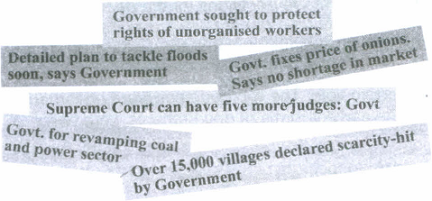
Look at the newspaper headlines above and list the different kinds of activities that the government is reported to be doing in these newspaper headlines.
1. 2. 3. 4.
(a) Isn't this a wide range of activities?
(b) What do you think government is? Discuss in class.
7.
Explain how the earliest forms of governments were not democratic
8.
When did the women's struggle get strengthened and why was this struggle called women's suffrage movement? How did women get the Right to Vote?
1.
A democratic government can be understood as a representative government where people elect their representatives through periodic elections. These representatives in turn, meet and make decisions to serve the interests of the entire population. A democratic government allows universal adult
franchise to its citizens.
However, in their earliest forms, governments allowed only men to vote. Poor people and women were exempted from this right. In this context, Gandhiji, in his journal 'Young India', rejected this idea. He held that it is not fair to extend the right to vote only to the wealthy lot. He advocated that men of good character and also poors should also be given the right to vote because poverty is not a crime.
2.
A direct democracy is a political system in which all citizens are allowed to influence policies by means of direct vote, or referendum on any particular issue. Indirect democracy is a term describing a means of governance by the people through elected representatives. Direct democracy functions well in a small community where the citizens can actively participate in the working of the government, but less suited to a big country like India, the USA and Canada, etc.
3.
Corruption is the lack of honesty and loyalty and misuse of one's position or power for money and other gains. It is immoral and leads to the misuse of country's resources.
(i) Citizens can fight corruption by not being a party to it and not offering bribe to government officials or seeking any undue favour from them.
(ii) Citizens can launch a movement against corruption by asking all voters to blacklist a party or candidate who doesn't work.
(iii) Public campaign against corruption is likely to keep the ministers on their toes and eradicate corruption.
(iv) Citizens should expose cases of corruption in public or private institutions.
4.
A Democratic Government has the following elements:
(i) In a democratic government, leaders keep on changing the parties which leads to instability of the government.
(ii) The elected leaders do not know about the best interest of the people. This leads to bad decisions.
(iii) Democracy leads to corruption as it is based on electoral competition.
(iv) In a democracy, people have to be consulted, that leads to delay in decision making.
5.
The main features of a democratic country are:
(i) People have the power to elect their representative to form and run the government and also to take decisions on their behalf.
(ii) The competitive elections are held at regular intervals.
(iii) There is aspiration of powers between the three organs of the government, i.e., Legislature, Executive and Judiciary.
(iv) People enjoy Freedom of speech and expression.
(v) Fundamental rights are enjoyed by its citizens.
(vi) There is effective participation of the people in the decision making process.
6.
List of the different kinds of activities that the government is reported to be doing in these newspaper headlines is:
(i) The Government protects the rights of unorganised workers.
(ii) The Government fixes the price of onions when they are in short supply.
(iii) The Government plans to tackle natural disasters like floods, earthquake, tsunami, ere as soon as possible.
(iv) Government revamps the coal and power sectors.
(a) Yes, the government has a wide range of activities.
(b) The government is the organisation which makes the decision with regard to:
• building roads and schools
• reducing the prices of essential commodities
• increasing the supply of electricity
• implementing several programmes to help the poor
7.
The earliest forms of government were basically a monarchy. So, the people's participation was absent. In this kind of government, a small group of people led by the monarch made decisions for the people. The final decision-making power remained with the monarch. The King or Queen did not have to explain his/her actions or defend the decisions they took. In UK and America, the government did not allow women and the poor to participate in elections.
They allowed only men who owned property and were educated, to vote. The two countries were governed by the rules and regulations that these few men made. Thus, the earliest forms of governments were not the democratic government.
8.
Women's struggle for right to vote got strengthened during the First World War. During the war, many men were away for fighting and because of this, women were called upon to do the work earlier done by men.
When people saw this, they began to realise that they had created many unfair stereotypes about women. Then women organised themselves and demanded equal right as men. This movement is called the women's suffrage movement as the term suffrage usually means the right to vote.
All women demanded the right to vote for themselves and to get their demands heard, they chained themselves to railing in public places. Many suffragettes were imprisoned and went on hunger strikes.
Finally, in 1920 America provided voting right for women and later in 1928 UK also gave them the right to vote.

6th Standard CBSE Syllabus & Materials
6th Standard CBSE
CBSE 6th Social Science Locating Places on the Earth - New Sample Question Papers Study Material - QB365 Set A
NEW6th Standard CBSE
CBSE 6th Science A Journey Through States of Water - New Sample Question Papers Study Material - QB365 Set A
NEW6th Standard CBSE
CBSE 6th Science Temperature and its Measurement - New Sample Question Papers Study Material - QB365 Set A
NEW6th Standard CBSE
CBSE 6th Science Materials Around Us - New Sample Question Papers Study Material - QB365 Set A



CBSE 6th Standard CBSE Subjects
CBSE Standards




