
 100% FREE ACCESS
6th Standard Syllabus & Materials
6th Standard
TN 6th Tamil பருவம் 1 - இயல் 1 - மொழி -தமிழ்த்தேன் - இன்பத்தமிழ் Sample Question Papers Study Material - QB365 Set A
NEW6th Standard
TN 6th English T1 - Supplementary - The Apple Tree and The Farmer Sample Question Papers Study Material - QB365 Set A
NEW6th Standard
TN 6th English T1 - Prose - When The Trees Walked Sample Question Papers Study Material - QB365 Set A
NEW6th Standard
TN 6th Social Science T3 - CIV - Road Safety Sample Question Papers Study Material - QB365 Set A
NEW6th Standard
TN 6th Social Science T3 - CIV - Local Bodies - Rural and Urban Sample Question Papers Study Material - QB365 Set A
NEW6th Standard
TN 6th Social Science T3 - CIV - Democracy Sample Question Papers Study Material - QB365 Set A

Published on: 13/05/2022
QB365 provides detailed and simple solution for every book back questions in class 6 Maths subject.It will helps to get more idea about question pattern in every book back questions with solution.
latest Book back QuestionsDownload Tamil Nadu 6th Standard Maths question papers, model tests, one-mark questions, important questions, and public exam papers in PDF format. Free study materials and answer keys for TN State Board students.
Questions + Answers key
Take MCQ Maths Test1.
Use a protractor to draw an obtuse angle 120°.
2.
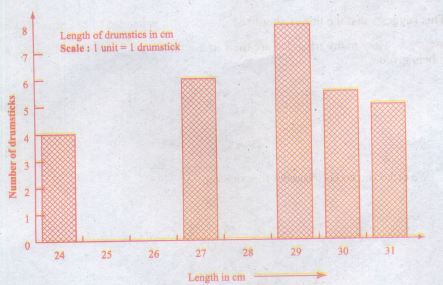
The lengths (in the nearest centimetre) of 30 drumsticks are given as follows.
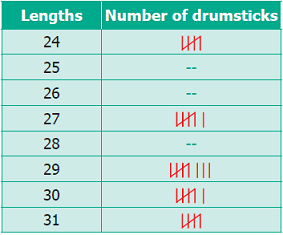
Draw the bar graph showing the same information.
3.
The bar graph illustrates the results of a survey conducted on vehicles crossing over a Toll Plaza in one hour.
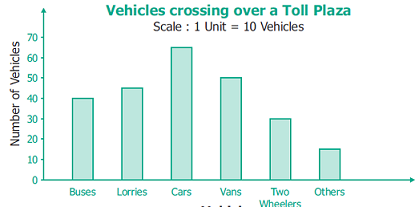
Observe the bar graph carefully and fill up the following table.
| Vehicles | Vans | Buses | Cars | Others | Total vehicles | ||
| Number of Vehicles | 30 | 45 |
4.
Yasmin of class VI was given a task to count the number of books which are biographies, in her school library. The information collected by her is represented as follows.
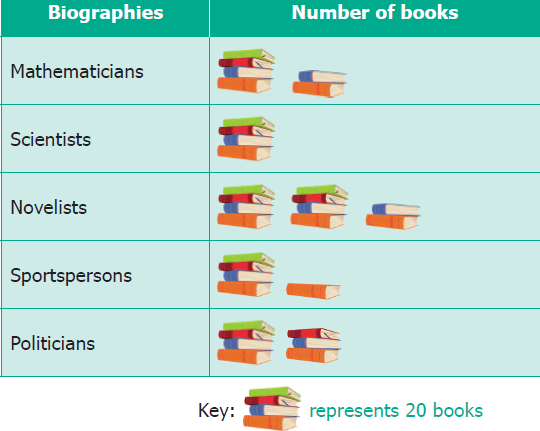
Observe the pictograph and answer the following questions.
(i) Which title has the maximum number of biographies?
(ii) Which title has the minimum number of biographies?
(iii) Which title has exactly half the number of biographies as Novelists?
(iv) How many biographies are there on the title of Sportspersons?
(v) What is the total number of biographies in the library?
5.
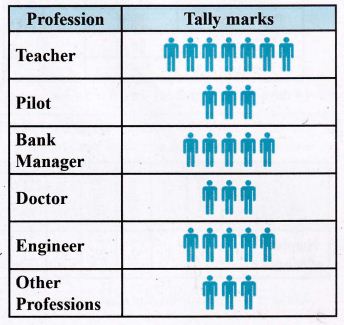
26 students were interviewed to find out what they want to become in future. Their responses are given in the following table.
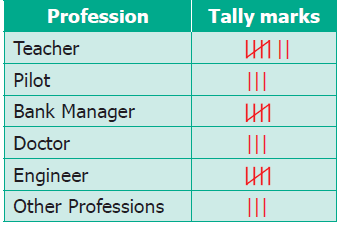
Represent this data using Pictograph.
6.
The prediction of Weather in the month of September is given below.
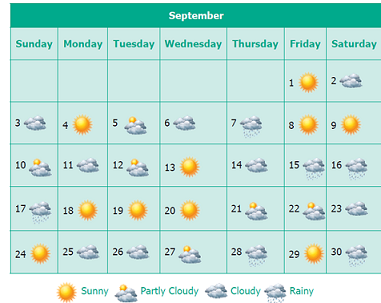
(i) Make a frequency table of the types of weather by reading the calendar.
(ii) How many days are either cloudy or partly cloudy?
(iii) How many days do not have rain? Give two ways to find the answer?
(iv) Find the ratio of the number of Sunny days to Rainy days.
7.
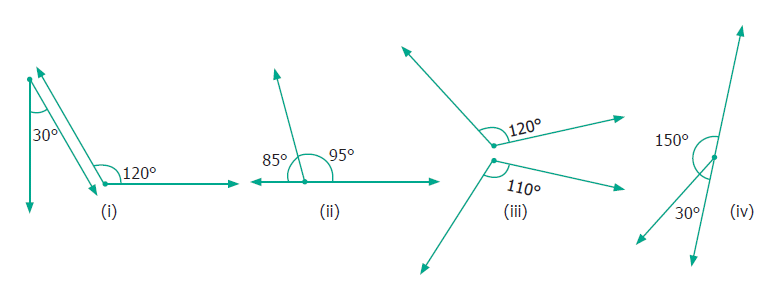
From the figures given below, classify the following pairs of angles into supplementary and non supplementary
8.
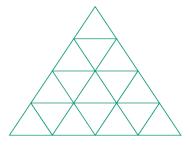
Find the minimum number of straight lines used in forming the following figures.
9.
Find the minimum number of straight lines used in forming the following figures.

10.
Count the number of squares in each of the following figures?

11.
Name the following angles as shown in the figure.
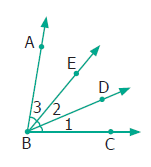
(i) ∠1 =
(ii) ∠2 =
(iii) ∠3 =
(iv) ∠1 + ∠2 =
(v) ∠2 + ∠3 =
(vi) ∠1 + ∠2 + ∠3 =
12.
The heights (in centimeters) of 40 children are.
110 112 112 116 119 111 113 115 118 120
110 113 114 111 114 113 110 120 118 115
112 110 116 111 115 120 113 111 113 120
115 111 116 112 110 111 120 111 120 111
Prepare a tally mark table.
13.

(i) Draw the next pattern.
(ii) Prepare a table for the number of dots used for each pattern.
(iii) Explain the pattern.
(iv) Find the number of dots in the 25th pattern.
14.
Read the given Bar Graph which shows the percentage of marks obtained by Brinda in different subjects in an assessment test.
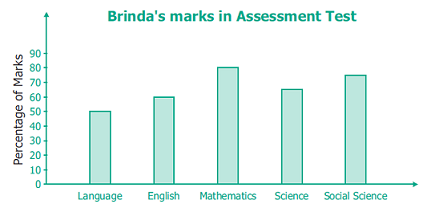
Observe the Bar Graph and answer the following questions.
(i) 1 Unit = __________ % of marks on vertical line.
(ii) Brinda has scored maximum marks in __________ subject.
(iii) Brinda has scored minimum marks in __________ subject.
(iv) The percentage of marks scored by Brinda in Science is __________.
(v) Brinda scored 60% marks in the subject __________.
(vi) Brinda scored 20% more in __________ subject than __________ subject.
15.
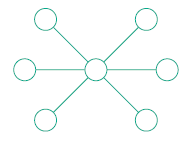
Put the numbers 1, 2, 3, 4, 5, 6, & 7 in the circles so that each straight line of three numbers add up to the same total.
16.
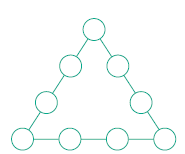
Using the numbers from 1 to 9
(i) Can you form a magic triangle?
(ii) How many magic triangles can be formed?
(iii) What are the sums of the sides of the magic triangle?
17.
Thirumagal's mother wears a bracelet made of 35 red beads and 30 blue beads. Thirumalgal wants to make smaller bracelets using the same two coloured beads in the same ratio. In how many different ways can she make the bracelets?

18.
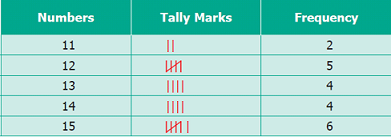
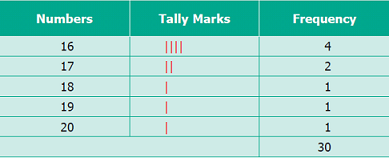
The following are the marks obtained by 30 students in a class test out of 20 in Mathematics subject.
11 12 13 12 12 15 16 17 18 12
20 13 13 14 14 14 15 15 15 15
16 16 16 15 14 13 12 11 19 17
Prepare a table using Tally Marks.
19.
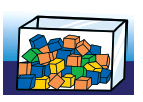
I have a box which has 3 green, 9 blue, 4 yellow, 8 orange coloured cubes in it.
(a) What is the ratio of orange to yellow cubes?
(b) What is the ratio of green to blue cubes?
(c) How many different ratios can be formed, when you compare each colour to anyone of the other colours?
20.
Karmegan made 54 runs in 9 overs and Asif made 77 runs in 11 overs. Whose run rate is better? (run rate = ratio of runs to overs)
21.
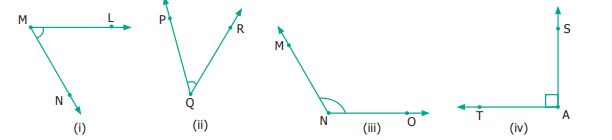
Name the angle in each figure given below in all the possible ways.
22.
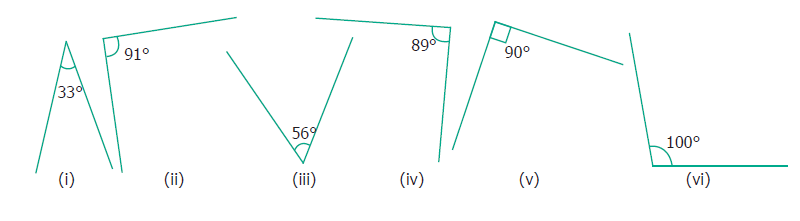
Pick out the Acute angles from the given figures.
23.
A picture is resized in a computer as shown below.
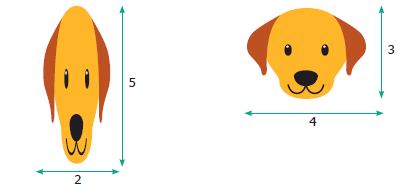
Do you observe any change in the shape and size of the picture? Check whether the ratios formed by its length and breadth are in proportion by cross product method.
24.
In a family, the amount spent in a month for buying Provisions and Vegetables are in the ratio 3 : 2. If the allotted amount is Rs. 4000, then what will be the amount spent for (i) Provisions and (ii) Vegetables?
25.
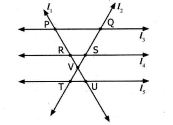
From the given figure, name
(i) all pairs of parallel lines.
(ii) all pairs of intersecting lines.
(iii) pair of lines whose point of intersection is ‘V’.
(iv) point of intersection of the lines ‘ l2’ and ‘l3’.
(v) point of intersection of the lines ‘l1’ and ‘l5’.
1.
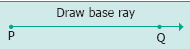 |
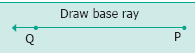 |
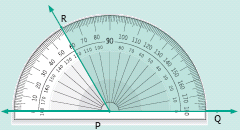 Place the centre of the protractor at the vertex P. Line up the ray\(\overrightarrow{PQ}\) with the 0° line. Then draw and label a point (R) at the 120° mark on the inner scale (anti clock wise) |
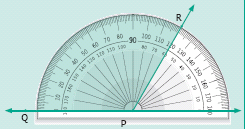 Place the centre of the protractor at the vertex P. Line up the ray \(\overrightarrow{PQ}\) with the 0° line. Then draw and label a point (R) at the 120° mark on the outer scale (clock wise) |
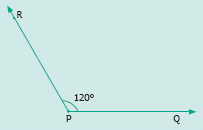 Remove the protractor and draw \(\overrightarrow{PR}\) to complete the angle. Now, ∠P = ∠QPR = ∠RPQ =120° |
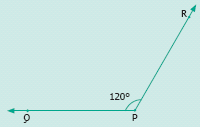 Remove the protractor and draw\(\overrightarrow{PR}\) to complete the angle. Now, ∠P = ∠QPR = ∠RPQ =120° |
2.
The bar graph showing the same information is given below:
3.
| Vehicles | Vans | Two Wheelers | Buses | Lorries | Cars | Others | Total vehicles |
| Number of Vehicles | 50 | 30 | 40 | 45 | 65 | 15 | 245 |
4.
i) Novelists
ii) Scientists
iii) Sports persons
iv) 25
v) 160
5.
6.
i)
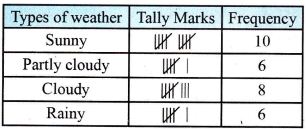
ii) 14 days
iii) 24 days
iv) 10 : 6 = 5 :3
7.
ii) and iv) are supplementary angles
i) and iii) are non supplementary angles
8.
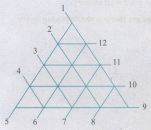
There are 12 straight lines used which is minimum.
9.
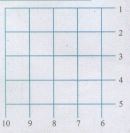
There are 5 horizontal lines and 5 vertical lines.
Total 10 lines minimum needed.
10.
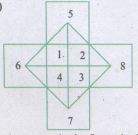
As we see in the figure in the middle 1, 2, 3 and 4 are 4 small squares.
Also we have 9 and 10 => 2 big squares. Outer squares 5, 6, 7, & 8 => 4.
Total = 4 + 4 + 1 + 1 = 10 squares.
11.
i) ∠1 = ∠CBD or ∠DBC
ii) ∠2 = ∠DBE or ∠EBD
iii) ∠3 = ∠ABE or ∠EBA
iv) ∠1+∠2 = ∠CBE or ∠EBC
v) ∠2 + ∠3 = ∠ABD or ∠DBA
vi) ∠1 + ∠2 + ∠3 = ∠ABC or ∠CBA
12.
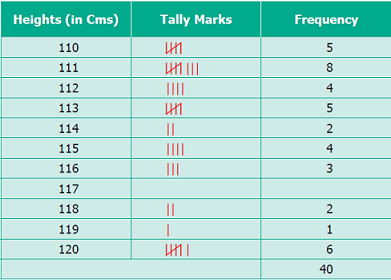
13.
(i) The next pattern is 
(ii)
| Pattern | 1 | 2 | 3 | 4 | 5 |
| Number of dots | 2 | 5 | 9 | 14 | 20 |
(iii)
| Pattern | Number of dots |
| 1 | 2 |
| 2 | 2+3 |
| 3 | 2+3+4 |
| 4 | 2+3+4+5 |
First number is 2
2nd number is 2 + 3 = 5
3rd number is 5 + 4 = 9
4th number is 9 + 5 = 14
5th number is 14 + 6 = 20
(iv) Number of dots in the 25th pattern is
| Pattern | 1 | 2 | 3 | 4 | 5 | 6 | 7 | 8 | 9 | 10 | 11 | 12 | 13 | 14 | 15 | 16 | 17 | 18 | 19 | 20 | 21 | 22 | 23 | 24 | 25 |
| No. of dots | 2 | 5 | 9 | 14 | 20 | 27 | 35 | 44 | 54 | 65 | 77 | 90 | 104 | 119 | 135 | 152 | 170 | 189 | 209 | 230 | 252 | 275 | 299 | 324 | 350 |
\(\therefore \) Number of dots in the 25th pattern = 350.
14.
i) 10%
ii) Mathematics
iii) Language
iv) 65%
v) English
vi) Mathematics; Science
15.
Here there are even number of terms.
Also we know that 1 + 6 = 7, 2 + 5 = 7, 3 + 4 = 7;
so placing 7 at the centre, and the pairs (1, 6) (2, 5) and (3, 4) at the opposite ends we get, the answer.
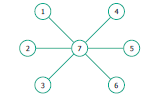
16.
(i) Yes
(ii) 5
(iii)
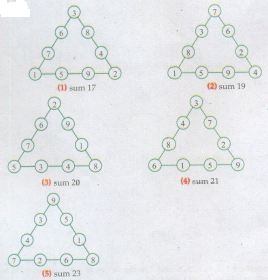
Sums are 17, 19, 20, 21 and 23.
17.
Ratio of red beads: blue beads = 35: 30
Fraction of 35 : 30 \(=\frac{35}{30}\)
= 7:6
Also given that the bracelet made is smaller in size
∴ The possible ways are red beads: blue beads
The equivalent ways are
\(
\frac{7 \times 2}{6 \times 2}=\frac{14}{12}=14: 12
\)
\( \frac{7 \times 3}{6 \times 3}=\frac{21}{18}=21: 18
\)
\( \frac{7 \times 4}{6 \times 4}=\frac{28}{24}=28: 24\)
= 7 : 6 (or) 14: 12 (or) 21 : 18 (or) 28 : 24
In 4 different way can she made.
18.
19.
Number of green cubes = 3
Number of blue cubes = 9
Number of yellow cubes = 4
Number of orange cubes = 8
(a) Ratio of orange to yellow cubes = \(\frac { Number\ of\ orange\ cubes }{ Number\ of\ yellow\ cubes } \)
=\(\frac { 8 }{ 4 } =\frac { 2 }{ 1 } \) = 2 : 1
Ratio of orange to yellow cubes = 2 : 1
(b) \(\frac { Number\ of\ green\ cubes }{ Number\ of\ blue\ cubes } =\frac { 3 }{ 9 } =\frac { 1 }{ 3 } \)
Ratio of green to blue cubes = 1 : 3
(c) The ratios can be Orange:
Yellow, Orange: blue, Orange: green, Yellow: orange, yellow: blue, yellow: green, blue: green, blue: orange, blue: yellow, green: orange, green: yellow, green: blue. Thus 12 ratios can be formed.
i.e., the possiblity of forming the different ratios
3 : 9, 3 : 4, 3 : 8
9 : 3, 9 : 4, 9 : 8
4 : 3, 4 : 9, 4 : 8
8 : 3, 8 : 9, 8 : 4
20.
Run rate = Ratio of runs to overs
Run rate of Karmegam = \(\frac { 54 }{ 9 } \) = \(\frac { 6 }{ 1 } \) = 6 :1
Run rate of Asif = \(\frac { 77 }{ 11 } \) = \(\frac { 7 }{ 1 } \) = 7 :1
∴ Asif's run rate is better.
21.
i) \(\angle L M N, \angle N M L, \angle M\)
ii) \(\angle P Q R, \angle R Q P, \angle Q\)
iii) \(\angle \mathrm{MNO}, \angle \mathrm{ONM}, \angle \mathrm{N}\)
iv) \(\angle \mathrm{TAS}, \angle \mathrm{SAT}, \angle \mathrm{A}
\)
22.
(i), (ii) and (iii) are acute angles
23.
The given pictures are in the ratio 2 : 5 and 4 : 3 respectively.
Here the extremes are 2 and 3 and the means are 5 and 4.
Product of extremes, ad = 2 \(\times\)3 = 6.
Product of means, bc = 5 \(\times\) 4 = 20.
Thus, we find ad\(\neq\) bc and hence 2 : 5 and 4 : 3 are not in proportion.
24.
(i) For Provisions:
Dividing the total amount Rs. 4000 into 3 + 2 = 5 equal parts then
3 out of 5 parts are spent for provisions & 2 out of 5 parts for vegetables
\(\therefore 4000\times\frac{3}{5}=2400\) for provisions
(ii) For vegetables:
\(4000\times\frac{2}{5}=1600\) for Vegetables
\(\therefore\) Rs.2400 spend on provisions & Rs.1600 spend on Vegetables
25.
(i) all pairs of parallel lines.
l3 and l4 ,l4 and l5 ,l3 and l5
(ii) all pairs of intersecting lines.
l1 and l2, l1 and l3 , l1 and l4 , l1 and l5 , l2 and l3 , l2 and l4, l2 and l5
(iii) pair of lines whose point of intersection is ‘V’.
l1 and l2
(iv) point of intersection of the lines ‘ l2’ and ‘l3’. l1 and l2
Q
(v) point of intersection of the lines ‘l1’ and ‘l5’.
U

6th Standard Syllabus & Materials
6th Standard
TN 6th Social Science T3 - GEO - Understanding Disaster Sample Question Papers Study Material - QB365 Set A
NEW6th Standard
TN 6th Social Science T3 - GEO - Globe Sample Question Papers Study Material - QB365 Set A
NEW6th Standard
TN 6th Social Science T3 - GEO - Asia and Europe Sample Question Papers Study Material - QB365 Set A
NEW6th Standard
TN 6th Social Science T3 - HIS - South Indian Kingdoms Sample Question Papers Study Material - QB365 Set A



Tamilnadu Stateboard 6th Standard Subjects
Tamilnadu Stateboard Standards




