
 100% FREE ACCESS
6th Standard Syllabus & Materials
6th Standard
TN 6th Tamil பருவம் 1 - இயல் 1 - மொழி -தமிழ்த்தேன் - இன்பத்தமிழ் Sample Question Papers Study Material - QB365 Set A
NEW6th Standard
TN 6th English T1 - Supplementary - The Apple Tree and The Farmer Sample Question Papers Study Material - QB365 Set A
NEW6th Standard
TN 6th English T1 - Prose - When The Trees Walked Sample Question Papers Study Material - QB365 Set A
NEW6th Standard
TN 6th Social Science T3 - CIV - Road Safety Sample Question Papers Study Material - QB365 Set A
NEW6th Standard
TN 6th Social Science T3 - CIV - Local Bodies - Rural and Urban Sample Question Papers Study Material - QB365 Set A
NEW6th Standard
TN 6th Social Science T3 - CIV - Democracy Sample Question Papers Study Material - QB365 Set A

Published on: 18/06/2021
QB365 provides detailed and simple solution for every book back questions in class 6 Maths subject.It will helps to get more idea about question pattern in every book back questions with solution.
Download Tamil Nadu 6th Standard Maths question papers, model tests, one-mark questions, important questions, and public exam papers in PDF format. Free study materials and answer keys for TN State Board students.
Questions + Answers key
Take MCQ Maths Test1.
Which of the following statements is true? Why?
(a) Every equilateral triangle is an isosceles triangle.
(b) Every isosceles triangle is an equilateral triangle.
2.
If one angle of an isosceles triangle is 124°, then find the other angles.
3.
I am a closed figure with each of my three angles is 60°. Who am I?
4.
Classify the given triangles based on its angles as acute angled, right angled or obtuse angled.
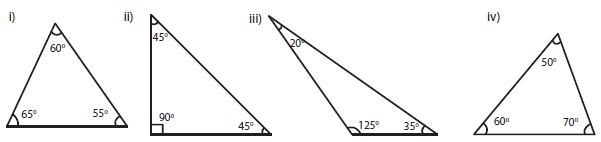
5.
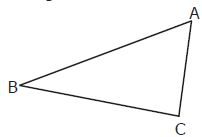
In \(\Delta\)ABC, name the
a) Three sides: ______ , ______ , _______
b) Three Angles: ______ , ______ , _______
c) Three Vertices: ______ , _______ , _______
6.
A vegetable vendor buys 10 kg of tomatoes per day at Rs. 10 per kg, for the first three days of a week. 1 kg of tomatoes got smashed on everyday for those 3 days. For the remaining 4 days of the week he buys 15 kg of tomatoes daily at Rs. 8 per kg. If for entire week he sells tomatoes at Rs. 20 per kg, then find his profit or loss for the week.
7.
A fruit seller bought 2 dozen bananas at Rs. 20 a dozen and sold them at Rs. 3 per banana. Find his gain or loss.
8.
Nathan paid Rs. 800 and bought 10 bottles of honey from a village vendor. He sold them in a city for Rs. 100 per bottle. Find his profit or loss.
9.
Valavan bought 24 eggs for Rs. 96. Four of them were broken and also he had a loss of Rs. 36 on selling them. What is the selling price of one egg?
10.
Seetha wakes up at 5.20 a.m. She spends 35 minutes to get ready and travels 15 minutes to reach the railway station. If the train departs exactly at 6:00 a.m, will Seetha catch the train?
11.
A room has a door whose measures are 1 m wide and 2 m 50 cm high.
i. Can we take a bed of 2 m and 20 cm length and 90 cm wide into the room.?
12.
Put  mark in the circles which adds upto the given measure.
| 1. | 1 Kg |  500 g |
50 g |
100 g |
200 g |
250 g |
| 2. | 1 m | 10 cm |
30 cm |
40 cm |
25 cm |
5 cm |
| 3. | 1 l | 200 ml |
100 ml |
50 ml |
500 ml |
200 ml |
13.
Two pipes whose lengths are 7 m 25 cm and 8 m 13 cm joined by welding and then a small piece 60 cm is cut from the whole. What is the remaining length of the pipe?
14.
Calculate the duration of time
(i) from 5.30 a.m to 12.40 p.m
(ii) from 1.30 p.m to 10.25 p.m
(iii) from 20:00 hours to 4:00 hours
(iv) from 17:00 hours to 5:15 hours
15.
A bag contains 81 kg of sugar. If the shopkeeper fill up these into small packets of 750 g each, then how many packets can be made from 81 kg of sugar?
16.
Convert 526 ml into l
17.
Find the smallest number which is exactly divisible by all the numbers from 1 to 9.
18.
The sum of three prime numbers is 80. The difference of two of them is 4. Find the numbers.
19.
Is 173 a prime? Why?
20.
Find the HCF and the LCM of the numbers 154, 198 and 286.
21.
Find the HCF of each set of numbers using prime factorisation method.
(i) 18, 24 (ii) 51, 85 (iii) 61, 76 (iv) 84, 120 (v) 27, 45, 81 (vi) 45, 55, 95
22.
Find the prime factorisation of each number by factor tree method and division method.
a) 60
b) 128
c) 144
d) 198
e) 420
f) 999
23.
The sum of any three odd natural numbers is odd. Justify this statement with an example.
24.
Write the smallest and the biggest two digit prime number.
25.
Express 42 and 100 as the sum of two consecutive primes.
1.
'a' is true.
An isosceles triangle need not have three equal sides.
2.
Given
One angle of an isoceles triangle = 124°
The sum of three angles of a triangle is = 180°
= 180° - 124° = 56°
Sum of other two angles are = 56°
Two angles are same = 56°/ 2 = 28°
Other angles are 28°, 28°.
3.
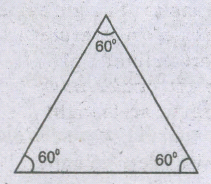
All angles are equal.
I am an equilateral triangle.
4.
i)
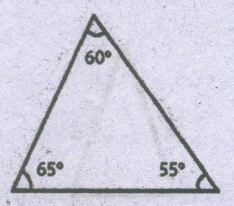
3 angles are acute.
Type: Acute angled triangle.
ii)
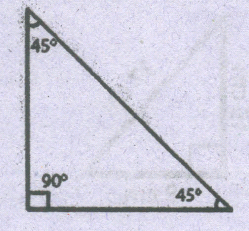
One angle is right angle.
Type: Right angled triangle.
iii)
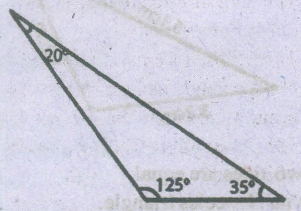
One angle is obtuse.
Type: Obtuse angled triangle.
iv)
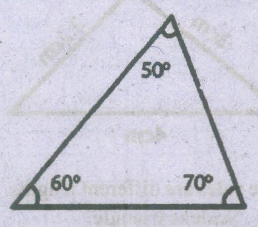
All angles are acute.
Type: Acute angled triangle.
5.
(a) Three Sides : \(\overline{\mathrm{AB}}, \overline{\mathrm{BC}}, \overline{\mathrm{CA}}\)
(b) Three Angles : \(
\angle \mathbf{A B C}, \angle \mathbf{B C A}, \angle \mathbf{C A B}
\) or \( \angle \mathbf{A}, \angle \mathbf{B}, \angle \mathbf{C} \)
(c) Three Vertices : A, B, C
6.
Total no. of days = 7
first 3 days (c.p) (10 Kgs)
1 kg = Rs. 10
1 kg of tomatoes got smashed everyday
1st day = 9kg \(\times\) 10 = Rs. 90
2nd day = 8kg \(\times\) 10 = Rs. 80
3rd day = 7kg \(\times\) 10 = Rs. 70
Total = Rs. 240
Next 4 days (c.p) (15 kgs)
1 kg = Rs. 8
1st day = 15 \(\times\) 8 = Rs. 120
2nd day = 15 \(\times\) 8 = Rs. 120
3rd day = 15 \(\times\) 8 = Rs. 120
4th day = 15 \(\times\) 8 = Rs. 120
Total = Rs. 480
c.p of 1 week = Rs. 240 + Rs. 480 = Rs. 720
Next 3 days (s.p) (15 kgs)
1 kg = Rs. 20
1st day = 9 \(\times\) 20 = Rs. 180
2nd day = 8 \(\times\)20 = Rs. 160
3rd day = 7 \(\times\) 20 = Rs. 140
Total = Rs. 480
Next 4 days (s.p) (15 kgs)
1st day = 15 \(\times\) 20 = Rs. 300
2nd day = 15 \(\times\) 20 = Rs. 300
3rd day = 15 \(\times\) 20 = Rs. 300
4th day = 15 \(\times\) 20 = Rs. 300
= Rs. 1200
s.p = Rs. 480 + Rs. 1,200
= Rs. 1680 - Rs. 720
= Rs. 960
7.
A fruit seller bought 2 dozen bananas.
1 dozen = Rs. 20
2 dozen = Rs. 20 \(\times\) 2
Therefore 24 bananas = Rs. 40
c.p = Rs. 40
s.p = 1 banana = Rs. 3
24 banana = Rs. 3 \(\times\) 24 = 72
s.p = Rs. 72
Here, s.p > c.p
Therefore, profit = s.p - c.p
= Rs. 72 - Rs. 40
Gain = Rs. 32
8.
Given
Nathan Paid = Rs. 800
10 Bottles = Rs. 800
c.p = Rs. 800
He sold them in a city for Rs. 100 per bottle.
1 bottle = Rs.100
Therefore 10 bottles = 10\(\times\)100
s.p = Rs.1000
Here, s.p > c.p
Therefore profit = s.p - c.p
= Rs. 1,000 - Rs. 800
Profit = Rs. 200
9.
Given
24 eggs (c.p) = Rs. 96
4 eggs were broken
Therefore 24 - 4 = 20 eggs
Loss = Rs. 36
s.p = c.p - loss
= Rs. 96 - Rs. 36
= Rs. 60
Therefore the selling price of one egg
= 60 / 20 = Rs. 3
10.
Seetha wakes up at 5.20 a.m.
She spends = 35 min.
Travels to reach the Railway Station = 15 min
Departure time exactly = 6.00 a.m.
Time taken to Seetha = 05.20 + 00.35 + 00.15 = 06.10
Therefore 10 minutes later.
Therefore she will not catch the train.
11.
i) (Rectangle Shape)
A door has 1m wide and 2 m 50 cm high.
Therefore l = 2 m 50 cm = 250 cm
b = 1 m = 100 cm
Area = I \(\times\) b = 250 \(\times\) 100 = 25000 cm2
ii) A bed have 2 m and 20 cm length and 90 cm wide.
Therefore I = 2 m 20 cm = 220 cm
b = 90 cm
Area = I \(\times\) b = 220 \(\times\) 90 = 19,800 cm2
Area of door > Area of a bed
Yes, we can take a bed into the room,
12.
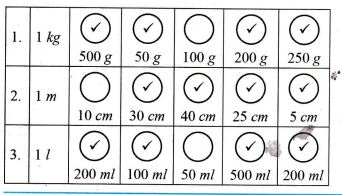
13.
| m | cm | |
| First Pipe's length | 7 | 25 |
| Second Pipe's length | 8 | 13 |
| Totallength | 15 | 38 |
Now a small piece 60 cm is cut from the whole.
Therefore remaining length of the pipe = 00 m 60 cm = 14 m 78 cm
Therefore remaining length = 14m 78cm.
14.
i) 12.00 - 5.30 = 06.30 + 0.40 = 7.10
Therefore 7 hours 10 minutes
ii)10.25 p.m - 1.30 p.m = 8.55 p.m
Therefore 8 hours 55 minutes
iii) 24.00 p.m - 20.00 p.m = 4.00 hours = 4.00 hours + 4.00 hours = 8.00 hours
Therefore 8 hours
iv) 24.00 - 17.00 = 7.00
= 7.00 + 5.15 = 12.15
Therefore 12 hours 15 mintues
15.
Quantity of sugar in the bag = 81 kg
Quantity of sugar in each packet =750 g
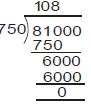
Number of packets required = 81 kg \(\div \) 750 g
= 81 \(\times\) 1000 g \(\div \) 750 g
= 81000 g \(\div \) 750 g
= 108
16.
526 ml = \(526.0\times \frac { 1 }{ 1000 } l\) 1l = 1000 ml
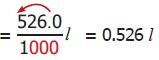 \(\frac { 1 }{ 1000 } l=1\ ml\)
17.
Given: numbers are 1 to 9.
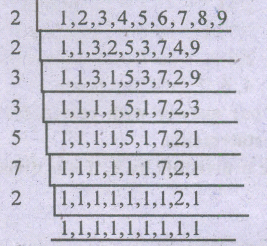
Therefore the smallest number
= \(2 \times 2 \times 3 \times 3 \times 5 \times 7 \times 2\)
= 2520
18.
Given statement
The sum of 3 prime numbers is 80.
The difference of two of them is 4.
Let the 3 prime numbers be x, y and z
x + y + z = 80 and z - y = 4
Prime numbers are
2, 3, 5, 7, 11, 13, 17, 19, 23, 29, 31, 37, 41, 43, 47, 53, 59, 61, 67, 71, 73, 79
80 = 2 + 37 + 41
= z - y
= 41 - 37 = 4
Therefore x = 2, y = 37, z = 41
Ans : The 3 prime numbers are 2, 37 and 41.
19.
Yes, given number is 173,
factors are 173 = 1, 173
173 have only two factors.
Therefore is a prime number.
20.
i) LCM
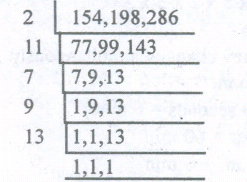
Therefore LCM = \(2 \times 11 \times 7 \times 9 \times 13\) = 18018
ii) HCF
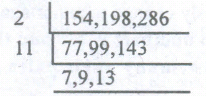
Therefore HCF = 2 \(\times\) 11 = 22
21.
i) 18, 24
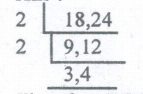
Therefore HCF = 2 \(\times\) 3 = 6
ii) 51, 85
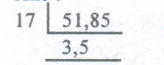
Therefore HCF = 17
iii) 61, 76
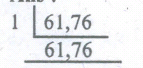
Therefore HCF = 1
iv) 84, 120
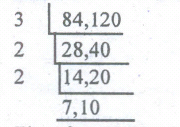
Therefore HCF = 3 \(\times\) 2 \(\times\) 2 = 12
v) 27, 45, 81
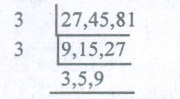
Therefore HCF = 3 \(\times\) 3 = 9
vi) 45, 55, 95
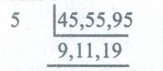
Therefore HCF = 5
22.
a) 60
i) Division method:
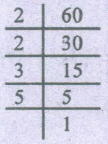
Therefore 60 = \(2 \times 2 \times 3 \times 5\)
(ii) Factor Tree method:
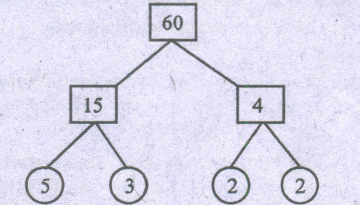
b) 128
i) Division method:
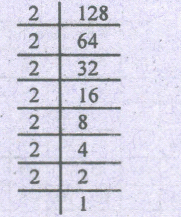
Therefore 128 = \(2 \times 2 \times 2 \times 2 \times 2 \times 2 \times 2\)
(ii) Factor Tree method:
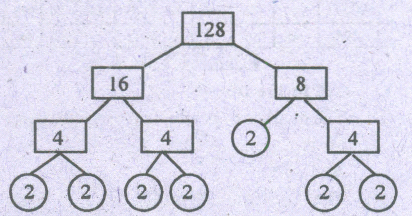
Therefore 128 = \(2 \times 2 \times 2 \times 2 \times 2 \times 2 \times 2\)
c) 144
i) Division method:
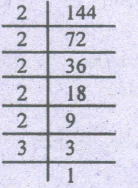
Therefore 144 = \(2\times 2 \times 2 \times 2 \times 3 \times 3\)
ii) Factor Tree method:
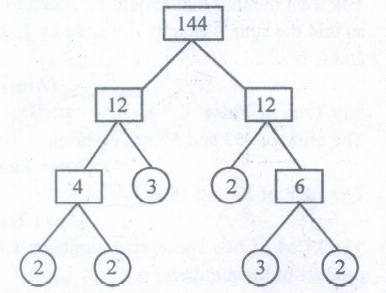
Therefore 144 = \(2 \times 2 \times 2 \times 2 \times 3 \times 3 .\)
d) 198
i) Division method:
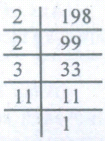
Therefore 144 = \(2 \times 3 \times 3 \times 11\)
ii) Factor Tree method:
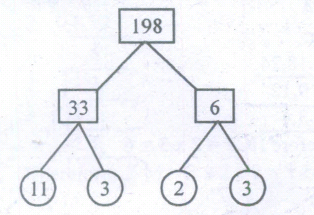
Therefore 144 = \(2 \times 3 \times 3 \times 11\)
e) 420
i) Division method:
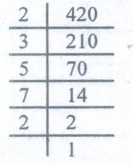
Therefore 420 = \(2 \times 2 \times 3 \times 5 \times 7\)
ii) Factor Tree method.
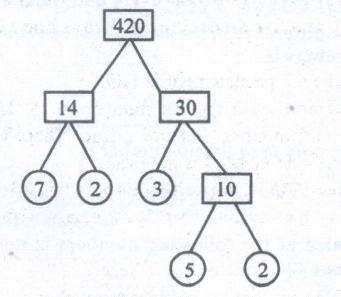
Therefore 420 = \(2 \times 2 \times 3 \times 5 \times 7\)
f) 999
i) Division method:
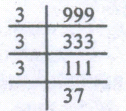
Therefore 999 = \(3 \times 3 \times 3 \times 37\)
ii) Factor Tree method:
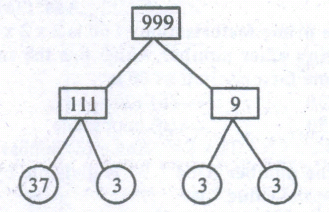
Therefore 999 = \(3 \times 3 \times 3 \times 37\)
23.
Let 3 odd natural numbers are 3, 7 and 9.
Sum = 3 + 7 + 9 = 19 is odd.
This statement is true.
24.
The Smallest two digit prime number = 11
The Biggest two digit prime number = 97
25.
42 = 19+23;
100 = 47+53

6th Standard Syllabus & Materials
6th Standard
TN 6th Social Science T3 - GEO - Understanding Disaster Sample Question Papers Study Material - QB365 Set A
NEW6th Standard
TN 6th Social Science T3 - GEO - Globe Sample Question Papers Study Material - QB365 Set A
NEW6th Standard
TN 6th Social Science T3 - GEO - Asia and Europe Sample Question Papers Study Material - QB365 Set A
NEW6th Standard
TN 6th Social Science T3 - HIS - South Indian Kingdoms Sample Question Papers Study Material - QB365 Set A



Tamilnadu Stateboard 6th Standard Subjects
Tamilnadu Stateboard Standards




