
 100% FREE ACCESS
6th Standard Syllabus & Materials
6th Standard
TN 6th Tamil பருவம் 1 - இயல் 1 - மொழி -தமிழ்த்தேன் - இன்பத்தமிழ் Sample Question Papers Study Material - QB365 Set A
NEW6th Standard
TN 6th English T1 - Supplementary - The Apple Tree and The Farmer Sample Question Papers Study Material - QB365 Set A
NEW6th Standard
TN 6th English T1 - Prose - When The Trees Walked Sample Question Papers Study Material - QB365 Set A
NEW6th Standard
TN 6th Social Science T3 - CIV - Road Safety Sample Question Papers Study Material - QB365 Set A
NEW6th Standard
TN 6th Social Science T3 - CIV - Local Bodies - Rural and Urban Sample Question Papers Study Material - QB365 Set A
NEW6th Standard
TN 6th Social Science T3 - CIV - Democracy Sample Question Papers Study Material - QB365 Set A

Published on: 18/06/2021
QB365 provides detailed and simple solution for every book back questions in class 6 Maths subject.It will helps to get more idea about question pattern in every book back questions with solution.
Download Tamil Nadu 6th Standard Maths question papers, model tests, one-mark questions, important questions, and public exam papers in PDF format. Free study materials and answer keys for TN State Board students.
Questions + Answers key
Take MCQ Maths Test1.
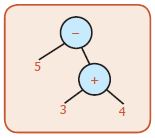
A football team gains 3 and 4 points for successive 2 days and loses 5 points on the third day. Find the total points scored by the team and also represent this in tree diagram.
2.
Write the numerical expression which gives the answer 10 and also convert into tree diagram.
3.
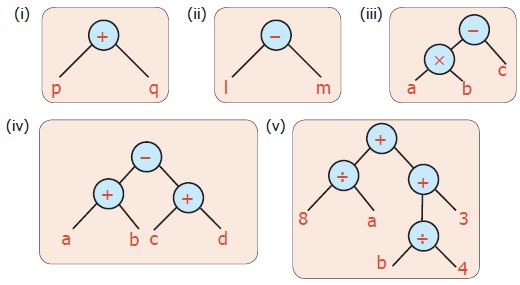
Convert Tree diagrams into Algebraic expressions.
4.
Complete the following table :
| Types of Triangle /Its Angles | Acute angled triangle | Right angled triangle | Obtuse angled triangle |
| Any two angles | Always acute angles | i. | Always acute angles |
| Third angle | ii. | Right angle | iii. |
5.
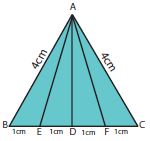
Study the given figure and identify the following triangles.
(a) equilateral triangle
(b) isosceles triangles
(c) scalene triangles
(d) acute triangles
(e) obtuse triangles
(f) right triangles
6.
Draw a line and mark a point R at a distance of 4.8 cm above the line. Through R draw a line parallel to the given line.
7.
Construct a line perpendicular to the given line through a point above it.
8.
Using the given information, write the type of triangle in the table given below
| S.No. | \(\angle \)1 | \(\angle \)2 | \(\angle \)3 | Type of triangle based on angles | Type of triangle based on sides |
| i. | 60° | 40° | 80° | Acute angled triangle. | Scalene Triangle |
| ii. | 50° | 50° | 80° | ||
| iii. | 45° | 45° | 90° | ||
| iv. | 55° | 45° | 80° | ||
| v. | 75° | 35° | 70° | ||
| vi. | 60° | 30° | 90° | ||
| vii. | 25° | 64° | 91° | ||
| viii. | 120° | 30° | 30° |
9.
Can a triangle be formed with the following angles? If yes, name the type of triangle.
(i) 60°, 60°, 60°
(ii) 90°, 55°, 35°
(iii) 60°, 40°, 42°
(iv) 60°, 90°, 90°
(v) 70°, 60°, 50°
(vi) 100°, 50°, 30°
10.
Complete the following table.
| Sl. No | C.P. in Rs. | M.P. in Rs | S.P. in Rs. | Discount in Rs. | Profit in Rs. | Loss in Rs. |
|---|---|---|---|---|---|---|
| i | 110 | 130 | 5 | |||
| ii | 110 | 130 | 20 | |||
| iii | 130 | 15 | 30 | |||
| iv | 130 | Nil | 25 | |||
| v | 125 | Nil | Nil | Nil | ||
| vi | 350 | 50 | 100 | Nil |
11.
Fill up the appropriate boxes in the following table:
| C.P. | S.P. | Profit | Loss | |
| (i) | Rs. 50 | Rs. 60 | ||
| (ii) | Rs. 70 | Rs. 60 | ||
| (iii) | Rs. 100 | Rs. 20 | ||
| (iv) | Rs. 80 | Rs.15 | ||
| (v) | Rs. 70 | Rs. 25 | ||
| (vi) | Rs. 100 | Rs. 30 |
12.
Ramya purchases some make-up items and gets the following bill.
| CASH BILL SHANTHI FANCY STORE |
||||
| Bill No. 100 Date: 15.05.2018 | ||||
| Sl. No. | Items | Rate (in Rs) | Quantity | Amount (in Rs.) |
| 1. | Hair clip | 15 each | 6 | 90 |
| 2. | Hair pin | 10 each | 4 | 40 |
| 3. | Ribbon | 12 per m | 3 | 36 |
| 4. | Handkerchief | 25 each | 2 | 50 |
| Total | 216 | |||
Observe the bill and answer the following questions.
(i) What is the bill number?
(ii) Mention the date of the bill.
(iii) How many different items were purchased?
(iv) What is the cost of an hair clip?
(v) What is the total cost of the ribbon?
13.
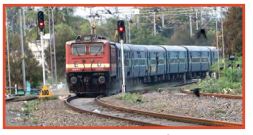
The arrival and departure timings of the Chennai - Trichy Express are given below.
| Station | Arrival | Departure |
| Chennai Egmore | - | 20:30 |
| Chengalpattu | 21:30 | 21:32 |
| Villupuram junction | 23:15 | 23:25 |
| Virudhachalam junction | 00:07 | 00:10 |
| Trichy | 04:30 | - |
(i) At what time does the train depart from Chennai Egmore to arrive at Trichy? The train departs from Egmore at 20:30 hours to arrive Trichy at 4:30 hours.
(ii) How long does it halt at Villupuram? It halts at Villupuram for 10 minutes.
(iii) How many halts are there in between Chennai and Trichy? There are 3 halts (1) Chengalpattu (2) Villupuram (3) Virudhachalam
(iv) Find the total journey time of the train from Chennai to Trichy.
14.
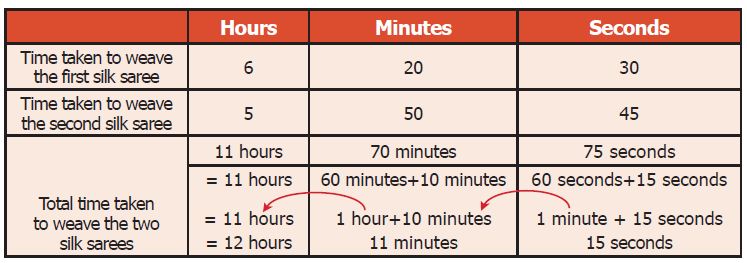
A handloom weaver takes 6 hours 20 minutes 30 seconds and 5 hours 50 minutes 45 seconds to weave two silk sarees. What is the total time to weave the two silk sarees?
15.
Find the LCM of 156 and 124.
1.
A football team gains
1st day = 3 points
2nd day = 4 points = 3 + 4
A football team loses 5 points = (-5)
Therefore 3rd day = (-5) points (loses)
Total Points scored
((3+4) - 5) = 2
Tree Diagram
2.
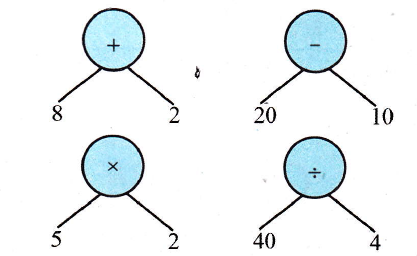
Numerical expression for the answer l0
= 8 + 2 or 20 - 10 or 5 \(\times\)2 or 40/4 etc.
3.
i) Algebraic Expression = p + q
ii) Algebraic Expression = I - m
iii) Algebraic Expression
= (a \(\times\) b) - c (or) (ab) - c
iv) Algebraic Expression
= (a + b) - (c + d)
v) Algebraic Expression
= 8 / a + (b / 4 + 3) .
(or) ((8 / a) + (b / 4) + 3))
4.
| Types of Triangle /Its Angles | Acute angled triangle | Right angled triangle | Obtuse angled triangle |
| Any two angles | Always acute angles | i. Always acute angles | Always acute angles |
| Third angle | ii. acute angle | Right angle | iii. Obtuse angle |
5.
(a) Equilateral Triangle :
ABC (AB = BC = CA = 4 cm)
(b) Isoceles Triangles :
ABC,AEF
(c) Scalene Triangles :
AEB, AED, ADF, AFC, ABD, ADC, ABF, AEC
(d) Acute Triangles :
ABC, AEF, ABF, AEC
(e) Obtuse Triangles :
AEB, AFC
(f) Right Triangles :
ADB, ADC, ADE, ADF
6.
| Step 1: Using a scale draw a line AB and mark a point Q on the line. |  |
| Step 2: Place the set square in such a way that the vertex of the right angle coincides with Q and one of the edges of right angle lies along AB. Mark the point R such that QR = 4.8 cm. | 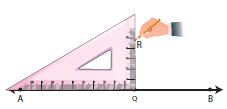 |
| Step 3: Place the scale and the set square as shown in the figure. | 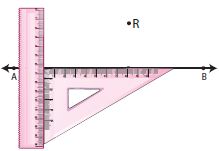 |
| Step 4: Hold the scale firmly and slide the set square along the edge of the scale until the other edge touches the point R. Draw a line RS through R. | 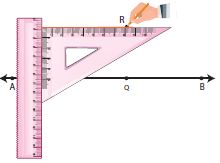 |
| Step 5: The line RS is parallel to AB. That is, RS ║AB. | 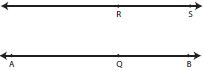 |
7.
| Step 1: Draw a line PQ. Take a point X anywhere above the line PQ. | 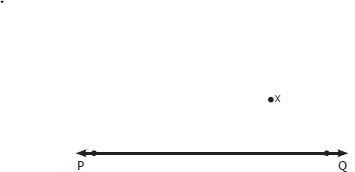 |
| Step 2: Place one of the arms of the right angle of a set square along the line PQ and the other arm of its right angle touches the point X. | 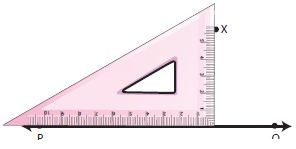 |
| Step 3: Draw a line through the point X meeting PQ at Y. | 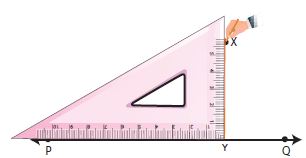 |
| Step 4: The line XY is perpendicular to the line PQ at Y. That is, XY \(\bot \) PQ | 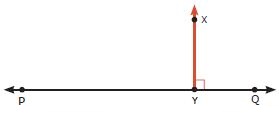 |
8.
| S.No. | \(\angle \)1 | \(\angle \)2 | \(\angle \)3 | Type of triangle based on angles | Type of triangle based on sides |
| i. | 60° | 40° | 80° | Acute angled triangle | Scalene Triangle |
| ii. | 50° | 50° | 80° | Acute angled triangle | Isoceles Triangle |
| iii. | 45° | 45° | 90° | Right angled triangle | Isoceles Triangle |
| iv. | 55° | 45° | 80° | Acute angled triangle | Scalene Triangle |
| v. | 75° | 35° | 70° | Acute angled triangle | Scalene Triangle |
| vi. | 60° | 30° | 90° | Right angled triangle | Scalene Triangle |
| vii. | 25° | 64° | 91° | Obtuse angled triangle | Scalene Triangle |
| viii. | 120° | 30° | 30° | Obtuse angled triangle | Isoceles Triangle |
9.
(i) 60°, 60°, 60°
The sum of the three angles of a triangle = 180°
Sum of three angles = 60° + 60° + 60° = 180° degrees
Yes, a triangle can be formed.
Type: Acute angled triangle.
(ii) 90°, 55°, 35°
The sum of three angles of a triangle = 90° + 55° + 35° = 180°
Yes, a triangle can be formed.
Type: Right angled triangle.
(iii) 60°, 40°, 42°
The sum of three angles of a triangle = 180°
Sum of the angles = 60° + 40° + 42° = 142°
No a triangle cannot be formed.
(iv) 60°, 90°, 90°
The sum of three angles of a triangle = 180°
Sum of the angles = 60° + 90° + 90°
= 240° \(\neq\) 180°
No a triangle cannot be formed.
(v) 70°, 60°, 50°
The sum of three angles of a triangle = 180°
Sum of the angles = 70° + 60° + 50° = 180° = 180° .
Yes, a triangle can be formed.
Type: Acute angled triangle.
(vi) 100°, 50°, 30°
The sum of three angles of a triangle = 180°
Sum of the angles = 100° + 50° + 30°
= 180° = 180°
Yes, a triangle cannot be formed.
Type: Obtuse angled triangle
10.
(i) C.P. = Rs. 110
M.P. = Rs. 130
Discount = Rs. 5
S.P. = M.P. - Discount
= Rs. 130 - Rs. 5
=Rs. 125
Profit = S.P. - C.P.
=Rs. 125 - Rs. 110
=Rs. 15
(ii) C.P. = Rs. 110
M.P. = Rs. 130
Discount = Rs. 20
S.P. = M.P. - Discount
= Rs. 130 - Rs. 20
= Rs.110
C.P. = S.P. \(\Rightarrow\) No profit or No loss.
(iii) M.P. = Rs. 130
Discount = Rs. 15
S.P. = M.P. - Discount
= Rs. 130 - Rs15
=Rs. 115
Profit = Rs. 30
Profit = S.P. - C.P.
Rs. 30 = Rs. 115 - C.P.
C.P. = Rs. 115 - Rs. 30
= Rs. 85
(iv) M.P. = Rs.130
Loss = Rs. 25
S.P. = M.P. - Discount
= Rs. 130 - Rs. 0
= Rs. 130
Loss = C.P. - S.P.
Rs. 25 = C.P. - Rs. 130
C.P. = Rs. 25 + Rs. 130
= Rs. 155
(v) M.P. = Rs. 125
Discount = Rs. 0
S.P. = M.P. - Discount
= Rs.125 - Rs. 0
= Rs. 125
No profit / No loss
C.P. = S.P.
C.P. = Rs. 125
(vi) S.P. = Rs. 350
Discount = Rs. 50
Profit = Rs. 100
M.P. = S.P.+ Discount
= Rs. 350+ Rs. 50 = Rs. 400
Profit = S.P. - C.P.
Rs 100 = Rs. 350 - C.P.
C.P. = Rs. 350 - Rs. 100
= Rs. 250
11.
(i) C.P. < S.P. \(\Rightarrow\) Profit = S.P. - C.P. = Rs. 60 - Rs. 50 = Rs. 10
(ii) C.P. > S.P. \(\Rightarrow\) Loss = C.P. - S.P. = Rs. 70 - Rs. 60 = Rs. 10
(iii) Profit = S.P. - C.P.
\(\Rightarrow\) Rs. 20 = S.P. - Rs. 100
\(\Rightarrow\) S.P. = Rs 20 + Rs. 100 = Rs. 120
(iv) Loss = C.P. - S.P.
\(\Rightarrow\) Rs. 15 = Rs. 80 - S.P.
\(\Rightarrow\) S.P. = Rs. 80 - Rs. 15 = Rs. 65
(v) Profit = S.P. - C.P.
\(\Rightarrow\) Rs. 25 = Rs. 70 - C.P.
\(\Rightarrow\) C.P. = Rs. 70 - Rs. 25 = Rs. 45
(vi) Loss = C.P. - S.P.
\(\Rightarrow\) Rs. 30 = C.P. - Rs. 100
\(\Rightarrow\) C.P. = Rs. 30 + Rs. 100 = Rs. 130
12.
(i) The bill number is 100.
(ii) The date of the bill is 15.05.2018.
(iii) There were four different items purchased.
(iv) The cost of 1 hair clip is Rs. 15.
(v) The total cost for the ribbon is Rs. 36.
13.
If the journey crosses the midnight, calculate the time duration from starting hours to midnight, then from midnight to arrival time.
| Method-1 | Method-2 |
|---|---|
Duration up to midnight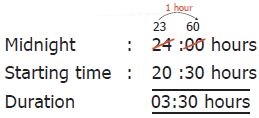 |
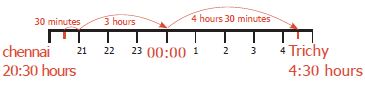 Total journey time = 3 hours 30 minutes+4 hours 30 minutes = 7 hours 60 minutes = 7 hours +1 hour = 8 hours |
| Duration from midnight to arrival = 4 hours 30 minutes Total journey time = Duration up to midnight + Duration from midnight to arrival = 3 hours 30 minutes + 4 hours 30 minutes = 7 hours 60 minutes = 7 hours + 1 hour = 8 hours |
|
14.
15.
Solution: By Division method
Step 1: Start with the smallest prime factor and go on dividing till all the numbers are divided as given below.
Step 2: LCM = product of all prime factors
= 2 \(\times\) 2 \(\times\) 3 \(\times\) 13 \(\times\) 31 = 4836
Thus, the LCM of 156 and 124 is 4836.
By Prime Factorisation method
Step 1: We write the prime factors of 156 and 124 as given below (use of divisibility test rules will also help).
156 = 2 \(\times\) 78 = 2 \(\times\) 2 \(\times\) 39 = 2 \(\times\) 2 \(\times\) 3 \(\times\) 13
124 = 2 \(\times\) 62 = 2 \(\times\) 2 \(\times\) 31
Step 2: The product of common factors is 2 \(\times\)2 and also the product of the factors that are not common is 3 \(\times\) 13 \(\times\) 31.
Step 3: Now, LCM = product of common factors x product of factors that are not common
= (2 \(\times\) 2) \(\times\) (3 \(\times\) 13 \(\times\) 31) = 4 \(\times\) 1209 = 4836
Thus, LCM of 156 and 124 is 4836.
(or)
156 = 2 \(\times\) 78 = 2 \(\times\) 2 \(\times\) 39 = 2 \(\times\) 2 \(\times\) 3 \(\times\) 13;
124 = 2 \(\times\) 62 = 2 \(\times\) 2 \(\times\) 31
The prime factor 2 appears a maximum of 2 times in the prime factorization of 156 and 124, the prime factor 3 appears only 1 time in the prime factorization of 156, the prime factor 13 appears only 1 time in the prime factorization of 156 and the prime factor 31 appears only 1 time in the prime factorization of 124.
Hence, the required LCM = (2 \(\times\) 2) \(\times\) 3 \(\times\) 13 \(\times\) 31 = 4836.

6th Standard Syllabus & Materials
6th Standard
TN 6th Social Science T3 - GEO - Understanding Disaster Sample Question Papers Study Material - QB365 Set A
NEW6th Standard
TN 6th Social Science T3 - GEO - Globe Sample Question Papers Study Material - QB365 Set A
NEW6th Standard
TN 6th Social Science T3 - GEO - Asia and Europe Sample Question Papers Study Material - QB365 Set A
NEW6th Standard
TN 6th Social Science T3 - HIS - South Indian Kingdoms Sample Question Papers Study Material - QB365 Set A



Tamilnadu Stateboard 6th Standard Subjects
Tamilnadu Stateboard Standards




