
 100% FREE ACCESS
6th Standard Syllabus & Materials
6th Standard
TN 6th Tamil பருவம் 1 - இயல் 1 - மொழி -தமிழ்த்தேன் - இன்பத்தமிழ் Sample Question Papers Study Material - QB365 Set A
NEW6th Standard
TN 6th English T1 - Supplementary - The Apple Tree and The Farmer Sample Question Papers Study Material - QB365 Set A
NEW6th Standard
TN 6th English T1 - Prose - When The Trees Walked Sample Question Papers Study Material - QB365 Set A
NEW6th Standard
TN 6th Social Science T3 - CIV - Road Safety Sample Question Papers Study Material - QB365 Set A
NEW6th Standard
TN 6th Social Science T3 - CIV - Local Bodies - Rural and Urban Sample Question Papers Study Material - QB365 Set A
NEW6th Standard
TN 6th Social Science T3 - CIV - Democracy Sample Question Papers Study Material - QB365 Set A

Published on: 18/06/2021
QB365 provides detailed and simple solution for every book back questions in class 6 Maths subject.It will helps to get more idea about question pattern in every book back questions with solution.
Download Tamil Nadu 6th Standard Maths question papers, model tests, one-mark questions, important questions, and public exam papers in PDF format. Free study materials and answer keys for TN State Board students.
Questions + Answers key
Take MCQ Maths Test1.
Find the area of the given 'L' shaped rectangular figure by dividing it into squares of equal sizes.
Take side: 7cm
2.
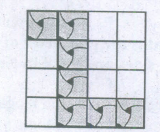
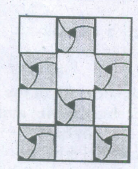
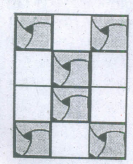
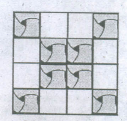
Find the number of tiles required to fill the are a of following ligures
(i)
(ii)
(iii)
(iv)
3.
Take two cards from a deck of playing cards and identify, which is greater between them, assuming that the joker card represents zero, black cards represent positive integers, red cards represent negative integers and the cards A, J. Q and K represent 1, 11, 12 and 13 respectively.
4.
Suppose in a building, there are 2 basement floors. If the ground floor is denoted as zero, how can we represent the basement floors?
(i) Is -15 < -26 ? why?
(ii) Which is smaller - 3 or -5 ? Why?
(iii) Which is greater 7 or -4 ? Why?
(iv) Which is the greatest negative integer?
(v) Which is the smallest positive integer?
5.
(i) Find the sum of \(5\cfrac { 4 }{ 9 } \)and \(3\cfrac { 1 }{ 6 } \)
(ii) Subtract \(7\cfrac { 1 }{ 6 } \) from \(12\cfrac { 3 }{ 8 } \)
(iii) Subtract the sum of \(6 \frac{1}{6}\) and \(3 \frac{1}{5}\) from the sum of \(9 \frac{2}{3} \text { and } 2 \frac{1}{2}\)
6.
Prepare a daily time schedule for evening study at home
7.
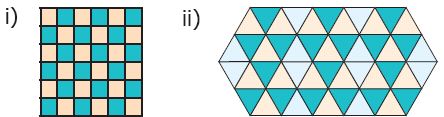
Colour the boxes in such a way that it posseses translation symmetry
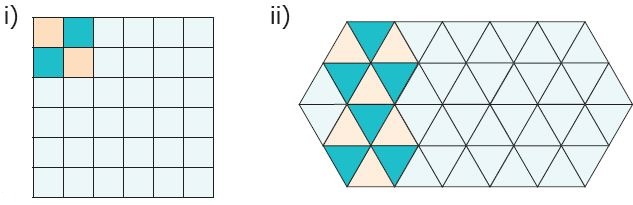
8.
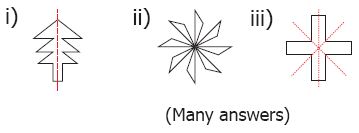
Draw the following :
i) A figure which has reflection symmetry but no rotational symmetry.
ii) A figure which has rotational symmetry but no reflection symmetry.
iii) A figure which has both reflection and rotational symmetry.
9.
Shade one square so that it possesses
i) One line of symmetry
ii) Rotational symmetry of order 2
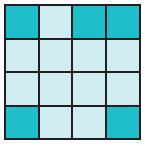
10.
Look at the picture of the house given and find the total area of the shaded portion.
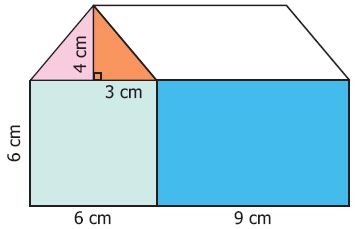
11.
What will be the area of a new square formed if the side of a square is made one-fourth?
12.
How many different rectangles can be made with a 48 cm long string? Find the possible pairs of length and breadth of the rectangles.
13.
A rectangle has length 40 cm and breadth 20 cm. How many squares with side 10 cm can be formed from it.
14.
Find the perimeter and area of the following shapes
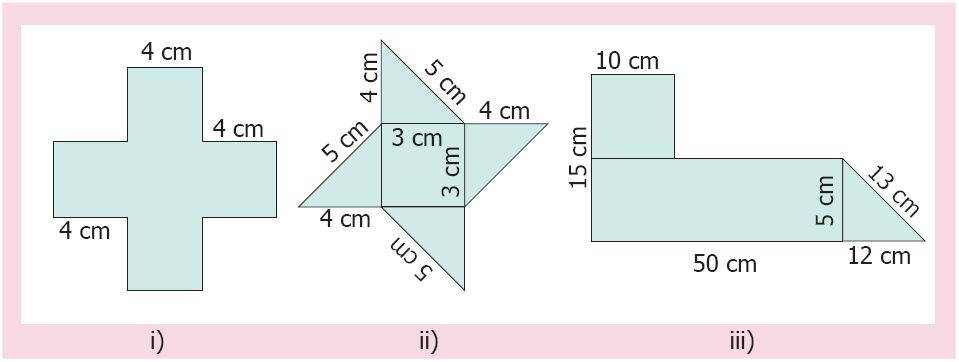
15.
The following bar graph shows the profit (+) and loss (−) of a small scale company (in crores) between the years 2011 to 2017.
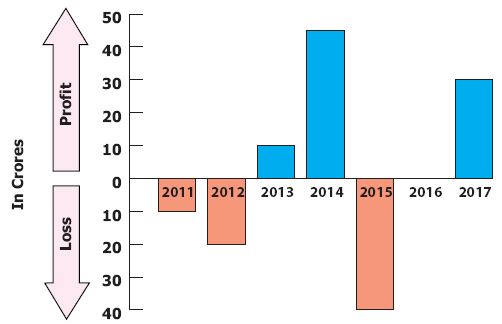
i) Write the integer that represents a profit or a loss for the company in 2014?
ii) Denote by an integer on the profit or loss in 2016.
iii) Denote by integers on the loss for the company in 2011 and 2012.
iv) Say True or False: The loss is minimum in 2012.
v) Fill in: The amount of loss in 2011 is _______ as profit in 2013.
16.
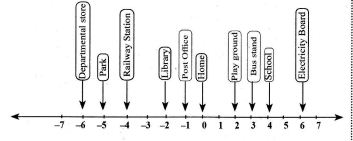
Assuming that the home to be the starting point, mark the following places in order on the number line as per instructions given below and write their corresponding integers

Places : Home, School, Library, Playground, Park, Departmental Store, Bus Stand, Railway Station, Post Office, Electricity Board.
Instructions :
i) Bus Stand is 3 units to the right of Home.
ii) Library is 2 units to the left of Home.
iii) Departmental Store is 6 units to the left of Home.
iv) Post Office is 1 unit to the right of the Library.
v) Park is 1 unit right of Departmental Store.
vi) Railway Station is 3 units left of Post Office.
vii) Bus Stand is 8 units to the right of Railway Station.
viii) School is next to the right of Bus Stand.
ix) Playground and Library are opposite to each other.
x) Electricity Board and Departmental Store are at equal distance from Home.
17.
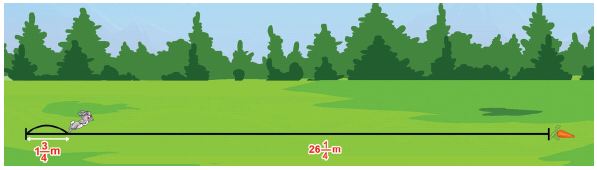
A rabbit has to cover \(26{1\over4}\)m to fetch its food. If it covers \(1{3\over4}\)m in one jump, then how many jumps will it take to fetch its food?
18.
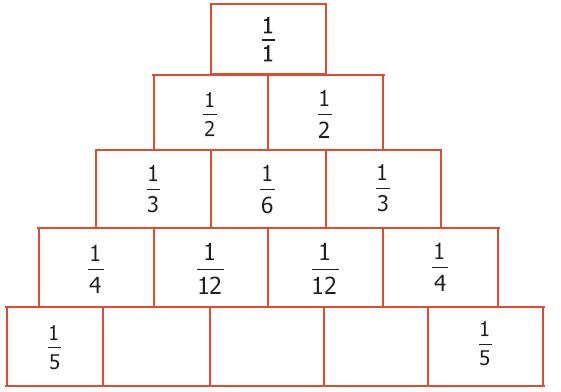
Complete the fifth row in the Leibnitz triangle which is based on subraction.
19.
Multiply the following:
\(i)\ {2\over3}\times6\)
\(ii)\ 8{1\over3}\times5\)
\(iii)\ {3\over8}\times{4\over5}\)
\(iv)\ {3{5\over7}}\times1{1\over13}\)
20.
Answer the following:
i) Find the sum of \(1\over7\)and \(3\over9\).
ii) What is the total of \(3{1\over3}\)and \(4{1\over6}\) ?
iii) Simplify: \(1{3\over5}+5{4\over7}\)
iv) Find the difference between \(8\over 9\)and \(2\over7\)
v) Subtract \(1{3\over 5}\)from \(2{1\over3}\)
vi) Simplify : \(7{2\over7}-3{4\over 21}\)
1.
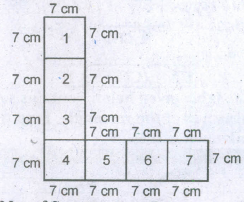
No. of Squares = 7
Area of each square = 7 \(\times\) 7 = 49
\(\therefore\) Area of 'L' shaped figure = 7 \(\times\)49 = 343 cm2
2.
(i) 4 square tiles horizontally and 4 square tiles vertically.
\(\Rightarrow\) 4 \(\times\) 4 = 16 sq. units.
No. of tiles tilled = 7
No. of tiles required = 16 -7 = 9
(ii) 4 square tiles vertically and 3 square tiles horizontally .
Area \(\Rightarrow\) 4 \(\times\) 3 = 12 sq. units.
No. of tiles filled = 6
(iii) 4 square tiles vertically and 3 square files horizontally.
Area = 4 \(\times\) 3 = 12 sq. units.
No. of tiles filled = 6
Required tiles = 12 - 6 = 6
(iv) 4 square tiles horizontally and 4 square tiles vertically.
Area = 4 \(\times\) 4 = 16 sq. units.
No. of tiles filled = 8
Required tiles = 16 - 8 = 8
3.
Take 2 cards from a deck of playing cards.
Given:
Joker card represents zero.
Black cards represents positive integers.
Red cards represents negative integer
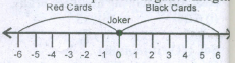
\(\therefore\) Joker > red cards \(\Rightarrow\) joker is greater.
red cards < black cards \(\Rightarrow\) black card is greater
black cards > Joker \(\Rightarrow\) black card is greater.
red cards < Joker
Also given,
A represent 1
J represent 11
Q represent 12 and
K represent 13
\(\therefore\) J > A, Q > A, Q > J, K > A, K > J, K > Q.
4.
There are 2 basement floors.
Ground flooris zero.
\(\therefore\) Basement floors denoted as +2
(i) No, -15 is greater than -26, (15 >- 26)
(ii) Given:
3 or -5
-3 is greater number.
- 5 is smaller number.
Reason: -3 and - 5 are negative integers.
\(\therefore\) -5 is smaller
(iii) Given:
7, -4
7\(\rightarrow\) Positive integer
-4 \(\rightarrow\) negative integer
\(\therefore\) 7 is greater.
(iv) -1 is the greatest negative integer
(v) 1 is the smallest positive integer
5.
\(5\cfrac { 4 }{ 9 } \) and \(3\cfrac { 1 }{ 6 } \)
\(\Rightarrow \cfrac { 49 }{ 9 } +\cfrac { 19 }{ 6 } \)
LCM of 9 and 6 is 18
= \(\cfrac { 49\times 2 }{ 9\times 2 } +\cfrac { 19\times 3 }{ 6\times 3 } \)
= \(\cfrac { 98 }{ 18 } +\cfrac { 57 }{ 18 } \)
= \(\cfrac { 98+57 }{ 18 } =\cfrac { 155 }{ 18 } \)
= \(8\cfrac { 11 }{ 18 } \)
(ii) \(7\cfrac { 1 }{ 6 } \Rightarrow \cfrac { 43 }{ 6 } \)
\(12\cfrac { 3 }{ 8 } \Rightarrow \cfrac { 99 }{ 8 } \)
Now to find : \(\cfrac { 99 }{ 8 } -\cfrac { 43 }{ 6 } \)
LCM = 24
= \(\cfrac { 99\times 3 }{ 8\times 3 } -\cfrac { 43\times 4 }{ 6\times 4 } \)
= \(\cfrac { 297 }{ 24 } -\cfrac { 172 }{ 24 } \)
= \(\cfrac { 297-172 }{ 24 } =\cfrac { 125 }{ 24 } \)
= \(5\cfrac { 5 }{ 24 } \)
(iii) To find
\(\left( 9\cfrac { 2 }{ 3 } +2\cfrac { 1 }{ 2 } \right) -\left( 6\cfrac { 1 }{ 6 } +3\cfrac { 1 }{ 5 } \right) \)
\(\Rightarrow \left( \cfrac { 29 }{ 3 } +\cfrac { 25 }{ 2 } \right) -\left( \cfrac { 37 }{ 6 } +\cfrac { 16 }{ 5 } \right) \)
\(\Rightarrow \) LCM of 3 and 2 is 6
LCM of 6 and 5 is 30
\(\Rightarrow \left( \cfrac { 29\times 2 }{ 3\times 2 } +\cfrac { 5\times 3 }{ 2\times 3 } \right) -\left( \cfrac { 37\times 5 }{ 6\times 5 } +\cfrac { 16\times 6 }{ 5\times 6 } \right) \)
\(\Rightarrow \left( \cfrac { 58 }{ 6 } +\cfrac { 15 }{ 6 } \right) -\left( \cfrac { 185 }{ 30 } +\cfrac { 96 }{ 30 } \right) \)
\(\Rightarrow \left( \cfrac { 58+15 }{ 6 } \right) -\left( \cfrac { 185+96 }{ 30 } \right) \)
\(\Rightarrow \cfrac { 73 }{ 6 } -\cfrac { 281 }{ 30 } \)
LCM of 6 and 30 is 30
\(\Rightarrow \cfrac { 73\times 5 }{ 6\times 5 } -\cfrac { 281 }{ 30 } \)
\(\cfrac { 365 }{ 30 } -\cfrac { 281 }{ 30 } =\) 
 = \(2\cfrac { 4 }{ 5 } \)
6.
| Time | Activity |
| 5.00 p.m. to 6.00 p.m. | Games |
| 6.00 p.m. to 8.00 p.m | Study |
| 8.00 p.m. to 8.30 p.m | Supper |
| 8.30 p.m. to 9.00 p.m | Recreation |
| 9.00 p.m. to 10.00 p.m | Study |
| 10.00 p.m | Sleep |
7.
8.
9.
i) One line of symmetry
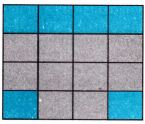
ii) Rotational symmetry of order 2
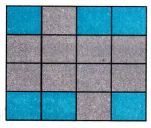
10.
Total area of the shaded portion = Area of square + 2 (Area of triangle) + Area of rectangle
Square: side = 6 cm
Triangles: Same Triangles \(\Rightarrow\)b = 3, h = 4
Rectangle : b = 6 cm, I = 9 cm
\(\therefore\)Total area = s2 + 2 (\(\cfrac { 1 }{ 2 } bh\) ) + lb
= 62 + 2 (\(\cfrac { 1 }{ 2 } \)\(\times\) 3 \(\times\) 24)+ 6 \(\times\) 9
= 36 + 12 + 54
= 102 cm2
11.
Side of square = s unit
The side of square is made one - fourth
\(\Rightarrow \cfrac { 1 }{ { 4 }^{ 2 } } =\cfrac { 1 }{ 16 } \) times
\(\therefore\) Area of the new square is reduced to\(\cfrac { 1 }{ 6 } \) times to that of original
12.
Length of the string = 48 cm
No. of possible pairs = 12
12 pairs,
The possible pairs of length and breadth of the rectangles are,
(1, 23), (2, 22), (3, 21), (4, 20), (5, 19); (6, 18), (7, 17), (8,16), (9,15),(10,14), (11, 13), (12, 12)
12 different rectangles can be made.
13.
length = 40 cm
breadth = 20 cm
Side of the square = 10 cm
Area of the rectangle = lb
= ( 40 \(\times\) 20)cm2
= 800 cm2
(side) s = 10cm
Area of a square (S2) = 102 = 100 cm2
No. of square = \(\cfrac { 800 }{ 100 } =8\)
14.
(i) Given :
Perimeter = 12 times 4 cm
= 12 \(\times\) 4 = 48 cm
Area \(\Rightarrow\) Given = 5 squares
= 5 \(\times\) area of square
= 5 \(\times\) (sider)2
= 5 \(\times\) 42
\(\therefore\) A = 5 \(\times\) 16 = 80 Cm2
\(\therefore\) P = 48 cm, A = 80 cm2
(ii) Given :
Perimeter = 4 times 4 cm + 4 times 5cm
= 4 (4) + 4 (5)
= 16 + 20 = 36 cm
Area = 4 triangles + 1 square
= \(4\left( \frac { 1 }{ 2 } bh \right) +1\left( s \right) ^{ 2 }\)
= \(4\left( \frac { 1 }{ 2 } \left( 5 \right) \left( 4 \right) \right) +1\left( { 3 }^{ 2 } \right) \)
= 4 \(\times\) 5 \(\times\) 2 + 9
= 40 + 9 = 49 cm2
(iii) Given :
Perimeter = (50 + 12 + l3 + 40 + 10 +10 + 10 + 5) cm
= 150 cm
= \(\left( lb+\cfrac { 1 }{ 2 } bh+{ s }^{ 2 } \right) { cm }^{ 2 }\)
= \(\left( 50\times 5 \right) +\cfrac { 1 }{ 2 } \times 12\times 5+{ 10 }^{ 2 }\)
= 250 + 30 + 100
= 380 cm2
\(\therefore\) P = 150 cm, A = 380 cm2
15.
(i) The integer that represent a profit is + 45
(ii) An integer on the profit or loss in, 2016 is 0
(iii) Loss in 2011 is -10, Loss in 2012 is - 20
(iv) False
(v) Fill in : The amount of loss in 2011 is the same as profit in 2013.
16.
Answer :
i) Bus stand = 3 units
ii) Library = −2 units
iii) Departmental store = −6 units
iv) post office = −1 units
v) Park = −5 units
vi) Railway station = −4 units
vii) Bus stand = 3 units
viii) School = 4 units
ix) Paly ground = 2 units
x) Electricity = 6 units
17.
Total distance = \(26\frac { 1 }{ 4 } \) m
= \(\cfrac { 105 }{ 4 } \)
A rabbit covers in 1 jump = \(1\frac { 3 }{ 4 } \)
= \(\cfrac { 7 }{ 4 } \)m
\(\cfrac { 7 }{ 4 } \) m = 1 jump
\(\cfrac { 105 }{ 4 } m=\cfrac { 7 }{ 7/4 } \times \cfrac { 105 }{ 4 } \)
= \(\cfrac { 4 }{ 7 } \times \cfrac { 105 }{ 4 } =15\)
18.
\(\cfrac { 1 }{ 4 } -\cfrac { 1 }{ 5 } =\cfrac { 5-4 }{ 20 } =\cfrac { 1 }{ 20 } \)
\(\cfrac { 1 }{ 12 } -\cfrac { 1 }{ 20 } =\cfrac { 5-3 }{ 60 } =\cfrac { 2 }{ 60 } =\cfrac { 1 }{ 30 } \)
\(\cfrac { 1 }{ 12 } -\cfrac { 1 }{ 30 } =\cfrac { 5-2 }{ 60 } =\cfrac { 3 }{ 60 } =\cfrac { 1 }{ 20 } \)
\(\cfrac { 1 }{ 20 } ,\cfrac { 1 }{ 30 } ,\cfrac { 1 }{ 20 } \)
19.
(i) \(\cfrac { 2 }{ 3 } \times 6=2\times =4\)
(ii) \(8\cfrac { 1 }{ 3 } \times 5\)
= \(\cfrac { 25 }{ 3 } \times 5=\cfrac { 25\times 5 }{ 3 } =\cfrac { 125 }{ 3 } =41\cfrac { 2 }{ 3 } \)
(iii) \(\cfrac { 3 }{ 8 } \times \cfrac { 4 }{ 5 } \)
= \(\cfrac { 3 }{ 8 } \times \cfrac { 4 }{ 5 } =\cfrac { 3\times 1 }{ 2\times 5 } =\cfrac { 3 }{ 10 } \)
(iv) \(3\cfrac { 5 }{ 7 } \times 1\cfrac { 1 }{ 13 } \)
= \(\cfrac { 26 }{ 7 } \times \cfrac { 14 }{ 13 } \)
= 2 \(\times\) 2 = 14
20.
(i) \(\cfrac { 1 }{ 7 }\ and\ \cfrac { 3 }{ 9 } \)
To find: \(\cfrac { 1 }{ 7 } +\cfrac { 3 }{ 9 } \)
LCM of 7 and 9 is 63
\(\Rightarrow \cfrac { 1 }{ 7 } \times \cfrac { 9 }{ 9 } +\cfrac { 3 }{ 9 } \times \cfrac { 7 }{ 7 } \)
= \(\cfrac { 9 }{ 63 } +\cfrac { 21 }{ 63 } =\cfrac { 9+21 }{ 63 } =\cfrac { 30 }{ 63 } =\cfrac { 10 }{ 21 } \)
(ii) \(3\cfrac { 1 }{ 3 } \ and\ 4\cfrac { 1 }{ 6 } \)
To find : \(3\cfrac { 1 }{ 3 } +4\cfrac { 1 }{ 6 } \)
= \(\cfrac { 10 }{ 3 } +\cfrac { 25 }{ 6 } \)
LCM of 3 and 6 is 6
= \(\cfrac { 10\times 2 }{ 3\times 2 } +\cfrac { 25 }{ 6 } \)
= \(\cfrac { 20 }{ 6 } +\cfrac { 25 }{ 6 } =\cfrac { 20+25 }{ 6 } =\cfrac { 45 }{ 6 } =\cfrac { 15 }{ 2 } =7\cfrac { 1 }{ 2 } \)
(iii) \(\cfrac { 8 }{ 5 } +\cfrac { 39 }{ 7 } \)
LCM of 5 and 7 is 35
= \(\cfrac { 8\times 7 }{ 5\times 7 } +\cfrac { 39\times 5 }{ 7\times 5 } \)
= \(\cfrac { 56 }{ 35 } +\cfrac { 195 }{ 35 } =\cfrac { 56+195 }{ 35 } =\cfrac { 251 }{ 35 } \)
= \(7\cfrac { 6 }{ 35 } \)
(iv) \(\cfrac { 8 }{ 9 } and\cfrac { 2 }{ 7 } \)
To find \(\cfrac { 8 }{ 9 } -\cfrac { 2 }{ 7 } \)
LCM 9 and 7 is 63
= \(\cfrac { 8\times 7 }{ 9\times 7 } -\cfrac { 2\times 9 }{ 7\times 9 } \)
= \(\cfrac { 56 }{ 63 } -\cfrac { 18 }{ 63 } =\cfrac { 56-18 }{ 63 } =\cfrac { 38 }{ 63 } \)
(v) \(1\cfrac { 3 }{ 5 } ,2\cfrac { 1 }{ 3 } \)
To find \(2\cfrac { 1 }{ 3 } -1\cfrac { 3 }{ 5 } \)
\(\Rightarrow \cfrac { 7 }{ 3 } -\cfrac { 8 }{ 5 } \)
LCM 3 and 5 is 15
= \(\cfrac { 7\times 5 }{ 3\times 5 } -\cfrac { 8\times 3 }{ 5\times 3 } \)
= \(\cfrac { 35 }{ 15 } -\cfrac { 24 }{ 15 } =\cfrac { 35-24 }{ 15 } =\cfrac { 11 }{ 15 } \)
(vi) \(7\cfrac { 2 }{ 7 } -3\cfrac { 4 }{ 21 } \)
\(\cfrac { 51 }{ 7 } -\cfrac { 67 }{ 21 } \)
LCM of 7 and 21 is 21
\(\Rightarrow \cfrac { 51\times 3 }{ 7\times 3 } -\cfrac { 67 }{ 21 } \)
= \(\cfrac { 153 }{ 21 } -\cfrac { 67 }{ 21 } =\cfrac { 153-27 }{ 21 } \)
= \(\cfrac { 86 }{ 21 } =4\cfrac { 2 }{ 21 } \)

6th Standard Syllabus & Materials
6th Standard
TN 6th Social Science T3 - GEO - Understanding Disaster Sample Question Papers Study Material - QB365 Set A
NEW6th Standard
TN 6th Social Science T3 - GEO - Globe Sample Question Papers Study Material - QB365 Set A
NEW6th Standard
TN 6th Social Science T3 - GEO - Asia and Europe Sample Question Papers Study Material - QB365 Set A
NEW6th Standard
TN 6th Social Science T3 - HIS - South Indian Kingdoms Sample Question Papers Study Material - QB365 Set A



Tamilnadu Stateboard 6th Standard Subjects
Tamilnadu Stateboard Standards




