
 100% FREE ACCESS
6th Standard Syllabus & Materials
6th Standard
TN 6th Tamil பருவம் 1 - இயல் 1 - மொழி -தமிழ்த்தேன் - இன்பத்தமிழ் Sample Question Papers Study Material - QB365 Set A
NEW6th Standard
TN 6th English T1 - Supplementary - The Apple Tree and The Farmer Sample Question Papers Study Material - QB365 Set A
NEW6th Standard
TN 6th English T1 - Prose - When The Trees Walked Sample Question Papers Study Material - QB365 Set A
NEW6th Standard
TN 6th Social Science T3 - CIV - Road Safety Sample Question Papers Study Material - QB365 Set A
NEW6th Standard
TN 6th Social Science T3 - CIV - Local Bodies - Rural and Urban Sample Question Papers Study Material - QB365 Set A
NEW6th Standard
TN 6th Social Science T3 - CIV - Democracy Sample Question Papers Study Material - QB365 Set A

Published on: 13/05/2022
QB365 provides detailed and simple solution for every book back questions in class 6 Maths subject.It will helps to get more idea about question pattern in every book back questions with solution.
latest Book back QuestionsDownload Tamil Nadu 6th Standard Maths question papers, model tests, one-mark questions, important questions, and public exam papers in PDF format. Free study materials and answer keys for TN State Board students.
Questions + Answers key
Take MCQ Maths Test1.
Arrange the fractions in descending order \(\cfrac { 9 }{ 20 } ,\cfrac { 3 }{ 4 } ,\cfrac { 7 }{ 12 } \)
(i) \(\cfrac { 2 }{ 3 } +\cfrac { 5 }{ 7 } \)
(ii) \(\cfrac { 3 }{ 5 } -\cfrac { 3 }{ 8 } \)
2.
Which is greater \(\cfrac { 3 }{ 8 } or\cfrac { 3 }{ 5 } ?\)
3.
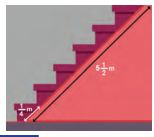
The length of the staircase is 5 \(\frac{1}{2}\) m If one step is set at \(\frac{1}{4}\) m then how many steps will be there in the staircase?
4.
Which is smaller? The difference between \(2{1\over2}\ and\ 3{2\over3}\) or the sum of \(1{1\over2}\ and\ 2{1\over4}\)
5.
Sankari purchased \(2{1\over2}\) m cloth to stich a long skirt and \(1{3\over 4}m\) cloth to stitch blouse. If the cost is Rs.120 per metre then find the cost of cloth purchased by her
1.
Given:\(\cfrac { 9 }{ 20 } ,\cfrac { 3 }{ 4 } ,\cfrac { 7 }{ 12 } \)
LCM of 20, 4, 12 is 60
\(\cfrac { 9 }{ 30 } \times \cfrac { 3 }{ 3 } =\cfrac { 27 }{ 60 } ,\cfrac { 3 }{ 4 } \times \cfrac { 15 }{ 15 } =\cfrac { 45 }{ 60 } ,\cfrac { 7 }{ 12 } \times \cfrac { 5 }{ 5 } =\cfrac { 35 }{ 60 } \)
\(\Rightarrow \cfrac { 27 }{ 60 } <\cfrac { 35 }{ 60 } <\cfrac { 45 }{ 60 } \Rightarrow \cfrac { 45 }{ 60 } >\cfrac { 35 }{ 60 } >\cfrac { 27 }{ 60 } \)
\(\therefore\) Descending order is \(\cfrac { 3 }{ 4 } ,\cfrac { 7 }{ 12 } ,\cfrac { 9 }{ 20 } \)
(i) LCM of 3 and 7 is 21
\(\Rightarrow \cfrac { 2 }{ 3 } \times \cfrac { 7 }{ 7 } +\cfrac { 5 }{ 7 } \times \cfrac { 3 }{ 3 } \)
\(\cfrac { 14 }{ 21 } +\cfrac { 15 }{ 21 } =\cfrac { 14+15 }{ 21 } =\cfrac { 29 }{ 21 } \)
(ii) LCM of5 and 8 is 40
\(\Rightarrow \cfrac { 3 }{ 5 } \times \cfrac { 8 }{ 8 } -\cfrac { 3 }{ 8 } \times \cfrac { 5 }{ 5 } \)
= \(\cfrac { 24 }{ 60 } -\cfrac { 15 }{ 40 } =\cfrac { 24-15 }{ 40 } =\cfrac { 9 }{ 40 } \)
2.
Given:\(\cfrac { 3 }{ 8 } ,\cfrac { 3 }{ 5 } \)
L. C. M of 8 and 5 is 40
\(\cfrac { 3 }{ 8 } \times \cfrac { 5 }{ 5 } =\cfrac { 15 }{ 40 } ,\cfrac { 3 }{ 5 } \times \cfrac { 8 }{ 8 } =\cfrac { 24 }{ 40 } \)
\(\therefore \ \cfrac { 24 }{ 40 } >\cfrac { 15 }{ 40 } \Rightarrow \cfrac { 3 }{ 5 } >\cfrac { 3 }{ 8 } \)
\(>\cfrac { 3 }{ 8 } \\ \) is greater
3.
Length of the staircase = \(5\cfrac { 1 }{ 2 } \) m
To one step = \(\cfrac { 1 }{ 4 } \) m
No. of the steps will be there = \(\cfrac { 5\frac { 1 }{ 2 } }{ \frac { 1 }{ 4 } } \)
= \(\cfrac { \frac { 11 }{ 2 } }{ \frac { 1 }{ 4 } } \Rightarrow \cfrac { 11 }{ 2 } \times \cfrac { 4 }{ 1 } =22\)
22 steps will be there in the staircase.
4.
Difference between \(2\cfrac { 1 }{ 2 }\ and\ 3\cfrac { 1 }{ 2 } \)
Difference = \(3\cfrac { 2 }{ 3 } -2\cfrac { 1 }{ 2 } \)
= \(\cfrac { 11 }{ 3 } -\cfrac { 5 }{ 2 } \)
= \(\cfrac { \left( 11\times 2 \right) -\left( 5\times 3 \right) }{ 6 } =\cfrac { 22-15 }{ 6 } \)
= \(\cfrac { 7 }{ 6 } \) ...(1)
Also given
Sum of \(1\cfrac { 1 }{ 2 }\ and\ 2\cfrac { 1 }{ 4 } \)
Sum =\(1\cfrac { 1 }{ 2 } +2\cfrac { 1 }{ 4 } \)
= \(\cfrac { 3 }{ 2 } +\cfrac { 9 }{ 4 } \)
= \(\cfrac { \left( 3\times 2 \right) +9 }{ 4 } =\cfrac { 6+9 }{ 4 } =\cfrac { 15 }{ 4 } \)
From (1) and (2),
Difference = \(\cfrac { 7 }{ 6 } \), Sum = \(\cfrac { 15 }{ 4 } \)
\(\cfrac { 7 }{ 6 } ,\cfrac { 15 }{ 4 } \)
\(\Rightarrow\) Lcm of 6 and 4 is 12
\(\cfrac { 7 }{ 6 } \times \cfrac { 2 }{ 2 } =\cfrac { 14 }{ 12 } ,\cfrac { 15 }{ 4 } \times \cfrac { 3 }{ 3 } =\cfrac { 45 }{ 12 } \)
\(\cfrac { 14 }{ 12 } <\cfrac { 45 }{ 12 } \Rightarrow \cfrac { 7 }{ 6 } <\cfrac { 15 }{ 4 } \)
\(\therefore \) The difference between \(2\cfrac { 1 }{ 2 }\ and\ 3\cfrac { 2 }{ 3 } \)
5.
Sankari purchased
To stitch a long skirt = \(2\cfrac { 1 }{ 2 } \ m\ cloth=\cfrac { 5 }{ 2 } m\)
To Stitch blouse = \(1\cfrac { 3 }{ 4 } m=\cfrac { 7 }{ 4 } m\)
Total length of clothe = \(\cfrac { 5 }{ 2 } m+\cfrac { 7 }{ 4 } m|\)
= \(\cfrac { (5\times 2)+7 }{ 4 } =\cfrac { 10+7 }{ 4 } \)
= \(\cfrac { 17 }{ 4 } m\)
Cost of 1 m cloth = Rs. 120
\(\therefore \cfrac { 17 }{ 4 } m\ cloth=120\times \cfrac { 17 }{ 4 } \)
= Rs. 510
Cost of cloth purchased by Sankari = Rs. 510

6th Standard Syllabus & Materials
6th Standard
TN 6th Social Science T3 - GEO - Understanding Disaster Sample Question Papers Study Material - QB365 Set A
NEW6th Standard
TN 6th Social Science T3 - GEO - Globe Sample Question Papers Study Material - QB365 Set A
NEW6th Standard
TN 6th Social Science T3 - GEO - Asia and Europe Sample Question Papers Study Material - QB365 Set A
NEW6th Standard
TN 6th Social Science T3 - HIS - South Indian Kingdoms Sample Question Papers Study Material - QB365 Set A



Tamilnadu Stateboard 6th Standard Subjects
Tamilnadu Stateboard Standards




