
 100% FREE ACCESS
6th Standard Syllabus & Materials
6th Standard
TN 6th Tamil பருவம் 1 - இயல் 1 - மொழி -தமிழ்த்தேன் - இன்பத்தமிழ் Sample Question Papers Study Material - QB365 Set A
NEW6th Standard
TN 6th English T1 - Supplementary - The Apple Tree and The Farmer Sample Question Papers Study Material - QB365 Set A
NEW6th Standard
TN 6th English T1 - Prose - When The Trees Walked Sample Question Papers Study Material - QB365 Set A
NEW6th Standard
TN 6th Social Science T3 - CIV - Road Safety Sample Question Papers Study Material - QB365 Set A
NEW6th Standard
TN 6th Social Science T3 - CIV - Local Bodies - Rural and Urban Sample Question Papers Study Material - QB365 Set A
NEW6th Standard
TN 6th Social Science T3 - CIV - Democracy Sample Question Papers Study Material - QB365 Set A

Published on: 13/05/2022
QB365 provides detailed and simple solution for every Book back Questions in class 6 Science Subject. It
will helps to get more idea about question pattern in every book back questions with solution.
Download Tamil Nadu 6th Standard Science question papers, model tests, one-mark questions, important questions, and public exam papers in PDF format. Free study materials and answer keys for TN State Board students.
Questions + Answers key
Take MCQ Science Test1.
Comment on importance of plant animal interaction.
2.
Write a short note on noise pollution.
3.
How are detergents manufactured?
4.
What is rainwater harvesting? Explain in a few sentences how it can be used in houses.
5.
How does the electromagnetic train work?
6.
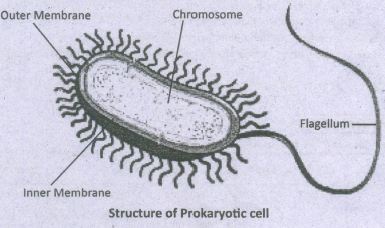
Draw a neat labelled diagram of a prokaryotic cell.
7.
Write short notes on conductors and insulators.
8.
Explain in detail above the applications of computer.
9.
Describe the various features which help Camel dwell well in the desert.
10.
Explain two methods that you can use to measure the length of a curved line.
11.
Why do we sweat more in summer?
12.
Can you guess why fire extinguishers throw a stream of carbon-di-oxide while putting - off fire?
13.
When a candle is lit the following changes are observed.
a. Wax melts.
b. Candle keeps burning.
c. The size of the candle decreases.
d. The molten wax solidifies
e. Which of the changes can be reversed? Justify your answer.
14.
Suppose your normal body temperature were lower than what it is. How would the sensation of hot and cold change?
15.
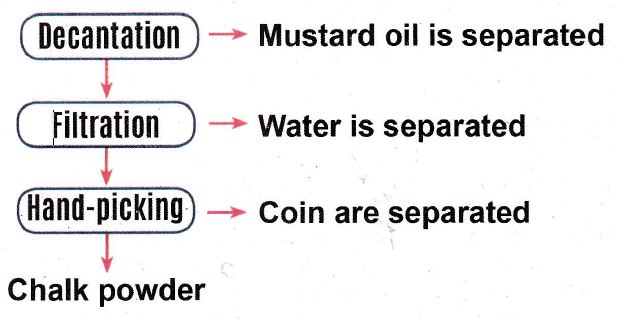
Using suitable apparatus from your laboratory separate the mixture of chalk powder, mustard oil, water and coins. Draw a flow chart to show the separation process
1.
(i) Like human being, animals also depend on plants for their necessity.
(ii) Silk worm eat mulbery leaves and produce silk.
(iii) Animals, insects and birds help in cross pollination.
(iv) Entering of insects into the flower leads to pollination. It increases yield of crop.
(v) Plants and algae living in coral reefs are the food variety of fishes and fisheries work is done in these areas.
(vi) Animals and plants are play an important role in spreading of seeds.
2.
(i) Noise pollution affects the environment. Unpleasant or loud sounds distrub us. This is called as noise pollution.
(ii) Loud music the sounds of motor vehicles, fireworks and machines causes noise pollution.
(iii) Continuous noise disturbs our sleep and does not let us to study and also it make stress and health impacts.
(iv) It is also disturb animals, bird and whales in under water.
(v) To reduce noise pollution lower the volume when you watch TV or listen to music.
(vi) Remind drivers not to use the horm too much.
(vii) Avoid fire works and do not speak loudly.
3.
Aim: Soap manufacturing.
Requirements:
i) 35 ml of water.
ii) 10 ml of NaOH.
iii) 60 ml of coconut oil.
Procedure:
i) Cover your work area with old newspaper.
ii) Take 35 ml of water in a jar.
iii) Add 10 gram of concentrated NaOH and allow it to cool.
iv) Then add 60 ml of coconut oil drop by drop and stir it well.
v) On getting dried, soap can be obtained.
4.
(i) Direct collection and use of rain water is called rainwater harvesting.
(ii) Excellent and valuable source of water in emergencies.
(iii) Ideal solution for inadequancy of water.
(iv) Increase ground water level.
(v) Reduces rainwater run off and solves drainage problems in houses.
5.
i) Electromagnets are used in electromagnetic trains.
ii) Electromagnets are magnetised when current flows through them. When the direction of current is changed, poles will be changed.
iii) Magnets are attached at the bottom of the train and rail tracks.
iv) The train is lifted from track upto 10 cm height by the property of some poles that repel each other.
v) By using attraction and repulsion at the same time between the magnets in tracks and bottom of the train it moves forward.
vi) The magnets are controlled by electricity.
vii) There is no friction. So the train can easily attain a speed of 300 km/h.
6.
7.
Conductors:
(i) The rate of flow of electric charges in a circuit is called electric current.
(ii) The materials which allow electric charges to pass through them are called conductors.
(iii) Examples: Copper, iron, aluminium, impure water, eafth etc.
Insulators (Non -Conductors) :
(i) The material which do not allow electric charges to pass through them are called insulators or non- conductors.
(ii) Examples: plastic, glass, wood, rubber, chinna clav, ebonite etc.
8.
(i) Computers are used in various fields.
(ii) In textile shop it is used for billing.
(iii) Computers are used to control large and small machines.
(iv) Computers are most important educational tools for teachers and learners.
(v) In Railways it is useful to book tickets and for other purposes.
(vi) It is also used in banks, ATM's, Post offices and in many places.
(vii) We can save many data and convert it into information.
9.
(1) The camel has long legs which help it to keep its body away from the hot sand in the desert.
(2) It can store large amount of water in its body.
(3) it loses very little water from its body through excretion.
(4) A camel's hump has fat stored in it. It ups the stored fat when required.
(5) It has large and flat padded feet to walk easily on soft sand.
(6) It has long eye lashes and hairs to protect its eyes and ears from the blowing dust.
(7) It can keep its nostrils closed to avoid dust.
10.
Method 1:
(i) Place a string along the curved line, Make sure that the stringcovers every bit of the curved line.
(ii) Mark the points where the curved line begins and ends on the string.
(iii) Now, stretch the string along the length of a meter scale and measure the distance between the two markings of the string.
(iv) This will give us the length of a curved line.
Method 2:
(i) Draw a curved line AB on a piece of paper.
(ii) Separate the legs of the divider by 0.5 cm or 1 cm using a ruler.
(iii) Place it on the curved line starting from one end. Mark the position of the other end. Move it along the line again and again cutting the line into number of segments of equal lengths. The remaining parts of the line can be measured using a scale.
(iv) Count the number of segments.
(v) Therefore, the length of the line = (number of segments x length of each segment) + length of the left over part.
11.
To protect from the skin dry due to over heat.
12.
Fire extinguishers throw a stream of carbon-, di-oxide while putting - off fire. Carbon-di-oxide covers the fire and cut-off the supply of fresh air to the burning things and stop burning.
13.
a) melting of wax and
d) Solidification of the molten wax can be reversed.
Burning of candle is a physical / reversible change. That is,
\(\text { Solid wax } \underset{\text { Cooling }}{\stackrel{\text { Heating }}{\rightleftarrows}} \text { molten wax }\)
14.
We feel hot because the heat is transferred from atmosphere to your body. Heat energy flows from higher temperature to lower temperature.
15.
(i) Using beakers, the mustard oil is separated by the process of decantation, because oil being lighter than water, floats on water.
(ii) Next filtration is using a funnel and filter paper and thus water gets separated from chalk powder and coins.
(iii) By hand-picking method, the coins are separated frorn chalk powder.

6th Standard Syllabus & Materials
6th Standard
TN 6th Social Science T3 - GEO - Understanding Disaster Sample Question Papers Study Material - QB365 Set A
NEW6th Standard
TN 6th Social Science T3 - GEO - Globe Sample Question Papers Study Material - QB365 Set A
NEW6th Standard
TN 6th Social Science T3 - GEO - Asia and Europe Sample Question Papers Study Material - QB365 Set A
NEW6th Standard
TN 6th Social Science T3 - HIS - South Indian Kingdoms Sample Question Papers Study Material - QB365 Set A



Tamilnadu Stateboard 6th Standard Subjects
Tamilnadu Stateboard Standards




