
 100% FREE ACCESS
6th Standard Syllabus & Materials
6th Standard
TN 6th Tamil பருவம் 1 - இயல் 1 - மொழி -தமிழ்த்தேன் - இன்பத்தமிழ் Sample Question Papers Study Material - QB365 Set A
NEW6th Standard
TN 6th English T1 - Supplementary - The Apple Tree and The Farmer Sample Question Papers Study Material - QB365 Set A
NEW6th Standard
TN 6th English T1 - Prose - When The Trees Walked Sample Question Papers Study Material - QB365 Set A
NEW6th Standard
TN 6th Social Science T3 - CIV - Road Safety Sample Question Papers Study Material - QB365 Set A
NEW6th Standard
TN 6th Social Science T3 - CIV - Local Bodies - Rural and Urban Sample Question Papers Study Material - QB365 Set A
NEW6th Standard
TN 6th Social Science T3 - CIV - Democracy Sample Question Papers Study Material - QB365 Set A

Published on: 04/01/2019
VII STD Model Question
Download Tamil Nadu 6th Standard Social Science question papers, model tests, one-mark questions, important questions, and public exam papers in PDF format. Free study materials and answer keys for TN State Board students.
Questions + Answers key
Take MCQ Social Science Test
1.
The North Pole is
90° N Latitude
90° S latitude
90° W Longitude
90° E longitude
2.
The shape of the Earth is _____________
Square
Rectangle
Geoid
Circle
3.
Who among the following built the VaikundaPerumal temple?
Narasimhavarma II
Nandivarma II
Dantivarman
Parameshvaravarma
4.
_______is National Panchayat Raj Day
January 24
July 24
November 24
April 24
5.
The monolithic iron pillar of Chandragupta is at __________
Mehrauli
Bhitari
Gadhva
Mathura
6.
Prayog Prashasti was composed by __________
Kalidasa
Amarasimha
Harisena
Dhanvantri
7.
Sakas ruled over Gandhara region _____________ as their capital.
Sirkap
Taxila
Mathura
Purushpura
8.
The ascending order of the administrative division in the ancient Tamizhagam was
Ur˂ Nadu ˂ Kurram ˂ Mandalam
Ur ˂ Kurram ˂ Nadu ˂Mandalam
Ur ˂Mandalam ˂ Kurram ˂ Nadu
Nadu ˂ Kurram ˂ Mandalam ˂Ur
9.
Which dynasty was not in power during the Sangam Age?
Pandyas
Cholas
Pallavas
Cheras
10.
The river _________ passes through nine countries of Europe
11.
The 90° lines of latitude on the Earth are called _____________.
12.
The music inscriptions in ____________and ____________show Pallavas interest in music.
13.
__________ invasion led to the downfall of Gupta Empire.
14.
Land revenue was called ______________
15.
The Virupaksha temple was built on the model of Kanchi Kailasanatha Temple.
16.
The famous musician Rudracharya lived during Mahendravarma I.
17.
Harsha belonged to Hinayana school of thought.
18.
Buddhacharita was written by Asvaghosha.
19.
Kizhar was the village chief.
20.
Explain: Indian Standard Time.
21.
Give an account on Western Chalukyas of Kalyani.
22.
Discuss about the statistics of 2017 accidents data
23.
What did Indian scientists achieve in astronomy and mathematics during the Gupta period?
24.
Highlight the contribution of Guptas to architecture.
25.
If I were a local body representative, I would.....
26.
Prepare a questionaire to interview a local body representative
27.
Give an account of the religious policy of Kanishka.
28.
Write a note on Gautamiputra Satakarni.
29.
Find out your area's representative’s names and write down
a. MP b. MLA 3. Local body member
30.
Compare and contrast direct democracy and representative democracy.
31.
Discuss the status of women in the Sangam Society.
32.
Mark the following in the outline map of Asia and Europe
Asia: Ural mountain, Himalayas, Pamir knot, Gobi Desert, Arabian Peninsula, Deccan plateau, River Yangtze, River Ob, Aral Sea and Lake Baykal.
Europe: The Pyrenees, Black forest, Apennines, Hungarian Plain, Caucasus Mountain, River Volga, River Danube, Strait of Gibraltar, Lake Ladoga, North Sea
33.
Mark the following places.
a. Korkai b. Kaveripoompattinam c. Musiri d. Uraiyur e. Madurai
34.
Name the important mountains found in the Alpine system.
35.
Asia is called the ‘Land of Contrasts’- Justify.
36.
Name the four hemispheres of the Earth.
37.
How many times would the sun pass overhead a line of longitude?
38.
Differentiate: Landslide – Avalanche
39.
Define Disaster
40.
What is the importance of Grama Sabha?
41.
Who are the representatives elected in a Village Panchayat
42.
What are the divisions of a Urban local body?
43.
Define: Representative Democracy
44.
Rice Bowl of southeast asia
45.
0° line of longitude
46.
0° line of latitude
47.
Western Chalukyas
48.
Eastern Chalukyas
1.
(a)
90° N Latitude
2.
(c)
Geoid
3.
(b)
Nandivarma II
4.
(d)
April 24
5.
(a)
Mehrauli
6.
(c)
Harisena
7.
(a)
Sirkap
8.
(b)
Ur ˂ Kurram ˂ Nadu ˂Mandalam
9.
(c)
Pallavas
10.
()
Danube
11.
()
poles.
12.
()
Kudumianmalai and Thirumayam temple
13.
()
Huns
14.
()
Irai
15.
(a)
16.
(a)
17.
(b)
18.
(a)
19.
(a)
20.
(i) The longitudinal extent of India is from 68°7' E to 97°25' E.
(ii) As many as twenty nine lines of longitude pass through India.
(iii) Having 29 standard time is not logical. Hence 821/2о Eline of longitude is observed as the Prime Meridian to calculate the Indian Standard Time (IST).
21.
(i) The Western Chalukya empire ruled most of the western deccan, South India, between the 10th and 12th Centuries.
(ii) They were the descendants of Badami chalukyas ruled from kalyani (modern day Basavakalyan)
(iii) In 1973, Tariapa - II, a feudatory of the Rashtrakuta ruling from Bijapur region defeated Parmara of Malwa.
(iv) Tailapa - II occupied Kalyani his fimasty quickly grew into an empire under Someswara - I.
(v) Someswara - I moved the capital from Manyakheta to Kalyani.
(vi) For over a century, the western chalukyas and the chola dynasty of Thanjavur, fought many fierce battles to control the fertile region of vengi.
(vii) During the rule of Vikramaditya VI in the late 1le century vast areas between the Narmada River in the north and Kaveri River in the south came under Chalukyas control.
(viii) The Kasi Visweshvara Temple at Lakkundi, the Mallikarjuna temple at Kuruvatti, the Kalleshwara temple at Bagali and the Mahadeva Temple at Itagi represeni well known examples of the architecture of western Chaitrkyas of Kalyani.
22.
(i) As per the report by the Ministry of Road Transport and Highways (MRTH) as many us 1.47 lakhs people died on Indian Roads in 4.64 lakh accidents.
(ii) Fatal road accidents victims largely constitute young people in the productive age groups. Young adults in the age group of 18-45 years accounted for 72.1% of victims.
(iii) People in working age group of 18-60 years accounted for a share of 87.2% in the total road accident fatalities.
23.
(i) Invention of zero and the consequent evolution of the decimal system were the legacy of Guptas to the modem world.
(ii) Aryabhatta, Varahamihira and Brahmagupta were. foremost astronomers and mathematicians of the time.
(iii) Aryabhatta, in his book Surya Siddhanta, explained the true causes of solar and lunar eclipses.
(iv) He was the first Indian astronomer to declare that the earth revolves around its own axis.
(v) Dhanvantriwas a famous scholar in the field of medicine. He was a specialist in Ayurveda. Charaka was a medical scientist. Susruta was the first Indian to explain the process of surgery.
24.
(i) The Guptas were the first to construct temples, which evolved from the earlier tradition of rock-cut shrines.
(ii) Adorned with towers and elobrate carvings, these temples were dedicated to all Hindu deities.
(iii) The most notable rock-cut caves are found at Ajanta and Ellora (Maharashtra), Bagh (Madhya Pradesh) and Udaygiri (Odisha).
(iv) The structural temples built during this period resemble the characteristic features of the Dravidian style.
25.
26.
27.
The religious policy of Kanishka:
(i) Kanishka was an ardent Buddhist.
(ii) Kanishka's empire was a Buddhist empire
(iii) Kanishka adopted Buddhism under the influence of Asvaghosha, a celebrated monk from Pataliputra
(iv) Though a great warrior and an empire builder, Kanishka was as equal as the exponent and champion of Mahayanism
(v) Kanishka made Buddhism as the state religion and built many stupas and monasterie in Mathura, Taxila and many other Parts of his kingdom
(vi) He sent Buddhist missionaries to Tibet, China and many countries of central Asia for the propagation of buddha's gospel
(vii) He organised the fourth Buddhist Council at Kundalavana near Srinagar.
28.
1. GautamiputraSatakarni was the greatest ruler of the family.
2. In the Nasik prashasti, published by his mother Gautami Balasri, Gautamiputra Satakami is described as the destroyer of Sakas, Yavanas (Greeks) and Pahlavas (Parthians).
3. Their domain included Maharashtra, North Konkan, Berar, Gujarat, Kathiawar and Malwa.
4. His ship coins are suggestive of Andhras skill in seafaring and their naval power.
29.
30.
| S.No | DIRECT DEMOCRACY | REPRESENTATIVE DEMOCRACY |
| 1. | In a direct democracy, only the citizens can make laws. | Elected members only can make laws. |
| 2. | All changes have to be approved by the citizen. |
Council of legislative changes the laws. |
| 3. | The politicians only rule over parliamentary procedure. |
Members of parliament rule the country. |
31.
1. There was no restriction for women in social life.
2. There were learned and wise women.
3. Forty women poets had lived and left behind their valuable works.
4. Marriage was a matter of self-choice.
5. However, chastity (karpu) was considered the highest virtue of women.
6. Sons and daughters had equal shares in their parents property.
32.
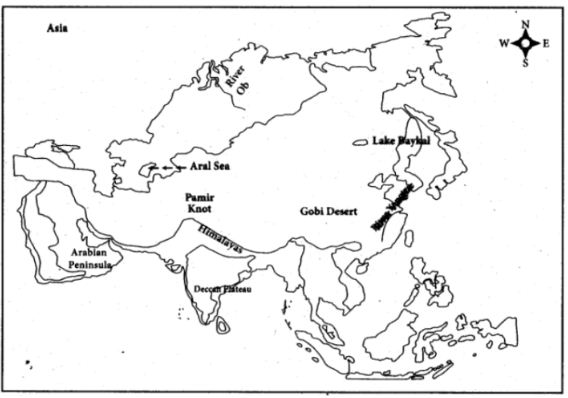
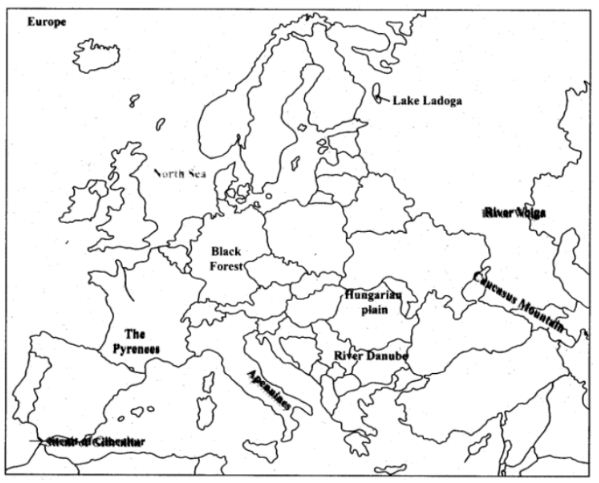
33.
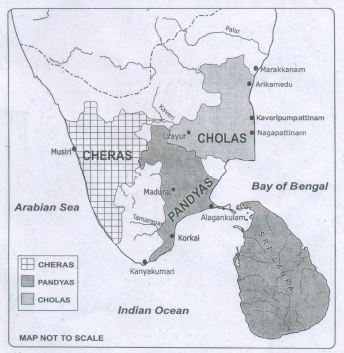
34.
The important mountain ranges are the Sierra Nevada, the Pyrenees, the Alps, the Apennines, the Dinaric Alps, the Caucasus and the Carpathian.
35.
(i) Asia is the biggest continent.
(ii) It has different types of land features such as mountain, plateau, plain, valley, bay, island etc.
(iii) It also has different climatic conditions from the equator to polar region.
(iv) Many races, languages, religions and cultures are followed by people who live in Asia.
(v) So, Asia is called 'the land of contrasts'.
36.
(i) Northern hemisphere
(ii) Southern hemisphere
(iii) Eastern hemisphere
(iv) Western hemisphere
37.
The Sun is overhead on a line of longitude only once in a day.
38.
| Landslide | Avalanches |
| The movement of a mass of rocks, debris, soil etc., down slope is celled landslide. | A large amount of ice, snow and rock falling quickly down the side of a mountain is called an Avalanches. |
39.
A disaster is a serious disruption of the functioning of a society involving human and material loss.
40.
(i) It is the only permanent unit in the panchayat Raj system
(ii) The Grama Sabha is the grass root level democratic institution in a Village Panchayat.
(iii) Grama Sabha meetings are conducted four times in a year. Officers like District collector, the block development officer, teachers, etc. also participate in this meeting.
(iv) The people can freely express their needs and grievances.
41.
(i) Panchayat President
(ii) Ward members
(iii) Councillor
(iv) District Panchayat Ward Councillor
42.
The urban local bodies are categorized into City Municipal Corporations, Municipalities and Town Panchayats.
43.
(i) When the people express their will on public affairs, through their elected representatives, the type of government is called representative democracy.
(ii) Ex: India, USA.
44.
Thailand
45.
Greenwich
46.
Equator
47.
Kalyani
48.
Vengi

6th Standard Syllabus & Materials
6th Standard
TN 6th Social Science T3 - GEO - Understanding Disaster Sample Question Papers Study Material - QB365 Set A
NEW6th Standard
TN 6th Social Science T3 - GEO - Globe Sample Question Papers Study Material - QB365 Set A
NEW6th Standard
TN 6th Social Science T3 - GEO - Asia and Europe Sample Question Papers Study Material - QB365 Set A
NEW6th Standard
TN 6th Social Science T3 - HIS - South Indian Kingdoms Sample Question Papers Study Material - QB365 Set A



Tamilnadu Stateboard 6th Standard Subjects
Tamilnadu Stateboard Standards



