
 100% FREE ACCESS
6th Standard Syllabus & Materials
6th Standard
TN 6th Tamil பருவம் 1 - இயல் 1 - மொழி -தமிழ்த்தேன் - இன்பத்தமிழ் Sample Question Papers Study Material - QB365 Set A
NEW6th Standard
TN 6th English T1 - Supplementary - The Apple Tree and The Farmer Sample Question Papers Study Material - QB365 Set A
NEW6th Standard
TN 6th English T1 - Prose - When The Trees Walked Sample Question Papers Study Material - QB365 Set A
NEW6th Standard
TN 6th Social Science T3 - CIV - Road Safety Sample Question Papers Study Material - QB365 Set A
NEW6th Standard
TN 6th Social Science T3 - CIV - Local Bodies - Rural and Urban Sample Question Papers Study Material - QB365 Set A
NEW6th Standard
TN 6th Social Science T3 - CIV - Democracy Sample Question Papers Study Material - QB365 Set A

Published on: 13/05/2022
QB365 provides detailed and simple solution for every Book back Questions in class 6 Social Science Subject. It will helps to get more idea about question pattern in every book back questions with solution.
latest Book back QuestionsDownload Tamil Nadu 6th Standard Social Science question papers, model tests, one-mark questions, important questions, and public exam papers in PDF format. Free study materials and answer keys for TN State Board students.
Questions + Answers key
Take MCQ Social Science Test
1.
Place the following words in the appropriate column.
Words: Jina, Mahayana, Tirthankaras, Stupas Nirvana, Digambara, Tripitakas, Agama
| Jainism | Buddhism |
2.
What are lines of latitude and longitude?
3.
Differentiate: Landslide – Avalanche
4.
Write a short note on ‘Thunder and lightning’.
5.
What is called barter system?
6.
What are actual resources?
7.
What is stereotype?
8.
List out the names of continents according to their size.
9.
Name the continents which surround the Atlantic Ocean.
10.
List out some of the classical dances of India.
11.
Why is India called a sub continent?
12.
Which is known as city of lakes? Why?
13.
What is the difference between Naalangadi and Allangadi.
14.
Mention the ancient cities of Tamil Nadu.
15.
Indus Civilisation is called urban civilisation. Give reasons.
16.
What do you know about anthropology?
17.
Why did humans move from place to place?
18.
What is evolution?
19.
Why were paintings drawn on rocks?
20.
What are the sources available to know about the pre-historic period?
21.
Draw posters related to road safety
22.
Discuss about the statistics of 2017 accidents data
23.
Can you guess what happened to the Harappan?
24.
Many pottery and its pieces have been discovered from Indus sites. What do you know from that?
25.
Observe the following features of Indus Civilisation and compare that with the present day.
a. Lamp post
b. Burnt bricks
c. Underground drainage system
d. Weights and measurement
e. Dockyard
1.
| Jainism | Buddhism |
| Jina, Tirthankaras, Digambara,Agama | Mahayana, Stupas Nirvana,Tripitakas, |
2.
(i) The imaginary lines which are drawn horizontally on East-West direction on the Earth are called the lines or Parallels of latitudes.
(ii) The imaginary lines drawn vertically connecting the North pole and the south pole called lines or meridians of longitude.
3.
| Landslide | Avalanches |
| The movement of a mass of rocks, debris, soil etc., down slope is celled landslide. | A large amount of ice, snow and rock falling quickly down the side of a mountain is called an Avalanches. |
4.
(i) Thunder is a series of sudden electrical discharge resulting from atmospheric conditions.
(ii) This discharge results in sudden flashes of light and trembling sound waves which are commonly known as thunder and lightning.
5.
(i) A system of exchanging goods for other goods, called barter system.
(ii) For example, exchange a bag of rice for enough clothes.
6.
Actual resources are resources that are being used and the quantity available is known. (e.g.) Coal at Neyveli.
7.
When prejudice gets stronger, it develops into a stereotype. stereotype is a false view or idea about something.
8.
From the largest to the smallest, they are Asia, Africa, North America, South America, Antartica, Europe and Australia.
9.
The Atlantic ocean is bounded by North America and South America in the West, and Europe and Africa in the East.
10.
| STATES | POPULAR DANCES |
| Tamil Nadu | Bharatanatyam |
| Kerala | Kathakali |
| Karnataka | Yakshagana |
| Andra Pradesh & Telungana | Kuchipudi |
| Odisha | Odissi |
| Manipur | Manipuri |
| Assam | Sattriya |
| North lndia | Kathak |
11.
(i) A continent is a very large area of land with various physical features such as mountains, plateaus, plains, rivers and seas and various types of weather patterns
(ii) India has all of them.
(iii) So, India is known as a sub-continent.
12.
(i) The city of lakes is known as Kancheepuram.
(ii) Hundreds of lakes were created for storing water around the town of Kanchi.
(iii) Hence, Kanchi came to be known as the district of lakes.
13.
| Naalangadi | Allangadi |
| Day Market of Sangam Age is called Naalangadi. | Evening Market of Sangam Age is called Allangadi |
14.
(i) Madurai
(ii) Kancheepuram
(iii) Poompuhar
15.
Indus Civilisation is called urban civilisation because
(i) There was well-conceived town planning.
(ii) Astonishing masonry and architecture were found.
(iii) Priority was given for hygiene and public health.
(iv) They used Standardised weights and measures.
(v) They had solid agricultural and artisanal base.
16.
(i) Anthropology is the study of human and evolutionary history.
(ii) The word anthropology is derived from two Greek words
(iii) Anthropos meaning "man" or "human";
(iv) Logos, meaning "thought" or "reason.
17.
Humans moved to another place in search of food.
18.
Evolution is the process through which the human kind changes and develops towards an advanced stage of life.
19.
(i) Some would have stayed back, without joining the hunting team.
(ii) So for their benefit, these pictures could have been drawn.
(iii) They might have done it as a part of their passtime.
20.
(i) Stone tools.
(ii) Excavated materials.
(iii) Rock paintings are the major sources of pre-history
21.
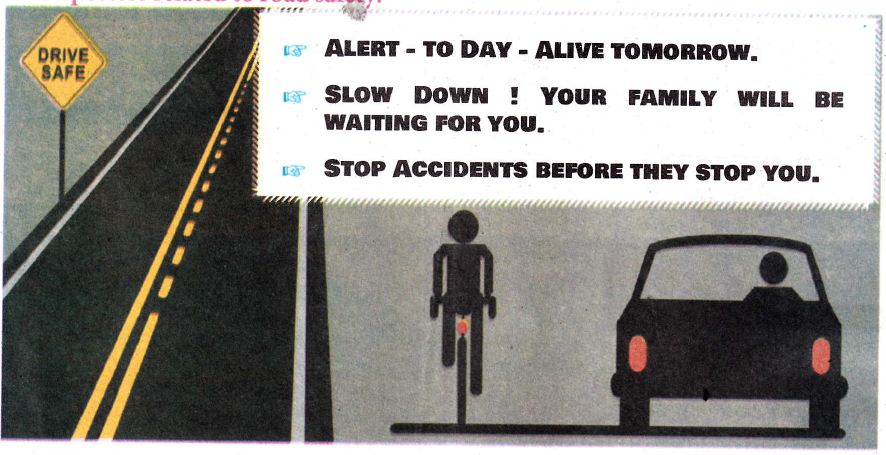
22.
(i) As per the report by the Ministry of Road Transport and Highways (MRTH) as many us 1.47 lakhs people died on Indian Roads in 4.64 lakh accidents.
(ii) Fatal road accidents victims largely constitute young people in the productive age groups. Young adults in the age group of 18-45 years accounted for 72.1% of victims.
(iii) People in working age group of 18-60 years accounted for a share of 87.2% in the total road accident fatalities.
23.
(i) By 1800 BCE, the Harappan culture had started declining.
(ii) It is assumed that the civilization met with
(a) repeated floods
(b) ecological changes
(c) invasions
(d) natural calamity
(e) climatic changes
(f) deforestation
(g) an epidemic might have disturbed the civilization.
24.
(i) The main occupation one of the Indus Civilisation people is pottery.
(ii) People of those times know how to use the potter's wheel
(iii) Pottery was practiced using the potter's wheel.
(iv) It was well fired.
(v) Potteries were red in colour with beautiful designs in black.
(vi) They know the uses of colour painting.
25.
(a) Lamp post
(i) Each house and street had a lamp post in Indus civilisation.
(ii) Now a days there is no electric lamp post in deep rural area.
(b) Burnt bricks
(i) The houses were built using baked bricks and mortar.
(ii) Present days we built varity of houses like concrete house, thatch house, etc....
(c) Underground drainage system
(i) Many of these cities in Indus has covered drains. The drains were covered with slabs or bricks.
(ii) Now a days underground drainage system is functioning only major cities.
(d) Weights and measurement
(i) Indus people had developed a systern of standardised weights and measures.
(ii) Present day we used electronic weighing machine also.
(e) Dockyard
(i) A naval dockyard has been discovered in Lothal in Gujarath. It shows the manitime activities of the Indus people.
(ii) Now a days there are so many seaports spread in all over India.

6th Standard Syllabus & Materials
6th Standard
TN 6th Social Science T3 - GEO - Understanding Disaster Sample Question Papers Study Material - QB365 Set A
NEW6th Standard
TN 6th Social Science T3 - GEO - Globe Sample Question Papers Study Material - QB365 Set A
NEW6th Standard
TN 6th Social Science T3 - GEO - Asia and Europe Sample Question Papers Study Material - QB365 Set A
NEW6th Standard
TN 6th Social Science T3 - HIS - South Indian Kingdoms Sample Question Papers Study Material - QB365 Set A



Tamilnadu Stateboard 6th Standard Subjects
Tamilnadu Stateboard Standards



