
 100% FREE ACCESS
6th Standard CBSE Syllabus & Materials
6th Standard CBSE
CBSE 6th Social Science The Value of Work - New Sample Question Papers Study Material - QB365 Set A
NEW6th Standard CBSE
CBSE 6th Social Science Family and Community - New Sample Question Papers Study Material - QB365 Set A
NEW6th Standard CBSE
CBSE 6th Social Science India's Cultural Roots - New Sample Question Papers Study Material - QB365 Set A
NEW6th Standard CBSE
CBSE 6th Social Science India,That is Bharat - New Sample Question Papers Study Material - QB365 Set A
NEW6th Standard CBSE
CBSE 6th Social Science Timeline and sources of history - New Sample Question Papers Study Material - QB365 Set A
NEW6th Standard CBSE
CBSE 6th Social Science Oceans and Continents - New Sample Question Papers Study Material - QB365 Set A

Published on: 06/03/2020
6th Standard Mathematics Board Exam Model Question 2019-2020
Download CBSE Class 6th Standard CBSE Mathematics question papers, sample papers, important questions, and previous year solved papers in PDF format. Get free study materials, NCERT solutions, and exam preparation resources for Class 6th Standard CBSE Mathematics
Questions + Answers key
Take MCQ Mathematics Test
1.
What is the area of a rectangle whose length and width are 20 cm and 10 cm, respectively?
2.
Draw a circle of radius 6.2 cm. Mark the points A and B such that
(a) OA = 2 x Radius of circle, OB = \(\frac{1}{2}\)OA.
(b) Find, where point B lies.
3.
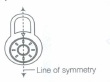
Identify the shapes given below. Check whether, they are symmetric or not. Draw the line of symmetry as well.

4.
Find the ratio of 80 cm to 1.2 m.
5.
The number of students who absent from the class during a week are given below:
| Day | Monday | Tuesday | Wednesday | Thursday | Friday |
| Number of absentees | 20 | 15 | 10 | 20 | 25 |
Draw a pictograph using the symbol  which represents 10 students.
6.
The length and breadth of a rectangle are x and y respectively. Find the rule which .gives perimeter of the rectangle.
7.
Which is the larger fraction? \(\frac { 12 }{ 24 } or\frac { 13 }{ 24 } \)
8.
Find the value of the following without using number lines.
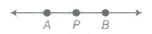
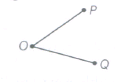
39 -16
9.
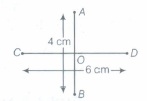
If the line segments AB and CD are perpendicular bisector of each other and AB = 4 cm and CD =6 cm. Then, find AO and OC?
10.
Write as fractions in lowest terms. 0.18
11.
Estimate the following product 9 \(\times\) 795
12.
Express each of the following numbers as the sum of three odd primes 31
13.
Find the number of common points, when two lines intersect each other.
14.
Find using the number line 3 x 3.
15.
Was that easy? Why was it easy?
16.
Grip size of a tennis racket is 12\(\frac{3}{20}\) cm. Express the size as an improper fraction.
17.
Draw a line AB to 6.5 cm length. At the end points A B draw two perpendiculars. Are these lines perpendicular to each other?
18.
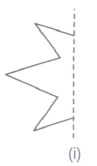
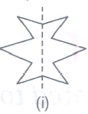
Complete the figure, given its line of symmetry.
19.
Test the divisibility of the following numbers.4864
20.
Write each of the following as decimals. \(\frac { 125 }{ 100 } \)
21.
The floor of a room is square in shape. If the side of the floor is 5 m. Find the area of the floor.
22.
Check whether the given ratios are equal, i.e. they are in proportion. If yes, then write them in the proper form. 1 : 5 and 3 : 15
23.
The following graph shows the runs scored by some cricketersin a selection test. Study the graph carefully and answer the questions.
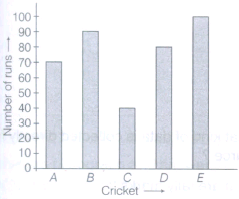
(a) If 50 is the qualifying run, who failed the test?
(b) Who scored highest in the test?
24.
Write down the operations which are used in forming the following expressions 2x-3.
25.
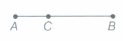
Which points in figure, appear to be mid-point of the line segments? When you locate a mid-point, name the two equal line segments formed by it.
26.
Write all the integers between the following numbers.
3 and 11
27.
Find the value of 968 x 73 + 968 x 27?
28.
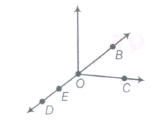
Use the figure to name
(a) five points.
(b) a line.
(c) four rays.
(d) five line segments.
29.
Poorvi cut a cake into 8 equal pieces. If she wanted to divide each of them into 3 equal pieces, what fraction of the whole cake would each small pieces be?
30.
Draw \(\angle\)POQ of measure 75° and find its line of symmetry.
31.
See the figure and find the ratio of
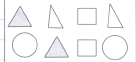
(a) number of triangles to the number of circles inside the rectangle.
(b) number of squares to the number of triangles inside the rectangle.
(c) number of squares to all the figures inside the rectangle.
(d) number of circles to all the figures inside the rectangle.
(e) number of triangles to all the figures inside the rectangle.
32.
A merchant has 130 L of oil of one kind, 190 L of another kind and 250 L of a third kind. He wants to sell the oil by filling the three kinds of oil in tins of equal capacity. What should be the greatest capacity of such a tin?
33.
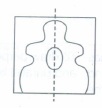
Complete the figure shown below:

34.
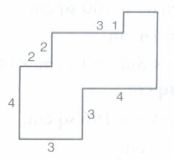
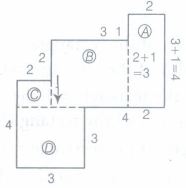
By splitting the following figures into rectangles, find their areas (the measures are given in centimetres).
35.
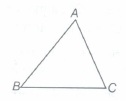
Take three non-collinear points (A, B, C) on your notebook. Join AB, BC, CA. What type of figure do you get? If it is a triangle, name the following
(a) side opposite to \(\angle B.\)
(b) angle opposite to side AC.
(c) vertex opposite to side BC.
(d) side opposite to vertex A and B.
36.
Sonal got 5 marks less than that of Ritu in a competition. If Ritu got 15 marks, how many marks obtained by Sonal?
37.
Find the sum of the smallest even positive integer and the greatest negative integer.
38.
The sale of electric bulbs on different days of a week is shown below
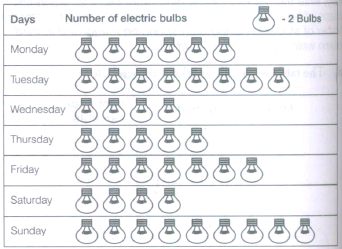
Observe the pictograph and answer the following questions.
(a) How many bulbs were sold on Friday?
(b) On which day, were the maximum number of bulbs sold?
(c) On which of the days, same number of bulbs were sold?
(d) On which of the days, minimum number of bulbs were sold?
(e) If one big carton can hold 9 bulbs. How many cartons were needed in the given week?
39.
Find the difference between the smallest number of 7-digit and the largest number of 4-digit.
40.
Draw a rough figure and label suitably in each of the following cases.
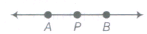
(a) Point P lies on \(\bar {AB}\).
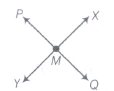
(b)\(\overleftrightarrow {XY}\) and\(\overleftrightarrow {PO}\) intersect at M.
(c) Line I contains E and F but not D.
(d)\(\overleftrightarrow {OP}\) and \(\overleftrightarrow {OQ}\) meet at O.
41.
You have the digits 4, 5, 6, 0, 7 and 8. Using them, make five numbers each with 6-digits.
(a) Put commas for easy reading.
(b) Arrange them in ascending and descending orders.
42.
Write \(\frac { 3 }{ 2 } ,\frac { 4 }{ 5 } and\frac { 8 }{ 5 } \) in decimal notation.
43.
The ratio 40 em to 1 m is
2:5
3:5
4:5
5:2
44.
Which of the following number is not a multiple of 6?
12
21
24
36
45.
One hundred and l-one =
101
1.01
10.1
0.101.
46.
Observe the following pictograph and answer the related questions :
| Day | Number of students present |
|---|---|
| \(\Box\) = 10 students | |
| Monday | \(\Box\) \(\Box\) \(\Box\) \(\Box\) \(\Box\) \(\Box\) |
| Tuesday | \(\Box\) \(\Box\) \(\Box\) \(\Box\) \(\Box\) |
| Wednesday | \(\Box\) \(\Box\) \(\Box\) \(\Box\) |
| Thursday | \(\Box\) \(\Box\) \(\Box\) \(\Box\) \(\Box\) \(\Box\) \(\Box\) \(\Box\) |
| Friday | \(\Box\) |
| Saturday | \(\Box\) \(\Box\) |
The number of students present on Friday is
10
20
40
50
47.
Perimeter of a rectangle =
Length x Breadth
Length + Breadth
2 x (Length + Breadth)
2 x (Length x Breadth)
48.
Which of the following fractions is not equivalent to \(\frac { 1 }{ 3 } \) ?
\(\frac { 5 }{ 15 } \)
\(\frac { 6 }{ 18 } \)
\(\frac { 4 }{ 12 } \)
\(\frac { 7 }{ 20 } \)
49.
An integer between - 3 and - 1 is
-3
-1
-2
0
50.
The number of corners of a cylinder is
0
1
2
none of these
51.
How many angles are there in a triangle?
1
2
3
4
52.
Using the digits 1,2,3,4 without repetition, the greatest 4-digit number that can be made is
4321
4312
4213
4231
53.
The natural number that has no predecessor in natural numbers is
1
10
100
1000.
54.
The instrument in the geometry box having the shape of a triangle is called a
protractor
compasses
divider
set-square
55.
Which of the following letters does not have the vertical line ot symmetry?
M
H
E
V
56.
If the perimeter of a regular hexagon is x m, then the length of each of its side is
(x + 6) m
(x÷6) m
(x-6)m
(6÷x)m
1.
200 cm2
2.
B lies on the circle.
3.
It is a symmetrical figure and its line of symmetry is shown below:
4.
Since, two quantities are not in the same unit.
Firstly, we have to convert them into same unit.
We know that 1 m= 100 cm \(\Rightarrow\) 1.2 m= 1.2 x 100 cm= 120 cm
\(\therefore\) Ratio of 80 cm to 1.2 m, i.e. 80 cm to 120 cm \(=\frac{80}{120}=\frac{2}{3}\),hence the required ratio is 2 : 3.
5.
Let represents 10 students.
.png)
6.
2(x + y)
7.
We have \(\frac { 12 }{ 24 } ,\frac { 13 }{ 24 } \)
Here, denominators of both fractions are same and 13 >12
So, \(\frac { 12 }{ 24 } >\frac { 13 }{ 24 } \)
8.
39 -16 = 39 + (Additive inverse of 16)
We have one negative and one positive value. So, we will subtract and take sign of greater value.
= 39 + (-16) = 23
9.
AO = 2 cm and OC = 3 cm.
10.
We have, \(0.18=\frac { 18 }{ 100 } =\frac { 18\div 2 }{ 100\div 2 } =\frac { 9 }{ 50 } \)
\(\left[ \because \quad HCF\quad of\quad 18\quad and\quad 100\quad =2 \right] \)
11.
∵ 9 ⟶ 10 [rounding off to nearest tens]
795 ⟶ 800 [rounding off to nearest hundreds]
∴ Estimated product = 10 \(\times\) 800 = 8,000
12.
We have, 31 \(\Rightarrow\) 31= 3+5+23
where 3, 5 and 23 are odd prime numbers.
13.
One common point
14.
To find 3 x 3
We have to multiply 3 by 3 i.e. 3 units x 3 (or 3 units 3 times). Let us start from 0, move 3 units to the right of 0.
.png)
After making 3 such moves, we reach at 9.
\(\therefore\) 3 x 3 = 9.
15.
Yes, it was easy. We just looked at the number of digits and obtained the answer. The number in which the number of digits was greatest, was the greatest number. If in two numbers the number of digits was the same, then the number in which on moving to the left the leftmost digit was greater, was the greater number. If the leftmost digits were also the same, than we saw the next digit. The number in which the next digit was greater, was the greater number. If requirement be, we proceeded next to next digits.
16.
The size of grip of tennis racket = 12 \(\frac{3}{20}\) cm
= 12 + \(\frac{3}{20}=\frac{12\times20+3}{20}\)
= \(\frac{240+3}{20}=\frac{243}{20}\)cm
17.
No, they are parallel to each other.
18.
19.
Given number is 4864. Here, unit place is 4. So, it is divisible by 2.
20.
Here \(\frac { 125 }{ 100 } =1.25\)
21.
Given, side of the floor = 5 m
Area of the floor = Side \(\times\) Side = 5 \(\times\) 5 sq m = 25 sq m
Hence, area of the floor is 25 sq m
22.
We have, 1: 5 and 3: 15
Here, \(3:15=\frac{3}{15}=\frac{3\div3}{15\div3}=\frac{1}{5}=1:5\) [dividing numerator and denominator both by 3]
i.e. 1 : 5 and 3 : 15 are in proportion.
Thus, the proper form is 1 : 5 :: 3: 15.
23.
(a) C
(b) E.
24.
Multiplication and subtraction
25.
In the figure, There is no mid-point in \(\overline{ AB } .\)
26.
4,5,6,7,8,9,10
27.
We have, 968 x 73 + 968 x 27
= 968 (73 + 27) [taking 968 as common term]
= 968 x 100 = 96800.
28.
From the given figure,
(a) Five points are B, C, D, E and O.
(b) A line is \(\vec {BD}\) (or \(\vec {OB}\)).
(c) Four rays are \(\vec {OB}\), \(\vec {OC}\), \(\vec {OE}\) and \(\vec {OD}\).
(d) Five line segments in the given figure are \(\overline { OB } ,\overline { OC } ,\overline { OE } ,\overline { OD } \) and \(\overline { DE } \).
29.
Number of pieces the cake cut = 8
Number of pieces each cut piece divided into = 3
∴ Total number of pieces =\(8\times3=24\)
Hence, each piece is represented by the fraction\(\frac{1}{24}.\)
30.
To find the line of symmetry of angle 75°, we use the following steps
Step I Draw \(\bar{OB}\) of any length.
.png)
Step II Place the centre of the protractor at O and the zero edge along \(\bar{AB}\).
.png)
Step III Start with zero near B, mark point C at 75°.
.png)
Step IV Join OC. \(\angle\)BOC is the required' angle of measure 75°.
.png)
Step V With O as centre and using compasses, draw an arc that cuts both rays of \(\angle\)O at P and Q.
.png)
Step VI With P as centre, draw (in the interior of \(\angle\)O an arc whose radius is more than half of the length of PQ).
Step VII With the same radius and with Q as centre, draw another arc in the interior of \(\angle\)O. Let the two arcs intersect at D.
.png)
Step VIII Join OD then \(\bar{OD}\) is the required bisector of \(\angle\)O. i.e. OD is the line of symmetry of an angle of measure 75°.
.png)
31.
(a) 2 : 1
(b) 1 : 2
(c) 1 : 2
(d) 1 : 4
(e) 1 : 2
32.
The greatest capacity of the required measure will be equal to the HCF of 130, 190 and 250 L.
Prime factorisation of 130, 190 and 250.
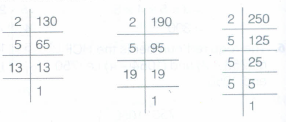
130=2x5x13
190= 2 x 5 x19
250=2x5x5x5
Common factors of 130, 190 and 250 = 2 x 5 = 10
Hence, greatest capacity of tin = 10
33.
34.
Let the given figure be divided into rectangles A, B, and D and their length and breadth be written on the figure.
For rectangle A,
Length = 4 cm and breadth = 2 cm
Now, area of the rectangle A = Length \(\times\) Breadth
= 4 cm \(\times\) 2 cm = 8 sq cm
For rectangle B,
Length = 3 cm and breadth = 3 cm
Area of the rectangle B = Length \(\times\) Breadth
= 3 cm \(\times\) 3 cm = 9 sq cm
For rectangle C,
Length = 2 cm and breadth = 1 cm
Area of the rectangle C = Length \(\times\) Breadth
= 2 cm \(\times\) 1 cm = 2 sq cm
For rectangle D, length = 3 cm and Breadth = 3 cm
∴ Area of the rectangle D = Length \(\times\) Breadth
= 3 cm \(\times\) 3 cm =9sq cm
Now, total area of the given figure
= Area of the rectangle A + Area of the rectangle B + Area of the rectangle C + Area of the rectangle D
= (8+9+2+9) sq cm = 28 sq cm
Hence, the required area is 28 sq cm.
35.
Given, three non-collinear points A, B and C.
Now, after joining AB, BC and CA, we get a ΔABC.
Then, we have
(a) side opposite to \(\angle B\) is AC.
(b) angle opposite to side AC is \(\angle B\) .
(c) vertex opposite to side BC is A.
(d) side opposite to vertex A and B is BC and AC respectively.
36.
10 marks
37.
1
38.
In the given pictograph, 1 picture = 2 bulbs
Now, number of bulbs sold on Monday = 6 pictures
= 6 x 2 = 12bulbs
Number of bulbs sold on Tuesday = 8 x 2 = 16 bulbs
Number of bulbs sold on Wednesday = 4 x 2 = 8 bulbs
Number of bulbs sold on Thursday = 5 x 2 = 10 bulbs
Number of bulbs sold on Friday = 7 x 2 = 14 bulbs
Number of bulbs sold on Saturday = 4 x 2 = 8 bulbs
Number of bulbs sold on Sunday = 9 x 2 = 18 bulbs
(a) Number of bulbs sold on Friday = 7 x 2 = 14 bulbs
(b) Maximum number of bulbs were sold on Sunday i.e. 18 bulbs.
(c) The same number of bulbs were sold on Wednesday and Saturday i.e. 8 bulbs.
(d) The minimum number of bulbs were sold on Wednesday and Saturday i.e. 8 bulbs.
(e) Total number of bulbs sold in a week
= 12 + 16 + 8 + 10 + 14 + 8 + 18 = 86
Now, number of cartons which can hold 9 bulbs = 1 and number of carton which can hold 1 bulb = \(\frac{1}{9}\)
\(\therefore\) Number of cartons which can hold 86 bulbs = \(\frac{1\times 86}{9}\)
= \(\frac{86}{9}=9\frac{5}{9}=10\)
Hence, 10 cartons were needed in the given week.
39.
The smallest number of 7-digit = 1000000
and the largest number of 4-digit = 9999
\(\therefore\) The difference between them
= 1000000 - 9999 = 990001
40.
A rough figure in each of the cases is given below:
(a) Point P lies on \(\bar {AB}\).
(b)\(\overleftrightarrow {XY}\) and \(\overleftrightarrow {PO}\) intersect at M.
(c) Line I contains E and F but not D.
(d) \(\overleftrightarrow {OP}\) and \(\overleftrightarrow {OQ}\) meet at O.
41.
Given digits are 4, 5, 6, 0, 7 and 8.
We can make many numbers by using these digits, five of them are as follows:
876540, 867540, 876450, 876045 and 867405
(a) After putting commas, numbers are as follows:
(i) 8,76,540 (ii) 8,67,540
(iii) 8,76,450 (iv) 8,76,045
(v) 8,67,405
(b) Ascending order of numbers is as follows:
867405 < 867540 < 876045 < 876450 < 876540
Descending order of numbers is as follows:
876540 > 876450 > 876045 > 867540 > 867405.
42.
(i) \(\frac { 3 }{ 2 } =\frac { 3\times 5 }{ 2\times 5 } \)
[multiplying numerator and denominator by 5 to make denominator 10]
\(=\frac { 15 }{ 10 } =1\frac { 5 }{ 10 } =1+\frac { 5 }{ 10 } =1+0.5=1.5\)
Therefore, \(\frac { 3 }{ 2 } \) is 1.5 in decimal notation.
(ii) \(\frac { 4 }{ 5 } =\frac { 4\times 2 }{ 5\times 2 } \)
[multiplying numerator and denominator by 2 to make denominator 10]
\(=\frac { 8 }{ 10 } =0.8\)
Therefore, \(\frac { 4 }{ 5 } \) is 0.8 in decimal notation.
(iii) \(\frac { 8 }{ 5 } =\frac { 8\times 2 }{ 5\times 2 } \)
[multiplying numerator and denominator by 2 to make denominator 10]
\(=\frac { 16 }{ 10 } =1\frac { 6 }{ 10 } =1+\frac { 6 }{ 10 } =1+0.6=1.6\)
Therefore, \(\frac { 8 }{ 5 } \) is 1.6 in decimal notation.
43.
1m = 100cm
\(\frac { 40 }{ 100 } =\frac { 2 }{ 5 } \)=2:5
44.
(b)
21
45.
(a)
101
46.
(a)
10
47.
(c)
2 x (Length + Breadth)
48.
(d)
\(\frac { 7 }{ 20 } \)
49.
(c)
-2
50.
(a)
0
51.
(c)
3
52.
(a)
4321
53.
54.
(d)
set-square
55.
(c)
E
56.
(b)
(x÷6) m

6th Standard CBSE Syllabus & Materials
6th Standard CBSE
CBSE 6th Social Science Locating Places on the Earth - New Sample Question Papers Study Material - QB365 Set A
NEW6th Standard CBSE
CBSE 6th Science A Journey Through States of Water - New Sample Question Papers Study Material - QB365 Set A
NEW6th Standard CBSE
CBSE 6th Science Temperature and its Measurement - New Sample Question Papers Study Material - QB365 Set A
NEW6th Standard CBSE
CBSE 6th Science Materials Around Us - New Sample Question Papers Study Material - QB365 Set A



CBSE 6th Standard CBSE Subjects
CBSE Standards




