
 100% FREE ACCESS
6th Standard CBSE Syllabus & Materials
6th Standard CBSE
CBSE 6th Social Science The Value of Work - New Sample Question Papers Study Material - QB365 Set A
NEW6th Standard CBSE
CBSE 6th Social Science Family and Community - New Sample Question Papers Study Material - QB365 Set A
NEW6th Standard CBSE
CBSE 6th Social Science India's Cultural Roots - New Sample Question Papers Study Material - QB365 Set A
NEW6th Standard CBSE
CBSE 6th Social Science India,That is Bharat - New Sample Question Papers Study Material - QB365 Set A
NEW6th Standard CBSE
CBSE 6th Social Science Timeline and sources of history - New Sample Question Papers Study Material - QB365 Set A
NEW6th Standard CBSE
CBSE 6th Social Science Oceans and Continents - New Sample Question Papers Study Material - QB365 Set A

Published on: 06/03/2020
6th Standard Mathematics Board Exam Sample Question 2020
Download CBSE Class 6th Standard CBSE Mathematics question papers, sample papers, important questions, and previous year solved papers in PDF format. Get free study materials, NCERT solutions, and exam preparation resources for Class 6th Standard CBSE Mathematics
Questions + Answers key
Take MCQ Mathematics Test
1.
How many (\(\surd \)) marks are there against guava?
2.
\(\bar {AB}\ and \ \bar{DC}\) are opposite sides. Name the other pair of opposite sides.
3.
Add the difference of \(1\frac { 2 }{ 3 } \) and to the sum of \(\frac { 3 }{ 7 } \)and \(\frac { 2 }{ 3 } \)
4.
What are the different methods to draw a perpendicular bisector of a line?
5.
Write two letters having only horizontal line of symmetry.
6.
Find the areas of the following figures by counting square.

7.
Write the statements for algebraic expression which are given below:
10b÷2
8.
Rohit takes 25 min to reach school from his house and Shivam takes one hour to reach school from his house. Find the ratio of the time taken by Rohit to the time taken by Shivam.
9.
In each of the following quadrilateral, classify convex and concave quadrilateral

10.
Using the number line write the integer, which is 5 more than -5
11.
Estimate the following using general rule 12,904 + 2888
12.
Write as fraction in lowest form. 2.25
13.
Express the following as the sum of two odd prime numbers 32
14.
Using distributive property, find the product of the following whole number 13, 30.
15.
Roma gave a wooden board of length 150 \(\frac{1}{4}\) cm to a carpenter for making a shelf. The carpenter sawed off a piece of 40 \(\frac{1}{5}\)cm from. it. What is the length of the remaining piece?
16.
Fatima wants to mail three parcels to three village schools. She finds that the postal charges are Rs 20, Rs 28 and Rs 36, respectively. If she wants to buy stamps only of one denomination, what is the greatest denomination of stamps she must buy to mail the three parcels?
17.
Naresh walked 2 km 35 m in the morning and 1km 7 m in the evening. How much distance did he walk in all?
18.
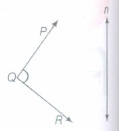
Draw the images P', Q' and R' of the points P, Q and R, respectively in the line n. Join P 'Q' and Q' R' to form an angle P'Q'R'. Measure ㄥPOR and ㄥP'Q'R'. Are the two angles equal?
19.
If one-fourth of a rectangular area is equal to 720sq,m then what will three-fourth the same rectangulara be equal to?
20.
Three boxes weight are (k+ 4) kg, 2k kg and (3k - 4) kg. If the second box weight is 6 kg, find the total weight of the three boxes.
21.
On a centimetre squared paper, make as many rectangles as you can, such that the area of the rectangle is 16 sq cm (consider only natural number lengths).
(a) Which rectangle has the greatest perimeter?
(b) Which rectangle has the least perimeter?
If you take a rectangle of area 24 sq cm, what will be your answers? Given any area, is it possible to predict the shape of the rectangle with the greatest perimeter? With the least perimeter? Give example and reason.
22.
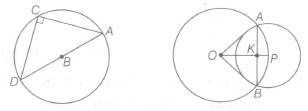
Using the information given, name the right angles in each part of figure.
(a) AC 丄 BD
(b) AE 丄 CE
(c) AC 丄 CD
(d) OP 丄 AB
23.
Sohan wants to show gratitude toward his teacher by giving a card made by him. He has three pieces of paper pasted one above the other as shown in the figure. These pieces are arranged in a way that AB||HC||GD||FE||.He wants to decorate the card by putting up a coloured take on non-parallel sides of the card.
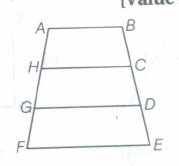
(a) Write the non-parallel sides of the card.
(b) Which value is depicted by the Sohan?
24.
Total number of animals in five villages are as follows:
| Villages | Number of animals |
| Village A | 80 |
| Village B | 120 |
| Village C | 90 |
| Village D | 40 |
| Village E | 60 |
Prepare a pictograph of these animals using OR symbol \(\bigotimes \) to represent 10 animals and answer the following questions.
(a) How many symbols represent animals of village E?
(b) Which village has the maximum number of animals?
(c) Which village has more animals: village A or village C?
25.
Temperature of a place at 12: 00 noon was +5°C. Temperature increased by 3°C in first hour and decreased by 1°C in the second hour. What was the temperature at 2 : 00 pm?
26.
Find the product of the smallest whole number with the largest three-digit whole number.
27.
Read these numbers
(i) 527864
(ii) 95432
(iii) 18950049
(iv) 70002509
(a) Write these numbers using placement boxes and then using commas in Indian system of numeration as well as Intemational system of numeration.
(b) Arrange these in ascending and descending orders.
28.
Inked-string Patterns: Fold a paper in half. On one half-portion, arrange short lengths of string dipped in a variety of coloured inks or paints. Now press the two halves. Study the figure you obtain. Is it symmetric? In how many ways can it be folded to produce two identical halves?
29.
The length and breadth of a rectangle are 3 cm and 2 cm, respectively. Find the area of a rectangle.
30.
Write as fraction in lowest form. 4.50
31.
Raju purchases 10 pens for Rs.150 and Manish buys 7 pens for Rs.84. Can you say who got the pens cheaper?
32.
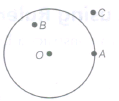
Draw any circle and mark points A. B and C such that
(i) A is on the circle.
(ii) B is in the interior of the circle.
(iii) C is in the exterior of the circle.
33.
Give expressions for the following cases.
x is subtracted from 5
34.
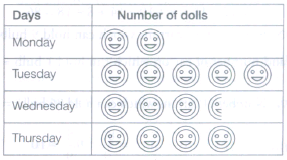
A factory made 200 dolls on Monday, 500 dolls on Tuesday, 350 dolls on Wednesday and 400 dolls on Thursday. Represent the information in the form of pictograph.
35.
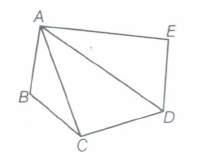
Name the vertices and the line segments in the given figure.
36.
Which of the following numbers are co-prime? 30 and 415
37.
Find the sum of -3 and -4 using the number line.
38.
Replace \(\Box\) in each of the following by the correct number. \(\frac { 2 }{ 7 } =\frac { 8 }{ \Box } \)
39.
In a school, there are four sections of class VI. Each section has 50 students. Money collected for picnic from each student is Rs 125. Find the r total amount collected.
40.
Measure and classify each angle.
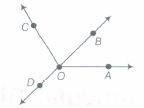
| Angle | Measure | Type |
|---|---|---|
| \(\angle AOB\) | ||
| \(\angle AOC\) | ||
| \(\angle BOC\) | ||
| \(\angle DOC\) | ||
| \(\angle DOA\) | ||
| \(\angle DOB\) |
41.
A vessel has 4 Land 500 mL of curd. In how many glasses, each of 25 mL capacity, can it be filled?
42.
200 is divisible by
8
3
6
11
43.
\(1+\cfrac { 1 }{ 10 } =\)
0.11
1.1
1.01
1.001.
44.
Which of the following is an equation in a variable?
\(\frac { 10 }{ 5 } \)=5
2x3+2x1=8
2x4=8
3p=12
45.
Observe the following table and answer the related questions:
| Blood groups | Number of students |
|---|---|
| A | 9 |
| B | 6 |
| O | 12 |
| AB | 3 |
| Total | 30 |
Which blood group is the rarest?
AB
B
A
O
46.
Meenu wants to put a lace border all around a rectangular table cover 2 m long and 1m wide. Find the length of the lace required by Meenu.
3 m
4 m
5 m
6 m
47.
The simplest form of \(\frac { 45 }{ 20 } \)is
\(\frac { 9 }{ 4 } \)
\(\frac { 4 }{ 9 } \)
\(\frac { 9 }{ 8 } \)
\(\frac { 2 }{ 9 } \)
48.
Which of the following is false?
-1 <-2
79< 89
-1 < 1
1> 0.
49.
Which of the following numbers comes next to 999?
100
998
1000
None of these
50.
The shape
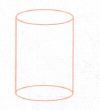
is of
cone
cylinder
cuboid
sphere
51.
The predecessor of 100 is
101
100
99
None of these
52.
The ratio of 6 books to 30 books is
5 : 1
2 : 3
1 : 5
2: 5
53.
Two lines are perpendicular, if they intersect each other at
acute angle
right angle
obtuse angle
None of these
54.
How many lines of symmetry are there in the given figure?
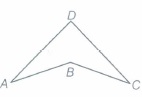
One
Two
Three
Four
55.
Which of the following has two end points?
Ray
Line
Line segment
None of the above
1.
There are four (\(\surd \)) marks against guava.
2.
The other pair of opposite sides is \(\bar {BC} \ and\ \bar{DA}\)
3.
\(2\frac { 1 }{ 21 } \)
4.
(i) By paper folding
(ii) By using ruler and compasses.
5.
Two letters having horizontal line of symmetry are E and K.
6.
Given, figure is covered by 10 full squares.
∴ Area=10 \(\times\) 1squnit =10sq units
7.
In this algebraic expression, 2 is divided from product of 10 and b.
8.
\(\because\) Time taken by Rohit = 25 min and Time taken by Shivam = 1h = 60 min
\(The\ required ratio=\frac{Time\ taken\ by\ Rohit}{Time\ taken\ by\ Shivam}=\frac{25}{60}=\frac{5}{12}=5:12\)
Hence, the required ratio is 5 : 12.
9.
concave quadrilateral
10.
To get the integer 5 more than -5, we start from -5 and move 5 steps to the right of -5 and reach at 0, as shown in the figure given below:

Hence, 5 more than -5 is O.
11.
∵12904 ⟶ 13000[rounding off to nearest thousands]
2888 ⟶ 3000 [rounding off to nearest thousands]
∴ Estimated sum = 13000 + 3000 = 16000
12.
We have, 2.25=2 ones + 2 tenths + 5 hundredths = 2 + 2 \(\times\) \(\frac { 1 }{ 10 } +\frac { 5 }{ 100 } =2+0.25\)
\(=2+\frac { 2 }{ 10 } +\frac { 5 }{ 100 } =2+\frac { 20+5 }{ 100 } =2+\frac { 25 }{ 100 } =2+\frac { 1 }{ 4 } =2\frac { 1 }{ 4 } =\frac { 9 }{ 4 } .\)
13.
Here, we have 32
32 = 29 +3
14.
390.
15.
Given, length of a wooden board
\(=150\frac { 1 }{ 4 } \)cm \(=\frac { 601 }{ 4 } \) cm
Carpenter sawed off a piece of wooden board
\(=40\frac { 1 }{ 5 } \)cm \(=\frac { 201 }{ 5 } \)cm
\(\therefore\) Length of the remaining piece \(=\frac { 601 }{ 4 } -\frac { 201 }{ 5 } \)
\(\because\) LCM of 4 and 5 = 20
\(\therefore \frac { 601 }{ 4 } \frac { 201 }{ 5 } =\frac { 601\times 5 }{ 4\times 5 } -\frac { 201\times 4 }{ 5\times 4 } \)
\(=\frac { 3005 }{ 20 } -\frac { 804 }{ 20 } \)
\(=\frac { 3005-804 }{ 20 } \)
\(=\frac { 2201 }{ 20 }\)cm
Hence the length of the remaining piece is\(\frac { 2201 }{ 20 } \)cm or \(110\frac { 1 }{ 20 } \)cm
16.
The given postal charges for three parcels are Rs20, Rs28, Rs 36.
The greatest denomination of stamps is the HCF of 20, 28 and 36.
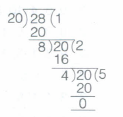

HCF of 20 and 28 is 4.
Now, we.find the HCF of 4 and 36.
HCF of 4 and 36 is 4.
Hence, HCF of 20, 28 and 36 is 4.
\(\therefore\) Fatima would by stamp of denomination of Rs4.
17.
Naresh walked in morning
= 2 km 35 m = 2 km + 35 m
\(=2\ km+35\times{1\over 1000}km\) \(\begin{bmatrix} \because 1m={1\over 1000}km\end{bmatrix}\)
\(=2\ km+{35\over 1000}km\)
= (2 + 0.035) km = 2.035 km
Naresh walked in evening
=1 km 7 m = 1 km + 7 m
\(=1\ m+7\times{1\over1000}km\) \(\begin{bmatrix} \because 1m={1\over 1000}km\end{bmatrix}\)
\(=1\ km+{7\over1000}km\)
= (1 + 0.007) km = 1.007 km
\(\therefore\) Total distance
\(\quad 2.035\\+1.007\\\_\_\_\_\_\_\_\\\ \ \ 3.042\\\_\_\_\_\_\_\_\)
Hence, total distance walked by Naresh is 3.042 km.
18.
The images of the point P, Q and R in the line n are P',Q' and R', respectively.
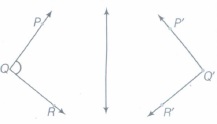
It is clear that ㄥPQR = ㄥP'Q'R'
19.
2160 sq m
20.
18 kg
21.
We know that,
Area of the rectangle = Length \(\times\) Breadth
Here, the area of the rectangle is 16 sq cm.
So, for getting the area 16 sq em, there are three cases.
Case I When length of the rectangle = 16 cm
and breadth of the rectangle = 1cm
∴ Area of the rectangle = Length \(\times\) Breadth
=16 cm \(\times\) 1 cm = 16sq cm
and perimeter of the rectangle
= 2 \(\times\) (Length + Breadth)
= 2 \(\times\)(16 cm + 1 cm) = ( 2 \(\times\) 17) cm= 34 cm
Case II When length of the rectangle = 4 cm
and breadth of the rectangle = 4 cm
∴ Area of the rectangle = Length\(\times\) Breadth
= 4 cm \(\times\) 4 cm 16 sq cm
and perimeter of the rectangle
= 2 \(\times\) (Length + Breadth)
= 2 \(\times\)(4 cm +4 cm) = (2 \(\times\) 8) cm = 16 cm
Case III When length of the rectangle = 8 cm
and breadth of the rectangle = 2 cm
∴ Area of the rectangle = Length\(\times\) Breadth
=8 cm \(\times\)2 cm =16sq cm
and perimeter of the rectangle
= 2 \(\times\) (Length + Breadth) = 2 \(\times\) (8 cm + 2 cm)
= (2\(\times\)10) cm = 20 cm
(a) The rectangle which made in Case I has the greatest perimeter.
(b) The rectangle which made in Case II has the least perimeter.
Now, given that the area of the rectangle is 24 sq cm.
Again, for getting the area 24 sq cm, there are three cases:
Case I When length of the rectangle = 24 cm
and breadth of the rectangle = 1 cm
∴ Area of the rectangle = Length \(\times\) Breadth
= 24 cm\(\times\) 1 cm = 24 sq cm
and perimeter of the rectangle
= 2 \(\times\) (Length + Breadth)
= 2 \(\times\) (24 cm + 1 cm) = (2 \(\times\) 25)cm = 50 cm
Case II When length of the rectangle = 12 cm
and breadth of the rectangle = 2 cm
∴Area of the rectangle = Length \(\times\)Breadth
= 12 cm \(\times\) 2 cm = 24 sqcm
and perimeter of the rectangle
= 2 \(\times\) (Length + Breadth)
= 2 \(\times\) (12 cm +2 cm)
= (2 \(\times\)14) cm = 28 cm
Case III When length of the rectangle = 6 cm
and breadth of the rectangle = 4 cm
∴ Area of the rectangle = Length \(\times\) Breadth
= 6 cm \(\times\) 4 cm = 24 sqcm
and perimeter of the rectangle
= 2 \(\times\) (Length + Breadth)
= 2 \(\times\) (6 cm +4 cm)
= 2 \(\times\) 10 cm = 20 cm
(a) The rectangle which made in Case I has the greatest perimeter.
(b) The rectangle which made in Case III has the least perimeter.
Yes, it is possible to predict the shape of the rectangle with greatest perimeter and with least perimeter.
e.g. A rectangle having area 16 sq ern and greatest perimeter 34 cm is of the shape 16 cm \(\times\) 1 cm
(i.e. length = 16 cm and breadth = 1 cm), also a rectangle
having area 24 sq cm and least perimeter 20 cm is of the shape 6 cm \(\times\) 4 cm (i.e. length = 6 cm and breadth = 4 cm).
The rectangle with the greatest length has the maximum perimeter and the rectangle with the smallest length has the least perimeter.
22.
(a) Since, AC 丄 BD, it means \(\angle E = 90°\)
∴ \(\angle AEB, \angle BEC, \angle CED\) and \(\angle AED\) are right angles.
(b) Since, AE 丄 CE, it means \(\angle E = 90°\)
∴ \(\angle AEC\) is a right angle.
(c) Since, AC 丄 CD, it means \(\angle C= 90°\)
∴ \(\angle ACD\) is a right angle.
(d) Since, OP 丄 AB, it means \(\angle K = 90°\)
\(\therefore\ \ \ \ \ \angle AKO, \angle OKB, \angle BKP\) and \(\angle AKP\) are right angles.
23.
(a) Non-parallel sides are AF and BE.
(b) Respect to teacher, happiness, beauty and knowledge.
24.
Given,10 animals are represented by 1 symbol \(\bigotimes \).
\(\therefore\) 1animal is represented by 1/10symbol \(\bigotimes \)
For village A,
80 animals are represented by \(\frac{80\times 1}{10}\) = 8 symbols \(\bigotimes \)
For village B,
120 animals are represented by \(\frac{120\times 1}{10}\) = 12 symbols \(\bigotimes \)
For village C,
90 animals are represented by \(\frac{90\times 1}{10}\) = 9 symbols \(\bigotimes \)
For village D,
40 animals are represented by \(\frac{40\times 1}{10}\) = 4 symbols \(\bigotimes \)
For village E,
60 animals are represented by \(\frac{60\times 1}{10}\) = 6 symbols \(\bigotimes \)
Then we have the following pictograph.
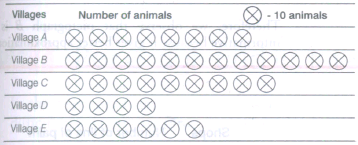
(a) It is clear that from the pictograph, that 6 symbols represent animals of village E.
(b) It is clear that from the pictograph, that village B has the maximum number of animals i.e.120 animals.
(c) From the pictograph, number of animals in village A = 80
Number of animals in village C = 90
\(\therefore\) 90 > 80
\(\therefore\) Village C has more animals
25.
Given, initial temperature at 12:00 noon was +5°C. Since, the temperature increased by 3°C in first hour.
∴ Temperature at 1: 00 pm = 5°C + 3° C 8°C
Also, the temperature decreased by 1°C in the second hour.
∴ Temperature at 2: 00 pm = 8°C - 1°C= 7°C
Hence, the temperature at 2 : 00 pm is 7°C
26.
0
27.
After reading these number, we have
(i) 527864 Five lakhs twenty seven thousands eight hundreds sixty four.
(ii) 95432 Ninety five thousands four hundreds thirty two.
(iii) 18950049 One crore eighty nine lakhs fifty thousands forty nine.
(iv) 70002509 Seven crores two thousand five hundreds nine.
(a) By USIng placement boxes, gIven number can be written as
By using the commas, given numbers can be written as :
| Number | Crores | Ten lakhs | Lakhs | Ten Thousands | Thousands | Hundreds | Tens | Ones |
| 52786 | - | - | 5 | 2 | 7 | 8 | 6 | 4 |
| 95432 | - | - | - | 9 | 5 | 4 | 3 | 2 |
| 1895004 | 1 | 8 | 9 | 5 | 0 | 0 | 4 | 9 |
| 70002509 | 7 | 0 | 0 | 0 | 2 | 5 | 0 | 9 |
(b) Ascending order of these numbers are as follow:
95432 < 527864 < 18950049 < 70002509
Descending order of these numbers are as follow:
70002509> 18950049> 527864 > 95432.
28.
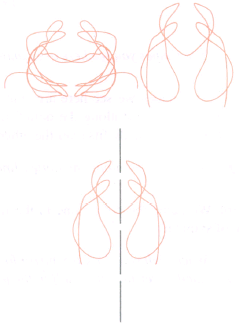
The figure obtained is symmetric. It can be folded only in one way to produce two identical halves.
29.
6cm2
30.
\(4.50=4+\frac { 50 }{ 100 } =4+\frac { 1 }{ 2 } =4\frac { 1 }{ 2 } =\frac { 9 }{ 2 } \)
31.
For Raju, cost of 10 pens = Rs.150
\(\therefore\) Cost of 1 pen \(=Rs.\frac{150}{10}=Rs.15\)
For Manish, cost of 7 pens = Rs.84
\(\therefore\) Cost of 1 pen \(=Rs.\frac{84}{7}=Rs.12\)
Here, Rs.12 < Rs.15
Hence, Manish got the pens cheaper.
32.
On drawing, we get the following circle with O as centre and of any radius:
(i) Take a point A such that A lies on the circle.
(ii) Take a point B such that B lies in the interior of the circle.
(iii) Take a point C such that C lies in the exterior of the circle.
33.
5-x
34.
Here, given production of dolls. Monday - 200, Tuesday - 500 Wednesday - 350, Thursday - 400
Let us assume that
100 may be represented by .png)
50 may be represented by .png)
Thus, the pictograph would be
35.
The vertices of the figure are A. B, C,D, E and the line segments are \(\bar {AB},\bar {BC},\bar {CD},\bar {DE},\bar {EA},\bar {AC},\bar {AD}\).
36.
We have, 30 and 415
30 = 1 x 30; 30 = 2 x 15; 30 = 3 x 10; 30 = 5 x 6
Factors of 30 are 1,2,3,5,6,10,15 and 30 and 415 = 1 x 415; 415 = 5 x 83
Factors of 415 are 1, 5, 83 and 415.
\(\because\)Common factors of 30 and 415 are 1 and 5.
So, 30 and 415 are not co-prime numbers.
37.
To add -3 and -4. Mark -3 on the number line. Move 4 steps to left of -3, we reach at -7.

∴ -3+(-4)= -7
38.
We have, \(\frac { 2 }{ 7 } ={{8}\over{\Box}}\)
∴ \(2\times \Box =7\times 8\)
So, \(2\times \Box =7\times 2\times 4=28\times 2\) [∵ 8 = 2\(\times\)4]
On comparing we get \(\Box =28\)
Hence \(\frac { 2 }{ 7 } =\frac { 8 }{ \boxed { 28 } } \)
39.
25000
40.
The measure of angle (by using the protractor) and its classification is shown as below
| Angle | Measure | Type |
|---|---|---|
| \(\angle AOB\) | 40° | Acute angle |
| \(\angle AOC\) | 125° | Obtuse angle |
| \(\angle BOC\) | 85° | Acute angle |
| \(\angle DOC\) | 95° | Obtuse angle |
| \(\angle DOA\) | 140° | Obtuse angle |
| \(\angle DOB\) | 180° | Straight angle |
41.
Given, capacity of vessel = 4 L 500 mL
= 4 \(\times\)1000 + 500 = 4000 + 500 = 4500 mL. [1L= 1000mL]
and capacity of one glass = 25 mL
∴ Number of glasses of curd filled out of vessel
\(=\frac { Capacity\quad of\quad a\quad vessel }{ Capacity\quad of\quad a\quad glass } =\frac { 4500 }{ 25 } =180\)
Hence, curd can be filled in 180 glasses.
42.
(a)
8
43.
(b)
1.1
44.
(d)
3p=12
45.
(a)
AB
46.
Length of the lace = 2(2 + 1) = 6 m
47.
(a)
\(\frac { 9 }{ 4 } \)
48.
(a)
-1 <-2
49.
(c)
1000
50.
(b)
cylinder
51.
(d)
None of these
52.
(c)
1 : 5
53.
(b)
right angle
54.
(a)
One
55.
(c)
Line segment

6th Standard CBSE Syllabus & Materials
6th Standard CBSE
CBSE 6th Social Science Locating Places on the Earth - New Sample Question Papers Study Material - QB365 Set A
NEW6th Standard CBSE
CBSE 6th Science A Journey Through States of Water - New Sample Question Papers Study Material - QB365 Set A
NEW6th Standard CBSE
CBSE 6th Science Temperature and its Measurement - New Sample Question Papers Study Material - QB365 Set A
NEW6th Standard CBSE
CBSE 6th Science Materials Around Us - New Sample Question Papers Study Material - QB365 Set A



CBSE 6th Standard CBSE Subjects
CBSE Standards




