
 100% FREE ACCESS
6th Standard Syllabus & Materials
6th Standard
TN 6th Tamil பருவம் 1 - இயல் 1 - மொழி -தமிழ்த்தேன் - இன்பத்தமிழ் Sample Question Papers Study Material - QB365 Set A
NEW6th Standard
TN 6th English T1 - Supplementary - The Apple Tree and The Farmer Sample Question Papers Study Material - QB365 Set A
NEW6th Standard
TN 6th English T1 - Prose - When The Trees Walked Sample Question Papers Study Material - QB365 Set A
NEW6th Standard
TN 6th Social Science T3 - CIV - Road Safety Sample Question Papers Study Material - QB365 Set A
NEW6th Standard
TN 6th Social Science T3 - CIV - Local Bodies - Rural and Urban Sample Question Papers Study Material - QB365 Set A
NEW6th Standard
TN 6th Social Science T3 - CIV - Democracy Sample Question Papers Study Material - QB365 Set A

Published on: 17/01/2019
Class 6 Integers Important Questions and Answers
Download Tamil Nadu 6th Standard Maths question papers, model tests, one-mark questions, important questions, and public exam papers in PDF format. Free study materials and answer keys for TN State Board students.
Questions + Answers key
Take MCQ Maths Test1.
P, Q, R and S are four different integers on a number line. From the following clues, find these integers and write them in ascending order.
i) S is the least of the given integers.
ii) R is the smallest positive integer.
iii) The integers P and S are at the same distance from 0.
iv) Q is 2 units to the left of integer R.
2.
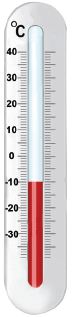
Look at the Celsius Thermometer and answer the following questions:
i) What is the temperature that is shown in the Thermometer?
ii) Where will you mark the temperature 5o C below 0o C in the Thermometer?
iii) What will be the temperature, if 10o C is reduced from the temperature shown in the Thermometer?
iv) Mark the opposite of 15o C in the Thermometer.
3.
Mark the following numbers on a number line
i) All integers which are greater than −7 but less than 7.
ii) The opposite of 3.
iii) 5 units to the left of −1.
4.
Arrange the following integers in ascending order.
i) −11, 12, −13, 14, −15, 16, −17, 18, −19, −20
ii) −28, 6, −5, −40, 8, 0, 12, −1, 4, 22
iii) −100, 10, −1000, 100, 0, −1, 1000, 1, −10
5.
Write all the integers between the given numbers.
i) 7 and 10
ii) −5 and 4
iii) −3 and 3
iv) −5 and 0
6.
Arrange the following integers in ascending order:
−15, 0, −7, 12, 3, −5, 1, −20, 25, 18
7.
Find the predecessor and successor of
i) 0 and
ii) −8 on a number line.
8.
Using the number line, write the integer which is 5 more than −6.
9.
Represent the following situations as integers:
i) A gain of Rs. 1000
ii) 20°C below 0°C
iii) 1990 BC (BCE)
iv) A deposit of Rs. 15847
v) 10 kg below normal weight
10.
Draw a number line and mark the integers 6, –5, –1, 4 and –7 on it.
11.
______ is an integer which is neither positive nor negative
12.
There are ______ integers from −5 to +5 (both inclusive).
13.
−46 is to the_____ of −35 on the number line
14.
A swimmer dives to a depth of 7 feet from the ground into the swimming pool. The integer that represents this, is _______ feet.
15.
The potable water available at 100m below the ground level is denoted as __________ m.
16.
All whole numbers are integers.
17.
All negative integers are greater than zero
18.
−10 and 10 are at equal distance from 1
19.
−1 is to the right of 0.
20.
Each of the integers −18, 6, −12, 0 is greater than −20.
21.
Construct a number line that shows the depth of 10 feet from the ground level and its opposite
22.
If 15 km east of a place is denoted as + 15 km, what is the integer that represents 15 km west of it?
23.
Find the opposite of the following numbers
i) 44
ii) −19
iii) 0
iv) −312
v) 789
24.
On the number line, which number is
i) 4 units to the right of −7?
ii) 5 units to the left of 3?
25.
Mark the numbers 4, −3, 6, −1 and −5 on the number line.
26.
Answer the following questions from the number line given below

i) Which integer is greater : G or K ? Why ?
ii) Find the integer that represents C.
iii) How many integers are there between G and H?
iv) Find the pairs of letters which are opposite of a number.
v) Say True or False : 6 units to the left of D is −6.
27.
The following bar graph shows the profit (+) and loss (−) of a small scale company (in crores) between the years 2011 to 2017.
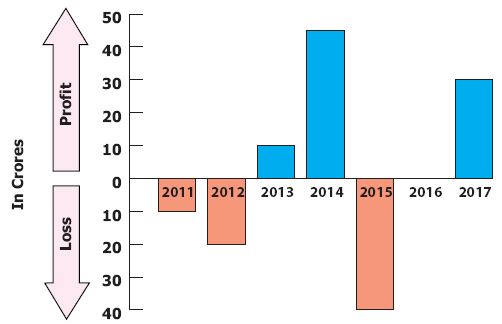
i) Write the integer that represents a profit or a loss for the company in 2014?
ii) Denote by an integer on the profit or loss in 2016.
iii) Denote by integers on the loss for the company in 2011 and 2012.
iv) Say True or False: The loss is minimum in 2012.
v) Fill in: The amount of loss in 2011 is _______ as profit in 2013.
28.
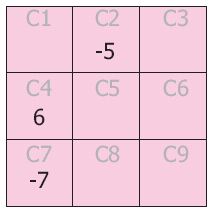
Complete the table using the following hints:
C1: the first non-negative integer.
C3: the opposite to the second negative integer.
C5: the additive identity in whole numbers.
C6: the successor of the integer in C2.
C8: the predecessor of the integer in C7.
C9: the opposite to the integer in C5
29.
Assuming that the home to be the starting point, mark the following places in order on the number line as per instructions given below and write their corresponding integers

Places : Home, School, Library, Playground, Park, Departmental Store, Bus Stand, Railway Station, Post Office, Electricity Board.
Instructions :
i) Bus Stand is 3 units to the right of Home.
ii) Library is 2 units to the left of Home.
iii) Departmental Store is 6 units to the left of Home.
iv) Post Office is 1 unit to the right of the Library.
v) Park is 1 unit right of Departmental Store.
vi) Railway Station is 3 units left of Post Office.
vii) Bus Stand is 8 units to the right of Railway Station.
viii) School is next to the right of Bus Stand.
ix) Playground and Library are opposite to each other.
x) Electricity Board and Departmental Store are at equal distance from Home.
30.
The number which determines marking the position of any number to its opposite on a number line is
-1
0
1
10
31.
3 units to the left of 1 is
-4
-3
-2
3
32.
One unit to the right of −7 is ___________
+1
-8
-7
-6
33.
The opposite of 20 units to the left of 0 is
20
0
-20
40
34.
There are __________ positive integers from −5 to 6.
5
6
7
11
1.
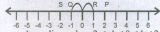
\(\therefore\) Ascending order : - 2 < - 1 < 0 < 1 < 2
\(\therefore\) S < Q < O < R < P
2.
i) – 10°C
ii) At −5°C
iii) −20°C
iv) −15°C
3.
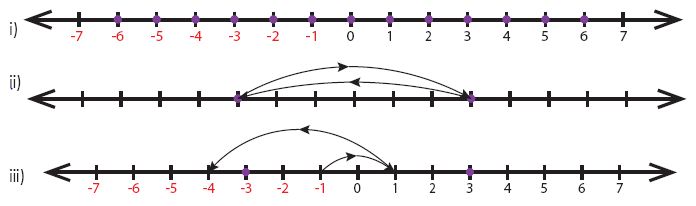
4.
i) −20, −19, −17, −15, −13, −11, 12, 14, 16, 18
ii) −40, −28, −5, −1, 0, 4, 6, 8, 12, 22
iii) −1000, −100, −10, −1, 0, 1, 10, 100, 1000
5.
(i) The integers between 7 and 10 are 8, 9
(ii) The integers between -5 and 4 are - 4, - 3, - 2, - 1, 0, 1, 2, 3
(iii) The integers between -3 and 3 are - 2, - 1, 0, 1, 2
(iv) The integers between -5 and 0 are - 4, - 3, - 2, - 1
6.
Step 1: First, separate the positive integers as 12, 3, 1, 25, 18 and the negative integers as −15, −7, −5, −20
Step 2: We can easily arrange positive integers in ascending order as 1, 3, 12, 18, 25 and negative integers in ascending order as −20, −15, −7, −5.
Step 3: As 0 is neither positive nor negative, it stays at the middle and now the arrangement −20, −15, −7, −5, 0, 1, 3, 12, 18 and 25 is in ascending order.
7.
Place the given numbers on the number line then move one unit to their right and left to get the successor and the predecessor respectively.

We can see that the successor of 0 is +1 and the predecessor of 0 is −1 and the successor of −8 is −7 and the predecessor of −8 is −9.
8.
From −6, we can move 5 units to its right to reach −1 as shown in the figure

9.
i) As gain is positive, Rs. 1000 is denoted as + Rs. 1000.
ii) 20°C below 0°C is denoted as - 20°C.
iii) A year in BC (BCE) can be considered as a negative number and a year in AD (CE) can be considered as a positive number. Hence, 1990 BC (BCE) can be represented as −1990.
iv) A deposit of Rs. 15847 is denoted as + Rs. 15847.
v) 10 kg below normal weight is denoted as -10 kg.
10.

11.
()
0
12.
()
11
13.
()
left
14.
()
-7
15.
()
–100
16.
(a)
17.
(b)
18.
(b)
19.
(b)
20.
(a)
21.
The depth of 10 feet from the ground level and its opposite
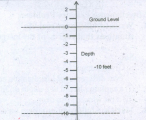
Opposite number of - 10 feet is 10 feet.
22.
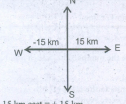
15 km east = + 15 km
\(\therefore\) 15 km west = - 15 km
23.
(i) 44
Opposite number = - 44
(ii) -19
Opposite number = +19 or 19
(iii) 0
Opposite number = 0
(iv) - 312
Opposite number = + 312 or 312
(v) 789
Opposite number = - 789
24.
(i)
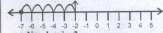
\(\therefore\) Number is : -3
(ii)

\(\therefore\) Number is : -2
25.

26.
(i) From the number line,
G is -3
K is -1
- 1 > -3, -1 is greater.
\(\therefore\) k is greater.
(ii) From the number line, C represents the integer is -4.
(iii) From the number line
G is -3
H is 4
Integers between G and H are -2, -1, 0, 1, 2, 3
Ans: 6 integers.
(iv) 2 pairs
(i.e) (E,J) and (C,H)
(-5, 5) (-4,4)
(v) units to the left of D is - 6. So, False.
27.
(i) The integer that represent a profit is + 45
(ii) An integer on the profit or loss in, 2016 is 0
(iii) Loss in 2011 is -10, Loss in 2012 is - 20
(iv) False
(v) Fill in : The amount of loss in 2011 is the same as profit in 2013.
28.
|
C1 |
C2 -5 |
C3 2 |
| C4 6 |
C5 0 |
C6 -4 |
| C7 -7 |
C8 -8 |
C9 0 |
C3: The opposite to the second negative integer.
C5: The additive identity in whole numbers.
C6: The successor of the integer in C2.
C8: The predecessor of the integer in C7.
C9: The opposite to the integer in C5.
29.
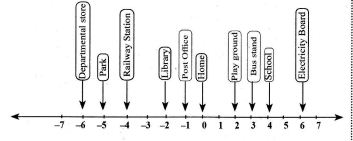
Answer :
i) Bus stand = 3 units
ii) Library = −2 units
iii) Departmental store = −6 units
iv) post office = −1 units
v) Park = −5 units
vi) Railway station = −4 units
vii) Bus stand = 3 units
viii) School = 4 units
ix) Paly ground = 2 units
x) Electricity = 6 units
30.
(b)
0
31.
(c)
-2
32.
(d)
-6
33.
(a)
20
34.
(c)
7

6th Standard Syllabus & Materials
6th Standard
TN 6th Social Science T3 - GEO - Understanding Disaster Sample Question Papers Study Material - QB365 Set A
NEW6th Standard
TN 6th Social Science T3 - GEO - Globe Sample Question Papers Study Material - QB365 Set A
NEW6th Standard
TN 6th Social Science T3 - GEO - Asia and Europe Sample Question Papers Study Material - QB365 Set A
NEW6th Standard
TN 6th Social Science T3 - HIS - South Indian Kingdoms Sample Question Papers Study Material - QB365 Set A



Tamilnadu Stateboard 6th Standard Subjects
Tamilnadu Stateboard Standards




