
 100% FREE ACCESS
6th Standard Syllabus & Materials
6th Standard
TN 6th Tamil பருவம் 1 - இயல் 1 - மொழி -தமிழ்த்தேன் - இன்பத்தமிழ் Sample Question Papers Study Material - QB365 Set A
NEW6th Standard
TN 6th English T1 - Supplementary - The Apple Tree and The Farmer Sample Question Papers Study Material - QB365 Set A
NEW6th Standard
TN 6th English T1 - Prose - When The Trees Walked Sample Question Papers Study Material - QB365 Set A
NEW6th Standard
TN 6th Social Science T3 - CIV - Road Safety Sample Question Papers Study Material - QB365 Set A
NEW6th Standard
TN 6th Social Science T3 - CIV - Local Bodies - Rural and Urban Sample Question Papers Study Material - QB365 Set A
NEW6th Standard
TN 6th Social Science T3 - CIV - Democracy Sample Question Papers Study Material - QB365 Set A

Published on: 20/02/2019
3rd Term SA Mock Test 2019
Download Tamil Nadu 6th Standard Maths question papers, model tests, one-mark questions, important questions, and public exam papers in PDF format. Free study materials and answer keys for TN State Board students.
Questions + Answers key
Take MCQ Maths Test1.
Observe the following and represent the shaded parts as fraction:
(i)
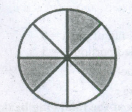
(ii)
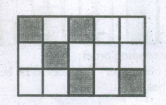
(iii)
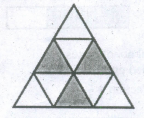
(iv)
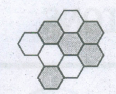
2.
Find the HCF of two numbers 16 and 28.
3.
Find the order of rotation for the following figures.
4.
Find the area of a right angled triangle whose base is 18 cm and height is 12 cm.
5.
Thendral, Tharani and Thanam are given a thread piece each of length 12 cm. They are asked to make a rectangle, a square and a triangle respectively with the thread for their Math activity. In how many ways, can they make the respective shapes?
6.
Compare −14 and −11
7.
Convert \(17\over3\) into a mixed fraction
8.
The order of rotational symmetry of the letter ‘z’ is ______
9.
______ is an integer which is neither positive nor negative
10.
−46 is to the_____ of −35 on the number line
11.
\(5{1\over3}-3{1\over2}=\)_______
12.
\(7{3\over4}+6{1\over2}=\)_________
13.
The number 191 has rotational symmetry
14.
The reflection of the name RANI is 
15.
All whole numbers are integers.
16.
−1 is to the right of 0.
17.
The reciprocal of an improper fraction is always a proper fraction
18.
If the Highest Common Factor of 26 and 54 is 2, then HCF of 54 and 28 is...
26
2
54
1
19.
Which of the following letter does not have a line of symmetry?
A
P
T
U
20.
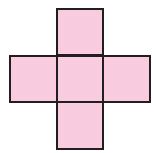
The following figures are of equal area. Which figure has the least perimeter?
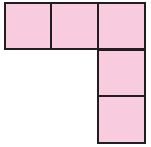
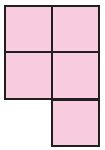
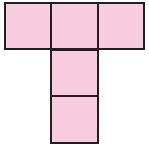
21.
3 units to the left of 1 is
-4
-3
-2
3
22.
The reciprocal of \(53\over17\) is
\(\frac{53}{17}\)
\(5 \frac{3}{17}\)
\(\frac{17}{53}\)
\(3 \frac{5}{17}\)
23.
Find HCF of the following pair of numbers by Euclid’s game.
i) 25 and 35
ii) 36 and 12
iii) 15 and 29
24.
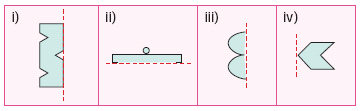
Complete the other half of the following figures such that the dotted line is the line of symmetry
25.
A square park has 40 m as its perimeter. What is the length of its side? Also find its area.
26.
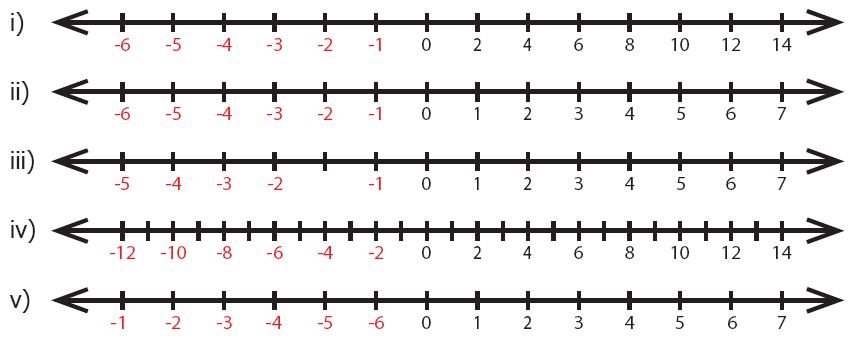
From the following number lines, identify the correct and the wrong representations with reason
27.
Which is smaller? The difference between \(2{1\over2}\ and\ 3{2\over3}\) or the sum of \(1{1\over2}\ and\ 2{1\over4}\)
28.
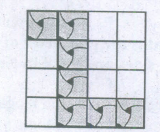
Find the number of tiles required to fill the are a of following ligures
(i)
(ii)
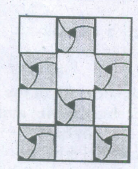
(iii)
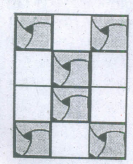
(iv)
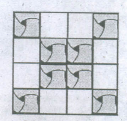
29.
Using the given fractions \(\cfrac { 1 }{ 5 } ,\cfrac { 1 }{ 6 } ,\cfrac { 1 }{ 10 } ,\cfrac { 1 }{ 15 } ,\cfrac { 2 }{ 15 } ,\cfrac { 4 }{ 15 } ,\cfrac { 1 }{ 30 } ,\cfrac { 7 }{ 30 } \) and \(\cfrac { 9 }{ 36 } \) fiIl in the missing ones in the given -3 \(\times\) 3 square in such a way that the addition of fractions through rows, columns and diagonals give the same total
| \(\cfrac { 1 }{ 30 } \) | ||
| \(\cfrac { 2 }{ 15 } \) |
30.
Find HCF of 28, 35, 42 by Euclid’s game
31.
Colour the boxes in such a way that it posseses translation symmetry
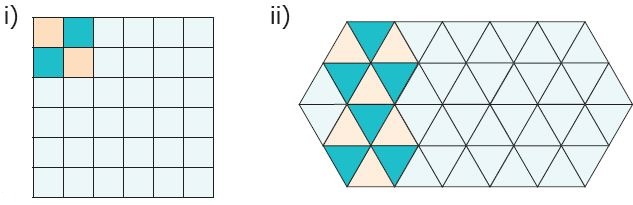
32.
Answer the following questions from the number line given below

i) Which integer is greater : G or K ? Why ?
ii) Find the integer that represents C.
iii) How many integers are there between G and H?
iv) Find the pairs of letters which are opposite of a number.
v) Say True or False : 6 units to the left of D is −6.
33.
The table given below contains some measures of the rectangle. Find the unknown values
| S. No | Length | Breadth | Perimeter | Area |
|---|---|---|---|---|
| i) | 5 cm | 8 cm | ? | ? |
| ii) | 13 cm | ? | 54cm | ? |
| iii) | ? | 15 cm | 60 cm | ? |
| iv) | 10 m | ? | ? | 120 square metre |
| v) | 4 feet | ? | 20 square feet |
1.
(i) Total parts = 8
Shaded paris of portion = 3
Fraction = \(\cfrac { 3 }{ 8 } \)
(ii) Shaded portion:
Total no. parts = 15
Shaded portion = 5
\(\therefore \) Fraction \(\cfrac { 5 }{ 15 } =\cfrac { 1 }{ 3 } \)
(iii) Shaded portion = 3
\(\therefore \) Fraction = \(\cfrac { 3 }{ 9 } =\cfrac { 1 }{ 3 } \)
(iv) Total no. of parts = 9
Shaded portion = 5
\(\therefore\) Fraction = \(\cfrac { 5 }{ 9 } \)
2.
Now the HCF of 16, 28
16 = 2 \(\times\) 2 \(\times\)2 \(\times\) 2
28 = 2 \(\times\)2 \(\times\) 7
HCF of (16, 28) = 2 \(\times\)2 = 4
Now the HCF of (16 , 28 -16)
16 = 2 \(\times\) 2 \(\times\)2 \(\times\) 2
12 = 2 \(\times\) 2 \(\times\) 3
HCF of (16, 12) = 2 \(\times\) 2 = 4
Therefore HCF of (16, 28) = HCF of (16, 28 - 16).
Hence, HCF of two numbers a and b, a > b, is same as the HCF of a and a – b.
3.
| Figures |  |
 |
 |
 |
| Order of rotation | 4 | 5 | 2 | 5 |
4.
Base, b = 18 cm
Height, h = 12 cm
Area, \(A={1\over2}(b x h)\ sq\ units\)
\(={1\over2}(18\times12)\)
= 108 sq. cm. (or) 108 cm2
5.
Thendral
Perimeter of the rectangle, P = 12 cm
2 ( l + b ) = 12
l + b = \({12\over6}=6cm\)
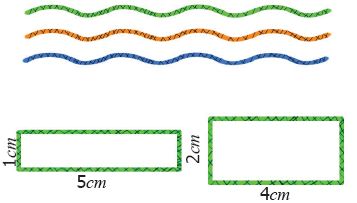
The possible pairs of measures whose sum is 6 are (5, 1) and (4, 2).
Hence, Thendral can make a rectangle in 2 ways. She can make a rectangle of length 5 cm and breadth 1 cm and another one with length 4 cm and breadth 2 cm.
Tharani
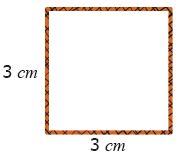
Perimeter of the square, P = 12 cm
4 \(\times\) s = 12
\(s={12\over4}=3 \ cm\)
Hence, Tharani can make only one square of side 3 cm.
Thanam
Perimeter of the triangle, P = 12 cm
a + b + c = 12 cm
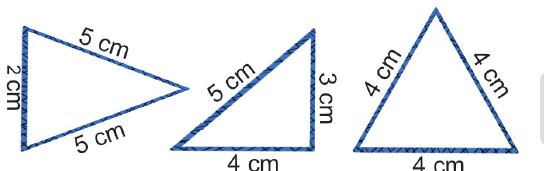
The possible triplets of measures whose sum is 12 and also satisfying the triangle inequality are (2, 5, 5); (3, 4, 5); (4, 4, 4).
Hence, Thanam can make 3 triangles of sides 2 cm, 5 cm & 5 cm; 3 cm, 4 cm & 5 cm and 4 cm, 4 cm & 4 cm.
6.
Draw number line and plot the numbers −14 and −11 as follows

Fixing −11, we find −14 is to the left of −11. So, −14 is smaller than −11. That is, −14 < −11.
7.
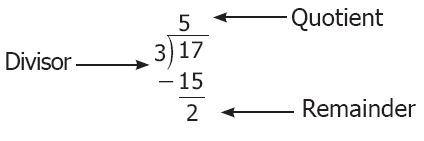
\({17\over3}=Quotient{Remainder\over Divisor}=5{2\over3}\)
8.
()
Two
9.
()
0
10.
()
left
11.
()
\(1{5\over6}\)
12.
()
\(14{1\over4}\)
13.
(b)
14.
(b)
15.
(a)
16.
(b)
17.
(a)
18.
(b)
2
19.
(b)
P
20.
(b)
21.
(c)
-2
22.
(c)
\(\frac{17}{53}\)
23.
(i) By Euclid's game
Given numbers = 25 and 35
HCF\(\Rightarrow\)(25, 35) = HCF(25, 35 - 25)
= (25, 10)
= (25 - 10, 10) = (15, 10)
= (5, 10)
= (5, 10 - 5)
= (5, 5)
(ii) By Euclid's game
Given numbers = 36 and 12
HCF of 36 and and 12 \(\Rightarrow\)(36, 12)
\(\Rightarrow\) (36 -12, 12)
\(\Rightarrow\)(24, 12)
\(\Rightarrow\)(24 - 12, 12)
\(\Rightarrow\)(12, 12)
\(\therefore\) HCF = 12.
(iii)
Given numbers are 15 and 29
By Euclid's game:
HCF of 15 and 29 is
\(\Rightarrow\)(15, 29)
\(\Rightarrow\)(15, 29 - 15)
\(\Rightarrow\)(15, 14)
\(\Rightarrow\)(15 - 14, 14)
\(\Rightarrow\)(1, 14)\(\Rightarrow\) (1, 14 - 1) \(\Rightarrow\)(1, 13)
\(\Rightarrow\)(1, 13 -1) \(\Rightarrow\)(1, 12) \(\Rightarrow\)(1, 12 -1), (1, 11) (1, 1)
\(\therefore\) HCF = 1
24.

25.
Perimeter (P) = 40 m
Side (8) =?
Area (A) =?
4S = P
\(4S=40\Rightarrow S=\cfrac { 40 }{ 4 } =10m\)
A = S2 = 102 = 100m2
\(\therefore\) Side (S) = 10 m, Area (A) = 100 m2
26.
i) Wrong, Integers are not continuously marked
ii) Correct, Integers are correctly marked.
iii) Wrong, Integer −2 is marked wrongly.
iv) Correct, Integers are marked at equal distance.
v) Wrong, negative integers marked wrongly.
27.
Difference between \(2\cfrac { 1 }{ 2 }\ and\ 3\cfrac { 1 }{ 2 } \)
Difference = \(3\cfrac { 2 }{ 3 } -2\cfrac { 1 }{ 2 } \)
= \(\cfrac { 11 }{ 3 } -\cfrac { 5 }{ 2 } \)
= \(\cfrac { \left( 11\times 2 \right) -\left( 5\times 3 \right) }{ 6 } =\cfrac { 22-15 }{ 6 } \)
= \(\cfrac { 7 }{ 6 } \) ...(1)
Also given
Sum of \(1\cfrac { 1 }{ 2 }\ and\ 2\cfrac { 1 }{ 4 } \)
Sum =\(1\cfrac { 1 }{ 2 } +2\cfrac { 1 }{ 4 } \)
= \(\cfrac { 3 }{ 2 } +\cfrac { 9 }{ 4 } \)
= \(\cfrac { \left( 3\times 2 \right) +9 }{ 4 } =\cfrac { 6+9 }{ 4 } =\cfrac { 15 }{ 4 } \)
From (1) and (2),
Difference = \(\cfrac { 7 }{ 6 } \), Sum = \(\cfrac { 15 }{ 4 } \)
\(\cfrac { 7 }{ 6 } ,\cfrac { 15 }{ 4 } \)
\(\Rightarrow\) Lcm of 6 and 4 is 12
\(\cfrac { 7 }{ 6 } \times \cfrac { 2 }{ 2 } =\cfrac { 14 }{ 12 } ,\cfrac { 15 }{ 4 } \times \cfrac { 3 }{ 3 } =\cfrac { 45 }{ 12 } \)
\(\cfrac { 14 }{ 12 } <\cfrac { 45 }{ 12 } \Rightarrow \cfrac { 7 }{ 6 } <\cfrac { 15 }{ 4 } \)
\(\therefore \) The difference between \(2\cfrac { 1 }{ 2 }\ and\ 3\cfrac { 2 }{ 3 } \)
28.
(i) 4 square tiles horizontally and 4 square tiles vertically.
\(\Rightarrow\) 4 \(\times\) 4 = 16 sq. units.
No. of tiles tilled = 7
No. of tiles required = 16 -7 = 9
(ii) 4 square tiles vertically and 3 square tiles horizontally .
Area \(\Rightarrow\) 4 \(\times\) 3 = 12 sq. units.
No. of tiles filled = 6
(iii) 4 square tiles vertically and 3 square files horizontally.
Area = 4 \(\times\) 3 = 12 sq. units.
No. of tiles filled = 6
Required tiles = 12 - 6 = 6
(iv) 4 square tiles horizontally and 4 square tiles vertically.
Area = 4 \(\times\) 4 = 16 sq. units.
No. of tiles filled = 8
Required tiles = 16 - 8 = 8
29.
| \(\cfrac { 4 }{ 15 } \) | \(\cfrac { 1 }{ 30 } \) | \(\cfrac { 1 }{ 5 } \) |
| \(\cfrac { 1 }{ 10 } \) | \(\cfrac { 1 }{ 6 } \) | \(\cfrac { 7 }{ 30 } \) |
| \(\cfrac { 2 }{ 15 } \) | \(\cfrac { 9 }{ 30 } \) | \(\cfrac { 1 }{ 15 } \) |
30.
Euclid's game
(28, 35, 41)
\(\Rightarrow\) (28, (35 - 28), (42 - 28))
\(\Rightarrow\) (28, 7, 14)
\(\Rightarrow\) (28 -7), 7, 14 - 7)
\(\Rightarrow\) (21, 7, 7) \(\Rightarrow\)((21 -7), 7, 7)
\(\Rightarrow\) (14, 7, 7)
\(\Rightarrow\) (14 - 7, 7, 7)
\(\Rightarrow\)(7, 7, 7)
\(\therefore\) HCF of (28, 35, 42) is 7
31.
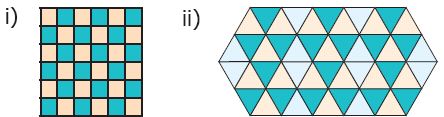
32.
(i) From the number line,
G is -3
K is -1
- 1 > -3, -1 is greater.
\(\therefore\) k is greater.
(ii) From the number line, C represents the integer is -4.
(iii) From the number line
G is -3
H is 4
Integers between G and H are -2, -1, 0, 1, 2, 3
Ans: 6 integers.
(iv) 2 pairs
(i.e) (E,J) and (C,H)
(-5, 5) (-4,4)
(v) units to the left of D is - 6. So, False.
33.
(i) Given:
Length (1) = 5 cm
breadth (b) = 8 cm
Perimeter = 2 (I + b)
= 2 (5 + 8)
= 2 \(\times\)13 = 26 cm
Are a (A) = lb = 5 \(\times\) 8 = 40 cm2
(ii) Given :
Length (1) = 13 cm
Perimeter (P) = 54 cm
To find: b and A
\(b=\cfrac { P-2l }{ 2 } \)
= \(\cfrac { 54-2(13) }{ 2 } \)
= \(\cfrac { 54-26 }{ 2 } =\cfrac { 28 }{ 2 } =14\)
b = 14 cm
Area (A) = lb = 13 \(\times\) 14
A = 182 cm2
(iii) Given:
Breadth (b) = 15 cm
Perimeter (P) = 60 cm
To find: 1 and A
\(I=\cfrac { P-2b }{ 2 } \)
= \(\cfrac { 60-2(15) }{ 2 } =\cfrac { 60-30 }{ 2 } =\cfrac { 30 }{ 2 } \)
1 = 15 cm
A = lb = 15 \(\times\) 15 = 225
A = 225 cm2
(iv) Given :
Length (1) = 10m
Area (A) = 120 sq. m
To find: band P
\(b=\cfrac { A }{ l } \)
= \(\cfrac { 120 }{ 10 } =12\)
b = 12m
P = 2 (1 + b)
= 2(10 + 12)
= 2 \(\times\) 22 = 44
P = 44 m
(v) Given:
Breadth (b) = 4 feet
Area (A) = 20 s. feet
To find: 1 and P
\(\therefore l=\cfrac { A }{ b } \)
= \(\cfrac { 20 }{ 4 } =5\)
1= 5 feet
P = 2(I + b)
= 2(5 + 4)
= 2(9) = 18
P = 18 feet

6th Standard Syllabus & Materials
6th Standard
TN 6th Social Science T3 - GEO - Understanding Disaster Sample Question Papers Study Material - QB365 Set A
NEW6th Standard
TN 6th Social Science T3 - GEO - Globe Sample Question Papers Study Material - QB365 Set A
NEW6th Standard
TN 6th Social Science T3 - GEO - Asia and Europe Sample Question Papers Study Material - QB365 Set A
NEW6th Standard
TN 6th Social Science T3 - HIS - South Indian Kingdoms Sample Question Papers Study Material - QB365 Set A



Tamilnadu Stateboard 6th Standard Subjects
Tamilnadu Stateboard Standards




