
 100% FREE ACCESS
6th Standard Syllabus & Materials
6th Standard
TN 6th Tamil பருவம் 1 - இயல் 1 - மொழி -தமிழ்த்தேன் - இன்பத்தமிழ் Sample Question Papers Study Material - QB365 Set A
NEW6th Standard
TN 6th English T1 - Supplementary - The Apple Tree and The Farmer Sample Question Papers Study Material - QB365 Set A
NEW6th Standard
TN 6th English T1 - Prose - When The Trees Walked Sample Question Papers Study Material - QB365 Set A
NEW6th Standard
TN 6th Social Science T3 - CIV - Road Safety Sample Question Papers Study Material - QB365 Set A
NEW6th Standard
TN 6th Social Science T3 - CIV - Local Bodies - Rural and Urban Sample Question Papers Study Material - QB365 Set A
NEW6th Standard
TN 6th Social Science T3 - CIV - Democracy Sample Question Papers Study Material - QB365 Set A

Published on: 04/10/2019
Fractions Model Question Paper
Download Tamil Nadu 6th Standard Maths question papers, model tests, one-mark questions, important questions, and public exam papers in PDF format. Free study materials and answer keys for TN State Board students.
Questions + Answers key
Take MCQ Maths Test1.
(i) Convert \(3\frac { 1 }{ 3 } \) into improper fraction.
(ii) Convert \(\cfrac { 45 }{ 7 } \) into improper fraction.
2.
Write the fraction of shaded part in the following:
(i)
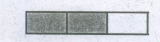
(ii)
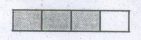
(iii)
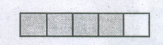
3.
Add the difference between \(1{1\over3}\) and \(3{1\over6}\) and the difference between \(4{1\over6}\ and\ 2{1\over3}\)
4.
Kandan shares\(1\over2\)piece of a cake between 2 persons. What will be the share of each?
5.
Simplify: \({3\over4}-{1\over2}\)
6.
Arrange \({2\over 3},{1\over 6},{4\over 9}\) in ascending order
7.
Find three equivalent fractions of \(3\over 4\) and \(2 \over 7\)
8.
The number which has its own reciprocal is ________
9.
\(5{1\over3}-3{1\over2}=\)_______
10.
\(7{3\over4}+6{1\over2}=\)_________
11.
\(3{1\over4}\times3{1\over 3}=9{1\over16}\)
12.
The mixed fraction of \(13\over4\)is \(3{1\over4}\)
13.
\(3{1\over2}\)can be written as \(3+{1\over2}\)
14.
Pugazh has been given four choices for his pocket money by his father. Which of the choices should he take in order to get the maximum money?
\(\frac{2}{3}\) of Rs. 150
\(\frac{3}{5}\) of Rs. 150
\(\frac{1}{5}\) of Rs. 150
\(\frac{4}{5}\) of Rs. 150
15.
The difference between \(3\over7\) and \(2\over9\) is
\(\frac{13}{63} \)
\(\frac{1}{9}\)
\(\frac{1}{7} \)
\(\frac{9}{16}\)
16.
Which of the following statement is incorrect?
\({1\over2}>{1\over3}\)
\({7\over8}>{6\over7}\)
\({8\over9}>{9\over10}\)
\({10\over11}>{9\over10}\)
17.
Arrange the fractions in descending order \(\cfrac { 9 }{ 20 } ,\cfrac { 3 }{ 4 } ,\cfrac { 7 }{ 12 } \)
(i) \(\cfrac { 2 }{ 3 } +\cfrac { 5 }{ 7 } \)
(ii) \(\cfrac { 3 }{ 5 } -\cfrac { 3 }{ 8 } \)
18.
Which is greater \(\cfrac { 3 }{ 8 } or\cfrac { 3 }{ 5 } ?\)
19.
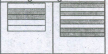
Shade the rectangle for the given pair of fractions and say which is greater among them.
(i) \(\cfrac { 1 }{ 3 } and\cfrac { 1 }{ 5 } \)
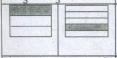
(ii) \(\cfrac { 2 }{ 5 } and\cfrac { 5 }{ 8 } \)
20.
Mangai bought \(6{3\over4}\) kg of apples. If Kalai bought \(1{1\over2}\) times as Mangai bought, then how many kilograms of apples did Kalai buy?
21.
Sankari purchased \(2{1\over2}\) m cloth to stich a long skirt and \(1{3\over 4}m\) cloth to stitch blouse. If the cost is Rs.120 per metre then find the cost of cloth purchased by her
22.
(i) Find the sum of \(5\cfrac { 4 }{ 9 } \)and \(3\cfrac { 1 }{ 6 } \)
(ii) Subtract \(7\cfrac { 1 }{ 6 } \) from \(12\cfrac { 3 }{ 8 } \)
(iii) Subtract the sum of \(6 \frac{1}{6}\) and \(3 \frac{1}{5}\) from the sum of \(9 \frac{2}{3} \text { and } 2 \frac{1}{2}\)
23.
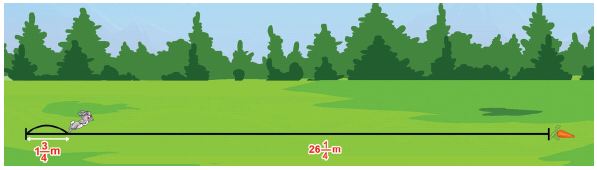
A rabbit has to cover \(26{1\over4}\)m to fetch its food. If it covers \(1{3\over4}\)m in one jump, then how many jumps will it take to fetch its food?
1.
Given : \(3\frac { 1 }{ 3 } \)
Improper fraction = \(\cfrac { (Whole\ number\ X\ Deno\ minator)+Numerator }{ Deominator } \)
= \(\cfrac { \left( 3\times 3 \right) +1 }{ 3 } =\cfrac { 9+1 }{ 3 } \)
(\(\therefore\) W.no = 3, D = 3, N = 1)
= \(\cfrac { 10 }{ 3 } \)
(ii) Given :\(\cfrac { 45 }{ 7 } \)
Mixed fraction = Quotilent + \(\cfrac { Remainder }{ Divisor } \)
= \(6+\cfrac { 3 }{ 7 } \)
= \(6\cfrac { 3 }{ 7 } \)
2.
(i) Total no. of boxes = 3
shaded portion = 2
\(\therefore\) Fraction = \(\cfrac { 2 }{ 3 } \)
(ii) Total no. of boxes = 4
shaded portion' = 3
\(\therefore\) Fraction = \(\cfrac { 3 }{ 4 } \)
(iii) Total no. of boxes = 5
shaded portion = 4
\(\therefore\) Fraction = \(\cfrac { 4 }{ 5 } \)
3.
Difference between \(1\cfrac { 1 }{ 3 } \) and \(3\cfrac { 1 }{ 6 } \)
= \(3\cfrac { 1 }{ 6 } -1\cfrac { 1 }{ 3 } \)
= \(\cfrac { 19 }{ 6 } -\cfrac { 4 }{ 3 } \)
LCM of 6 and 3 is 6
= \(\cfrac { 19 }{ 6 } -\cfrac { 4\times 2 }{ 3\times 2 } =\cfrac { 19 }{ 6 } -\cfrac { 8 }{ 6 } =\cfrac { 19-8 }{ 6 } \)
= \(\cfrac { 11 }{ 6 } \)
Also given:
Difference between \(4\cfrac { 1 }{ 6 }\ and\ 2\cfrac { 1 }{ 3 } \)
= \(4\cfrac { 1 }{ 6 } -2\cfrac { 1 }{ 3 } \)
= \(\cfrac { 25 }{ 7 } -\cfrac { 7 }{ 3 } \)
LCM of 6 and 3 is 6
= \(\cfrac { 25 }{ 6 } -\cfrac { 7\times 2 }{ 3\times 2 } =\cfrac { 25 }{ 6 } -\cfrac { 14 }{ 6 } =\cfrac { 25-14 }{ 6 } \)
= \(\cfrac { 11 }{ 6 } \)
Adding (1) and (2), we get
= \(\cfrac { 11 }{ 6 } +\cfrac { 11 }{ 6 } =\cfrac { 11+11 }{ 6 } =\cfrac { 22 }{ 6 } \)
= \(\cfrac { 11 }{ 3 } =3\cfrac { 2 }{ 3 } \)
4.
To know the share, we need to find \({1\over2}\div 2\)
\({1\over2}\div 2={1\over2}\times{1\over2}\)(reciprocal of 2 is \(\frac{1}{2}\))
\(={1\over2}\times{1\over2}={1\times1\over 2\times2}={1\over 4}\)
5.
Common multiple of 2 and 4 is 4
Equivalent fraction of \(1\over2\) is
\({1\over2}={1\times2\over 2\times2}={2\over4}\)
Now
\({3\over 4}-{1\over2}={3\over4}-{2\over4}={3-2\over4}={1\over 4}\)
Therefore, Vani has \(1\over4\) amount of water in the bottle. This can be verified by the following diagram

6.
Equivalent fractions of \(2\over 3\)are \({4\over 6},{6\over 9},{8\over 12},{10\over 15},{12\over 18},.....\)
Equivalent fractions of \(1\over 6\) are \({2\over12},{3\over 18}\) ,...
Equivalent fractions of \(4\over9\) is \({8\over18},....\)
Therefore \({3\over 18}<{8\over18}<{12\over 18}\)
The ascending order of given fractions is \({1\over 6},{4\over 9},{2\over3}\)
7.
Equivalent Fraction of \(3\over 4\)
\({3\over 4}={3\times2\over 4\times 2}={6\over 8}\)
\({3\over 4}={3\times3\over 4\times 3}={9\over 12}\)
\({3\over 4}={3\times4\over 4\times 4}={12\over 16}\)
Equivalent Fraction of \(2 \over 7\)
\({2 \over 7}={2\times2\over 7\times2}={4\over 14}\)
\({2 \over 7}={2\times3\over 7\times3}={6\over 21}\)
\({2 \over 7}={2\times4\over 7\times4}={8\over 28}\)
Equivalent fractions of \({3\over4}:{3\over 4}={6\over 8}={9\over 12}={12\over 16}\)
Equivalent fractions of \({2\over7}:{3\over 7}={4\over 14}={6\over 21}={8\over 28}\)
8.
()
1
9.
()
\(1{5\over6}\)
10.
()
\(14{1\over4}\)
11.
(b)
12.
(a)
13.
(a)
14.
(d)
\(\frac{4}{5}\) of Rs. 150
15.
(a)
\(\frac{13}{63} \)
16.
(d)
\({10\over11}>{9\over10}\)
17.
Given:\(\cfrac { 9 }{ 20 } ,\cfrac { 3 }{ 4 } ,\cfrac { 7 }{ 12 } \)
LCM of 20, 4, 12 is 60
\(\cfrac { 9 }{ 30 } \times \cfrac { 3 }{ 3 } =\cfrac { 27 }{ 60 } ,\cfrac { 3 }{ 4 } \times \cfrac { 15 }{ 15 } =\cfrac { 45 }{ 60 } ,\cfrac { 7 }{ 12 } \times \cfrac { 5 }{ 5 } =\cfrac { 35 }{ 60 } \)
\(\Rightarrow \cfrac { 27 }{ 60 } <\cfrac { 35 }{ 60 } <\cfrac { 45 }{ 60 } \Rightarrow \cfrac { 45 }{ 60 } >\cfrac { 35 }{ 60 } >\cfrac { 27 }{ 60 } \)
\(\therefore\) Descending order is \(\cfrac { 3 }{ 4 } ,\cfrac { 7 }{ 12 } ,\cfrac { 9 }{ 20 } \)
(i) LCM of 3 and 7 is 21
\(\Rightarrow \cfrac { 2 }{ 3 } \times \cfrac { 7 }{ 7 } +\cfrac { 5 }{ 7 } \times \cfrac { 3 }{ 3 } \)
\(\cfrac { 14 }{ 21 } +\cfrac { 15 }{ 21 } =\cfrac { 14+15 }{ 21 } =\cfrac { 29 }{ 21 } \)
(ii) LCM of5 and 8 is 40
\(\Rightarrow \cfrac { 3 }{ 5 } \times \cfrac { 8 }{ 8 } -\cfrac { 3 }{ 8 } \times \cfrac { 5 }{ 5 } \)
= \(\cfrac { 24 }{ 60 } -\cfrac { 15 }{ 40 } =\cfrac { 24-15 }{ 40 } =\cfrac { 9 }{ 40 } \)
18.
Given:\(\cfrac { 3 }{ 8 } ,\cfrac { 3 }{ 5 } \)
L. C. M of 8 and 5 is 40
\(\cfrac { 3 }{ 8 } \times \cfrac { 5 }{ 5 } =\cfrac { 15 }{ 40 } ,\cfrac { 3 }{ 5 } \times \cfrac { 8 }{ 8 } =\cfrac { 24 }{ 40 } \)
\(\therefore \ \cfrac { 24 }{ 40 } >\cfrac { 15 }{ 40 } \Rightarrow \cfrac { 3 }{ 5 } >\cfrac { 3 }{ 8 } \)
\(>\cfrac { 3 }{ 8 } \\ \) is greater
19.
(i) \(\cfrac { 1 }{ 3 } \) is greater than \(\cfrac { 1 }{ 5 } \)
That is \(\cfrac { 1 }{ 3 } \ge \cfrac { 1 }{ 5 } \)
(ii) \(\cfrac { 2 }{ 5 } \) is smaller \(\cfrac { 5 }{ 8 } \)
That is \(\cfrac { 2 }{ 5 } \le \cfrac { 1 }{ 5 } \)
20.
Mangai bought = \(6\cfrac { 3 }{ 4 } kg\) of apple
Kalai bought = \(1\cfrac { 1 }{ 2 } \) times as Mangai bought
= \(\left[ 1\cfrac { 1 }{ 2 } \times 6\cfrac { 3 }{ 4 } \right] kg\) of apples
= \(\cfrac { 3 }{ 2 } \times \cfrac { 27 }{ 4 } \)
= \(\cfrac { 81 }{ 8 } \)
\(\therefore \) Kalai bought = \(10\cfrac { 1 }{ 8 } \) kg of apples.
21.
Sankari purchased
To stitch a long skirt = \(2\cfrac { 1 }{ 2 } \ m\ cloth=\cfrac { 5 }{ 2 } m\)
To Stitch blouse = \(1\cfrac { 3 }{ 4 } m=\cfrac { 7 }{ 4 } m\)
Total length of clothe = \(\cfrac { 5 }{ 2 } m+\cfrac { 7 }{ 4 } m|\)
= \(\cfrac { (5\times 2)+7 }{ 4 } =\cfrac { 10+7 }{ 4 } \)
= \(\cfrac { 17 }{ 4 } m\)
Cost of 1 m cloth = Rs. 120
\(\therefore \cfrac { 17 }{ 4 } m\ cloth=120\times \cfrac { 17 }{ 4 } \)
= Rs. 510
Cost of cloth purchased by Sankari = Rs. 510
22.
\(5\cfrac { 4 }{ 9 } \) and \(3\cfrac { 1 }{ 6 } \)
\(\Rightarrow \cfrac { 49 }{ 9 } +\cfrac { 19 }{ 6 } \)
LCM of 9 and 6 is 18
= \(\cfrac { 49\times 2 }{ 9\times 2 } +\cfrac { 19\times 3 }{ 6\times 3 } \)
= \(\cfrac { 98 }{ 18 } +\cfrac { 57 }{ 18 } \)
= \(\cfrac { 98+57 }{ 18 } =\cfrac { 155 }{ 18 } \)
= \(8\cfrac { 11 }{ 18 } \)
(ii) \(7\cfrac { 1 }{ 6 } \Rightarrow \cfrac { 43 }{ 6 } \)
\(12\cfrac { 3 }{ 8 } \Rightarrow \cfrac { 99 }{ 8 } \)
Now to find : \(\cfrac { 99 }{ 8 } -\cfrac { 43 }{ 6 } \)
LCM = 24
= \(\cfrac { 99\times 3 }{ 8\times 3 } -\cfrac { 43\times 4 }{ 6\times 4 } \)
= \(\cfrac { 297 }{ 24 } -\cfrac { 172 }{ 24 } \)
= \(\cfrac { 297-172 }{ 24 } =\cfrac { 125 }{ 24 } \)
= \(5\cfrac { 5 }{ 24 } \)
(iii) To find
\(\left( 9\cfrac { 2 }{ 3 } +2\cfrac { 1 }{ 2 } \right) -\left( 6\cfrac { 1 }{ 6 } +3\cfrac { 1 }{ 5 } \right) \)
\(\Rightarrow \left( \cfrac { 29 }{ 3 } +\cfrac { 25 }{ 2 } \right) -\left( \cfrac { 37 }{ 6 } +\cfrac { 16 }{ 5 } \right) \)
\(\Rightarrow \) LCM of 3 and 2 is 6
LCM of 6 and 5 is 30
\(\Rightarrow \left( \cfrac { 29\times 2 }{ 3\times 2 } +\cfrac { 5\times 3 }{ 2\times 3 } \right) -\left( \cfrac { 37\times 5 }{ 6\times 5 } +\cfrac { 16\times 6 }{ 5\times 6 } \right) \)
\(\Rightarrow \left( \cfrac { 58 }{ 6 } +\cfrac { 15 }{ 6 } \right) -\left( \cfrac { 185 }{ 30 } +\cfrac { 96 }{ 30 } \right) \)
\(\Rightarrow \left( \cfrac { 58+15 }{ 6 } \right) -\left( \cfrac { 185+96 }{ 30 } \right) \)
\(\Rightarrow \cfrac { 73 }{ 6 } -\cfrac { 281 }{ 30 } \)
LCM of 6 and 30 is 30
\(\Rightarrow \cfrac { 73\times 5 }{ 6\times 5 } -\cfrac { 281 }{ 30 } \)
\(\cfrac { 365 }{ 30 } -\cfrac { 281 }{ 30 } =\) 
 = \(2\cfrac { 4 }{ 5 } \)
23.
Total distance = \(26\frac { 1 }{ 4 } \) m
= \(\cfrac { 105 }{ 4 } \)
A rabbit covers in 1 jump = \(1\frac { 3 }{ 4 } \)
= \(\cfrac { 7 }{ 4 } \)m
\(\cfrac { 7 }{ 4 } \) m = 1 jump
\(\cfrac { 105 }{ 4 } m=\cfrac { 7 }{ 7/4 } \times \cfrac { 105 }{ 4 } \)
= \(\cfrac { 4 }{ 7 } \times \cfrac { 105 }{ 4 } =15\)

6th Standard Syllabus & Materials
6th Standard
TN 6th Social Science T3 - GEO - Understanding Disaster Sample Question Papers Study Material - QB365 Set A
NEW6th Standard
TN 6th Social Science T3 - GEO - Globe Sample Question Papers Study Material - QB365 Set A
NEW6th Standard
TN 6th Social Science T3 - GEO - Asia and Europe Sample Question Papers Study Material - QB365 Set A
NEW6th Standard
TN 6th Social Science T3 - HIS - South Indian Kingdoms Sample Question Papers Study Material - QB365 Set A



Tamilnadu Stateboard 6th Standard Subjects
Tamilnadu Stateboard Standards




