
 100% FREE ACCESS
6th Standard Syllabus & Materials
6th Standard
TN 6th Tamil பருவம் 1 - இயல் 1 - மொழி -தமிழ்த்தேன் - இன்பத்தமிழ் Sample Question Papers Study Material - QB365 Set A
NEW6th Standard
TN 6th English T1 - Supplementary - The Apple Tree and The Farmer Sample Question Papers Study Material - QB365 Set A
NEW6th Standard
TN 6th English T1 - Prose - When The Trees Walked Sample Question Papers Study Material - QB365 Set A
NEW6th Standard
TN 6th Social Science T3 - CIV - Road Safety Sample Question Papers Study Material - QB365 Set A
NEW6th Standard
TN 6th Social Science T3 - CIV - Local Bodies - Rural and Urban Sample Question Papers Study Material - QB365 Set A
NEW6th Standard
TN 6th Social Science T3 - CIV - Democracy Sample Question Papers Study Material - QB365 Set A

Published on: 07/08/2019
Download Tamil Nadu 6th Standard Maths question papers, model tests, one-mark questions, important questions, and public exam papers in PDF format. Free study materials and answer keys for TN State Board students.
Questions + Answers key
Take MCQ Maths Test1.
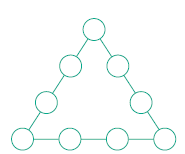
Using the numbers from 1 to 9
(i) Can you form a magic triangle?
(ii) How many magic triangles can be formed?
(iii) What are the sums of the sides of the magic triangle?
2.
The following table shows the number of vehicles sold in a year
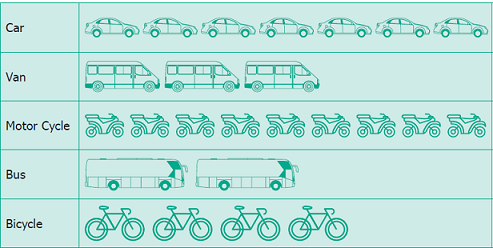
key: One picture represents 10 vehicles
Look at the pictograph and answer the following questions.
(i) How many motor cycles were sold in a year?
(ii) Number of buses sold in a year is 20. Say True or False.
(iii) How many bicycles were sold?
(iv) How many cars and vans were sold?
(v) How many vehicles were sold altogether?
3.
The following are the marks obtained by 30 students in a class test out of 20 in Mathematics subject.
11 12 13 12 12 15 16 17 18 12
20 13 13 14 14 14 15 15 15 15
16 16 16 15 14 13 12 11 19 17
Prepare a table using Tally Marks.
4.
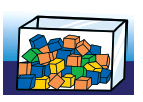
I have a box which has 3 green, 9 blue, 4 yellow, 8 orange coloured cubes in it.
(a) What is the ratio of orange to yellow cubes?
(b) What is the ratio of green to blue cubes?
(c) How many different ratios can be formed, when you compare each colour to anyone of the other colours?
5.
A piece of wire is ‘12s’ cm long. What will be the length of the side, if it is formed as
(i) an equilateral triangle
(ii) a square
6.
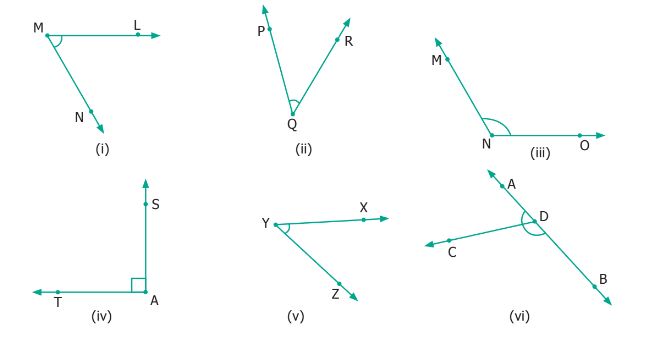
Pick out the Obtuse angles from the given figures.
7.
Simplify : 20 + [ 8 \(\times\) 2 + {\({ (6\times 3) } \) -10 \(\div \) 5}]
8.
A line segment 63 cm long is to be divided into two parts in the ratio 3 : 4. Find the length of each part.
9.
The heights (in metres) of the mountains in Tamil Nadu are as follows:
| SI.No | Mountains | Height (in metres) |
| 1 | Doddabetta | 2637 |
| 2 | Mahendragiri | 1647 |
| 3 | Anaimudi | 2695 |
| 4 | Velliangiri | 1778 |
(i) Which is the highest mountain listed above?
(ii) Order the mountains from the highest to the lowest.
(iii) What is the difference between the heights of the mountains Anaimudi and Mahendragiri?
10.
How many thousands are there in 1 lakh?
1.
(i) Yes
(ii) 5
(iii)
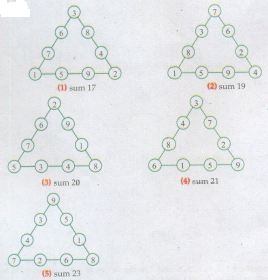
Sums are 17, 19, 20, 21 and 23.
2.
1 picture represents 10 vehicles
(i) There were 9 × 10 = 90 motor cycles sold.
(ii) True.
(iii) There were 4 × 10 = 40 bicycles sold.
(iv) There were 7 cars and 3 vans pictures. Therefore 70 + 30 = 100 cars and vans sold.
(v) There were 7 cars, 3 vans, 9 motor cycles, 2 buses and 4 bicycles sold. Therefore, 70 + 30 + 90 + 20 + 40 = 250 vehicles sold.
3.
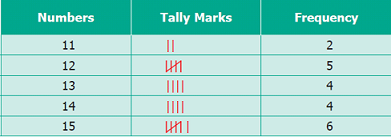
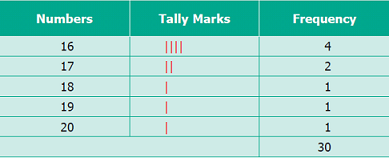
4.
Number of green cubes = 3
Number of blue cubes = 9
Number of yellow cubes = 4
Number of orange cubes = 8
(a) Ratio of orange to yellow cubes = \(\frac { Number\ of\ orange\ cubes }{ Number\ of\ yellow\ cubes } \)
=\(\frac { 8 }{ 4 } =\frac { 2 }{ 1 } \) = 2 : 1
Ratio of orange to yellow cubes = 2 : 1
(b) \(\frac { Number\ of\ green\ cubes }{ Number\ of\ blue\ cubes } =\frac { 3 }{ 9 } =\frac { 1 }{ 3 } \)
Ratio of green to blue cubes = 1 : 3
(c) The ratios can be Orange:
Yellow, Orange: blue, Orange: green, Yellow: orange, yellow: blue, yellow: green, blue: green, blue: orange, blue: yellow, green: orange, green: yellow, green: blue. Thus 12 ratios can be formed.
i.e., the possiblity of forming the different ratios
3 : 9, 3 : 4, 3 : 8
9 : 3, 9 : 4, 9 : 8
4 : 3, 4 : 9, 4 : 8
8 : 3, 8 : 9, 8 : 4
5.
(i) Length of wire = '12 s' cm
Sum of 3 sides of equilateral triangle = '12 s'
3 \(\times\) side = 12 s
The length of a side = \(\frac{12 \mathrm{~s}}{3}=\) '4 s' cm
(ii) Sum of 4 sides of square = '12 s'
The length of a side = \(\frac{12 \mathrm{~s}}{4}=\) '3 s' cm
6.
i), iii) are obtuse angles
7.
20 + [8 \(\times\) 2 + {\({ 6\times 3 } \)− 10 ÷ 5}] (given question)
=20 + [8 \(\times\) 2 + {18 − 10 ÷ 5}] (bar completed first)
=20 + [8 \(\times\) 2 + {18 − 2}] ( ÷ completed second )
=20 + [8 \(\times\) 2 + 16] ({ } completed third)
=20 + [16 + 16] ( \(\times\) completed fourth)
=20 + 32 ([ ] operation completed fifth)
=52 ( + completed last)
8.
Total length 63 cm, on dividing 3 + 4 = 7 equal parts, we get the line segments with lengths
\(\frac{3}{7}\times63=27\ cm\)
\(\frac{4}{7}\times63=36\ cm\)
Length of each line segment is 27 cm & 36 cm
9.
Arranging the numbers in place value chart
| Mountains | TH | H | T | O |
|---|---|---|---|---|
| Doddabetta | 2 | 6 | 3 | 7 |
| Mahendragiri | 1 | 6 | 4 | 7 |
| Anaimudi | 2 | 6 | 9 | 5 |
| Velliangiri | 1 | 7 | 7 | 8 |
(i) Highest mountain is Anaimudi [Comparing left most digits]
(ii) From the above chart
In thousands place, Doddabetta and Anaimudi have greater value 2.
Comparing digits of 2637 and 2695
2 = 2, 6 = 6, 3 < 9.
\(\therefore\) 2637 < 2695
Again comparing the digits of 1647 and 1778
1=1,6 < 7
\(\therefore\) 1647 < 1778.
\(\therefore\) The required order is 2695 > 2637 > 1778> 1647.
\(\therefore\) Anaimudi > Doddabetta > Veliangiri > Mahendragiri
(iii)
| The height of Anaimudi mountain | = 2695 m |
| The height of mahendragiri mountain | = 1647 m |
| The difference | = 1048 m |
10.
| Place Value | L | T Th | Th | H | T | O | |
| 1 lakh | 1 | 0 | 0 | 0 | 0 | 0 | \(\frac { 1lakh }{ 1thousand } =\frac { 100000 }{ 1000 } =100\) |
| 1 thousand | 1 | 0 | 0 | 0 |
Lakh is 2 places to the left of thousand. So, it is 10 \(\times\) 10 = 100 times thousand.
Hence, 1 lakh = 100 thousand.

6th Standard Syllabus & Materials
6th Standard
TN 6th Social Science T3 - GEO - Understanding Disaster Sample Question Papers Study Material - QB365 Set A
NEW6th Standard
TN 6th Social Science T3 - GEO - Globe Sample Question Papers Study Material - QB365 Set A
NEW6th Standard
TN 6th Social Science T3 - GEO - Asia and Europe Sample Question Papers Study Material - QB365 Set A
NEW6th Standard
TN 6th Social Science T3 - HIS - South Indian Kingdoms Sample Question Papers Study Material - QB365 Set A



Tamilnadu Stateboard 6th Standard Subjects
Tamilnadu Stateboard Standards




