
 100% FREE ACCESS
6th Standard CBSE Syllabus & Materials
6th Standard CBSE
CBSE 6th Social Science The Value of Work - New Sample Question Papers Study Material - QB365 Set A
NEW6th Standard CBSE
CBSE 6th Social Science Family and Community - New Sample Question Papers Study Material - QB365 Set A
NEW6th Standard CBSE
CBSE 6th Social Science India's Cultural Roots - New Sample Question Papers Study Material - QB365 Set A
NEW6th Standard CBSE
CBSE 6th Social Science India,That is Bharat - New Sample Question Papers Study Material - QB365 Set A
NEW6th Standard CBSE
CBSE 6th Social Science Timeline and sources of history - New Sample Question Papers Study Material - QB365 Set A
NEW6th Standard CBSE
CBSE 6th Social Science Oceans and Continents - New Sample Question Papers Study Material - QB365 Set A

Published on: 06/03/2020
6th Standard Science Board Exam Model Question 2019-2020
Download CBSE Class 6th Standard CBSE Science question papers, sample papers, important questions, and previous year solved papers in PDF format. Get free study materials, NCERT solutions, and exam preparation resources for Class 6th Standard CBSE Science
Questions + Answers key
Take MCQ Science Test
1.
Why do you think mountaineers carry oxygen cylinders with them, while climbing high mountains?
2.
What do you mean by endoskeleton?
3.
Due to Sudden power failure in Ravi's house, he lighted three candles. He placed one of them in the drawing room, second in the kitchen for his mother and third one in his grandmother's room as she was ailing and bed-ridden.
(i) What is the importance of light in one's life?
(ii) What is the chemical transformation in a candle?
(iii) What values are exhibited by Ravi?
4.
Classify into reversible/irreversible changes.
(a) Growth of plant.
(b) Falling of rain
5.
(a) What type of adaptation is found in a deer, that helps it to see in all the directions?
(b) How does exchange of gases take place in an earthworm
6.
What do you understand by incandescent body?
7.
What is a saturated solution?
8.
How do people know how far they have travelled?
9.
Does the magnet with iron filings sticking to it look like a bar magnet?
10.
What is paper mash?
11.
Oceans are the biggest sources of water, yet they are not fit for human consumption. Why?
12.
Write two names of liquid which are insoluble in water.
13.
Write the type of soil which is best for the cultivation of cotton crop?
14.
Name the male reproductive part of flower.
15.
Fat rich foods are harmful for us if we eat them too much. What do you think?
16.
Pulses are rich sources of proteins, usually cooked. Is there a way to consume pulses raw?
17.
What do we notice on leaves or metal surfaces like iron grills and gates on a cold morning?
18.
What type of cells are used in calculators? What are the main advantages of using such type of cells?
19.
How is common salt obtained from sea water?
20.
Give two examples of each of the following mode of transport used by humans- (a) Land, (b) Water, (c) Air
21.
Column I shows different positions in which one pole of a magnet is placed near that of the other. Column II indicates the resulting action between them for each situation. Fill in the blanks.
| Column I | Column II |
| N-N | |
| N- | Attraction |
| S-N | |
| -S | Repulsion |
22.
(a) What do you do with the left over food at home?
(b) If you and your friends are given the choice of eating in a plastic plate or a banana leaf platter at a party, which one would you prefer and why?
23.
Which of the non-living things listed below, were once part of a living thing?
Butter, leather, soil, wool, electric bulb, cooking oil, apple, rubber
24.
Observe the given figure carefully and answer the following questions:
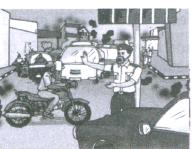
(a) What is covering the nose and mouth of the policeman?
(b) Why is he putting a cover on his nose?
(c) Can you comment on air quality of the place as shown in the figure?
25.
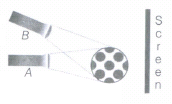
A torch is placed at two different positions A and B one by one as shown in figure.The shape of the shadow obtained in two positions is shown in the given figure.
Match the position of the torch and shape of the shadow of the ball.
26.
We need two muscles together to move a bone.Why?
27.
Given below are the names of some objects and materials:
Water, basket ball, orange, sugar, globe, apple and earthen pitcher. Group them as
(a) round shaped and other shapes.
(b) eatables and non-eatables.
28.
Taking an example of plant, explain that stems are modified for making food in some plants.
29.
A bag of cement lying in the open gets wet due to rain during the night. The next day, the sun. shines brightly. Do you think the changes which have occurred in the cement, could be reversed?
30.
Name two items that are made from coconut fibre.
31.
While using iodine in the laboratory, some drops of iodine fell on Paheli's socks and some fell on her teacher's saree. The drops of iodine on the saree turned blue-black while their colour did not change on the socks. What can be the possible reason?
32.
A and B are two plants. Plant A produces flowers which are eaten as vegetable and its fruit is nutritious, so eaten raw as a fruit. Plant B produces seed which is a source of oil and its leaves are used as vegetable. Name the plants A and B and their edible parts.
33.
Chalk, iron nail, wood, aluminium, candle, cotton usually look different from each other. Give some properties by which we can prove that these materials are different.
34.
Describe the skeleton of a cockroach.
35.
Where is Cactus mostly found? How is it adapted to survive in such a habitat?
36.
What are the characteristics of plants?
37.
State different uses of water
38.
Three identical bars are kept on a table. Two out of three bars are magnets. In one of the magnets the North-South poles are marked. How will you find out which of the other two bars is a magnet? Identify the poles of this magnet.
39.
Rahul's friend has his birthday tomorrow. Since, he was busy so he could not buy a present for him. He looked around and found papers not in usable condition.
He used them and prepared a card, a diary of colourful pages and a photo frame as gifts for hit friend.
All his friends when saw them were surprised and so was his friend. All of them asked Rahullots of question about his gifts.
(a) Papers are which type of waste?
(b) What is the name of the process used by Rahul'
(c) List a few benefits of this process.
(d) Can all types of paper be treated by this method?
(e) What values do you observe in Rahul?
40.
With the help of a labelled diagram, explain the structure and function of a torch?
41.
Write a few sentences for an imaginary situation if any of the following gases disappear from the atmosphere.
(a) Oxygen (b) Nitrogen (c) Carbon dioxide
42.
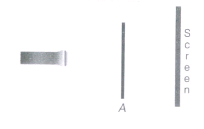
A sheet of plywood, a piece of muslin cloth and that of a transparent glass, all of the same size and shape were placed at A one by one in the arrangement shown in figure. Will the shadow be formed in each case? If yes, then how will the shadow on the screen be different in each case? Give reasons for your answer.
43.
It is not accurate to measure a length with elastic tapes. Explain why.
44.
It was Paheli's birthday, her brother Simba was helping her to decorate the house for the birthday party and their parents were also busy making other arrangements. Following were the activities going on at Paheli's home:
(a) Simba blew balloons and put them on the wall.
(b) Some of the balloons got burst.
(c) Paheli cut colourful strips of paper and put them on the wall with the help of tape.
(d) She also made some flowers by origami (paper folding) to decorate the house.
(e) Her father made dough balls.
(f) Mother rolled the dough balls to make puries.
(g) Mother heated oil in a pan.
(h) Father fried the puries in hot oil.
Identify the activities at Paheli's home, as those that can be reversed and those, which cannot be reversed.
45.
A cotton shirt, before it reaches you, completes a long journey. Elaborate this journey starting from cotton bolls.
46.
Paheli was feeling thirsty but there was only a pot of water at home which was muddy and unfit for drinking. How do you think Paheli would have made this water fit for drinking if the following materials were available to her?
Alum, tub, muslin cloth, gas stove, thread, pan and lid.
47.
Radha came back from school hungry and went to her mother in kitchen. Radha's mother was peeling vegetables. She noted that the peels were very thick and her mother then started washing vegetables. Radha asked her to stop washing the vegetables. Her mother was surprised and asked why? Radha told her all she knew about how nutrients are washed away if we peel and then wash them?
(a) If thick peels are removed from vegetables, what happens?
(b) Washing of vegetables after peeling is not a good practice. Can you tell why?
(c) What are those components that get washed away?
(d) Give two examples of vitamins and minerals containing food.
(e) Do you think Radha has any values? Name them.
48.
Ashu is visiting a slum area as a part of his homework assignment. He reaches the place and observe that people are very poor and their living conditions are bad. He asks questions to residents and realises that due to drought there is no food available to them and that people are hungry and children are under nourished. Ashu promises them that he will try to help and next day bring food and other amenities along with his freinds.
(a) Do you think food is responsible for some of consequences faced by villagers?
(b) Why do all living organisms require food?
(c) Name the condition which arises due to lack of food or undernourishment.
(d) What values can you observe in Ashu?
49.
The process followed to separate grains form the stalks is called
Winnowing
Threshing
Sieving
Hand picking
50.
Global warming increases the concentration of ___________ in the atmosphere
Oxygen
Nitrogen
Carbon dioxide
Hydrogen
51.
A plant with verigated leaves is_______.
Pea
Balsam
Coleus
Cuscuta
52.
A complete electric circuit is called______________ electric circuit.
open
Closed
Complete
None of these
53.
Muscles are attached to the bones by_____________
nerves
joints
tendons
cartilages
54.
Lodestone is used for
Weighing
Colouring
Knowing direction
Jewellery
55.
This is made up of a number of fibres twisted together:
Cloth
Yarn
Fibre
Fabric
56.
Which of the following does not belong to the group?
Ink
Milk
Honey
Oil
57.
Which of the following is a non-biodegradable waste?
Broken glass
Plastic container
Wrapper of tea, coffee
All of these
58.
When a chocolate melts, it is:
a reversible change
an irreversible change
a physical change
both (a) and (c)
59.
Given below are the steps to test the presence of proteins in a food item:
(i) Take a small quantity of the food item in a test tube, add 10 drops of water to it and shake it.
(ii) Make a paste or powder of food to be tested.
(iii) Add 10drops of caustic soda solution to the test tube and shake well.
(iv) Add 2 drops of copper sulphate solution to it.
Which of the following is the correct sequence of the steps?
(i), (ii),(iv), (iii)
(ii), (i), (iv), (iii)
(ii), (i), (iii),(iv)
(iv), (ii),(i), (iii)
60.
Find the odd one out:
Rotation of earth about its axis
Tabla surface
Blades of rotating fan
Moving vehicle on straight road
61.
Which of the following components of air is present in the largest amount in the atmosphere?
Nitrogen
Oxygen
Water vapour
Carbon dioxide
62.
Light travels in a
random direction
straight line
curved line
zig-zag line
63.
Which is not a part of water cycle?
Cloud formation
Rain
Drinking by animals
Sun
64.
One of the following food is not obtained from animals. The food is
honey
milk
maize
mutton
1.
The amount of oxygen decreases at high altitude. So, for normal breathing, mountaineers carry oxygen cylinders with them, while climbing high mountains.
2.
The part of skeletal system that is inside the body and covered by soft tissues is endoskeleton. It cannot be seen from outside. One can feel or see it through X-ray photography only.
3.
(i) Light helps us to see an object.
(ii) It converts chemical energy into light energy.
(iii) The values exhibited by Ravi are caring, love and presence of mind.
4.
(a) Growth of plant-Irreversible change.
(b) Falling of rain-Irreversible change
5.
(a) Eyes of the deer are located on the sides of its head. This helps it to see in all the directions.
(b) Exchange of gases in an earthworm takes place through its moist skin
6.
If we make a metal red hot, it emits light. This is called incandescent body
7.
A saturated solution of a substance is the one in which no more of that substance can be dissolved.
8.
By measuring distance by a particular standard unit of measurement.
9.
Yes
10.
It is a thick paste made up of clay, paper pieces and some rice husk.
11.
The ocean water contains high concentration of different salts rendering the water salty making it unfit for use.
12.
Mustard oil and kerosene oil are the two liquids which are insoluble in the water.
13.
Black soil is best for the cultivation of cotton crop.
14.
Anther and filaments are male reproductive parts of a flower.
15.
Yes, it can be very harmful to eat too much fat rich foods. Unused fats get deposited in our body.
16.
Yes, sprouting of pulses can be done. In this form, pulses are highly nutritious.
17.
We notice tiny water droplets, i.e., dew on leaves or metal surfaces like iron grills and gates on a cold morning.
18.
The cells used in calculators are known as button cells, as they resemble the shape of a button. The plates of these cells are made from compounds of nickel and cadmium. The main advantage of these cells is that they can stay in an active stage for months without any leakage.
19.
Sea water is allowed to stand in shallow pits. Due to solar heat, water in the pits get evaporated. After some days, the water evaporates completely and the solid salts remain in the pits. These salts are further purified to get pure common salt
20.
(a) Land-motorcycle, car.
(b) Water-Boat, steamer.
(c) Air-Aeroplane, helicopter.
21.
As, we know that like poles of a magnet repel each other and unlike poles attract each other.
Thus, the complete table is shown as below:
| Column I | Column II |
| N-N | Repulsion |
| N-S | Attraction |
| S-N | Attraction |
| S-S | Repulsion |
22.
(a) We usually throw the left over food at home. But it is a biodegradable waste which can be converted into useful products by microorganisms.
So, left over food at home should be dumped into compost pits to convert them into manure. This manure can be used for growing plants.
(b) We will prefer a banana leaf platter because it is biodegradable and can be disposed easily. By the process of composting, it can be converted into manure, while a plastic plate is non-biodegradable and has a lot of difficulty in disposal. It also causes pollution.
23.
Following are the non-living things from the list which were once part of living things:
Butter - Obtained from milk from dairy animals
Leather - From animal skin
Wool - From hair of sheep or goat
Cooking oil - Seeds of plants
Apple - Fruit from apple tree
Rubber - Latex of rubber tree
24.
(a) Mask is covering the nose and mouth of the policeman.
(b) Policeman is putting a cover on his nose to save himself from dirt/polluted air.
(c) Air quality of the place is not good. It is due to the smoke and gases emitted by the automobiles along with dust particles present in the air.
25.
Position A of the torch will form the image (a) and position B of the torch will form the image (b) of the football.
26.
A muscle can only pull, it cannot push. Thus, two muscles are required to work together to move a bone. When one muscle contracts, bone is pulled. When another muscle of the pair pulls, it brings the bone in its original position.
27.
(a) Objects or materials which are in the form of circle, are known as round shapes.
| Round shape | Other shape |
| Basket ball | Water |
| Apple | Sugar |
| Orange | |
| Globe | |
| Earthen pitcher |
(b) The substances which we can eat, are known as eatable otherwise it is known as non-eatable.
| Eatable | Non-Eatable |
| Water | Basket ball |
| Orange | Globe |
| Apple | Earthen pitcher |
| Sugar |
28.
Stems are modified to perform special functions. One of such function includes making of food. In some plants like cactus, fleshy stem is found which can perform the process of photosynthesis.
29.
No, the changes which have occurred in the cement cannot be reversed because it is a irreversible chemical change.
30.
Two items that are made from coconut fibre are
(i) Ropes
(ii) Mats
31.
The drops of iodine are used to detect the presence of starch in the food item. The possible reason for appearance of blue-black colour on teacher's saree is due to the presence of starch. The saree would have been starched. Paheli's socks did not have starch on it, thereby their colour did not change.
32.
The plant A is banana whose fruit is eaten raw and flowers are cooked as vegetable. The plant is B mustard. Its seeds are used to make mustard oil whereas its leaves are cooked to make green vegetable called 'sarson ka saag'.
33.
There are following properties by which we can prove that these materials are different:
| Material | Lustre | Hardness/softness | Roughness/smoothness |
|---|---|---|---|
| Chalk | - | Soft | Rough |
| Iron nail | Lustrous | Hard | Rough |
| Wood | - | Hard | Rough |
| Aluminium | Lustrous | Hard | Smooth |
| Candle | Candle | Soft | Smooth |
| Cotton | - | Soft | Smooth |
34.
Cockroaches walk and climb as well as fly in the air. They have three pairs of legs which help them in walking. The body is covered with a hard outer skeleton. This outer skeleton is made of different units joined together which permit movement. There are two pairs of wings attached to the thorax. The cockroaches have distinct muscles-those near the legs move the legs for walking. The thoracic muscles move the wings when the cockroach flies.
35.
Cactus is mostly found in the deserts.
It has the following special features to adapt itself to survive in the desert :
(i) Leaves are modified into the spines to reduce the rate of loss of water.
(ii) Stem becomes green and fleshy to take over the function of photosynthesis.
(iii) Stem is also covered with a thick layer of wax to retain water.
(iv) Its roots go deeper into the soil for better absorption of water.
36.
Characteristics of plants are :
(i) They cannot move from one place to another.
(ii) They can prepare their own food.
(iii) These are the living organisms on the earth which are responsible for the formation of food for all the living forms directly or indirectly.
(iv) All other organisms on the earth depend on the plants and their products for their survival.
(v) Plants grow in the soil from where they take nutrients for their growth and propagation.
37.
Water is used:
(i) for drinking and cooking
(ii) for bathing and cleaning.
(iii) in agriculture, to produce food.
(iv) in Industries, to perform different activities
38.
To find out the magnet
(i) Take the bar magnet A in your hand.
(ii) Take the bar magnet B in other hand.
(iii) Bring one side of B towards South pole and note down it is attracted or repelled.
(iv) Bring other side of B towards South pole and again note down the same thing.
(v) If there is an attraction in both cases (iii) and (iv), then it is definitely an iron bar.
(vi) If there is an attraction in one case and repulsion in other case, then it is a bar magnet.
(vii) Do the same for the iron bar C.
To find out the poles:
If in case (iii) the bar is attracted, then it is North pole of the identified bar magnet. If bar is repelled, then it is obviously a south pole of the identified bar magnet.
39.
(a) Papers are biodegradable wastes.
(b) Rahul used recycling of paper by making papier mache.
(i) use the materials again. (ii) reduce wastage,
(d) No, shiny paper contains plastic. hence they cannot be recycled.
(e) Rahul is thoughtful. creative and eager to use his knowledge.
40.
An electric torch is a device which is used as a lamp. It has two or more than two cells, a bulb and a switch.
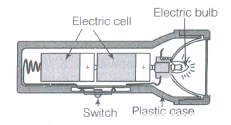
So, when we slide the switch of electric torch, circuit becomes complete and bulb starts glowing, while on sliding switch back, circuit gets broken and bulb goes OFF.
41.
(a) There will be no life on the earth. Oxygen is vital for life. It helps in burning, respiration, photosynthesis, etc. Oxygen is basic need of all living beings.
(b) Nitrogen does not support burning. If nitrogen gas disappear from the atmosphere, things will burn very fast.
(c) Carbon dioxide is needed for photosynthesis which occurs in green plants. In its absence, plants will not be able to prepare their food and hence, there will be no life on the earth.
42.
Yes, the shadow will be formed in all the cases but in all the cases, the darkness of the shadow will be different.
(i) Most of the light in case of transparent sheet will pass through the glass. So, the darkness of shadow will be very low.
(ii) Also most the light in case of muslin cloth will be reflected. So, the shadow will be darker than the transparent sheet.
(iii) While in case of plywood, all the light would be stopped completely by the plywood. So, the darkness strength will be highest in this case.
43.
Elastic tapes are stretchable due to which their length can be increased during the measurement if it is not handle with care. Therefore, the measurement done by elastic tapes may be greater than the actual length of the object. So, we can say that elastic tapes are not accurate to measure a length.
44.
Reversed changes are as follows:
(a) Simba blew balloons and put them on the wall.
(d) Making of some flowers by origami (paper folding) to decorate the house.
(e) Her father made dough balls.
(f) Mother rolled the dough balls to make puries.
(g) Mother heated oil in a pan.
Changes that cannot be reversed are as follows:
(b) Some of the balloons got burst.
(c) Paheli cut colourful strips of paper and put them on the wall with the help of tape.
(h) Father fried the puries in hot oil
45.
Cotton is the most important of all plant fibres, used to make clothes.Cotton shirt can be prepared by following steps:
Cotton bolls \(\underset { \xrightarrow{}}{ Ginning } \) Cotton fibre \(\underset { \xrightarrow{}}{ Spinning } \) Cotton yarn \(\underset { \xrightarrow{}}{ Weaving} \) Cotton fabric \(\underset { \xrightarrow{}}{ sewing} \) Cotton shirt
The making of cotton shirt is a long process. From cotton bolls, cotton is usually picked by hand. Fibres are then separated from the seeds by combing. This process is called ginning.
In spinning process, the fibres from a mass of cotton wool are drawn out and twisted. This brings the fibres together to form a yarn.
Weaving is binding of two sets of yarns at right angles to make a fabric. Weaving is done on looms. Now, on sewing this cotton fabric by needle, we get the cotton shirt.
46.
Paheli can make this water fit for drinking by work on following sequence:
Filtration using muslin cloth (cotton fabric).
\(\downarrow\)
Swirl with alum and leave water undisturbed for some time.
\(\downarrow\)
The clear liquid above the impurities is poured in another container(decantation).
\(\downarrow\)
Boil for 10 min in covered pan with lid.
\(\downarrow\)
Cool, filter and now, it is fit for drinking.
47.
(a) Many vegetables contain most of the nutrients just below their skin surface. Thick peeling may lead to their removal.
(b) Washing of vegetables after peeling or cutting removes the water soluble vitamins and minerals from them and lowers their nutritive value.
(c) These components are called nutrients like minerals (iron, calcium, phosporous) and vitamins (B, A, C, D, E).
(d) Vegetables like tomatoes, potatoes, green leafy vegetables, etc.
(e) Yes, Radha is sincere, observant, helpful and knowledgeable. She used her knowledge in right place and stopped her mother for doing incorrect work.
48.
(a) Yes, without food there is no energy in people and their body cannot fight against infections.
(b) Food is required because it gives us energy to carry out all life processes.
It helps in growth and maintenance of body.
(c) Malnutrition.
(d) Ashu is sincere, caring and a helpful boy. He is eager to provide his support and encourages his friends in helping him to help villagers.
49.
(b)
Threshing
50.
(c)
Carbon dioxide
51.
(c)
Coleus
52.
(b)
Closed
53.
(c)
tendons
54.
(c)
Knowing direction
55.
(b)
Yarn
56.
(d)
Oil
57.
(d)
All of these
58.
(d)
both (a) and (c)
59.
(b)
(ii), (i), (iv), (iii)
60.
(d)
Moving vehicle on straight road
61.
(a)
Nitrogen
62.
(b)
straight line
63.
(d)
Sun
64.
(c)
maize

6th Standard CBSE Syllabus & Materials
6th Standard CBSE
CBSE 6th Social Science Locating Places on the Earth - New Sample Question Papers Study Material - QB365 Set A
NEW6th Standard CBSE
CBSE 6th Science A Journey Through States of Water - New Sample Question Papers Study Material - QB365 Set A
NEW6th Standard CBSE
CBSE 6th Science Temperature and its Measurement - New Sample Question Papers Study Material - QB365 Set A
NEW6th Standard CBSE
CBSE 6th Science Materials Around Us - New Sample Question Papers Study Material - QB365 Set A



CBSE 6th Standard CBSE Subjects
CBSE Standards




