
 100% FREE ACCESS
6th Standard CBSE Syllabus & Materials
6th Standard CBSE
CBSE 6th Social Science The Value of Work - New Sample Question Papers Study Material - QB365 Set A
NEW6th Standard CBSE
CBSE 6th Social Science Family and Community - New Sample Question Papers Study Material - QB365 Set A
NEW6th Standard CBSE
CBSE 6th Social Science India's Cultural Roots - New Sample Question Papers Study Material - QB365 Set A
NEW6th Standard CBSE
CBSE 6th Social Science India,That is Bharat - New Sample Question Papers Study Material - QB365 Set A
NEW6th Standard CBSE
CBSE 6th Social Science Timeline and sources of history - New Sample Question Papers Study Material - QB365 Set A
NEW6th Standard CBSE
CBSE 6th Social Science Oceans and Continents - New Sample Question Papers Study Material - QB365 Set A

Published on: 06/03/2020
6th Standard Science Board Exam Sample Question 2020
Download CBSE Class 6th Standard CBSE Science question papers, sample papers, important questions, and previous year solved papers in PDF format. Get free study materials, NCERT solutions, and exam preparation resources for Class 6th Standard CBSE Science
Questions + Answers key
Take MCQ Science Test
1.
Think of six activities which use electric current Also name the devices used to perform the activity.
| Activity you perform | Device | |
|---|---|---|
| Example: | Get light | Torch |
| ___________ | ....................... | |
| ___________ | ....................... | |
| ___________ | ....................... | |
| ___________ | ....................... | |
| ___________ | ....................... |
2.
(a) Which components of food are known as protective foods?
(b) Which food provides water to our body?
(c) Why should vegetables not be washed after cutting? Why should food not be overcooked?
3.
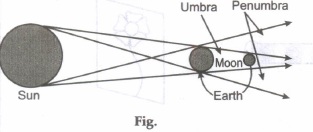
Explain about solar eclipse and lunar eclipse. Also, give the ray diagrams.
4.
State different uses of water
5.
How can we find the length of a curved line? Explain.
6.
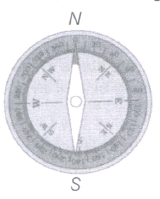
Given below is a figure which shows a magnetic compass. Briefly explain what will happen to the position of its needle if you bring a bar magnet near it. Also, draw a diagram to show the effect on the needle on bringing the bar magnet near it. Also, draw the diagram to show the effect when the other end of the bar magnet is brought near it.
7.
Vermicompost produced from kitchen waste is far more better than chemical fertilisers. Why?
8.
Explain what makes the carbon dioxide gas present in air necessary for all in the atmosphere.
9.
Like many animals although a car also moves it is not considered as a living organism. Give two or three reasons.
10.
How is the skeleton of a bird well-suited for flying?
11.
Kavita bought new silver anklets. After a month, she found that the anklets had lost their lustre and turned black. She had doubts that they were not made of pure silver. But her mother told her that they were of pure silver. She washed her silver anklets with lemon juice and found that the silver anklets had get the lustre back.
Read the above passage and answer the following questions.
(a) Do you think that the anklets are not of pure silver?
(b) Why silver anklets lost their lustre after some time?
(c) What values were shown by Kavita's mother?
12.
Paheli mixed flour and water and
(a) made a dough,
(b) rolled the dough to make a chapati,
(c) baked the chapati on a pan,
(d) dried the chapati and ground it in a grinder to make powder.
Identify the changes (a) to (d) as the changes that can be reversed or that cannot be reversed.
13.
Sarita was interested in knowing more about plants and its parts. She started exploring and collecting plants. She wanted to preserve them, so that she can have a good collection of plants.
(a) Suggest the steps to help her in identifying plants.
(b) Is there any other method to identify plants Explain.
(c) What are the values shown by Sarita?
14.
A cotton shirt, before it reaches you, completes a long journey. Elaborate this journey starting from cotton bolls.
15.
Paheli was feeling thirsty but there was only a pot of water at home which was muddy and unfit for drinking. How do you think Paheli would have made this water fit for drinking if the following materials were available to her?
Alum, tub, muslin cloth, gas stove, thread, pan and lid.
16.
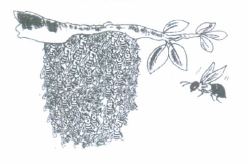
Given figure shows some insects and a place where it collects its food.
(a) Name the insect and the place where it lives as shown in the figure.
(b) What is the food of this insect?
(c) How does it help farmers while collecting its food?
(d) Name the product we collect from this insect.
(e) Name the nutritive constituents of the insect.
17.
Global warming increases the concentration of ___________ in the atmosphere
Oxygen
Nitrogen
Carbon dioxide
Hydrogen
18.
Pollen grains are produced in_________?
Flower
Ovaries
Anthers
Fruits
19.
This joint helps the bowler in the game of cricket___________.
Hinge joint
pivot joint
ball and socket joint
slightly movable joint
20.
In a magnet, the regions of maximum attraction are:
All over the body
At the two ends of the magnet
At anyone end of the magnet
At the centre of the magnet
21.
Separation of seeds from cotton bolls is known as:
Weaving
Knitting
Giruting
Spinning
22.
Which of the following is a bio-degradable waste?
Chalk box
Faeces and urine
Pencil scrap
All of these
23.
During photosynthesis, plants take in
Carbon dioxide
Oxygen and nitrogen
Oxygen and dust particles
Only oxygen
24.
Which of the following changes can not be reversed?
Hardening of cement
Freezing of ice cream
Opening a door
Melting of chocolate
25.
Curved length can be measured by :
Metre scale
Cubit
Measuring tape
All of these
26.
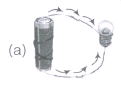
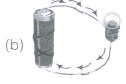
Choose the figure from the options (a), (b), (c) and (d) given below which shows the correct direction of current.
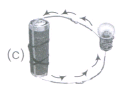
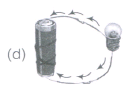
27.
A student observes a tree given in figure through a pinhole camera. Which of the diagrams given in figure. (a) to (d) depicts the image seen by her correctly?


28.
Transpiration is a process in which plants
receive water from soil
absorb water vapour from air
prepare food from water
release water in the form of water vapour
29.
Pick one material from the following which is completely soluble in water.
Chalk powder
Tea leaves
Glucose
Sawdust
30.
While preparing chapatis, Paheli found that the flour to be used was mixed with wheat grains. Which out of the following is the most suitable method to separate the grains from the flour?
Threshing
Sieving
Winnowing
Filtration
31.
Which one of the following food items does not provide dietary fibre?
Whole grains
Whole pulses
Fruits and vegetables
Milk
32.
We get eggs from
goose
buffalo
bee
goat
33.
(a) List all those components of food that provide nutrients.
(b) Mention two components of food that do not provide nutrients.
34.
Give two examples of a periodic motion
35.
Perform an activity by taking some seeds of chana (Bengal gram) or moong (green gram). Put them in a vessel containing water and keep it overnight. The next day, wrap them in a piece of wet cloth and keep them aside for another day. What changes do you observe in the seeds?
36.
Name the organs that are protected by the rib cage.
37.
Is the soil a magnetic or a non-magnetic material?
38.
List some items of waste materials which cannot be used for vermicomposting.
39.
Write the most common characteristics of plants found in deserts.
40.
A fused bulb does not glow. Why?
41.
Policemen use the masks for what reason?
42.
Name the things other than source of light and opaque object required to see the shadow.
43.
Oceans are the biggest sources of water, yet they are not fit for human consumption. Why?
44.
Write two objects through which things can be seen clearly.
45.
Melting of wax is a irreversible change. Is it correct?
46.
Which two crops were cultivated near the river Nile and were used for making fabrics?
47.
Generally, a leaf performs the function of photosynthesis. Does the stem prepare food for any plant?
48.
Temperature affects the solubility of solids in liquids. Explain.
49.
What do you mean by the hardness of materials? Explain with an example
50.
What is waste management? Is garbage disposal the responsibility of the government?
51.
Differentiate between physical and chemical changes. Give two examples.
52.
(a) What are carbohydrates? Give an example.
(b) In which forms are carbohydrates found in our food?
53.
What is sedimentation? Give an example.
54.
Ravi does not eat enough food per day. His mother advised him to eat enough food.
(a) What are the functions of food?
(b) What values were shown by his mother?
55.
Column I shows different positions in which one pole of a magnet is placed near that of the other. Column II indicates the resulting action between them for each situation. Fill in the blanks.
| Column I | Column II |
| N-N | |
| N- | Attraction |
| S-N | |
| -S | Repulsion |
56.
When the chemicals in the electric cell are used up, the electric cell stops producing electricity. The electric cell is then replaced with a new one. In case of rechargeable batteries (such) as the type used in mobile phones, cameras and inverters), they are used again and again. How?
57.
Two animals X and Y are present in the same habitat called grassland. The animal X is a herbivore. It has eyes on the sides of its head and big ears. It is very agile animals. The animal Yis a carnivore. It has eyes in the front of the head. This animal has long, strong sharp claws in its front legs which can tear flesh easily and withdraw inside the toes. It also runs very fast.
(a) Can you recognise animal X and Y?
(b) List the benefit of animal X or having eyes on the sides of the head?
(c) Mention the advantage of animal Yfor having eyes in front of its head?
58.
What is the composition of air?
59.
Correct the following statements.
(a) The colour of)he shadow of an object depends on its colour.
(b) Transparent objects allow light to pass through them partially.
60.
The body of the fish is similar to the boat. Explain, how does fish move in water.
61.
To clean their spectacles, people often breathe out on glasses to make them wet. Explain why the glasses become wet.
62.
The height of a person is 1.65 m. Express it into cm and mm.
63.
Classify the following fibres as natural or synthetic:
64.
If a plant has leaves with reticulate venation, what kind of roots will it have?
1.
| Activity you perform | Device |
|---|---|
| (1) Get light | Torch |
| (2) Get the hot water | Geyser |
| (3) Get the cold water | Refrigerator |
| (4) Get the moving air | Fan |
| (5) Do the mechanical work | Motor |
| (6) Watch movies | Television |
2.
(a) Vitamins and minerals
(b) Tea, coffee, fruits, vegetables etc.
(c) Vegetables contain vitamins and minerals
which get washed away if vegetables are washed after cutting them.
Food should not be overcooked to prevent the loss of nutrients from it.
3.
Solar Eclipse: When the sun, the earth and the moon come in a straight line with the moon in between the earth and the sun, then the shadow of the moon falls on the earth. This results in solar eclipse. Solar eclipse occurs on a new moon day.
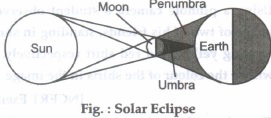
Lunar Eclipse: When the sun, the earth and the moon come in a straight line with the earth in between the moon and the sun, then the shadow of the earth falls on the moon. This results in Lunar eclipse. Lunar eclipse takes place on a full moon day. The shadow consists of two parts. One part is completely dark part of the shadow, where light does not reach from the source of light and this part is known as umbra. Other part is not completely dark, where some light reaches from the source of light and this part is known as penumbra. Penumbra surrounds the umbra.
4.
Water is used:
(i) for drinking and cooking
(ii) for bathing and cleaning.
(iii) in agriculture, to produce food.
(iv) in Industries, to perform different activities
5.
Draw a curved line CD. Take a thread and make a knot at one of its ends. Keep the knot made in the thread on point C of the line. Place a small portion of the thread along the line, keeping it tight using your fingers and thumb. Keep on stretching the thread on the curved line till you take the thread to the point D of the line. Make a mark on the thread where it touches the other end of the line at point D. Now, stretch the thread along a metre scale and the length between the knot in the beginning and mark on the thread is measured through scale. This measured length on scale will give you the length of the curved line CD.
6.
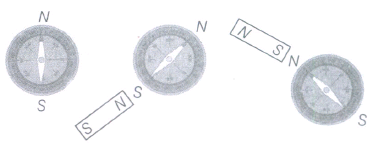
As given in figures, the North pole will be far apart when we bring more near to the compass needle and it will be closer to it when we bring the South pole towards it.
7.
The manure produced from vermicomposting is of high quality Vermicompost is better because
(i) it is cheap and easy to produce while chemical fertilisers are very expensive.
(ii) vermicompost is a natural manure which does not harm the soil or the plants they are added to while chemical fertilisers have adverse effect on both.
8.
The presence of small amount of carbon dioxide gas in the atmosphere is essential for the growth and existence of living beings. The desirable proportion of carbon dioxide in the atmosphere is 0.03%. The importance of carbon dioxide in atmosphere is as follows
(i) It causes greenhouse effect, leading to the heating of the earth and its atmosphere which is essential for our survival.
(ii) It takes part in the photosynthesis process carried out by green plants to prepare food for plants and animals.
9.
A moving car though moves is not considered as a living organism because of the following reasons:
(i) Living organisms have the ability to move on their own, whereas a car moves by the burning of fuels like diesel and petrol.
(ii) Like all living organisms, a car does not show any other living characteristics like respiration, digestion, reproduction or growth.
10.
The skeleton of a bird is well-suited for flying because
(i) bones are hollow and light in weight
(ii) bones of hindlimbs are used for walking and perching.
(iii) bones of forelimbs are modified as wings.
(iv) shoulder bones are strong, thus helpful in flying.
(v) breast bones hold flight muscles and are used to move the wings up and down for flying.
11.
(a) No, the anklets were made of pure silver.
(b) Silver anklets lost their lustre and appear dull, because of the action of air and moisture on them.
(c) Kavita's mother is knowledgeable and intelligent.
12.
(a) Made a dough this change cannot be reversed
(b) Rolled the dough to make a chapati. This change can be reversed.
(c) Baked the chapati on a pan, this change cannot be reversed.
(d) Dried the chapati and ground it in a grinder to make powder, this change cannot be reversed.
13.
(a) Sarita can follow the following steps:
(i) Collect plant twig with flowers.
(ii) Press the8m in papers/magazines.
(iii) Change the paper/magazine every day for 5-6 days.
(iv) When plants are well pressed and dried place them on white plane paper sheet.
(v) Stick the plants to sheet with cello tape.
(vi) Try to identify the plant.
(vii) Take help of teachers/seniors for plant identification.
(b) Yes, plants can also be identified on the basis of the nature of their stem and size.
(c) Inquisitive, scientific attitude and love for nature.
14.
Cotton is the most important of all plant fibres, used to make clothes.Cotton shirt can be prepared by following steps:
Cotton bolls \(\underset { \xrightarrow{}}{ Ginning } \) Cotton fibre \(\underset { \xrightarrow{}}{ Spinning } \) Cotton yarn \(\underset { \xrightarrow{}}{ Weaving} \) Cotton fabric \(\underset { \xrightarrow{}}{ sewing} \) Cotton shirt
The making of cotton shirt is a long process. From cotton bolls, cotton is usually picked by hand. Fibres are then separated from the seeds by combing. This process is called ginning.
In spinning process, the fibres from a mass of cotton wool are drawn out and twisted. This brings the fibres together to form a yarn.
Weaving is binding of two sets of yarns at right angles to make a fabric. Weaving is done on looms. Now, on sewing this cotton fabric by needle, we get the cotton shirt.
15.
Paheli can make this water fit for drinking by work on following sequence:
Filtration using muslin cloth (cotton fabric).
\(\downarrow\)
Swirl with alum and leave water undisturbed for some time.
\(\downarrow\)
The clear liquid above the impurities is poured in another container(decantation).
\(\downarrow\)
Boil for 10 min in covered pan with lid.
\(\downarrow\)
Cool, filter and now, it is fit for drinking.
16.
(a) The insect is 'honeybee'. Its place is 'beehive'.
(b) This insect feeds on pollens and nectar of flowers.
(c) Honeybee visits the flowers and it brings about pollination while collecting its food, thus helps the farmers, setting is facilitated.
(d) We collect honey from beehive.
(e) Honey is rich in sugars, enzymes and minerals. We use it as a food.
17.
(c)
Carbon dioxide
18.
(c)
Anthers
19.
(c)
ball and socket joint
20.
(b)
At the two ends of the magnet
21.
(c)
Giruting
22.
(d)
All of these
23.
(a)
Carbon dioxide
24.
25.
(c)
Measuring tape
26.
(b)
27.
(d)
28.
(d)
release water in the form of water vapour
29.
(c)
Glucose
30.
(b)
Sieving
31.
(d)
Milk
32.
(a)
goose
33.
(a) The components of food that provide nutrients are given below:
(i) Carbohydrates
(ii) Fats
(iii) Proteins
(iv) Vitamins
(v) Minerals
(b) The two components of food that do not provide nutrients are:
(i)Water
(ii)Roughage.
34.
The two examples of a periodic motion are motion of a pendulum and motion of a child on a swing.
35.
The tiny white structures have grown out of the seeds wrapped in a piece of wet cloth. The seeds are said to be sprouted and the process is known as sprouting. The sprouts contain nutrients which make seeds healthy snacks.
36.
Heart and lungs are protected by the rib cage.
37.
The soil is generally a non-magnetic material. But, some iron filings are available in the soil which can stick to magnet.
38.
Polybags, broken glass, aluminium wrappers, old shoes, etc cannot be used for vermicomposting.
39.
The desert plants have reduced leaves and thick fleshy stem.
40.
A fused bulb does not glow because in a fused bulb, the filament of bulb burns up and connection is broken or incomplete, so the current cannot flow.
41.
To prevent inhalation of smoke given out by automobiles, policemen use masks.
42.
A screen like cardboard, wall and ground is required to see the shadow.
43.
The ocean water contains high concentration of different salts rendering the water salty making it unfit for use.
44.
Polythene and glass container are the transparent objects through which things can be seen clearly.
45.
No, melting of wax is a reversible change because solid wax melts on heating and melting wax becomes solid on cooling
46.
In ancient Egypt, cotton as well as flax were cultivated near the river Nile and were used for making fabrics.
47.
Yes, in cactus the stem is green and performs photosynthesis, to prepare food for plants.
48.
The solubility of solids in liquids increases with increase in temperature.
49.
Hardness is the property of materials that can be found out by pressing the materials. A material may be soft or hard.
Soft materials : The materials which can be compressed easily are known as soft materials.e.g.,-cotton, sponge, etc.
Hard materials: The materials that are difficult to compress are known as hard materials. e.g., - iron, wood, etc.
50.
Waste management is the collection, transportation, processing, recycling and reusing of the usable waste materials. Proper disposal of garbage should be a concern of every citizen and not just of the government. Each and every individual must reduce activities that pollute the environment. A lot of waste is generated from homes, offices, schools, hospitals, etc. It includes food waste, paper, plastic, glass, metal, etc. Therefore, it is required that every individual must reduce the production of wastes and must help in the proper disposal of wastes.
51.
| S.No | Physical change | Chemical change |
|---|---|---|
| 1 | Only physical properties like colour volume, etc change. | The chemical composition and chemical properties of the reacting substances undergo a chang |
| 2 | No new substance is formed. Examples: (i) Conversion of water into ice. (ii)Tearing of paper. |
One or more new substances are formed Examples: (i) Burning of cooking gas, (ii)Ripening of fruits. |
52.
(a) Carbohydrates are the compounds made up of carbon, hydrogen and oxygen. These are formed in plants during photosynthesis, e.g., glucose.
(b) Carbohydrates found in our food are in the form of starch and sugar.
53.
When a mixture is allowed to stand for some time, the heavier components in the mixture settle at the bottom and the process is called sedimentation. For example, when mixture of sand and water is allowed to stand for some time, the particles of sand settle down at the bottom of vessel. The settling down of sand particles is called sedimentation.
54.
(a) The functions of food are as follows:
(i) It helps in the growth and development of a living organism.
(ii) It provides energy to do physical work.
(iii) It helps to perform body functions.
(b) Love, caring.
55.
As, we know that like poles of a magnet repel each other and unlike poles attract each other.
Thus, the complete table is shown as below:
| Column I | Column II |
| N-N | Repulsion |
| N-S | Attraction |
| S-N | Attraction |
| S-S | Repulsion |
56.
A rechargeable battery has such chemicals which on after use can be restored by passing suitable current in the opposite direction to the rechargeable batteries, so it can be used again and again.
57.
(a) Yes, X is dear and Y is lion
(b) The eyes on the sides of the head enables the deer to see in all directions at the same time.
(c) The eyes in front of its head enables the lion to have correct idea of the location of its prey like deer.
58.
Air is a mixture of gases, water vapour and dust particles. Largely, it consists of
(i) Nitrogen (78%)
(ii) Oxygen (21%)
(iii) Carbon dioxide (0.03%)
(iv) Other gases like helium, hydrogen, etc (0.17%)
(v) Water vapour and dust particles.
59.
(a) The colour of the shadow of an object does not depend on its colour.
(b) Transparent Objects allow light to pass through them mostly.
60.
The streamlined shape of fish helps it to move in water. Skeleton and muscles present in front side of fish move it on one side while tail muscles move the body the other side. This makes a jerk and pushes the body forward. In this way, it moves in water.
61.
When we breathe out, the hot air comes out from our mouth which get condensed and changed into tiny water droplets and glasses become wet.
62.
Given, height of a person = 1.65 m
We know that
1 metre (m)= 100 centimetre (cm)
1 metre (m) = 1000 millimetre (mm)
(a) The height of a person in cm = 1.65x 100 cm = 165 cm
(b) The height of a person in mm = 1.65x 1000 mm = 1650 mm
63.
Nylon, wool, cotton, silk, polyester, jute
Natural fibres Wool, cotton, silk, jute.
Synthetic fibres Nylon, polyester.
64.
If a plant has leaves with reticulate venation, then the plant is likely to have tap root system.

6th Standard CBSE Syllabus & Materials
6th Standard CBSE
CBSE 6th Social Science Locating Places on the Earth - New Sample Question Papers Study Material - QB365 Set A
NEW6th Standard CBSE
CBSE 6th Science A Journey Through States of Water - New Sample Question Papers Study Material - QB365 Set A
NEW6th Standard CBSE
CBSE 6th Science Temperature and its Measurement - New Sample Question Papers Study Material - QB365 Set A
NEW6th Standard CBSE
CBSE 6th Science Materials Around Us - New Sample Question Papers Study Material - QB365 Set A



CBSE 6th Standard CBSE Subjects
CBSE Standards




