
 100% FREE ACCESS
6th Standard CBSE Syllabus & Materials
6th Standard CBSE
CBSE 6th Social Science The Value of Work - New Sample Question Papers Study Material - QB365 Set A
NEW6th Standard CBSE
CBSE 6th Social Science Family and Community - New Sample Question Papers Study Material - QB365 Set A
NEW6th Standard CBSE
CBSE 6th Social Science India's Cultural Roots - New Sample Question Papers Study Material - QB365 Set A
NEW6th Standard CBSE
CBSE 6th Social Science India,That is Bharat - New Sample Question Papers Study Material - QB365 Set A
NEW6th Standard CBSE
CBSE 6th Social Science Timeline and sources of history - New Sample Question Papers Study Material - QB365 Set A
NEW6th Standard CBSE
CBSE 6th Social Science Oceans and Continents - New Sample Question Papers Study Material - QB365 Set A

Published on: 19/01/2019
Separation of Substances Chapter Full Material
Download CBSE Class 6th Standard CBSE Science question papers, sample papers, important questions, and previous year solved papers in PDF format. Get free study materials, NCERT solutions, and exam preparation resources for Class 6th Standard CBSE Science
Questions + Answers key
Take MCQ Science Test
1.
How will you separate a mixture of saw dust and sugar?
2.
How is common salt obtained from sea water?
3.
Describe the process of sieving. Write one of its uses.
4.
What is sedimentation? Give an example.
5.
Why do we separate substances?
6.
What happens when sand and powdered leaves are being fallen at the same place?
7.
Name and describe briefly a method which can be helpful in separating a mixture of husk from grains. What is the principle of this method?
8.
Lemonade is prepared by mixing lemon juice and sugar in water. You wish to add ice to cool it. Should you add ice to the lemonade before or after dissolving sugar? In which case would it be possible to dissolve more sugar?
9.
How will you separate sand and water from their mixture?
10.
What is winnowing? Where is it used?
11.
Raghav is given a glass bottle with some white substances in it that is either chalk or sugar. How can be find out which of the two is sugar or chalk, without tasting it.
12.
If you are given two transparent clear liquids, without tasting, how would you determine which is distilled water and which is a solution of salt water?
13.
In sharbat, what should be mixed first, ice cubes or sugar?
14.
How will you separate iodine from washing soda?
15.
Does water dissolve equal amounts of different soluble substances?
16.
Sheela, Saima and Ravi have to dissolve maximum amount of sugar in the same amount of milk, so as to win in a game. Ravi took hot boiling milk, while Saima took ice cold milk. Sheela managed to get milk at room temperature. Whom do you think would win the game and why?
17.
When a hot saturated solution is heated, crystals will be formed. Is it correct? If no, correct the statement.
18.
Define the term condensation.
19.
Winnowing is based on which property?
20.
When the process of handpicking is used?
21.
A mixture of iron nails, salt, oil and water is provided to you. Give step wise method to separate each component from this mixture?
22.
You are provided with a mixture of salt, sand, oil and water. Write the steps involved for the separation of salt, sand and oil from the mixture by giving an activity along with the diagram
23.
Read the story titled 'Wise Farmer' and tick the correct option to complete the story.
A farmer was sad/happy to see his healthy wheat crops ready for harvest. He harvested the crops and left it under the sun/rain to dry the stalks. To separate the seeds from the bundles of the stalk, he handpicked/threshed them.
After gathering the seed grains, he wanted to separate the stones and husk from it. His wife winnowed/ threshed them to separate the husk and later sieved/ handpicked to remove stones from it. She ground the wheat grains and sieved/filtered the flour. The wise farmer and his wife got a good price for the flour. Can you tell why?
24.
Paheli was feeling thirsty but there was only a pot of water at home which was muddy and unfit for drinking. How do you think Paheli would have made this water fit for drinking if the following materials were available to her?
Alum, tub, muslin cloth, gas stove, thread, pan and lid.
25.
Both Sarika and Mohan were asked to make salt solution. Sarika was given a teaspoonful of salt and half a glass of water whereas, Mohan was given twenty teaspoonful of salt and half a glass of water.
(a) How would they make salt solutions?
(b) Who would be able to prepare saturated solution?
26.
In a solution of salt and water, no more salt can be dissolved. If we want to add more salt, it needs to be
Shaked well
Filtered
Alum has to be added
Heated
27.
In an activity a teacher dissolved a small amount of solid copper sulphate in a tumbler half filled with water. Which method would you use to get back solid copper sulphate from the solution?
Decantation
Evaporation
Sedimentation
Condensation
28.
Sedimentation is followed by which process?
Decantation
Evaporation
Filtration
None of these
29.
Which of the following is a heterogeneous solution?
Salt and water
Mud and water
Sugar and water
Both (a) and (c)
30.
Most of the substances present around us are:
Pure substances
Mixtures
Impure substances
31.
Paheli asked for a glass of water from Boojho. He gave her a glass of ice cold water. Paheli observed some water droplets on the outer surface of the glass and asked Boojho, how these droplets of water were formed? Which of the following should be Boojho's answer?
Evaporation of water from the glass
Water that seeped out from the glass
Evaporation of atmospheric water vapour
Condensation of atmospheric water vapour
32.
During summer, Boojho carries water in a transparent plastic bottle to his school. One day, he left his bottle in the school. The bottle still had some water left in it. The next day, he observed some water droplets on the inner surface of the empty portion of the bottle. These droplets of water were formed due to
boiling and condensation
evaporation and saturation
evaporation and condensation
condensation and saturation
33.
In an activity, a teacher dissolved a small amount of solid copper sulphate in a tumbler half-filled with water. Which method would you use to get back solid copper sulphate from the solution?
Decantation
Evaporation
Sedimentation
Condensation
34.
You might have observed the preparation of ghee from butter and cream at home. Which method(s) can be used to separate ghee from the residue?
(i) Evaporation
(ii) Decantation
(iii) Filtration
(iv) Churning
Which of the following combinations is the correct answer?
(i) and (ii)
(ii) and (iii)
(ii) and (iv)
Only (iv)
35.
While preparing chapatis, Paheli found that the flour to be used was mixed with wheat grains. Which out of the following is the most suitable method to separate the grains from the flour?
Threshing
Sieving
Winnowing
Filtration
36.
Four mixtures are given below:
(i) Kidney beans and chickpeas
(ii) Pulses and rice
(iii) Rice flakes and corn
(iv) Potato wafers and biscuits
Which of these can be separated by the method of winnowing?
(i) and (ii)
(ii) and (iii)
(i) and (iii)
(iii) and (iv)
37.
Which amongst the following methods would be most appropriate to separate grains from bundles of stalks?
Handpicking
Winnowing
Sieving
Threshing
38.
Which of the following mixtures would you be able to separate using the method of filtration?
Oil in water
Cornflakes in milk
Salt in water
Sugar in milk
39.
Boojho's grandmother is suffering from diabetes. Her doctor advised her to take 'Iassi' with less fat content. Which of the following methods would be most appropriate for Boojho to prepare it?
Filtration
Decantation
Churning
Winnowing
40.
Paheli bought some vegetables such as french beans, lady's finger, green chillies, brinjals and potatoes all mixed in a bag. Which of the following methods of separation would be most appropriate for her to separate them?
Winnowing
Sieving
Threshing
Handpicking
41.
Components of a ____ retain their properties.
42.
A mixture of chalk powder from water can be separated by _____
43.
Shallow salt water lakes are called ________
44.
For separation of two miscible liquids we use ______
45.
Centrifugation is used to separate ________ milk.
46.
What is evaporation?
47.
Can mixture of salt and sugar be separated by filtration?
48.
What is meant by centrifugation?
49.
Define loading.
50.
Name two materials that are used as filters
1.
Following steps are used to separate a mixture of
saw dust and sugar :
(i) Add water to the mixture
(ii) Sugar present in the mixture dissolves in water but saw dust does not.
(iii) The solution is then filtered through filter paper.
(iv) We will get sugar solution as filtrate and saw dust will remain on the filter paper.
(v) Then the solution is heated and when water evaporates completely, sugar is left behind
2.
Sea water is allowed to stand in shallow pits. Due to solar heat, water in the pits get evaporated. After some days, the water evaporates completely and the solid salts remain in the pits. These salts are further purified to get pure common salt
3.
Sieving is a process used for separating solid components of mixtutres varying in size.
It allows the fine particles to pass through the holes of the .sieve while the bigger particles remain on the sieve. It is used to separate pebbles and stones from the sand
4.
When a mixture is allowed to stand for some time, the heavier components in the mixture settle at the bottom and the process is called sedimentation. For example, when mixture of sand and water is allowed to stand for some time, the particles of sand settle down at the bottom of vessel. The settling down of sand particles is called sedimentation.
5.
We need to separate harmful or non-useful substances that may be mixed with the substance used. Sometimes, we separate even useful components if we need to use them separately.
For example: To separate stones from rice, churning milk to obtain butter etc.
6.
Since, sand is heavier while powdered leaves are lighter. When we fall these at the same place, winds separate them as sand is reached at that place vertically and leaves are blown away. This process is known as winnowing.
7.
Winnowing is used to separate grains from impurities like husk by dropping it vertically from a height.
All light impurities are separated by a blowing air or wind and hence, husk from grains are separated easily.
8.
We should add ice to lemonade after dissolving sugar. Without ice, sugar dissolves easily in lemon of juice because solubility depends on the temperature.
When the temperature is high, then more sugar can be dissolved. After mixing ice, it gets cool and less sugar will dissolve in it.
9.
We will separate sand and water from their mixture by the process of sedimentation and decantation.
Sedimentation During this process, we leave mixture for some time, after that the sand which is heavier is settled down at the bottom.
Decantation After the above process, water is poured into another vessel and sand is left in first vessel. Thus, sand and water will be separated from their mixture.
10.
Winnowing is used to separate heavier and lighter components of a mixture by wind or by blowing air, e.g. wheat grains and husk are different in weight, husk being lighter than wheat.
When this mixture is allowed to fall down from a height. the wind carries the lighter husk with it and the heavy grains fall vertically down on the ground. This process is used by farmers to separate lighter husk particles from grain.
11.
This can be done by dissolving both of them in water. Sugar gets dissolved in water while or chalk is insoluble in water.
12.
We will differentiate between the distilled water and the solution of salt water without tasting by the process of evaporation.
On evaporation, the salt water container will leave a caky residue which is absent from the distilled water.
13.
We shall mix sugar first and then ice cubes
14.
I will separate iodine from washing soda by sublimation process
15.
No, water dissolve unequal amounts of different soluble substances.
16.
Milk at higher temperature would dissolve more amount of sugar as solubility increase with temperature. So, Ravi would win the game.
17.
It is not correct as when a hot saturated solution is cooled, crystals will be formed.
18.
The process of conversion of water vapour into its liquid form is called condensation.
19.
Winnowing is based on the property that the grains are heavier than husk and hay.
20.
Handpicking is used to separate undesirable components when present in small amount.
21.
The method to separate each component from the mixture is given below:
(i) Hand picking: It is used to separate iron nails from the mixture.
(ii) Decantation: The mixture is allowed to stand for some time. The clear liquid is poured to another container to separate oil from the mixture.
(iii) Evaporation: The remaining liquid is allowed to evaporate till residue is obtained. This residue is salt.
22.
A mixture of salt, sand, oil and water can be separated by following steps:
Step I : First of all, the clear liquid is poured into another container by the process of decantation. By this process, oil is separated from the mixture.
Step II : Now filter the mixture by using filter paper, funnel and container by the process of filtration. By this process, sand is separated from the mixture
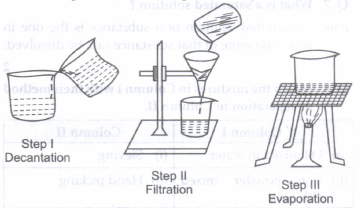
Step III : Finally, the remaining liquid evaporates till the residue in obtained by the process of evaporation. By this process, salt is separated from the mixture.
23.
(i) happy
(ii) sun
(iii) threshed
(iv) winnowed
(v) handpicked
(vi) sieved
They got a good price as they used appropriate methods of separation to get good quality of flour (atta).
24.
Paheli can make this water fit for drinking by work on following sequence:
Filtration using muslin cloth (cotton fabric).
\(\downarrow\)
Swirl with alum and leave water undisturbed for some time.
\(\downarrow\)
The clear liquid above the impurities is poured in another container(decantation).
\(\downarrow\)
Boil for 10 min in covered pan with lid.
\(\downarrow\)
Cool, filter and now, it is fit for drinking.
25.
(a) They will mix salt with water within a certain amount to make salt solution. Hence, Sarika will make a better salt solution.
(b) Saturation is the point at which a solution of a substance can dissolve no more of that substance and additional amount of that substance will appear as a precipitate, Mohan's solution would be saturated because in Mohan's case, some salt would remain undissolved and settled at the bottom of the glass.
26.
(d)
Heated
27.
(b)
Evaporation
28.
29.
(b)
Mud and water
30.
Compounds
31.
(d)
Condensation of atmospheric water vapour
32.
(c)
evaporation and condensation
33.
(b)
Evaporation
34.
(c)
(ii) and (iv)
35.
(b)
Sieving
36.
(d)
(iii) and (iv)
37.
(d)
Threshing
38.
(b)
Cornflakes in milk
39.
(c)
Churning
40.
(d)
Handpicking
41.
()
mixture
42.
()
filtration
43.
()
lagoon
44.
()
distillation
45.
()
cream
46.
()
The process of conversion of water into vapour is called evaporation
47.
()
No, because both salt and sugar are soluble in water.
48.
()
Centrifugation is a process xof separating suspended solid particles from a liquid.
49.
()
The process of settling down of solid particles quickly by addition of alum is known as loading.
50.
()
Paper and cloth

6th Standard CBSE Syllabus & Materials
6th Standard CBSE
CBSE 6th Social Science Locating Places on the Earth - New Sample Question Papers Study Material - QB365 Set A
NEW6th Standard CBSE
CBSE 6th Science A Journey Through States of Water - New Sample Question Papers Study Material - QB365 Set A
NEW6th Standard CBSE
CBSE 6th Science Temperature and its Measurement - New Sample Question Papers Study Material - QB365 Set A
NEW6th Standard CBSE
CBSE 6th Science Materials Around Us - New Sample Question Papers Study Material - QB365 Set A



CBSE 6th Standard CBSE Subjects
CBSE Standards




