
 100% FREE ACCESS
6th Standard CBSE Syllabus & Materials
6th Standard CBSE
CBSE 6th Social Science The Value of Work - New Sample Question Papers Study Material - QB365 Set A
NEW6th Standard CBSE
CBSE 6th Social Science Family and Community - New Sample Question Papers Study Material - QB365 Set A
NEW6th Standard CBSE
CBSE 6th Social Science India's Cultural Roots - New Sample Question Papers Study Material - QB365 Set A
NEW6th Standard CBSE
CBSE 6th Social Science India,That is Bharat - New Sample Question Papers Study Material - QB365 Set A
NEW6th Standard CBSE
CBSE 6th Social Science Timeline and sources of history - New Sample Question Papers Study Material - QB365 Set A
NEW6th Standard CBSE
CBSE 6th Social Science Oceans and Continents - New Sample Question Papers Study Material - QB365 Set A

Published on: 19/01/2019
The Living Organisms and their Surroundings Full Material
Download CBSE Class 6th Standard CBSE Science question papers, sample papers, important questions, and previous year solved papers in PDF format. Get free study materials, NCERT solutions, and exam preparation resources for Class 6th Standard CBSE Science
Questions + Answers key
Take MCQ Science Test
1.
Why does a fish die when kept outside the water?
2.
If an organism fails to adapt to its environment, what could be the possible consequences?
3.
Do the features of a lion help it in any way to survive?
4.
A habitat is said to have two supporting components. What are they?
5.
What are the specific features present in a deer that help it to detect the presence of predators like lion?
6.
Mention one adaptation present in the following animals.
(a) In camels to keep their bodies away from the heat of sand.
(b) In frogs to enable them to swim.
(c) In dolphins and whales to breathe in air when they swim near the surface of water.
7.
List the types of movements seen in plants.
8.
Paheli has a rose plant in her garden. How can she increase the number of rose plants in the garden?
9.
Explain why speed is important for survival in the grasslands for animals that live there.
10.
How are cactus adapted to survive in a desert?
11.
How do yaks and snow leopard protect themselves from extreme cold ?
12.
What features made crocodiles so adaptable to live on earth for the longest time?
13.
An adaptation requires change in body shape of animals present. Name the habitat and the modification present.
14.
Some animals cannot cope in low temperature habitat. What happens to them?
15.
Mention two way by which animals cope with low temperature.
16.
Why is reproduction important for organisms?
17.
Classify the following habitats into terrestrial and aquatic types.
Grassland, pond, ocean, rice field
18.
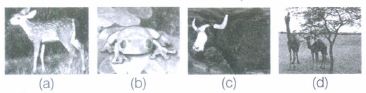
Using the following words, write the habitat of each animal given in figures (a to d). Grassland, mountain, desert, pond, river
19.
Write the most common characteristics of plants found in deserts.
20.
Name one characteristic which identify seeds as living beings.
21.
Which of the following has strong hooves?
Lion
Deer
Mountain leopard
Mountain goat
22.
Which of the following is an amphibian?
Man
Dove
Fish
Frog
23.
Respiration in aquatic animals occurs by
lungs
gills
nostrils
legs
24.
Choose the set that represents only the biotic components of a habitat.
Tiger, deer, grass, soil
Rocks, soil, plants, air
Sand, turtle, crab, rocks
Aquatic plant, fish, frog, insect
25.
Which one of the following is not associated with reproduction?
A new leaf coming out of a tree branch
A dog giving birth to puppy
A seed growing into a plant
Chick hatching from an egg
26.
Which of the following is correct for respiration in plants?
Respiration takes place only during day time
Respiration takes place only during night
Respiration takes place both during day and night
Respiration takes place only when plants are not making food
27.
Hibernation is an adaptation for
preventing loss of water
escaping hot weather
escaping cold weather
None of the above
28.
Which of the following is an incorrect statement about excretion?
Excretion takes place in plants.
Excretion takes place both in plants and animals.
Excretion is the process of getting rid of excess water only.
Secretion is one method of excretion.
29.
Boojho comes across an animal having a streamlined and slippery body. What is the habitat of the animal?
Water
Desert
Grassland
Mountain
30.
Which of the following cannot be called a habitat?
A desert with camels
A pond with fishes
A jungle with wild animals
Cultivated land with gratr'ng cattle
31.
What are the adaptive features of a lion that help it in hunting?
32.
Where is Cactus mostly found? How is it adapted to survive in such a habitat?
1.
Fish breathes through gills which take up dissolved oxygen present in water. When it is kept out of the water, it is unable to respire due to difference in pressure of gas. Hence, it dies.
2.
If an organism fails to adapt to its environment, the possible consequences could be:
(i) The organism will die.
(ii) The species will become extinct
3.
Yes, the following features of a lion help it to survive:
(i) Light brown colour of skin-It helps it to hide in dry grasslands when it hunts for prey.
(ii) Eyes in front of the face--Allow it to have a correct idea about the location of its prey.
4.
A habitat includes
(i) a living component which is called as biotic.
(ii) non-living component called abiotic.
5.
Deer have following specific features that help it to detect the presence of predators like lion
(i) Long ears to hear movement of predators.
(ii) Eyes on the sides of its head which allow it to look in all directions.
6.
(a) Camels have long legs to keep their bodies away from the heat of sand.
(b) Frogs have webbed feet that enable them to swim.
(c) Dolphins and whales have blow holes which help them to breathe in air when they swim near the surface of water.
7.
We see the following movements in plants
(i) Opening and closing of flower.
(ii) Growth of stem and leaves.
(iii) Growth of stem and twigs towards light and roots towards soil and water.
8.
Paheli can increase the numbers of rose plants in the garden by planting stem cutting of the rose plant. This will lead to reproduction.
9.
In grasslands, there are limited number of trees and places for animals to hide. When the enemy attacks an animal, it has to run fast, so as to reach a safe place. if it fails, it has to loose its life. So, speed in such places as grasslands is very important for the survival of animals.
10.
To survive in a desert, a cactus has the following adaptations:
(i) Leaves modified into spine or absent to prevent water loss through transpiration.
(ii) Stem is modified to perform photosynthesis and covered with a thick waxy layer to retain water.
(iii) The root system of cactus is well developed and grows deep for absorbing water.
11.
Yanks have long hair and leopard has thick fur on its body including feet and toes to prevent them from extreme cold.
12.
Crocodile has very strong jaws, very hard back cover and can live on land also. It can live hungry for quite a long time. It is a social animal and does sharing with group.
13.
Animals in aquatic habitat have streamlined bodies which help them in surviving underwater.
14.
Animals unable to cope in harshen conditions go to sleep to prevent extreme cold and food shortage, this is known as hibernation.
15.
Animals living in colder areas have hairy skin to warm their bodies and they have thick layer of fat under their skin.
16.
Reproduction is important for organism as it leads to the production of more individuals of an organism of its own kind. This helps in continuity of life on the earth.
17.
The habitats can be classified as:
Terrestrial habitats - Grassland and rice field
Aquatic habitats - Pond and ocean
18.
(a) The diagram is of a deer which lives in grassland.
(b) The diagram is of a frog which lives in pond.
(c) The diagram is of a yak which lives in mountain.
(d) The diagram is of a camel which lives in desert.
19.
The desert plants have reduced leaves and thick fleshy stem.
20.
Seeds respire so, it can be identified as living beings.
21.
(d)
Mountain goat
22.
(d)
Frog
23.
(b)
gills
24.
(d)
Aquatic plant, fish, frog, insect
25.
(a)
A new leaf coming out of a tree branch
26.
(b)
Respiration takes place only during night
27.
(c)
escaping cold weather
28.
(c)
Excretion is the process of getting rid of excess water only.
29.
(a)
Water
30.
(d)
Cultivated land with gratr'ng cattle
31.
There are following adaptive features of a lion that help it in hunting:
(i) Light brown colour of skin, which helps it to hide in dry grasslands when it hunts for prey.
(ii) Eyes in front of face, which help it to know the correct location of its prey.
(iii) Powerful paws and long claws, which help it . to catch and kill the prey
32.
Cactus is mostly found in the deserts.
It has the following special features to adapt itself to survive in the desert :
(i) Leaves are modified into the spines to reduce the rate of loss of water.
(ii) Stem becomes green and fleshy to take over the function of photosynthesis.
(iii) Stem is also covered with a thick layer of wax to retain water.
(iv) Its roots go deeper into the soil for better absorption of water.

6th Standard CBSE Syllabus & Materials
6th Standard CBSE
CBSE 6th Social Science Locating Places on the Earth - New Sample Question Papers Study Material - QB365 Set A
NEW6th Standard CBSE
CBSE 6th Science A Journey Through States of Water - New Sample Question Papers Study Material - QB365 Set A
NEW6th Standard CBSE
CBSE 6th Science Temperature and its Measurement - New Sample Question Papers Study Material - QB365 Set A
NEW6th Standard CBSE
CBSE 6th Science Materials Around Us - New Sample Question Papers Study Material - QB365 Set A



CBSE 6th Standard CBSE Subjects
CBSE Standards




