
 100% FREE ACCESS
6th Standard CBSE Syllabus & Materials
6th Standard CBSE
CBSE 6th Social Science The Value of Work - New Sample Question Papers Study Material - QB365 Set A
NEW6th Standard CBSE
CBSE 6th Social Science Family and Community - New Sample Question Papers Study Material - QB365 Set A
NEW6th Standard CBSE
CBSE 6th Social Science India's Cultural Roots - New Sample Question Papers Study Material - QB365 Set A
NEW6th Standard CBSE
CBSE 6th Social Science India,That is Bharat - New Sample Question Papers Study Material - QB365 Set A
NEW6th Standard CBSE
CBSE 6th Social Science Timeline and sources of history - New Sample Question Papers Study Material - QB365 Set A
NEW6th Standard CBSE
CBSE 6th Social Science Oceans and Continents - New Sample Question Papers Study Material - QB365 Set A

Published on: 19/01/2019
Water Complete Material
Download CBSE Class 6th Standard CBSE Science question papers, sample papers, important questions, and previous year solved papers in PDF format. Get free study materials, NCERT solutions, and exam preparation resources for Class 6th Standard CBSE Science
Questions + Answers key
Take MCQ Science Test
1.
Water is one of our most precious commodities and no life can survive without it It has been predicted that water scarcity will become the subject of "Wars"in the near future. Write any two ways in which water is getting polluted. Write any two measures to stop water pollution at your level
2.
How do the areas covered with concrete affect the availability of groundwater?
3.
Why is there a need for conserving water? Give two reasons.
4.
Water kept in sunlight gets heat from the sun and is evaporated. But how does water kept under the shade of a tree also gets evaporated? Explain.
5.
Why do wet clothes placed on a clothes line dry after sometime? Explain.
6.
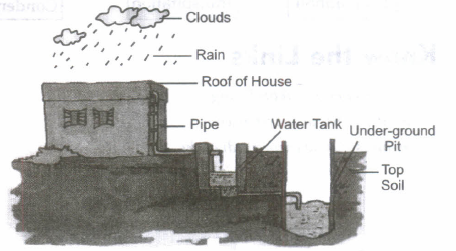
Explain the process of rooftop rain water harvesting with the help of a suitable diagram.
7.
State different uses of water
8.
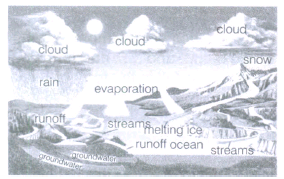
Draw a diagram to show how sea water reaches a lake or pond?
9.
Explain the process of cloud formation with the help of diagram.
10.
About 97% of the water on the earth is
salt water
pure water
polluted water
drinking water
11.
Water changes to ice at
0°C
100°C
102°C
98°C
12.
Plants regulate their temperature by
Transpiration
Respiration
Photosynthesis
Perspiration
13.
Water cycle is a
continuous process
drinking process
non-continuous process
non-cyclic process
14.
Observe the given figure and tell which process is taking place
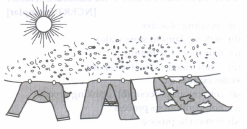
Condensation
Evaporation
Transpiration
None of the above
15.
When we move up in air, the temperature becomes:
Very high
Little high
Low
Very low
16.
For using ground water, man uses:
Canals
Dams
Tube wells
None of these
17.
Clouds are formed by
Water drops
Air
Gases
None of the above
18.
Water harvesting is a technique of
Flooding water
Farming water
Stopping flood
Saving rain water
19.
Water occurs in the atmosphere in how many forms?
One
Two
Three
Four
20.
Flood means:
Excess of water
Scarcity of water
Food and milk
Spilling of milk
21.
Drought is caused by_______ of water
Excess
Scarcity
Freezing
None of these
22.
Evaporation of water from the soil surface is due to heat from
Sun
Earth
Moon
Fire
23.
Colour of water is
Sky blue
White
Green
Colourless
24.
When we spread our wet clothes in the sun, the water:
Transpires
Respires
Transports
Evaporates
25.
Rain water harvesting is a technique to collect and store rain water
26.
Water changes to ice at 0°C.
27.
Water does not play any role in the germination of seeds
28.
Water covers over 90% of the earth's surface
29.
Water is non-renewable natural resource
30.
_______is a pure from of water.
31.
The water droplets collect together to form_______
32.
Water evaporates from different water bodies due to the _______of the________
33.
_______is a method to collect rain water on the rooftops of the buildings
34.
Water is colourless, odourless and_______
35.
Flood causes excessive damage to ________ and_______
36.
For generation of_______ and _______electricity water is required in large quantities.
37.
_______and _______are two forms of precipitation
38.
_______is another _______calamity caused by _______rains in short time
39.
Drought is a natural_______ caused due to ________ rains over a long time
40.
Is cutting of trees responsible for droughts and floods?
41.
Why do some water pipes burst in winter?
42.
Why do wet clothes placed on a clothesline get dry after some time? Explain.
43.
Write a short note on the water cycle
44.
How can we conserve water?
45.
Why is water used as coolant in the radiator of engines?
46.
Which liquid is called universal solvent and why?
47.
How are lakes and ponds formed?
48.
How do fish and aquatic plants survive in water?
49.
How is marine life dependent on oceans?
50.
Why is water essential for plants ?
51.
How does hail occur during precipitation?
52.
Is oxygen soluble in water? How is this important?
53.
Mention three ways by which water evaporates.
54.
Explain the formation of rain
1.
Water is getting polluted:
(i) By industrial waste
(ii) By human activities
Measures to stop water pollution:
(i) We should not throw waste materials and garbage into water.
(ii) We should sensitize people about harmful effects of water pollution.
Associated Value : We should discourage any activity in our life that may cause water pollution
2.
Areas covered with concrete affect the availability of groundwater because concrete reduces the seepage of rainwater into the ground which leads to reduction in the availability of groundwater.
3.
There is a need for conserving water because of the following reasons
(i) Increasing population is creating more demand for usable water.
(ii) Availability of freshwater is decreasing day-by-day.
4.
Water kept under the shade of a tree also evaporates because moving air gets heated from sunlight. This warm air provides heat for evaporation of water kept in the shade.
5.
Wet clothes placed on a clothes line dry after sometime because water present in wet clothes is converted into water vapour and released in atmosphere due to evaporation which leaves them dry.
6.
In this process, the rain water is collected from the rooftop to a storage tank, through pipes. This water may contain soil from the roof and need filtering before it is used. Instead of collecting rain water in the tank, the pipes can go directly into a pit in the ground. This then seeps into the soil to recharge the ground water.
7.
Water is used:
(i) for drinking and cooking
(ii) for bathing and cleaning.
(iii) in agriculture, to produce food.
(iv) in Industries, to perform different activities
8.
Sea water reaches a lake or pond is represented by a diagram:
9.
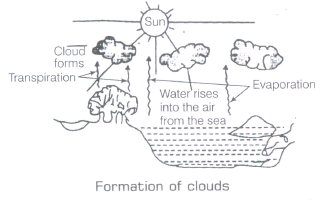
The climate close to the earth's surface is warm. It gets cooled as one go up in atmosphere. Water vapour being lighter, rises up in the atmosphere. At the upper layer of atmosphere, where the temperature is lower the vapour get condensed into tiny water droplets and forms cloud.
10.
(a)
salt water
11.
(a)
0°C
12.
(a)
Transpiration
13.
(a)
continuous process
14.
(b)
Evaporation
15.
(d)
Very low
16.
(c)
Tube wells
17.
(a)
Water drops
18.
(d)
Saving rain water
19.
(c)
Three
20.
(a)
Excess of water
21.
(b)
Scarcity
22.
(a)
Sun
23.
(d)
Colourless
24.
(d)
Evaporates
25.
(a)
26.
(a)
27.
(b)
28.
(b)
29.
(b)
30.
()
Rain water
31.
()
clouds
32.
()
heat, sun
33.
()
Rain water harvesting
34.
()
tasteless
35.
()
crops, domestic life
36.
()
thermal, hydro
37.
()
Snow, rain
38.
()
Flood, natural, excess
39.
()
calamity, less/no
40.
Yes, cutting of trees are responsible for droughts and floods. Cutting of trees disrupts the natural water cycle. trees are natural water tanks. They absorb water during rain. When we cut trees, water can't be absorbed, so it has to go where gravity takes it, which causes flood. Deforestation and soil erosion would dry up the place where it happens, since water isn't absorbed. This causes drought.
41.
Some water pipes burst in winters because during winter, cold develops enormous pressure in the pipes and due to this high pressure, water pipes burst.
42.
Wet clothes placed on a clothesline get dry after some time due to evaporation. In this process, water present in wet clothes is converted into water vapour which is released into atmosphere .
43.
Water from the oceans and surface of the earth goes into air as vapours and returns as rain, hail or snow and finally goes back to the oceans. The circulation of water in this manner is known as water cycle. The circulation of water between ocean and land is a continuous process. It maintains the supply of water on land.
44.
We can conserve water by following ways:
(i) Do not waste water and repair all the leaking water taps.
(ii) Do not use drinking water in garden or in cleaning.
(iii) Do not throw any waste in ponds or rivers to prevent their pollution
45.
Engines release large amount of heat. This heat gets consumed in the conversion of water (present in radiator ) into water vapours , therefore engine parts do not heat up.
46.
Water is called the universal solvent because it dissolves most of the salts and substances in it.
47.
Lakes and ponds are formed by the collection of rain water in low lying areas and leakages from the ground water reserves also add water to it.
48.
Oxygen is slightly soluble in water. Fish and aquatic plants need oxygen to survive and they inhale this dissolved oxygen for their survival
49.
For marine life, ocean is most important and vital. It provides them habitats and it is the source of oxygen. Without oxygen they won't be able to breathe, move and will die
50.
Water is the medium by which plant sucks all necessary minerals from soil , takes food to various parts and absorbs oxygen. Water is also necessary for photosynthesis
51.
If water reaches earth in the frozen form, it is called hail
52.
Yes, oxygen is soluble in water. This is the source of oxygen supply for aquatic habitats.
53.
Water evaporates from sea, lakes and other water surfaces. Water also evaporates from wet lands, clothes, etc. Water also evaporates from plants through transpiration.
54.
Water from the ocean and surface of earth goes into air as vapour through evaporation and transpiration where it cools down and forms tiny water droplets through condensation. These then turn into clouds and returns as rain

6th Standard CBSE Syllabus & Materials
6th Standard CBSE
CBSE 6th Social Science Locating Places on the Earth - New Sample Question Papers Study Material - QB365 Set A
NEW6th Standard CBSE
CBSE 6th Science A Journey Through States of Water - New Sample Question Papers Study Material - QB365 Set A
NEW6th Standard CBSE
CBSE 6th Science Temperature and its Measurement - New Sample Question Papers Study Material - QB365 Set A
NEW6th Standard CBSE
CBSE 6th Science Materials Around Us - New Sample Question Papers Study Material - QB365 Set A



CBSE 6th Standard CBSE Subjects
CBSE Standards




