
 100% FREE ACCESS
6th Standard Syllabus & Materials
6th Standard
TN 6th Tamil பருவம் 1 - இயல் 1 - மொழி -தமிழ்த்தேன் - இன்பத்தமிழ் Sample Question Papers Study Material - QB365 Set A
NEW6th Standard
TN 6th English T1 - Supplementary - The Apple Tree and The Farmer Sample Question Papers Study Material - QB365 Set A
NEW6th Standard
TN 6th English T1 - Prose - When The Trees Walked Sample Question Papers Study Material - QB365 Set A
NEW6th Standard
TN 6th Social Science T3 - CIV - Road Safety Sample Question Papers Study Material - QB365 Set A
NEW6th Standard
TN 6th Social Science T3 - CIV - Local Bodies - Rural and Urban Sample Question Papers Study Material - QB365 Set A
NEW6th Standard
TN 6th Social Science T3 - CIV - Democracy Sample Question Papers Study Material - QB365 Set A

Published on: 16/03/2020
6th Standard Science English Medium All Chapter Book Back and Creative Five Marks Questions 2020
Download Tamil Nadu 6th Standard Science question papers, model tests, one-mark questions, important questions, and public exam papers in PDF format. Free study materials and answer keys for TN State Board students.
Questions + Answers key
Take MCQ Science Test1.
Discuss in detail aboutthe types of software.
2.
What is the difference between hardware and software?
3.
Write the various types of ecosystem.
4.
Distinguish between bio degradable and Non-bio degradable.
5.
Differentiate organic and inorganic fertilizers.
6.
Which are physical and chemical changes?
7.
What are the reasons for scarcity of water?
8.
Where and how water is found on the earth?
9.
Write the differences between a normal train and an electromagnetic train.
10.
Distinguish between magnetic and non-magnetic substances.
11.
Comment on importance of plant animal interaction.
12.
Write short notes on – Timber yielding plants.
13.
Write a short note on noise pollution.
14.
Give two examples of how you can avoid or reduce waste?
15.
How are detergents manufactured?
16.
Who is known as waterman of India? Browse the net and find the details about the award, the waterman received for water management. State the findings by drafting a report.
17.
What is potable water? List down its characteristics.
18.
How does the electromagnetic train work?
19.
You are provided with an iron needle. How will you magnetize it ?
20.
Draw a neat labelled diagram of a prokaryotic cell.
21.
Tabulate any five cell organelles and their function.
22.
Why is atmosphere essential for life on earth?
23.
Give one example for each case that happens around you.
a. Slow and fast change
b. Reversible and irreversible change
c. Physical and chemical change
d. Natural and man-made change
e. Desirable and undesirable change
24.
Write short notes on conductors and insulators.
25.
What is the source of electricity? Explain the various power stations in India?
26.
Explain in detail above the applications of computer.
27.
Tabulate the vitamins and their corresponding deficiency diseases.
28.
Describe the various features which help Camel dwell well in the desert.
29.
Complete the map by filling the blanks
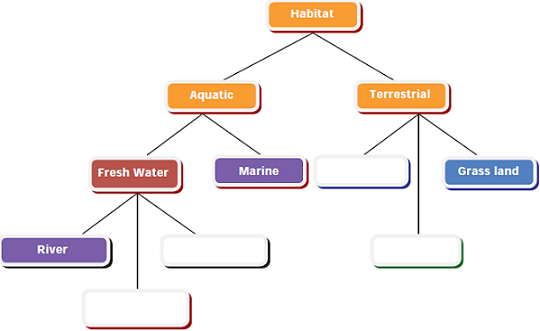
30.
Make a list of the functions of root and stem.
31.
Fill with examples:
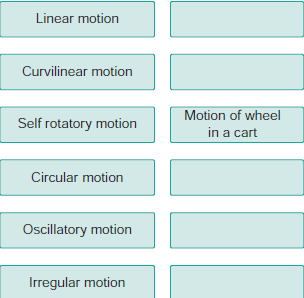
32.
What is motion? Classify different types of motion with examples.
33.
Explain two methods that you can use to measure the length of a curved line.
34.
Why do we hiccup and cough sometimes when we swallow food?
35.
What will happen if the diaphragm shows no movement?
36.
Can you guess why fire extinguishers throw a stream of carbon-di-oxide while putting - off fire?
37.
When a candle is lit the following changes are observed.
a. Wax melts.
b. Candle keeps burning.
c. The size of the candle decreases.
d. The molten wax solidifies
e. Which of the changes can be reversed? Justify your answer.
38.
If you heat a circular disk with a hole, what change do you expect in the diameter of the hole? Remember that the effect of heating increases the separation between any pair of particles.
39.
Suppose your normal body temperature were lower than what it is. How would the sensation of hot and cold change?
40.
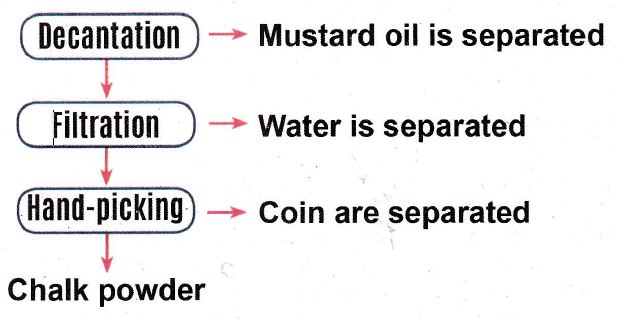
Using suitable apparatus from your laboratory separate the mixture of chalk powder, mustard oil, water and coins. Draw a flow chart to show the separation process
41.
Distinguish the properties of solid, liquid and gas. Draw a suitable diagram.
42.
Find the answer for the following questions within the grid.
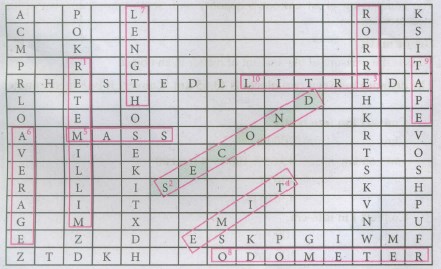
1. 10-3 is one_____
2. SI Unit of time is_____
3. Cross view of reading a measurement leads to______
4. ____is the one what a clock reads.
5. _____is the amount of substance present in an object.
6. ______can be taken to get the final reading of the recordings of different students for a single measurement.
7. ______is a fundamental quantity.
8. _____shows the distance covered by an automobile
9. A tailor uses to take______ measurements to stitch the cloth.
10. Liquids are measured with this physical quantity.
1.
The operating system and application software are available in two fortns. They are:
i) Free and Open source
ii) Paid and Proprietary Software
i) Free and Open source
1. Free and open software is available at free of cost and can be shared to many end users.
2. Free software is editable and customizable by the user and this leads to updation or development of new software.
3. Examples of Free and Open source software are: LINUX, Open office, Geogebra etc.
ii) Paid and Proprietary Software
1. There are software that need a license to use it.
2. They have to be paid for using either permanently or temporarily,
3. The license of the software would not be provided unless itis purchased.
4. Similarly the end users are legally prohibited to steal the software program or to use the pirated version of the Paid and Proprietary Software.
5. Some of the examples of Paid and Proprietary Software are: Windows, Microsoft office, Adobe Photoshop, etc.
2.
| Hardware | Software |
| i) Computer hardware is any physical device used in or with your machine | Software is a collection of code installed onto your computer's hard drive |
| ii) Physical parts of the computer are called hardware. | A set of instructions given to the computer is called software |
| iii) You can touch, see and feel hardware. | You cannot touch and feel software. |
| iv) Hardware is constructed using physical materials or components. | Software'is developed by writing instructions in programming language. |
| v) Computer is hardware, which operates under the control of a software. | The operations of computer are controlled through software |
| vi) If hardware is damaged, it is replaced with new one. | If software is damaged or corrupted, its backup copy can be reinstalled.Software is affected by computer viruses. |
3.
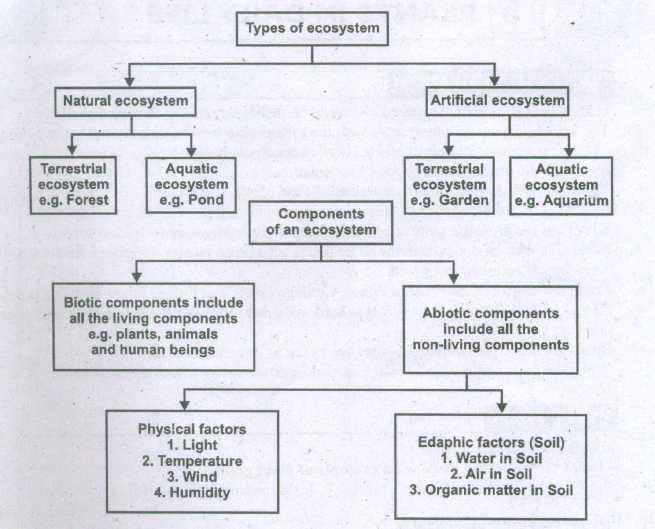
4.
| Biodegradable | Non-bio degradable |
|
i) The term 'Biodegradable' is used for those things that can be easily decomposed by natural agents like water, oxygen, ultraviolet rays of the sun, micro-organisms, etc. |
Those materials which cannot be broken down or decomposed into the soil by micro-organisms and natural agents are labeled as non-biodegradable. These substances consist of plastic materials, metal scraps, aluminum cans and bottles, etc. |
5.
| Organic fertilizer | Inorganic fertilizer |
| Fertilizers containing only plant or animal-based materials or those synthesized by micro-organisms are called 'organic fertilizers. These fertilizers can be prepared easily. This type of fertilizers are economical. (e.g) Vermi compost, compost. |
The fertilizers prepared by using natural elements by making them undergo chemical changes in the factories are called inorganic fertilizers. (e.g) Urea, Ammonium sulphate and Super phosphate. |
6.
Physical changes
i) Breaking of a stick into two pieces
ii) Burning of a paper
iii) Tearing paper into small pieces
Chemical changes
i) Dissolving of sugar in water
ii) Burning of petrol or LPG gas
iii) Water boiling into water vapour
iv) Coconut oil becoming solid during winter
7.
The main reasons for water scarcity
i) Population explosion
ii) Uneven distribution of rainfall
iii) Decline of ground water table
iv) Pollution of water
v) Careless use of water
8.
i) Water is available in nature in three forms -, Solid, Liquid, Vapour. ~
ii) Solid form of water - Ice - It is present in icebergs and ice caps on top of tall mountains, galaciers and polar regions.
iii) Liquid form, of water - Water - It is present in oceans, seas, lakes, rivers and even underground.
iv) Gaseous form of water - Vapour -It is present in the air around us.
9.
| Normal train | Electromagnetic train |
| Fiction | No fiction |
| Medium speed | High speed |
| Noisy. | No noise |
| Run by fuel or coal | Run by electromagnetic mechanism |
10.
| Magnetic | Non - Magnetic |
| Substances which are attracted by magnet are called magnetic substances. Iron, cobalt, nickel are magnetic substances. | Substances which are not attracted by magnet are called non-magnetic substances. Paper, plastic are called non- magnetic substances. |
11.
(i) Like human being, animals also depend on plants for their necessity.
(ii) Silk worm eat mulbery leaves and produce silk.
(iii) Animals, insects and birds help in cross pollination.
(iv) Entering of insects into the flower leads to pollination. It increases yield of crop.
(v) Plants and algae living in coral reefs are the food variety of fishes and fisheries work is done in these areas.
(vi) Animals and plants are play an important role in spreading of seeds.
12.
(i) Timber is used to build houses and in making furniture.
(ii) We use wood for these purposes due to their features like durability, stylish finishing and resistance to temperature changes.
(iii) Commercial timber is classified into hardwood and softwood.
(iv) Hardwood is used in construction work and in making furniture.
(v) Softwoods have a wide range of applications such as making plywood and paper making.
13.
(i) Noise pollution affects the environment. Unpleasant or loud sounds distrub us. This is called as noise pollution.
(ii) Loud music the sounds of motor vehicles, fireworks and machines causes noise pollution.
(iii) Continuous noise disturbs our sleep and does not let us to study and also it make stress and health impacts.
(iv) It is also disturb animals, bird and whales in under water.
(v) To reduce noise pollution lower the volume when you watch TV or listen to music.
(vi) Remind drivers not to use the horm too much.
(vii) Avoid fire works and do not speak loudly.
14.
AVOID:
Avoid the usage of unwanted materials which create more debris.
(e.g) (i) Avoid buying packaged foods.
(ii) Refuse to buy use and throw plastic products.
REDUCE:
We can reduce the waste by using durable goods that last longer instead of things that are used once and thrown away.
(e.g) (i) Write both sides of papers.
(ii) Instead of unnecessary printing use electronic facilities.
15.
Aim: Soap manufacturing.
Requirements:
i) 35 ml of water.
ii) 10 ml of NaOH.
iii) 60 ml of coconut oil.
Procedure:
i) Cover your work area with old newspaper.
ii) Take 35 ml of water in a jar.
iii) Add 10 gram of concentrated NaOH and allow it to cool.
iv) Then add 60 ml of coconut oil drop by drop and stir it well.
v) On getting dried, soap can be obtained.
16.
(i) Dr. Rajendra Singh is known as "Waterman of India".
(ii) He is a well - known water conservationist and environmentalist.
(iii) His team built rainwater storage tanks, check dams and other timetested as well as path - breaking techniques.
(iv) His team built over 8600 johads to collect rain water for all seasons. It has brought water back to over 1000 villages and revived five rivers in Rajasthan.
Awards:
(i) He won stockholm water prize in 2005, an award known as "The Noble Prize for water".
(ii) Ramon Magsaysay Award in 2001.
(iii) Jamnalal Bajaj Award in 2005.
17.
(i) Potable water is the water which is safe to drink. On an average the human body requires 2-3 liters of water per day for proper functioning.
(ii) It is transparent.
(iii) It is odourless and colourless.
(iv) Cleaned of harmful contaminants.
(v) It is harmless or free from disease causing bacteria.
18.
i) Electromagnets are used in electromagnetic trains.
ii) Electromagnets are magnetised when current flows through them. When the direction of current is changed, poles will be changed.
iii) Magnets are attached at the bottom of the train and rail tracks.
iv) The train is lifted from track upto 10 cm height by the property of some poles that repel each other.
v) By using attraction and repulsion at the same time between the magnets in tracks and bottom of the train it moves forward.
vi) The magnets are controlled by electricity.
vii) There is no friction. So the train can easily attain a speed of 300 km/h.
19.
i) Place the iron needle on a table. Now take a bar magnet and place one of its poles near one edge of iron needle and rub from one end to another end without changing the direction of the pole of the magnet. Repeat the process for 30 to 40 times.
ii) Bring a pin or some iron filings near the iron needle to check whether it has become a magnet. Does the iron needle attract the pin / Iron filing? If not continue the same process for some more time.
20.
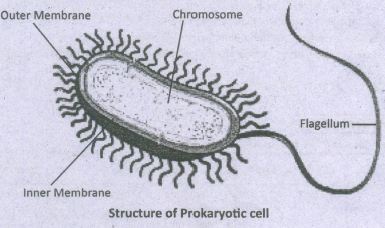
21.
| Cell Organelles | Main Functions |
|---|---|
| Cell wall | Surrounds and protects the cell. Make the cell stiff and strong. |
| Cell membrane | Holds and protects the cell. Controls the movement of materials in and out of the cell. |
| Cytoplasm | A watery gel - like material in which cell parts move. |
| Mitochondria | Produce and supply most of the energy for the cell. |
| Chloroplasts | Capture the energy from sunlight and use it to produce food for the cell by photosynthesis. |
22.
A huge envelope of air surrounded the earth is called Atmosphere.
(i) This envelope is thicker near the earth's surface.
(ii) As we go higher up, the density and the availabillty of air gradually decreases.
(iii) Movement of wind, Presence of water vapours for cloud formation are the vital roles of atmosphere.
(iv) Troposphere is the responsible layer for the weather we experience on earth.
(v) Stratosphere has the Ozone layer which protects all life on earth from the harmful UV rays of the sun.
23.
(a) Slow and fast change
(i) Slowchange - Changeofseasons
(ii) Fast change - Bursting of fire crackers
(b) Reversible and irreversible change
(i) Reversible change - Stretching of rubber
(ii) Irreversible change - Digestion of food
(c) Physical and chemical change
(i) Physical change - Melting of Ice
(ii) Chemical change - Rusting of Iron
(d) Natural and man-made change
(i) Natural change - Rotation of the earth
(ii) Man-made change - Cooking
(e) Desirable and undesirable change
(i) Desirable change - Milk changing to curd
(ii) Undesirable change - Deforestation
24.
Conductors:
(i) The rate of flow of electric charges in a circuit is called electric current.
(ii) The materials which allow electric charges to pass through them are called conductors.
(iii) Examples: Copper, iron, aluminium, impure water, eafth etc.
Insulators (Non -Conductors) :
(i) The material which do not allow electric charges to pass through them are called insulators or non- conductors.
(ii) Examples: plastic, glass, wood, rubber, chinna clav, ebonite etc.
25.
We get electricity from thermal power, hydel power, tidal power wind power, solar power etc as sources of electricity
Thermal Power stations:
In thermal power stations, the thermal energy generated by burning coal, diesel or gas is used to produce steam. The steam is used to rotate the turbine. While the turbine rotates, the coil of wire kept between the electromagnet rotates. Due to electro magnetic induction electricity is produced. Here heat energy is converted into electrical energy.
Hydel power stations:
In hydel power stations, the turbine is made to rotate by the flow of water from dams to produce electricity. Here kinetic energy is converted into electrical energy. Hydel stations have long economic lives and low operating cost.
Atomic power stations:
In atomic power stations, nuclear energy is used to boil water. Here the steam is used to rotate the turbine. As a result, electricity is produced. Atomic power stations are also called as nuclear power stations. Here nuclear energy is converted into mechanical energy and then electrical energy.
Wind Mills:
In wind mills, wind energy is used to rotate the turbine to produce electricity. Here kinetic energy is converted into electrical energy.
26.
(i) Computers are used in various fields.
(ii) In textile shop it is used for billing.
(iii) Computers are used to control large and small machines.
(iv) Computers are most important educational tools for teachers and learners.
(v) In Railways it is useful to book tickets and for other purposes.
(vi) It is also used in banks, ATM's, Post offices and in many places.
(vii) We can save many data and convert it into information.
27.
| S.no | Property | deficiency disease |
| 1 | vitamin A | Night blindness |
| 2 | vitamin B | Beri beri |
| 3 | vitamin C | Scurvy |
| 4 | vitamin D | Rickets |
| 5 | vitamin E | Nervous weakness, dimming of eyesight |
| 6 | vitamin K | Weakness of the bones, teeth etc. |
28.
(1) The camel has long legs which help it to keep its body away from the hot sand in the desert.
(2) It can store large amount of water in its body.
(3) it loses very little water from its body through excretion.
(4) A camel's hump has fat stored in it. It ups the stored fat when required.
(5) It has large and flat padded feet to walk easily on soft sand.
(6) It has long eye lashes and hairs to protect its eyes and ears from the blowing dust.
(7) It can keep its nostrils closed to avoid dust.
29.
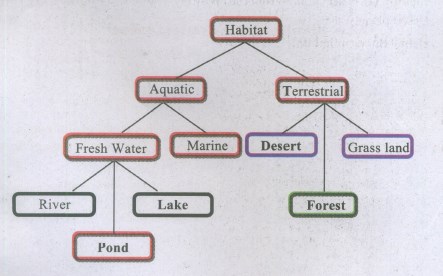
30.
FUNCTIONS OF THE ROOT:
i) The root fixes the plant to the soil.
ii) Absorbs water and minerals from the soil.
iii) Stores food in some plants like Carrot and beetroot
FUNCTIONS OF THE STEM:
i) The stem supports the branches, leaves, flowers and fruits.
ii) Transports Water and minerals from roots to upper aerial plant parts.
iii) Transports the prepared food from leaves to other parts through stem.
iv) Stores food as in the case of sugarcane
31.
Linear motion - A coconut falling from a tree
Curvilinear motion - A car driving around a curve
Self rotatory motion - Motion of the wheel in a cart
Circular motion - Athlete running around a track
Oscillatory motion - Swinging of a pendulum
Irregular motion - Movement of people in a bazaar
32.
When there is a change of position of an object with respect to time then it is called motion.
Types of motion:
a) Based on path:
i) Linear motion - a person walking on a straight path
ii) Curvilinear motion - throwing ball
iii) Circular motion - swirling stone tied to the rope
iv) Rotatory motion - a rotating top
v) Oscillatory motion - pendulum of clock
vi) Zig zag (or) Irregular motion - the motion of a bee
b) Based on duration:
i) period motion - movement of hour hand of a clock
ii) Non-periodic - motion flapping of a flag in wind
c) Based on speed:
9) Uniform motion - motion of a train at a constant speed
ii) Non-uniform motion - a vehicle moves in different speed
33.
Method 1:
(i) Place a string along the curved line, Make sure that the stringcovers every bit of the curved line.
(ii) Mark the points where the curved line begins and ends on the string.
(iii) Now, stretch the string along the length of a meter scale and measure the distance between the two markings of the string.
(iv) This will give us the length of a curved line.
Method 2:
(i) Draw a curved line AB on a piece of paper.
(ii) Separate the legs of the divider by 0.5 cm or 1 cm using a ruler.
(iii) Place it on the curved line starting from one end. Mark the position of the other end. Move it along the line again and again cutting the line into number of segments of equal lengths. The remaining parts of the line can be measured using a scale.
(iv) Count the number of segments.
(v) Therefore, the length of the line = (number of segments x length of each segment) + length of the left over part.
34.
While swallowing food if the food particles enter into respiratory tract leads to hiccup and cough to eject out the food particles from respiratory tract.
35.
If the diaphragm is not moved, breathing will not occur. It leads to death.
36.
Fire extinguishers throw a stream of carbon-, di-oxide while putting - off fire. Carbon-di-oxide covers the fire and cut-off the supply of fresh air to the burning things and stop burning.
37.
a) melting of wax and
d) Solidification of the molten wax can be reversed.
Burning of candle is a physical / reversible change. That is,
\(\text { Solid wax } \underset{\text { Cooling }}{\stackrel{\text { Heating }}{\rightleftarrows}} \text { molten wax }\)
38.
Many of us expect that diameter of hole will decrease, but actually as the diameter of ring increases diameter of hole will also increase.
39.
We feel hot because the heat is transferred from atmosphere to your body. Heat energy flows from higher temperature to lower temperature.
40.
(i) Using beakers, the mustard oil is separated by the process of decantation, because oil being lighter than water, floats on water.
(ii) Next filtration is using a funnel and filter paper and thus water gets separated from chalk powder and coins.
(iii) By hand-picking method, the coins are separated frorn chalk powder.
41.
| PARTTCLES IN A SOLID |
PARTICLES IN A LIQUID | PARTICLES IN GASEOUS |
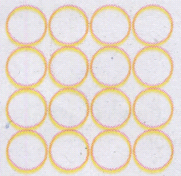 |
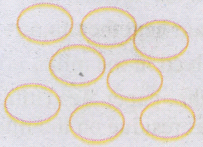 |
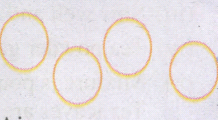 |
| S.No. | SOLID STATE | LIQUID STATE | GASEOUS STATE |
| 1. | Definite shape and volume | No definite shape, liquids attain the shape of the vessel in which they are kept. | Gases have neither a definite shape nor a definite volume. |
| 2. | Incompressible | Compressible to a small extent. | Highly compressible |
| 3. | There is little space between the particles of solid. | These particles have a greater space between them. | The space between gas particles is the greatest. |
| 4. | These particles attract each other very strongly. | The force of attraction between liquid particles is lesser than solid particles. | Thd force of attraction is least between gaseous particles. |
| 5. | Particles of solid cannot move freely. | These particles move freely. | Gaseous particles are in a continuous, random motion. |
42.
1. Millimetre
2. Second
3. Error
4. Time
5. Mass
6. Average
7. Length
8. Odometer
9. Tape
10. Litre

6th Standard Syllabus & Materials
6th Standard
TN 6th Social Science T3 - GEO - Understanding Disaster Sample Question Papers Study Material - QB365 Set A
NEW6th Standard
TN 6th Social Science T3 - GEO - Globe Sample Question Papers Study Material - QB365 Set A
NEW6th Standard
TN 6th Social Science T3 - GEO - Asia and Europe Sample Question Papers Study Material - QB365 Set A
NEW6th Standard
TN 6th Social Science T3 - HIS - South Indian Kingdoms Sample Question Papers Study Material - QB365 Set A



Tamilnadu Stateboard 6th Standard Subjects
Tamilnadu Stateboard Standards




