
 100% FREE ACCESS
6th Standard Syllabus & Materials
6th Standard
TN 6th Tamil பருவம் 1 - இயல் 1 - மொழி -தமிழ்த்தேன் - இன்பத்தமிழ் Sample Question Papers Study Material - QB365 Set A
NEW6th Standard
TN 6th English T1 - Supplementary - The Apple Tree and The Farmer Sample Question Papers Study Material - QB365 Set A
NEW6th Standard
TN 6th English T1 - Prose - When The Trees Walked Sample Question Papers Study Material - QB365 Set A
NEW6th Standard
TN 6th Social Science T3 - CIV - Road Safety Sample Question Papers Study Material - QB365 Set A
NEW6th Standard
TN 6th Social Science T3 - CIV - Local Bodies - Rural and Urban Sample Question Papers Study Material - QB365 Set A
NEW6th Standard
TN 6th Social Science T3 - CIV - Democracy Sample Question Papers Study Material - QB365 Set A

Published on: 04/10/2019
Human Organ Systems
Download Tamil Nadu 6th Standard Science question papers, model tests, one-mark questions, important questions, and public exam papers in PDF format. Free study materials and answer keys for TN State Board students.
Questions + Answers key
Take MCQ Science Test1.
The ______________ is the largest sense organ in our body.
2.
The process by which the body removes waste is____________________.
3.
The part of the skeleton that protects the brain is __________________.
4.
A group of organs together make up an ____________________ system.
5.
The brain, the spinal cord and nerves form the nervous system.
6.
Thin tube like structures which are the component of circulatory system are called blood vessels.
7.
The other name of food pipe is alimentary canal.
8.
All the waste products of the body are excreted through the circulatory system.
9.
Enzymes : Digestive glands :: _____________ : Endocrine glands.
10.
Arteries : Carry blood from the heart :: _________ : carry blood to the heart.
11.
Name the five important sense organs.
12.
Write any two functions of digestive system.
13.
Define the term "Trachea".
14.
Describe about skeletal system.
15.
Differentiate between the voluntary muscles and involuntary muscles.
16.
List out the functions of the human skeleton.
17.
Label the diagram given below to show the four main parts of the urinary system and answer the following questions.
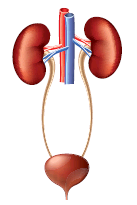
A. Which organ removes extra salts and water from the blood?
B. Where is the urine stored?
C. What is the tube through which urine is excreted out of the body?
D. What are the tubes that transfer urine from the kidneys to the urinary bladder called?
18.
List out the functions of Endocrine system and Nervous system.
19.
Why is the heart divided into two halves by a thick muscular wall?
20.
Lungs
21.
Heart
22.
Diaphragm
23.
Skeletal System
24.
Ear
25.
Urethra ⟶ Ureter ⟶ Urinary Bladder ⟶ Kidney
26.
Stomach ⟶ Large intestine ⟶ Oesophagus ⟶ Pharynx ⟶ Mouth ⟶ Small Intestine ⟶ Rectum ⟶ Anus
1.
()
Skin
2.
()
excretion
3.
()
Skull
4.
()
organ
5.
True
6.
True
7.
False - Correct statement: The other name of food pipe ls Oesophagous.
8.
False - Correct statement: All the waste product of the body are excreted through the excretory system
9.
hormones
10.
veins
11.
Eyes, Ears, Nose, Tongue and Skin are the sense organs.
12.
Digestion and absorption of food done by digestive system.
13.
Trachea commonly called wind pipe - allowing the passage of air to lungs.
14.
The skeletal system consists of bones, cartilages and joints. It provides a framework for the body.
15.
| Voluntary muscles | Involuntary muscles |
| Voluntary muscles of our body are attached to the bones. | Involuntary muscles are found in the walls of digestive tract, and other internal organs. |
| They can be controlled by our will. | They can't controlled by our will. |
16.
(i) Bone provide a frame work for the body.
(ii) Bones along with muscles help in movements such as walking, running chewing and dancing, etc.,
17.
A. Kidneys removes extra salts and water from the blood
B. The urine is stored in Urinary bladder
C. Through urethra urine is excreted out of the body.
D. Ureter transfer urine from the kidneys to the urinary bladder.
18.
Endocrine system:
(i) Endocrine glands are present in the body produce chemical substances called hormonds.
(ii) It regulates various fundions of the body and maintains the internal environment.
Nervous system:
(i) Nervous system is well developed by neurons or nerve cells.
(ii) Nervous system along with the endocrine system doing conduction and co-ordination in human body.
19.
Thick walls are present in ventricles to pump the blood from the heart to various part of body.
20.
Air sacs
21.
Cardiac muscle
22.
Flat muscle
23.
Protection of internal organs
24.
Sound
25.
Kidney ⟶ Ureter ⟶ Urinary Bladder ⟶ Urethra
26.
Mouth ⟶ Pharynx ⟶ Oesophagus ⟶ Stomach ⟶ Small Intestine ⟶ Large intestine ⟶ Rectum ⟶ Anus

6th Standard Syllabus & Materials
6th Standard
TN 6th Social Science T3 - GEO - Understanding Disaster Sample Question Papers Study Material - QB365 Set A
NEW6th Standard
TN 6th Social Science T3 - GEO - Globe Sample Question Papers Study Material - QB365 Set A
NEW6th Standard
TN 6th Social Science T3 - GEO - Asia and Europe Sample Question Papers Study Material - QB365 Set A
NEW6th Standard
TN 6th Social Science T3 - HIS - South Indian Kingdoms Sample Question Papers Study Material - QB365 Set A



Tamilnadu Stateboard 6th Standard Subjects
Tamilnadu Stateboard Standards




