
 100% FREE ACCESS
6th Standard Syllabus & Materials
6th Standard
TN 6th Tamil பருவம் 1 - இயல் 1 - மொழி -தமிழ்த்தேன் - இன்பத்தமிழ் Sample Question Papers Study Material - QB365 Set A
NEW6th Standard
TN 6th English T1 - Supplementary - The Apple Tree and The Farmer Sample Question Papers Study Material - QB365 Set A
NEW6th Standard
TN 6th English T1 - Prose - When The Trees Walked Sample Question Papers Study Material - QB365 Set A
NEW6th Standard
TN 6th Social Science T3 - CIV - Road Safety Sample Question Papers Study Material - QB365 Set A
NEW6th Standard
TN 6th Social Science T3 - CIV - Local Bodies - Rural and Urban Sample Question Papers Study Material - QB365 Set A
NEW6th Standard
TN 6th Social Science T3 - CIV - Democracy Sample Question Papers Study Material - QB365 Set A

Published on: 04/02/2020
6th Standard Science Important Questions
Download Tamil Nadu 6th Standard Science question papers, model tests, one-mark questions, important questions, and public exam papers in PDF format. Free study materials and answer keys for TN State Board students.
Questions + Answers key
Take MCQ Science Test1.
Which one of the following is an input device?
Speaker
Keyboard
Monitor
Printer
2.
Which one of the following is an output device?
Mouse
Keyboard
Speaker
Pendrive
3.
Circulatory system transports these throughout the body
Oxygen
Nutrient
Hormones
All of these
4.
Most organelles in an eukaryotic cell is found in the
Cell wall
cytoplasm
nucleus
Vacuole
5.
Which one of the following is not an unicellular organism?
Yeast
Amoeba
Spirogyra
Bacteria
6.
Under the microscope Priya observes a cell that has a cell wall and distinct nucleus. The cell that she observed is
a plant cell
an animal cell
a nerve cell
a bacteria cell
7.
The constituent of air that supports combustion is _________________
Nitrogen
carbon-di-oxide
Oxygen
water vapour
8.
Gas exchange takes place in plants using __________
Stomata
Chlorophyll
Leaves
Flowers
9.
Air pollution leading to Acid rain is a
reversible change
fast change
natural change
human made change
10.
Formation of curd from milk is
a reversible change
a fast change
an irreversible change
an undesirable change
11.
Drying of wet clothes in air is an example of
Chemical change
Undesirable change
irreversible change
physical change
12.
Choose the symbol for battery
.JPG)
.JPG)
.JPG)
_____________
13.
Electricity is produced in
transformer
power station
electric wire
television
14.
An iron ball at 50°C is dropped in a mug containing water at 50o C. The heat will
flow from iron ball to water
not flow from iron ball to water or from water to iron ball
flow from water to iron ball
increase the temperature of both
15.
Any human being should take minimum ___________ of water every day.
2 liters
3 liters
8 liters
6 liters
16.
Beri Beri is caused due to the deficiency of________
Vitamin C
Vitamin D
Vitamin K
Vitamin B
17.
Lizards are walk with four legs and is known as
Bipedal
Tripedal
Monopedal
quadripedal
18.
Polar bear and Penguins dwell in___________.
Cold region
Hot region
Cold and Hot region
Forest region
19.
A cheetah running with an average speed of_____________
112 kmIh
121 km/h
211 km/h
122 km/h
20.
A___________ is the fastest land animal
Horse
Lion
Cheetah
Tiger
21.
Periodic motion among the following is___________
sabling swing in wind
revolution of the moon around the earth
a coconut falling from a tree
paper flight moving
22.
We mix rice, dal, salt, chillies, pepper, ghee and other ingredients to make pongal. So pongal is also a ___________
Mixture
Compound
Element
Matter
23.
A standard sheet of paper is about___________ atoms thick.
Thousands
Crores
Lakhs
Million
24.
The first land plants are____________
Neem tree
hibiscus'
banyan tree
mosses and liver worts
25.
___________ is the longest river in the world.
Sutlej
Yellow
Nile
Congo
26.
On the lower side of the leaf there are tiny pores or openings known as ____________
Leaf base
mid rib
petiole
stomato
27.
The matric system of units was created by the________in 1790.
Italy
Australia
Russia
French
28.
Volume of liquid is usually measured___________
litres
grams
nano
kilo
29.
Who is the computer’s first programmer?
Lady Wellington
Augusta ado Lovelace
Mary Curie
Mary Comb
30.
When was the first computer introduced?
1980
1947
1946
1985
31.
We should include fruits and vegetables in our diet, because _______.
They are the best source of Carbohydrates
They are the best source of Proteins
They are rich in minerals and Vitamins
They have high water content
32.
Which of the following cannot be called as a habitat?
A desert with camels
A pond with fish and snails
Cultivated land with grazing cattle
A jungle with wild animals
33.
The habitat of water hyacinth is
Aquatic
Terrestrial
Desert
Mountain
34.
Lighter impurities like dust when mixed with rice or pulses can be removed by __________
filtration
sedimentation
decantation
winnowing
35.
Unit of speed is__________
m
s
kg
m/s
36.
The height of a tree can be measured by
Metre scale
plastic ruler
Metre rod
measuring tape
37.
Tabulate any five cell organelles and their function.
38.
Explain in detail above the applications of computer.
39.
Tabulate the vitamins and their corresponding deficiency diseases.
40.
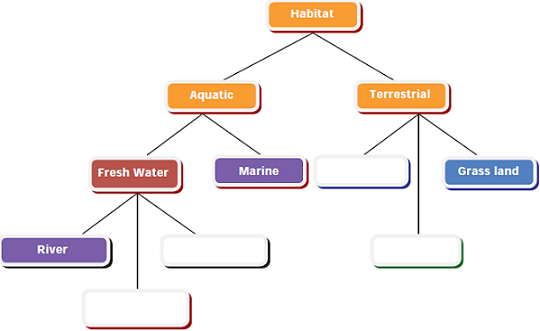
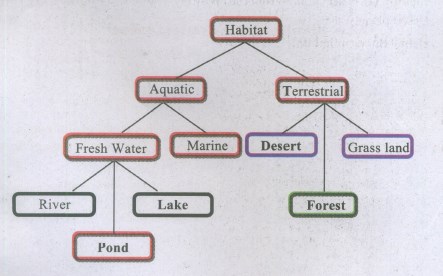
Complete the map by filling the blanks
41.
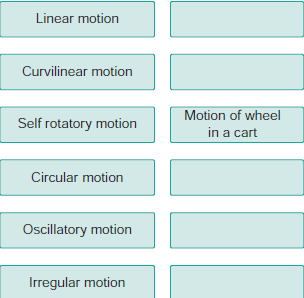
Fill with examples:
42.
What is motion? Classify different types of motion with examples.
43.
How will you measure the volume of irregular objects?
44.
A vehicle covers a distance of 400km in 5 hour. Calculate its speed.
45.
Why do we sweat more in summer?
46.
Can you guess why fire extinguishers throw a stream of carbon-di-oxide while putting - off fire?
47.
When a candle is lit the following changes are observed.
a. Wax melts.
b. Candle keeps burning.
c. The size of the candle decreases.
d. The molten wax solidifies
e. Which of the changes can be reversed? Justify your answer.
48.
Rahul wants to make an electric circuit. He has a bulb, two wires, a safety pin and a piece of copper. He does not have any electric cell or battery. Suddenly he gets some idea. He uses a lemon instead of a battery and makes a circuit. Will the bulb glow?
49.
Suppose your normal body temperature were lower than what it is. How would the sensation of hot and cold change?
50.
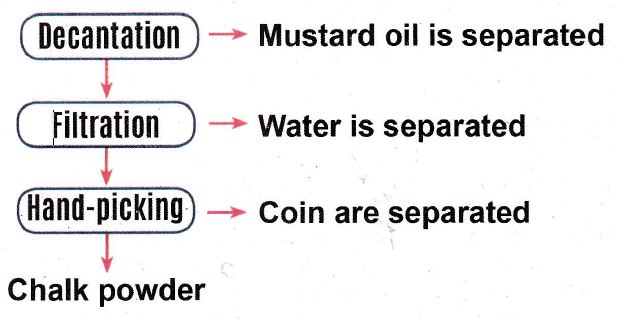
Using suitable apparatus from your laboratory separate the mixture of chalk powder, mustard oil, water and coins. Draw a flow chart to show the separation process
51.
List out the functions of the human skeleton.
52.
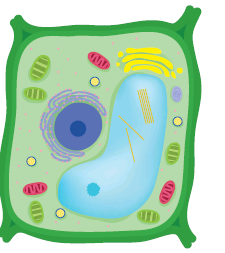
Identify any four parts of the Plant cell.
53.
Biscuits kept open on a plate during monsoon days lose its’ crispness. Why?
54.
Can deforestation be considered a desirable change? Explain.
55.
Can the cell used in the clock gives us an electric shock? Justify your answer.
56.
Distinguish between heat and temperature.
57.
Write the adaptive features of Polar bear and Penguin.
58.
59.
Distinguish between terrestrial and aquatic habitats.
60.
Circle the odd one out. Give reason for your choice.
Switch, Bulb, Battery, Generator.
61.
What are the three types of blood vessels?
62.
Write the functions of epiglottis.
63.
Which one is called as “Area of movement"?
64.
What are the organelles found only in plant cell?
65.
Who discovered the cell in 1665?
66.
How do the roots of land plants get oxygen for breathing?
67.
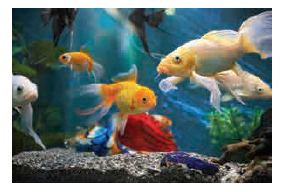
What will happen if we remove plants from the aquarium?
68.
What is a solution?
69.
Define a slow change.
70.
What kind of a change is associated with decaying of a plants?
71.
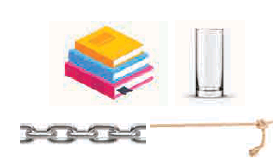
Identify the conductor from the following figures.
72.
What is temperature?
73.
Which structure helps the bird to change its direction while flying in air?
74.
Define - Sedimentation
75.
Why do we separate mixtures?
76.
Relate the terms leaves and photosynthesis.
77.
Classify the plants on the basis of their habitat.
78.
Write a short note on Data.
79.
What is a Computer?
80.
Mention any two viral diseases.
81.
Write two examples for each of the following.
a) Food items rich in fat.
b) Vitamin deficiency diseases.
82.
1 Metre, 1 centimetre, 1 kilometre, and 1 millimetre.
1.
(b)
Keyboard
2.
(c)
Speaker
3.
(d)
All of these
4.
(b)
cytoplasm
5.
(c)
Spirogyra
6.
(a)
a plant cell
7.
(c)
Oxygen
8.
(a)
Stomata
9.
(d)
human made change
10.
(c)
an irreversible change
11.
(d)
physical change
12.
(a)
13.
(b)
power station
14.
(b)
not flow from iron ball to water or from water to iron ball
15.
(a)
2 liters
16.
(d)
Vitamin B
17.
(d)
quadripedal
18.
(a)
Cold region
19.
(a)
112 kmIh
20.
(c)
Cheetah
21.
(b)
revolution of the moon around the earth
22.
(a)
Mixture
23.
(d)
Million
24.
(d)
mosses and liver worts
25.
(c)
Nile
26.
(d)
stomato
27.
(b)
Australia
28.
(a)
litres
29.
(b)
Augusta ado Lovelace
30.
(c)
1946
31.
(a)
They are the best source of Carbohydrates
32.
(c)
Cultivated land with grazing cattle
33.
(a)
Aquatic
34.
(d)
winnowing
35.
(d)
m/s
36.
(d)
measuring tape
37.
| Cell Organelles | Main Functions |
|---|---|
| Cell wall | Surrounds and protects the cell. Make the cell stiff and strong. |
| Cell membrane | Holds and protects the cell. Controls the movement of materials in and out of the cell. |
| Cytoplasm | A watery gel - like material in which cell parts move. |
| Mitochondria | Produce and supply most of the energy for the cell. |
| Chloroplasts | Capture the energy from sunlight and use it to produce food for the cell by photosynthesis. |
38.
(i) Computers are used in various fields.
(ii) In textile shop it is used for billing.
(iii) Computers are used to control large and small machines.
(iv) Computers are most important educational tools for teachers and learners.
(v) In Railways it is useful to book tickets and for other purposes.
(vi) It is also used in banks, ATM's, Post offices and in many places.
(vii) We can save many data and convert it into information.
39.
| S.no | Property | deficiency disease |
| 1 | vitamin A | Night blindness |
| 2 | vitamin B | Beri beri |
| 3 | vitamin C | Scurvy |
| 4 | vitamin D | Rickets |
| 5 | vitamin E | Nervous weakness, dimming of eyesight |
| 6 | vitamin K | Weakness of the bones, teeth etc. |
40.
41.
Linear motion - A coconut falling from a tree
Curvilinear motion - A car driving around a curve
Self rotatory motion - Motion of the wheel in a cart
Circular motion - Athlete running around a track
Oscillatory motion - Swinging of a pendulum
Irregular motion - Movement of people in a bazaar
42.
When there is a change of position of an object with respect to time then it is called motion.
Types of motion:
a) Based on path:
i) Linear motion - a person walking on a straight path
ii) Curvilinear motion - throwing ball
iii) Circular motion - swirling stone tied to the rope
iv) Rotatory motion - a rotating top
v) Oscillatory motion - pendulum of clock
vi) Zig zag (or) Irregular motion - the motion of a bee
b) Based on duration:
i) period motion - movement of hour hand of a clock
ii) Non-periodic - motion flapping of a flag in wind
c) Based on speed:
9) Uniform motion - motion of a train at a constant speed
ii) Non-uniform motion - a vehicle moves in different speed
43.
Measuring the volume of irregular solid by displacement method.
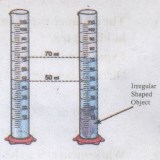
(i) Take a graduated measuring cylinder and a stone.
(ii) Fill with water to certain level and mark it.
(iii) Tie the stone with a piece of fine thread.
(iv) Immerse the stone completely in to the water.
(v) We can observe the water level and mark it.
(vi) The water level is increased.
(vii) Find the increased level of water.
(vii) It would be equal to the space taken by stone.
(viii) This will be the volume of irregular stone.
44.
Distance travelled (d) = 400 km
Time taken (t) = 5 hour
Average Speed (s) = \(\frac{d}{t}=\frac{400}{5}=80\)
Average Speed = 80 kmph (or) Km/hr.
45.
To protect from the skin dry due to over heat.
46.
Fire extinguishers throw a stream of carbon-, di-oxide while putting - off fire. Carbon-di-oxide covers the fire and cut-off the supply of fresh air to the burning things and stop burning.
47.
a) melting of wax and
d) Solidification of the molten wax can be reversed.
Burning of candle is a physical / reversible change. That is,
\(\text { Solid wax } \underset{\text { Cooling }}{\stackrel{\text { Heating }}{\rightleftarrows}} \text { molten wax }\)
48.
(i) Yes, the bulb will glow.
(ii) A piece of zinc metal (such as a galvanized nail) and a piece of copper are inserted into a lemon and connected by LED bulb.
(iii) The zinc and copper are electrds and the juice (acetic acid) is a electrolyte.
(iv) Power generated by reaction of the metals in acetic acid.
49.
We feel hot because the heat is transferred from atmosphere to your body. Heat energy flows from higher temperature to lower temperature.
50.
(i) Using beakers, the mustard oil is separated by the process of decantation, because oil being lighter than water, floats on water.
(ii) Next filtration is using a funnel and filter paper and thus water gets separated from chalk powder and coins.
(iii) By hand-picking method, the coins are separated frorn chalk powder.
51.
(i) Bone provide a frame work for the body.
(ii) Bones along with muscles help in movements such as walking, running chewing and dancing, etc.,
52.
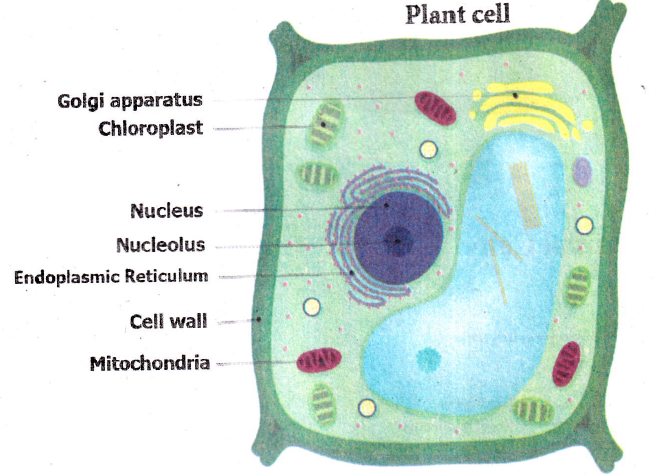
53.
During monsoon, the biscuits placed in open lose its crispness. Sugar in biscuits takes up water from the atmosphere and become so soft.
54.
No. Deforestation can be an undesirable change. That is, Deforestation is harmful to our environment and not desired by us.
55.
No the cell used in the clock cannot give us an electric shock because the voltage is very low in the cell.
56.
| HEAT | TEMPERATURE |
| i) Heat is an energy | The measurement of warmness or coldness of a substance |
| ii) Heat not only depends on the temperature of the substance but also depends on how many molecules are there in the object | Temperature is related to how fast the atoms or molecules move or vibrate within the substance. |
| iii) Heat measures the total kinetic energy of molecules | Temperature measures the average kinetic energy of molecules |
| iv) SI unit of heat is Joule | SI unit of temperature is kelvin |
57.
Adaptive features of polar Bear : Thick skin for protection, White fur.
Adaptive features of Penguin : Paddle to swim, walk with two legs.
58.
59.
| Terrestrial plant | Aquatic plant |
| (i) Terrestrial habitats are the ones that are found on land like forest, grassland and desert. | (i) Aquatic habitat includes area that are permanently covered by water and surrounding areas that are occationally covered by water. |
| (ii) They are classified into three types. 1. Desert habitat 2. Grassland habitat 3. Forest habitat |
(ii) They are two types 1. Fresh water habitat 2. Marine water habitat |
60.
Switch, Bulb and Battery are the parts of the electric circuit. Generator is the source of electricity.
61.
Arteries, Veins and capillaries are the blood vessels.
62.
The entry of food into the wind pipe is prevented by a flap like structure called epiglottis.
63.
Cytoplasm is called as "Area of movement"
64.
Cell wall and chloroplast found only in plant cell
65.
Robert hook discovered the cell in 1665.
66.
The roots of a plant take up air from the spaces between the soil particles.
67.
If we remove plants from the aquarium
(i) All types of wastes created by aquatic animals, excess food and decaying materials level will increase in water.
(ii) The dissolved oxygen level in water will decrease.
(iii) Algae will grow due to excess nutrients and light in aquariums.
(iv) Some types of fish even breed and lay eggs on the leaves of ths plants. This will affect.
68.
When solute is dissolved in a solvent it forms a solution.
Solute + Solvent ⟶ Solution
69.
Changes which take place over a long period of time are known as Slow changes.
70.
Plants decaying is a chemical change.
71.
The Iron chain is the conductor from the above figures.

72.
(i) The measurement of warmness or coldness of a substance is known as its Temperature.
(ii) SI unit of temperature is kelvin
73.
The tail of the bird helps to change the direction of the movements.
74.
The settling down of heavier component of a mixture when allowed to remain undisturbed for some time is called sedimentation.
75.
We have to separate mixture,
(i) to remoe impurities
(ii) to separate useful components
(iii) to get a highty pure form substance
76.
The green leaves prepare food by the.process of photosynthesis.
77.
Based on habitat, plant are classified as
i) aquatic plants
ii) terrestrial plants.
78.
(i) Data is the information that has to be processed.
(ii) They are in the form of numbers, alphabets and images.
79.
A computer is an electronic device that process the data and information according to our needs.
80.
i) Common cold
ii) Influenza
81.
(a) Food items rich in fat - Ex: Butter, Ghee.
(b) vitamin deficiency diseases - Ex: Night blindness, Beri-beri
82.
1 millimetre < 1 centimetre < 1 Metre < 1 kilometre.

6th Standard Syllabus & Materials
6th Standard
TN 6th Social Science T3 - GEO - Understanding Disaster Sample Question Papers Study Material - QB365 Set A
NEW6th Standard
TN 6th Social Science T3 - GEO - Globe Sample Question Papers Study Material - QB365 Set A
NEW6th Standard
TN 6th Social Science T3 - GEO - Asia and Europe Sample Question Papers Study Material - QB365 Set A
NEW6th Standard
TN 6th Social Science T3 - HIS - South Indian Kingdoms Sample Question Papers Study Material - QB365 Set A



Tamilnadu Stateboard 6th Standard Subjects
Tamilnadu Stateboard Standards




