
 100% FREE ACCESS
6th Standard Syllabus & Materials
6th Standard
TN 6th Tamil பருவம் 1 - இயல் 1 - மொழி -தமிழ்த்தேன் - இன்பத்தமிழ் Sample Question Papers Study Material - QB365 Set A
NEW6th Standard
TN 6th English T1 - Supplementary - The Apple Tree and The Farmer Sample Question Papers Study Material - QB365 Set A
NEW6th Standard
TN 6th English T1 - Prose - When The Trees Walked Sample Question Papers Study Material - QB365 Set A
NEW6th Standard
TN 6th Social Science T3 - CIV - Road Safety Sample Question Papers Study Material - QB365 Set A
NEW6th Standard
TN 6th Social Science T3 - CIV - Local Bodies - Rural and Urban Sample Question Papers Study Material - QB365 Set A
NEW6th Standard
TN 6th Social Science T3 - CIV - Democracy Sample Question Papers Study Material - QB365 Set A

Published on: 28/12/2018
3rd Term FA(B) Model Test
Download Tamil Nadu 6th Standard Social Science question papers, model tests, one-mark questions, important questions, and public exam papers in PDF format. Free study materials and answer keys for TN State Board students.
Questions + Answers key
Take MCQ Social Science Test
1.
The total number of lines of latitude are
171
161
181
191
2.
Which of the following lines of longitude is considered for the Indian Standard Time?
82½° E
82½° W
81½° E
81½° W
3.
Who among the following built the VaikundaPerumal temple?
Narasimhavarma II
Nandivarma II
Dantivarman
Parameshvaravarma
4.
a) Bana - 1. 10,000 students
b) Harsha - 2. Prayag
c) Nalanda University - 3. Harshacharita
d) Hiuen -Tsang - 4. Ratnavali
e) Buddhist Assembly - 5. Si-Yu-Ki
4, 3, 2, 1, 5
5, 2, 1, 3, 4
3, 5, 1, 2, 4
2, 1, 3, 4, 5
5.
The head of a corporation is called a_______-
Mayor
Commissioner
Chair Person
President
6.
Prayog Prashasti was composed by __________
Kalidasa
Amarasimha
Harisena
Dhanvantri
7.
_________ was the founder of Satavahana dynasty.
Simuka
Satakarani
Kanha
Sivasvati
8.
The lowest unit of administration during the Sangam Age was______________
Mandalam
Nadu
Ur
Pattinam
9.
The rule of Pandyas was followed by _______
Satavahanas
Cholas
Kalabhras
Pallavas
10.
The river _________ passes through nine countries of Europe
11.
The Prime Meridian is also called ______________
12.
The music inscriptions in ____________and ____________show Pallavas interest in music.
13.
__________, the Pallava king was defeated by Samudragupta.
14.
____________ built Kallanai across the river Kaveri.
15.
The Virupaksha temple was built on the model of Kanchi Kailasanatha Temple.
16.
Thevaram was composed by Azhwars.
17.
Harsha was noted for his religious intolerance.
18.
Buddhacharita was written by Asvaghosha.
19.
Puhar was the general term for city.
20.
What are the significant lines of latitude? Explain the zones found between them.
21.
Give an account on Western Chalukyas of Kalyani.
22.
What did Indian scientists achieve in astronomy and mathematics during the Gupta period?
23.
Give an account of Samudragupta’s military conquests.
24.
Find out the number of local bodies in your district and list them.
25.
Discuss; If there is a contribution to the improvement of your school by local body representatives
26.
Local bodies play an important role in the development of villages and cities. How?
27.
The importance of Gandhara School of Art.
28.
Give an account of the conquests of Pushyamitra Sunga.
29.
Find out your area's representative’s names and write down
a. MP b. MLA 3. Local body member
30.
Karikal Valavan is regarded as the greatest Chola king. Justify.
31.
Mark the following in the outline map of Asia and Europe
Asia: Ural mountain, Himalayas, Pamir knot, Gobi Desert, Arabian Peninsula, Deccan plateau, River Yangtze, River Ob, Aral Sea and Lake Baykal.
Europe: The Pyrenees, Black forest, Apennines, Hungarian Plain, Caucasus Mountain, River Volga, River Danube, Strait of Gibraltar, Lake Ladoga, North Sea
32.
Mark the following places.
a. Korkai b. Kaveripoompattinam c. Musiri d. Uraiyur e. Madurai
33.
Asia is called the ‘Land of Contrasts’- Justify.
34.
How many times would the sun pass overhead a line of longitude?
35.
What is a geoid?
36.
Chennai, Cuddalore and Cauvery delta are frequently affected by floods. Give reason.
37.
Define Disaster
38.
Identify the following signs
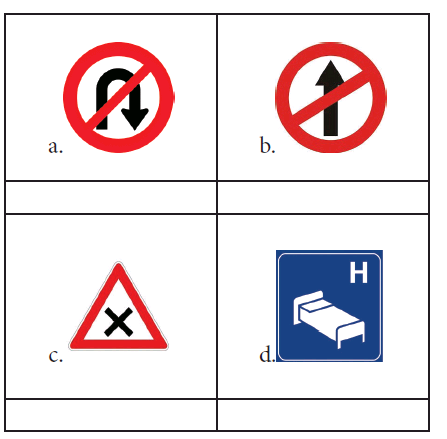
39.
What are the special features of Panchayat Raj system?
40.
List out a few functions of corporations
41.
Define: Direct Democracy
42.
What are the types of democracy?
43.
Bull Fighting
44.
180° line of longitude
45.
0° line of longitude
46.
Rashtrakutas
47.
Pallavas
48.
The North western highlands and the Alpine mountain range.
1.
(c)
181
2.
(a)
82½° E
3.
(b)
Nandivarma II
4.
(c)
3, 5, 1, 2, 4
5.
(a)
Mayor
6.
(c)
Harisena
7.
(b)
Satakarani
8.
(c)
Ur
9.
(c)
Kalabhras
10.
()
Danube
11.
()
Greenwich Meridian
12.
()
Kudumianmalai and Thirumayam temple
13.
()
Vishnu goba
14.
()
Karikalan
15.
(a)
16.
(b)
17.
(a)
18.
(a)
19.
(b)
20.
Important lines of latitude:
1. North pole 90o N.
2. Tropic of Capricorn 231/2o S.
3. Arctic Circle 661/2o N.
4. Antartic Circle 661/2o S.
5. Tropic of Cancer 231/2o N.
6. South Pole 90o S.
7. Equator 0o.
Zones of the Earth:
Torrid zone:
(i) It lies 0o to 231/2o North and South latitude.
(ii) The Sun's rays fall vertically over this region and the average temperature is very high.
Temperate zone:
(i) It lies 231/2o N to 661/2o North and South latitude.
(ii) The Sun's rays fall slantingly. Moderate temperature prevails in this region.
Frigid zone:
(i) It lies 661/2o N to 90o North and South latitude.
(ii) The Sun's rays fall further inclined, throughout the year. The temperature is very low.
21.
(i) The Western Chalukya empire ruled most of the western deccan, South India, between the 10th and 12th Centuries.
(ii) They were the descendants of Badami chalukyas ruled from kalyani (modern day Basavakalyan)
(iii) In 1973, Tariapa - II, a feudatory of the Rashtrakuta ruling from Bijapur region defeated Parmara of Malwa.
(iv) Tailapa - II occupied Kalyani his fimasty quickly grew into an empire under Someswara - I.
(v) Someswara - I moved the capital from Manyakheta to Kalyani.
(vi) For over a century, the western chalukyas and the chola dynasty of Thanjavur, fought many fierce battles to control the fertile region of vengi.
(vii) During the rule of Vikramaditya VI in the late 1le century vast areas between the Narmada River in the north and Kaveri River in the south came under Chalukyas control.
(viii) The Kasi Visweshvara Temple at Lakkundi, the Mallikarjuna temple at Kuruvatti, the Kalleshwara temple at Bagali and the Mahadeva Temple at Itagi represeni well known examples of the architecture of western Chaitrkyas of Kalyani.
22.
(i) Invention of zero and the consequent evolution of the decimal system were the legacy of Guptas to the modem world.
(ii) Aryabhatta, Varahamihira and Brahmagupta were. foremost astronomers and mathematicians of the time.
(iii) Aryabhatta, in his book Surya Siddhanta, explained the true causes of solar and lunar eclipses.
(iv) He was the first Indian astronomer to declare that the earth revolves around its own axis.
(v) Dhanvantriwas a famous scholar in the field of medicine. He was a specialist in Ayurveda. Charaka was a medical scientist. Susruta was the first Indian to explain the process of surgery.
23.
(i) When Samaudragupta become emperor, he carried on a Vigorous Compaign all over the Country.
(ii) In the Southern Pallava Kingdom, the king who was defeated by Samudragupta was Vishnugopa.
(iii) He conquered nine Kingdom's in northern India.
(iv) He reduced 12 rulers of the southern India forced them to pay tribute.
(v) He also received homage from the rulers of East Bengal, Assam, Nepal, the eastern part of Punjab and Various tribes of Rajasthan.
24.
| Name of the District | Village Panchayat | Panchyat Union | District Panchayat | Town Panchayat | Municipality | Corporation |
| Kanchipuram | 648 | 13 | 0 | 24 | 10 | 0 |
25.
26.
Local bodies play an important role in the development of villages and cities, because there are many services provided by local bodies to the people like drinking water supply, street lighting, Drainage and sewage pipe system, Laying down roads and maintenance, laying public parks, libraries, play grounds, etc. The main work of local bodies is activation of central and state government schemes to the common people.
27.
(i) The Gandhara School of Art flourished during his time.
(ii) The most favourite subject of the Gandhara artists was the carving of sculptures of Buddha.
(iii) Both Sakas and Kushanas were patrons of Gandhara School.
(iv) The art of the Gandhara School was primarily Mahayana.
(v) The Mahayana Buddhist learnt the art of the carving out caves from the Greeks and become skilled in rock cut architecture.
28.
(i) Pushyamitra's kingdom extended westward to include Ujjain and Vidisha.
(ii) He Successfully repulsed the invasion of Bactria king, Menander.
(iii) Pushyamitra thwarted an attack from the Kalinga King Kharavela.
(iv) He also conquered Vidarba.
29.
30.
(i) Karikalvalavan or Karikalan was the most famous of the chola kings.
(ii) He defeated the combined army of the cheras, Pandyas and the eleven velir chieftains who supported them at Venni, a small village in the Thanjavur region.
(iii) He converted forests into cultivable lands. He built kallanai across the river Kaveri to develop agriculture.
(iv) Their port puhar attracted merchants from various regions of the Indian Ocean.
(v) The Pattinapaalai, a poetic work in the Pathinenkeezhkanakku, gives elaborate information of the trading activity during the rule of karikalan.
31.
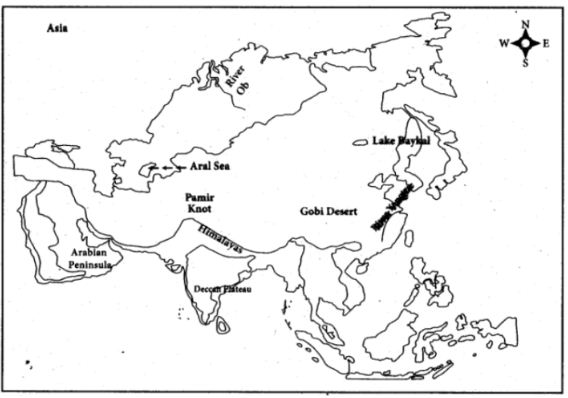
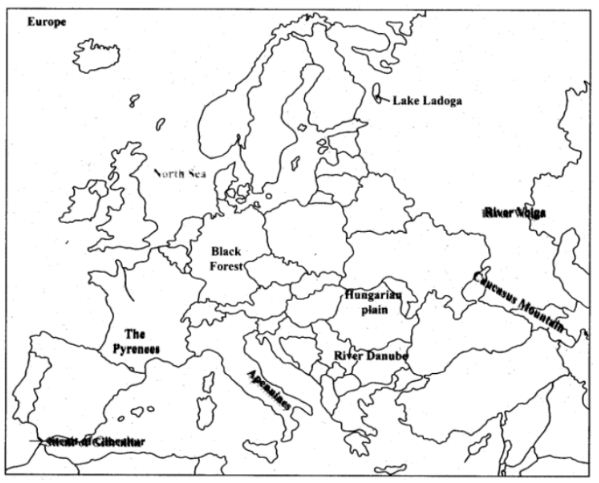
32.
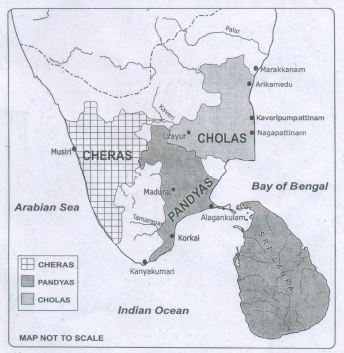
33.
(i) Asia is the biggest continent.
(ii) It has different types of land features such as mountain, plateau, plain, valley, bay, island etc.
(iii) It also has different climatic conditions from the equator to polar region.
(iv) Many races, languages, religions and cultures are followed by people who live in Asia.
(v) So, Asia is called 'the land of contrasts'.
34.
The Sun is overhead on a line of longitude only once in a day.
35.
(i) The Earth which is spherical, is flat at the poles and bulges at the Equator.
(ii) The Earth cannot be compared with any other geometrical shape as it has a very unique shape.
(iii) Hence, its shape is called a geoid.
36.
(i) Due to heavy rainfall from North east Monsoon.
(ii) Inefficient engineering design in the construction of embankments, dams, and canals
(iii) Did not follow some important safety precautions.
37.
A disaster is a serious disruption of the functioning of a society involving human and material loss.
38.

39.
(i) Grama Sabha
(ii) Three tier local body governance
(iii) Reservations
(iv) Panchayat Elections
(v) Tenure
(vi) Finance Commission
(v) Account and Audit, etc
40.
(i) Drinking water supply
(ii) Street Lighting
(iii) Maintenance of Clean Environment
(iv) Primary Health Facilities
(v) Laying of Roads
(vi) Building flyovers
(vii) Space for markets
41.
(i) When the people themselves directly express their will on public affairs the type of government is called pure or direct democracy.
(ii) Ex: Switzerland.
42.
Direct democracy and Representative democracy are the types of democracy.
43.
Spain south east
44.
International Date Line
45.
Greenwich
46.
Manyakheta
47.
Kanchi
48.
| S.No | The North western highlands | The Alpine mountain range |
| 1. | Region includes the mountains and plateaus of Norway, Sweden, Finland, Scotland and Iceland. | The alpine mountain system consists of a chain of young fold mountains found in the southern part.of Europe. |
| 2. | This region has the most beautiful fjord coast. | Eg: It lies Sierra Wevada, Pyrenees, Kaskasas are important mountains. |

6th Standard Syllabus & Materials
6th Standard
TN 6th Social Science T3 - GEO - Understanding Disaster Sample Question Papers Study Material - QB365 Set A
NEW6th Standard
TN 6th Social Science T3 - GEO - Globe Sample Question Papers Study Material - QB365 Set A
NEW6th Standard
TN 6th Social Science T3 - GEO - Asia and Europe Sample Question Papers Study Material - QB365 Set A
NEW6th Standard
TN 6th Social Science T3 - HIS - South Indian Kingdoms Sample Question Papers Study Material - QB365 Set A



Tamilnadu Stateboard 6th Standard Subjects
Tamilnadu Stateboard Standards



