
 100% FREE ACCESS
6th Standard Syllabus & Materials
6th Standard
TN 6th Tamil பருவம் 1 - இயல் 1 - மொழி -தமிழ்த்தேன் - இன்பத்தமிழ் Sample Question Papers Study Material - QB365 Set A
NEW6th Standard
TN 6th English T1 - Supplementary - The Apple Tree and The Farmer Sample Question Papers Study Material - QB365 Set A
NEW6th Standard
TN 6th English T1 - Prose - When The Trees Walked Sample Question Papers Study Material - QB365 Set A
NEW6th Standard
TN 6th Social Science T3 - CIV - Road Safety Sample Question Papers Study Material - QB365 Set A
NEW6th Standard
TN 6th Social Science T3 - CIV - Local Bodies - Rural and Urban Sample Question Papers Study Material - QB365 Set A
NEW6th Standard
TN 6th Social Science T3 - CIV - Democracy Sample Question Papers Study Material - QB365 Set A

Published on: 29/02/2020
6th Standard Social Science Book Back and Creative Important questions All Chapter 2019-2020
Download Tamil Nadu 6th Standard Social Science question papers, model tests, one-mark questions, important questions, and public exam papers in PDF format. Free study materials and answer keys for TN State Board students.
Questions + Answers key
Take MCQ Social Science Test
1.
_________became republics or smaller kingdoms.
northern India
Kalinga
Janapadas
Magadha
2.
The intellectual and spiritual development in India, historian Will Durant has rightly called it_________
the shower of stars
to sacrificial rit
Tirthankara
3.
A________ is the one who revealed religious truth at different times
the shower of stars
to sacrificial rites
Tirthankaras
4.
Agroup of villages was called______
Gramani
Viz
Grama
5.
Aryans of the Rig Vedic Period were________
nomadic
semi-nomadic
developed
6.
People then move to a new piece of land for________
cultivation
industrial
manufactures
7.
Chandra Gupta Maurya abdicated the thrown and went to Sravanbelgola along with Jaina Saint ___________
Badrabahu
Stulabahu
Parswanatha
Rushabhanatha
8.
The Kingdom which was most powerful among the four Mahajanapadas
Anga
Magadha
Kosala
Vajji
9.
How many Tirthankaras were there in Jainism?
23
24
25
26
10.
Aryans came from ______________.
China
North Asia
Central Asia
Europe
11.
Aryans first settled in ___________ region.
Punjab
Middle Gangetic
Kashmir
North east
12.
The eleventh President of India was
Narasimha Rao
Man Mohan Singh
Dr. APJ Abdul Kalam
Lal Bahadur Sastri
13.
'Roof of the world'denotes to
Tibetan Plateau
Chhotanagpur Plateau
Deccan Plateau
Malwa Plateau
14.
Andes mountain is located in
North America
South America
Asia
Europe
15.
The second largest planet in the solar system is______________
Mars
Star
Earth
Saturn
16.
The outer planets are_______
Jupiter and Mercury
Venus and Earth
Saturn and Mars
Uranus and Neptune
17.
___________is self luminous and gives light on its own
sun
Moon
Star
Earth
18.
Pearls were found in abundance in
Chozha Nadu
Pandya Nadu
Thondai Nadu
Chera Nadu
19.
Thoonga Nagaram refers to
Kanchi
Poompuhar
Madurai
Korkai
20.
Name the place related to the export of Sandal.
Western Ghats
Southern Sea
Eastern Sea
Elam
21.
Who was the first ruler to give up war after victory
Bimbisar
Raja Raja Chola
Akbar
Ashoka
22.
Where did early man live?
mud house
under tree
caves
river banks
23.
Indus valley civilization is great, because
It had advanced sanitation and drainage system
Repeated floods affected this area
Indus people maintained a big army
They did not use iron
24.
These people had a big toe to hold tightly and less protruding face
Homo erectus
Homo habilis
Neanderthal
Homo sapiens
25.
As per the 2011 Census the highest literate district in Tamil Nadu
Namakkal
Salem
Kanyakumari
Sivagangai
26.
B.R. Ambedkar was conferred Bharat Ratna in the year
1990
1989
1988
1987
27.
Which one of the following is not the reason for Prejudice?
Socialization
Economic Benefits
Authoritarian personality
Geography
28.
V.A. Smith called India as _________________
Great Democracy
Unique land of diversities
Ethnological museum
Secular nation
29.
Onam festival celebrated in
Kerala
Tamil Nadu
Punjab
Karnataka
30.
Recognised official languages of India, as per VIIIth Schedule of Indian Constitution
25
23
22
26
31.
The frozen continent is
North America
Australia
Antarctica
Asia
32.
The movement of the Earth on its axis is called
Revolution
Seasons
Rotation
Circulation
33.
Which city is not related to the Bay of Bengal?
Poompuhar
Madurai
Korkai
Kancheepuram
34.
Which of the following region has a city more than 6500 years old?
Iraq
Indus Valley
Tamilagam
Thondaimandalam
35.
Indus Civilisation belonged to
Old Stone age
Medieval stone age
New stone age
Metal age
36.
Tanzania is situated in the continent of
Asia
Africa
America
Europe
37.
The process of evolution is _____________ .
direct
indirect
gradual
fast
38.
What was the step taken by the early man to collect his food?
Trade
Hunting
Painting
Rearing of animals
39.
What are the classification of natural resources ?
40.
Give an example for the human resources?
41.
Which resources must be reduced while using?
42.
Place the following words in the appropriate column.
Words: Jina, Mahayana, Tirthankaras, Stupas Nirvana, Digambara, Tripitakas, Agama
| Jainism | Buddhism |
43.
Given an account on the economic life of the Aryans.
44.
How did the barter system prevalent?
45.
What did the Aryans do after settling?
46.
What is sustainable development?
47.
Human resources.
48.
When you travel from Japan to California, which ocean would you travel across?
49.
Complete the given table with the help of an atlas. Follow the example.
| S.No | Name of the ocean | Area (million sq.km) | Trenches | Depth (m) |
| 1. | Pacific Ocean | 168.72 | Mariana | 10,994 |
| 2. | Atlantic Ocean | |||
| 3. | Indian Ocean | |||
| 4. | Southern Ocean | |||
| 5. | Arctic Ocean |
50.
What are the articles that are discussing the equality in the Indian Constitution?
51.
What is a continent?
52.
Why is India called the land of unity in diversity?
53.
Which is known as city of lakes? Why?
54.
Mention the other names of Madurai.
55.
Discuss the sources available to know about Tamil cities.
56.
Can you point out the special features of their drainage system?
57.
Why Indus Civilisation is called Bronze Age civilisation?
58.
Describe the ancient methods of hunting?
59.
Why were paintings drawn on rocks?
60.
What are the sources available to know about the pre-historic period?
61.
Mark the following in the outline map of India.
1. Neyveli
2. Bay of Bengal
3. Arabian Sea
4. Forest region of Tamil Nadu
5. Indian Ocean
6. Iron mining in Kanjamalai(Salem)
62.
Map reading (with the help of atlas )
a. A sea in the east of India
b. Continents in the west of Atlantic Ocean
c. Continents in the south of Arctic Ocean
d. A strait between India and Sri Lanka
e. Oceans which surround Australia
f. Find out the Isthumusses
(Create more questions)
63.
Mark the following places in the political map of India.
a. Delhi
b. Chennai
c. Tamil Nadu
d. Andhra Pradesh
e. Kerala
f. Karnataka
64.
Write about the resources?
65.
Explain the primary, secondary and tertiary activities.
66.
Write the Gandhian thought on conservation of resources.
67.
Write any five welfare measures you would do if you were a king like Ashoka?
68.
What did Ashoka do to spread Buddhism? (Write any three points).
69.
Karma – a person’s action. Name any 10 good actions (deeds).
70.
Write any three differences between Hinayana and Mahayana sects of Buddhism?
71.
Write about the Vedic women in a pragraph.
72.
December 11 International Mountain Day.
73.
Look at the picture and answer the questions given below.
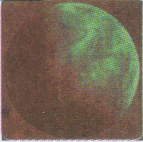
a) Identify the planet
b) What is the colour of the planet?
c) Why is it of this colour?
74.
Observe the following features of Indus Civilisation and compare that with the present day.
a. Lamp post
b. Burnt bricks
c. Underground drainage system
d. Weights and measurement
e. Dockyard
75.
What are the causes of Prejudice?
76.
Various discrimination in India. Discuss.
77.
List out the various festivals celebrated in different states.
78.
City of temples. Give short notes.
79.
Importance of invention of wheel from the ancient period to the modern period.
80.
How were dogs useful to pre historic men?
81.
Explain Linguistic diversity and cultural diversity.
82.
Write down the importance of oceans.
83.
What are the effects of rotation and revolution?
84.
| Poompuhar was located on which river bank? | Name the ancient city which had Tamil Sangam | Name a Sangam literary work |
| Which Greek historian gave accounts about the Pandya kingdom? | To which Tamil kingdom did the southern districts of Tamil Nadu belong to during the Sangam Age? | Name the Chinese traveler who stayed and studied in Nalanda University. |
| Thirunavukarasar mentioned Kanchi as | What is the name of evening market during the Sangam Age? | Name the temple built by Pallava king Rajasimha at Kanchi. |
| Which district is known as the district of lakes? | What is trade? | Name a port located on the shore of Bay of Bengal. |
1.
(c)
Janapadas
2.
(a)
the shower of stars
3.
(c)
Tirthankaras
4.
(b)
Viz
5.
(b)
semi-nomadic
6.
(a)
cultivation
7.
(a)
Badrabahu
8.
(b)
Magadha
9.
(b)
24
10.
(c)
Central Asia
11.
(a)
Punjab
12.
(c)
Dr. APJ Abdul Kalam
13.
(a)
Tibetan Plateau
14.
(b)
South America
15.
(d)
Saturn
16.
(d)
Uranus and Neptune
17.
(a)
sun
18.
(b)
Pandya Nadu
19.
(c)
Madurai
20.
(a)
Western Ghats
21.
(d)
Ashoka
22.
(c)
caves
23.
(a)
It had advanced sanitation and drainage system
24.
(b)
Homo habilis
25.
(c)
Kanyakumari
26.
(a)
1990
27.
(d)
Geography
28.
(c)
Ethnological museum
29.
(a)
Kerala
30.
(c)
22
31.
(c)
Antarctica
32.
(c)
Rotation
33.
(b)
Madurai
34.
(b)
Indus Valley
35.
(d)
Metal age
36.
(b)
Africa
37.
(c)
gradual
38.
(b)
Hunting
39.
Natural resources can be classified into differentgroups depending on origin, development, renewability, distribution, ownership etc.
40.
People are also referred to as resources
41.
The receding of coal and petrol was in need of an inexhaustible resource (time).
42.
| Jainism | Buddhism |
| Jina, Tirthankaras, Digambara,Agama | Mahayana, Stupas Nirvana,Tripitakas, |
43.
(i) Use of iron plough and axe helped to put more areas of land under cultivation.
(ii) Crops of wheat, rice and barley were cultivated.
(iii) With the growth of agriculture, the idea of private possession of land came into existence.
(iv) New crafts and arts developed leading to production of commodities for sale
44.
(i) Barter system was prevalent (exchange of goods).
(ii) They used Nishka, Satmana (gold coins) and Krishnala (silver coins) for business transactions.
45.
When Aryans permanently settled in Sindh and the Punjab regions they began to practise agriculture.
46.
The present needs of resources are met and the conserving of resources for the future are balanced, we call it sustainable development.
47.
Human resources are groups of individuals who use nature to create more resources.
48.
Pacific Ocean.
49.
| S.No | Name of the ocean | Area (million sq.km) | Trenches | Depth (m) |
| 1. | Pacific Ocean | 168.72 | Mariana | 10,994 |
| 2. | Atlantic Ocean | 85.13 | Milwaukee Deep | 8,380 |
| 3. | Indian Ocean | 70.56 | Java Trench | 7,725 |
| 4. | Southern Ocean | 21.96 | Sandwich Trench | 7,235 |
| 5. | Arctic Ocean | 15.56 | Eurasian Basin | 5,449 |
50.
(1) Article 14 of the Indian constitution provides equality before the law or equal protection within the territory of India.
(2) Article 15(1) of the Constitution states that the State shall not to discriminate against any citizen on grounds only of religion, race, caste, sex, place of birth or any of them.
(3) Article 17(1) of the Indian constitution, untouchability is totally abolished.
51.
The vast land masses on Earth are called Continents.
52.
The feeling of oneness and unity among the people of various religions, castes of a country is called unity in diversity
53.
(i) The city of lakes is known as Kancheepuram.
(ii) Hundreds of lakes were created for storing water around the town of Kanchi.
(iii) Hence, Kanchi came to be known as the district of lakes.
54.
(i) Sangam Valartha Nagaram
(ii) Thoonga Nagaram (the city that never sleeps).
(iii) Koodal nagar are the other names of Madurai.
55.
(i) Tamil Literature
(ii) Accounts of foreign travellers
(iii) Archaeological finds provide us information about the ancient town of Tamilagam.
56.
(i) They had well covered drains.The drains were covered with slabs or bricks.
(ii) Each drain had a gentle slope so that water could flow.
(iii) Manholes were provided at regular intervals to clear the drains.
(iv) House drains passed below many lanes before finally emptying into the main : drains.
(v) Every house had its own soak pit, which collected all the sediments and allowed only the water to flow into the street drain.
57.
Indus, civilisation is called Bronze Age civilisation because it is a historical period characterised by the use of articles made of bronze.
58.
(i) Go as a group and hunt the prey.
(ii) Dig a pit and trap the animals and hunt.
59.
(i) Some would have stayed back, without joining the hunting team.
(ii) So for their benefit, these pictures could have been drawn.
(iii) They might have done it as a part of their passtime.
60.
(i) Stone tools.
(ii) Excavated materials.
(iii) Rock paintings are the major sources of pre-history
61.
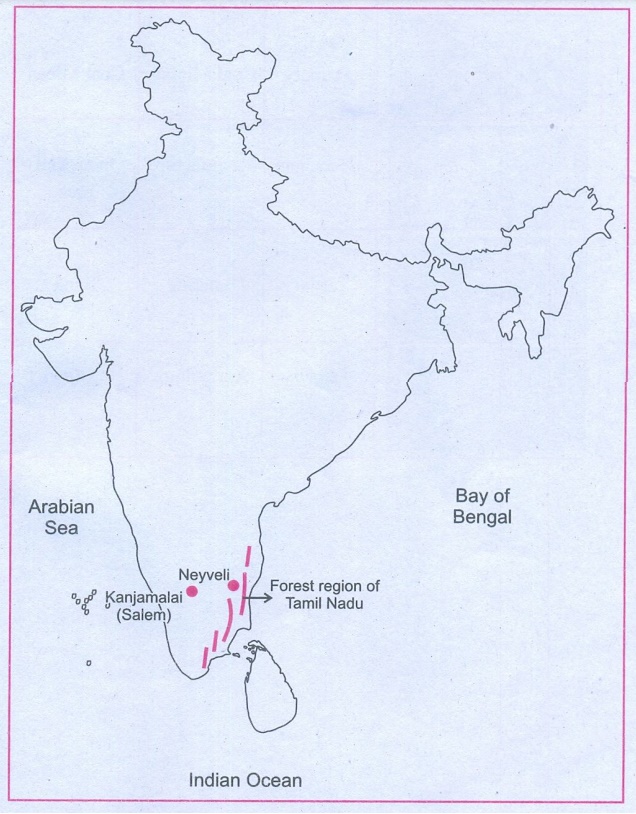
62.
a. Bay of Bangal
b. North America and South America
c. Almost completely surrounded by Eurasia and North America.
d. Palk Strait.
e. Indian Ocean to the west, the South Pacific Ocean to the East and the Southern
Ocean to the South.
f. Isthumusses -ANarrow piece ofland connecting two larger areas across an expanse of water. Isthumus of Panama - Central America.
63.
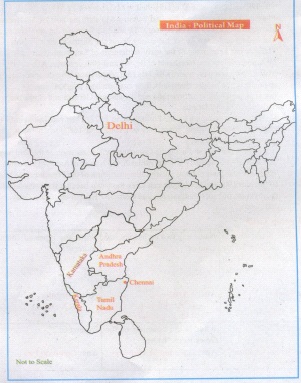
64.
Resource is anything that fulfills human needs.
(i) When anything is of some use it becomes valuable.
(ii) All resources have value.
(iii) The value can be either commercial or non-commercial. Commercial resources have great economic value. (e.g.) Petroleum.
(iv) The Non-commercial resources are very abundant in availability (e.g.) Air.
65.
Primary Activities:
Collection of resources directly from nature is called primary activities.
(e.g) sun, air
Secondary activities:
The raw materials obtained from the primary activities are converted into finished products through machinery on a large scale. These activities are called secondary activities.
(e.g) Bridges, Houses, Roads
Tertiary Activities:
Tertiary activities are basically concerned with the distribution of primary and secondary products through a system of transport and trade.
(e.g) Banking, Trade and Communications.
66.
Mahatma Gandhi blamed "human beings" for depletion of resources because of
(i) Over exploitation of resources
(ii) Unlimited needs of human beings. So, conservation is very important
67.
If I were a King like Ashoka; I will implement some schemes.
Education:
To provide quality and equal free education to all from primary to higher studies.
Medical Aid:
To provide quality and free medical aid to all.
Health:
To provide basic needs like food, shelter, dress to all.
Economics:
To develop the economic status of our country giving importance to agricultural activities.
Employment:
To create employment opportunities for growing population from long term schemes.
Information technology:
Due to up coming technologies in the world I will implement new schemes to modernise the
68.
(i) Ashoka sent his son Mahinda and Sanghamitra to Srilanka to propagate Buddhism.
(ii) He also sent missionaries to West Asia, Egypt and Eastern Europe to spread the message of Dhamma.
(iii) The Dhamma - mahamattas were a new cadre of officials created by Ashoka.
(iv) Their job was to spread dhamma all over the empire.
(v) Ashoka held the third Buddhist Council at his capital Pataliputra.
69.
(i) Not to kill any living things.
(ii) Not to steal in any situation;
(iii) No sexual miscontacts.
(iv) Right speech and thoughts.
(v) Right livelyhood.
(vi) No greed.
(vii) No Anger.
(viii) Good View.
(ix) Right efforts.
(x) Right knowledge.
70.
| S.No | HINAYANA | MAHAYANA |
| 1. | Did not worship idols or images of Buddha. | Worshiped images of Buddha. |
| 2. | Practiced austerity | Observed elaborate rituals. |
| 3. | Believed that salvation of the individual as its goal. | Believed that salvation of all beings as its |
| 4. | Used Prakrit language. | Used Sanskrit language. |
| 5. | Confined to India. | Spread to Central Asia, Ceylon, Burma, Nepal, Tibet China, Japan, where middle path was accepted. |
71.
Status of women in Rig Vedic Period:
(i) In Rig Vedic society, women relatively enjoyed some freedom.
(ii) The wife was respected as the mistress of the household.
(iii) She could perform rituals in her house.
(iv) Child marriage and sati were unknown.
(v) There was no bar on the remarriage of widows.
(vi) Nevertheless, the women were denied right.to inherit property from their parents.
(vii) They played no role in public affairs.
Later Vedic period:
(i) In the later Vedic period the role of women in society, as well as their status, even within the family, declined.
(ii) Women could no longer perform rituals in the family.
(iii) The rules of marriage became much more rigid.
(iv) Polygamy became common.
(v) Widow remarriage was not encouraged.
(vi) Education was denied to women.
(vii) lntercaste marriages were spurned.
72.
Prepare slogans, posters and placards to celebrate International Mountain Day.
(i) "Mountains are among the most beautiful land masses in the world."
(ii) "Mountains are beautiful as they rise up above the clouds and show just how grand the world can be."
(iii) "Great things are done when men and mountains meet."
(iv) "How glorious a greeting the Sun gives the mountains."
(v) "Mountains are earth's undecaying monuments."
(vi) "The mountains, forests and seas render men savage, they develop fierce, but yet do not destroy the human. "
(vii) "Men stumble over pebbles, never over mountains."
(viii) "Each fresh peak ascended teaches something."
(ix) "Mountains are the beginning and end of all natural scenery."
(x) "He who climbs upon the highest mountains laughs at all tragedies, real or imaginary.
73.
a) Uranus
b) Green
c) Due to the presence of methane
74.
(a) Lamp post
(i) Each house and street had a lamp post in Indus civilisation.
(ii) Now a days there is no electric lamp post in deep rural area.
(b) Burnt bricks
(i) The houses were built using baked bricks and mortar.
(ii) Present days we built varity of houses like concrete house, thatch house, etc....
(c) Underground drainage system
(i) Many of these cities in Indus has covered drains. The drains were covered with slabs or bricks.
(ii) Now a days underground drainage system is functioning only major cities.
(d) Weights and measurement
(i) Indus people had developed a systern of standardised weights and measures.
(ii) Present day we used electronic weighing machine also.
(e) Dockyard
(i) A naval dockyard has been discovered in Lothal in Gujarath. It shows the manitime activities of the Indus people.
(ii) Now a days there are so many seaports spread in all over India.
75.
Some common social factors. that contributes to the rise of prejudice are
(i) Socialisation
(ii) Conforming behaviours
(iii) Economic benefits
(iv) Authorita, rian personality
(v) Ethno-cntrism
(vi) Group losure
(vii) Conflicts
76.
(i) The different forms of inequalities such as caste inequality, religious inequality, race inequality or gender inequality give rise to discrimination.
(ii) Discrimination can happen on the basis of colour, class, religion gender etc.
(iii) Treating dark-skinned people differently from fair-skinned people, giving more importance to people of higher than to those of lower caste and thinking boys are smarter than girls are all thoughts of discrimination.
(iv) Article 15(1) of the constitution states that the State not to discriminate against any citizen on grounds only of religion, race, caste, sex, place of birth or any of them.
77.
1. Andhra Pradesh - Brahmotsavam
2. Arunachal Pradesh - Losar festival
3. Assam - Bohag Bihu
4. Bihar - Chhath Puja
5. Chhattisgarh - Bastar Dussehra
6. Goa - Carnival
7. Gujarat - Janmashtami, Diwali
8. Haryana - Baisaki
9. Himachal Pradesh - Maha Sivarathiri
10. Jammu and Kashmir - Eid-Ul-Fitr and Eid-ul-Azha
11. Jharkhand - Holi
12. Karnataka - Vgadi
13. Kerala - Onam
14. Madhya Predesh - Diwali
15. Maharastra - Ganesh Chaturthi
16. Manipur - Yaoshang
17. Meghalaya - Nongkrem Dance Festival
18. Mizoram - Chapachar kut Festival
19. Nagaland - Hombill Festival
20. Odisha - Raja Parba
21. Punjab - Lohri
22. Rajasthan - Gangaur Festival
23. Sikkim - Saga Dawa
24. Tamil Nadu - Pongal
25. Telangana - Bonalu
26. Tripura - Kashi puja
27. Uttra Pradesh - Navaratri
28. Uttarkhand - Ganga Dusshera
29. West Bengal - Durga Pooja
78.
(i) Kanchi is also known as the temple city.
(ii) The famous temple of great architectural beauty, Kailasanathar temple, was built by later pallava king Rajasimha II at Kanchi.
(iii) During the Pallava period, a large number of cave temples were built.
(iv) Some temples are situated at Kancheepuram like Ekambaranather Temple, Ulaganath Perumal Temple, Varatharaja Perumal Temple.
79.
(i) The invention of wheel by human is considered to be the foremost invention,
(ii) The invention of wheel made pot making easier.
(iii) The wheel helps to man one place to another place.
(iv) It is used to transportation in trading goods.
(v) In modern days the wheel is most significance in Transport facilities.
(vi) It also used in function of machine in several factories
80.
(i) In ancient period, the people lived in caves.
(ii) Hunting was their main occupation.
(iii) Caves did not live in such a safe environment.
(iv) There might have been changes of wild animals entering caves.
(v) But they realised that dogs could help them prevent the entry of such dangerous animal by sniffing skill.
(vi) Hence they started domesticating dog for their protection and hunting activities.
81.
(i) According to census of India 2001, India has 122 major languages and 1599 other languages.
(ii) Four major Indian language families are Indo-Aryan, Dravidian, Austroasiatic, and Sino Tibetian. Tamil is the oldest Dravidian language.
(iii) Historically, the Portuguese, the Dutch, the British, the Danish and the French came to India for trade and their occupation of India or some parts of it has left behind a certain impact upon the culture and language of the people.
(iv) Because the British ruled over the entire country for over three hundred years before independence in 1947, the English language gained prominence in India. In due course, English has emerged as an important language and a medium of instruction in schools and colleges.
(v) It is widely used in official communication and daily life.
Cultural Diversity :
(i) The term 'culture' refers to customs and practices of people, their language, their dress code, cuisine, religion, social habits, music, art, and architecture.
(ii) The culture of a group of people is reflected in their social behavior and interactions.
(iii) The group identity fostered by social patterns is unique to a group.
(iv) Art and architecture are an integral part of every community.
(v) It develops as a part of culture and tradition of a community.
(vi) Each of the 29 states and 7 Union territories of India has rich traditions and unique ways of artistic expression.
82.
(i) The oceans cover over 70% of the Earth's surface.
(ii) It carry out about 50% of global primary production and support the greatest biodiversity on the Earth.
(iii) They are also one of the largest carbon reservoirs in the Earth system.
(iv) It regulate climate and weather climate.
(v) They vital role in transportation in sea trade.
(vi) Ocean currens are playing a keyrole in climatic control in coastal regions.
83.
Rotation:
(i) It is the spinning movement of the earth on its axis.
(ii) The rotation of the earth causes day and night.
(iii) As the earth is spherical in shape, only one half of it is illuminated by the sun at a time.
(iv) The other half remains dark.
(v) The illuminated portion of the earth experiences day, whereas the darkened part of the earth experiences night.
Revolution:
(i) It is the movement of the earth around the sun on its elliptical path.
(ii) The inclination of the earth on its axis and its revolution around the sun cause different seasons.
84.
| Poompuhar was located on which river bank? Cauvery |
Name the ancient city which had Tamil Sangam Madurai |
Name a Sangam literary work Pattinappallai |
| Which Greek historian gave accounts about the Pandya kingdom? Megasthanese |
To which Tamil kingdom did the southern districts of Tamil Nadu belong to during the Sangam Age? Pandya Nadu |
Name the Chinese traveller who stayed and studied in Nalanda University. Hieun Tsang |
| Thirunavukarasar mentioned Kanchi as Kalviyil Kayaillatha Kanchi |
What is the name of evening market during the Sangam Age? Allangadi |
Name the temple built by Pallava king Rajasimha at Kanchi. Kailasanathar TempIe |
| Which district is known as the district of lakes? Kancheepuram |
What is trade? The action of buying and selling goods and services |
Name a port located on the shore of Bay of Bengal. Poompuhar Port |

6th Standard Syllabus & Materials
6th Standard
TN 6th Social Science T3 - GEO - Understanding Disaster Sample Question Papers Study Material - QB365 Set A
NEW6th Standard
TN 6th Social Science T3 - GEO - Globe Sample Question Papers Study Material - QB365 Set A
NEW6th Standard
TN 6th Social Science T3 - GEO - Asia and Europe Sample Question Papers Study Material - QB365 Set A
NEW6th Standard
TN 6th Social Science T3 - HIS - South Indian Kingdoms Sample Question Papers Study Material - QB365 Set A



Tamilnadu Stateboard 6th Standard Subjects
Tamilnadu Stateboard Standards



