
 100% FREE ACCESS
6th Standard Syllabus & Materials
6th Standard
TN 6th Tamil பருவம் 1 - இயல் 1 - மொழி -தமிழ்த்தேன் - இன்பத்தமிழ் Sample Question Papers Study Material - QB365 Set A
NEW6th Standard
TN 6th English T1 - Supplementary - The Apple Tree and The Farmer Sample Question Papers Study Material - QB365 Set A
NEW6th Standard
TN 6th English T1 - Prose - When The Trees Walked Sample Question Papers Study Material - QB365 Set A
NEW6th Standard
TN 6th Social Science T3 - CIV - Road Safety Sample Question Papers Study Material - QB365 Set A
NEW6th Standard
TN 6th Social Science T3 - CIV - Local Bodies - Rural and Urban Sample Question Papers Study Material - QB365 Set A
NEW6th Standard
TN 6th Social Science T3 - CIV - Democracy Sample Question Papers Study Material - QB365 Set A

Published on: 11/10/2019
HIS - Society and Culture in Ancient Tamizhagam: The Sangam Age
Download Tamil Nadu 6th Standard Social Science question papers, model tests, one-mark questions, important questions, and public exam papers in PDF format. Free study materials and answer keys for TN State Board students.
Questions + Answers key
Take MCQ Social Science Test
1.
Match the following dynasties with the Royal Insignia
a. Chera - 1. Fish
b. Chola - 2. Tiger
c. Pandya - 3. Bow and arrow
A. 3 2 1
B. 1 2 3
C. 3 1 2
D. 2 1 3
2.
The ascending order of the administrative division in the ancient Tamizhagam was
Ur˂ Nadu ˂ Kurram ˂ Mandalam
Ur ˂ Kurram ˂ Nadu ˂Mandalam
Ur ˂Mandalam ˂ Kurram ˂ Nadu
Nadu ˂ Kurram ˂ Mandalam ˂Ur
3.
What was the occupation of the inhabitants of the Kurinji region?
Plundering
Cattle rearing
Hunting and gathering
Agriculture
4.
The lowest unit of administration during the Sangam Age was______________
Mandalam
Nadu
Ur
Pattinam
5.
Which dynasty was not in power during the Sangam Age?
Pandyas
Cholas
Pallavas
Cheras
6.
Pattini cult in Tamil Nadu was introduced by _______
Pandyan Neduncheliyan
Cheran Senguttuvan
Ilango Adigal
Mudathirumaran
7.
Land revenue was called ______________
8.
The chief of the army was known as ____________
9.
____________ built Kallanai across the river Kaveri.
10.
The earliest Tamil grammar work of the Sangam period was_____________.
11.
The battle of Venni was won by ____________________.
12.
Coastal region was called Marudham.
13.
Puhar was the general term for city.
14.
Kizhar was the village chief.
15.
Caste system developed during the Sangam period.
16.
The singing bards of the Sangam age were called Irular.
17.
Adiyaman
18.
Senni
19.
Vanavar
20.
Thennar
21.
Name the seven patrons (Kadaiyelu Vallalgal).
22.
Name any two archaeological sites related to Sangam period.
23.
Name five thinais mentioned in the Sangam literature.
24.
Name any two literary sources to reconstruct the history of ancient Tamizhagam.
25.
The period of Kalabhra is not a dark age. Give reasons.
26.
Discuss the status of women in the Sangam Society.
27.
Mark the following places.
a. Korkai b. Kaveripoompattinam c. Musiri d. Uraiyur e. Madurai
28.
| Mention two epics of the Sangam period. | Name the two groups of officials who assisted the king. | Name any two women poets of the Sangam period. |
| Name any three major ports of Sangam age. | What constituted Muthamizh? | Silapathikaram was written by ___________ |
| Talayalanganam is related to which is related to which Pandya king? | Which eco-region was called menpulam? | The light houses in the ports are called _________ |
1.
(a)
A. 3 2 1
2.
(b)
Ur ˂ Kurram ˂ Nadu ˂Mandalam
3.
(c)
Hunting and gathering
4.
(c)
Ur
5.
(c)
Pallavas
6.
(b)
Cheran Senguttuvan
7.
()
Irai
8.
()
Thani thalaivan
9.
()
Karikalan
10.
()
Tholkappiyam
11.
()
Karikalavallavan (or) Karikalan
12.
(b)
13.
(b)
14.
(a)
15.
(b)
16.
(b)
17.
Velir
18.
Cholas
19.
Cheras
20.
Pandyas
21.
The seven patrons (Kadaiyelu Vallalgal) were Pari, Kari, Ori, Pegan, Ay, Adiyaman and Nalli.
22.
1. Adichanallur,
2. Arikamedu,
3. Kodumanal,
4. Puhar
5. Korkai
6. Alagankulam
7. Uraiyur
23.
1. Kurinji
2. Mullai
3. Marutham
4. Neithel
5. Palai
24.
Tholkappiyam, Ettuthogai (eight anthologies), Pathupattu (ten idylls).
25.
(i) Following the sangam Period, the kalabhra had occupied the Tamil country for about two and half centuries.
(ii) We have very little information about kalabhras. They left neither artefacts nor monuments. But there is evidence of their rule in literary texts.
(iii) The literary sources for this period includes Tamil Navalar charithai, yapernkalam and Peria Puranam.
(iv) Seevaka chinthamani and kundalakesi were also written during this period.
(v) In Tamilzhagam, Jainism and Buddhism became prominent during this period.
(vi) Introduction of sanskrit and Prakrit languages had resulted in the development of a new script called vattezhuththu.
(vii) Many works under Pathinenkeezhkanakku were composed.
(viii) Trade and commerce continued to flourish during this period. So the Kalabhra period is not a dark age as it is portrayed.
26.
1. There was no restriction for women in social life.
2. There were learned and wise women.
3. Forty women poets had lived and left behind their valuable works.
4. Marriage was a matter of self-choice.
5. However, chastity (karpu) was considered the highest virtue of women.
6. Sons and daughters had equal shares in their parents property.
27.
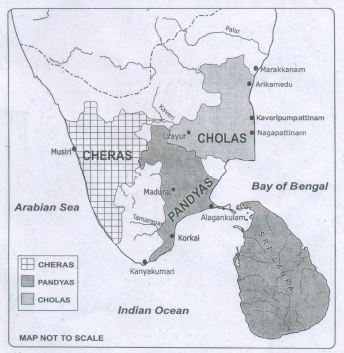
28.
| Silapathikaram and Manimegalai | Aimperunguzhu and Enberaayam | Avvaiyar, VelliVeethiyar |
| Puhar, musiri,, korkai | Iyal, Isai, Naatakam | lIango Adigl |
| Nedun chezhian | Marutham | Kalangarai llangu sudar |

6th Standard Syllabus & Materials
6th Standard
TN 6th Social Science T3 - GEO - Understanding Disaster Sample Question Papers Study Material - QB365 Set A
NEW6th Standard
TN 6th Social Science T3 - GEO - Globe Sample Question Papers Study Material - QB365 Set A
NEW6th Standard
TN 6th Social Science T3 - GEO - Asia and Europe Sample Question Papers Study Material - QB365 Set A
NEW6th Standard
TN 6th Social Science T3 - HIS - South Indian Kingdoms Sample Question Papers Study Material - QB365 Set A



Tamilnadu Stateboard 6th Standard Subjects
Tamilnadu Stateboard Standards



